
#On the Cult That Keeps Receipts
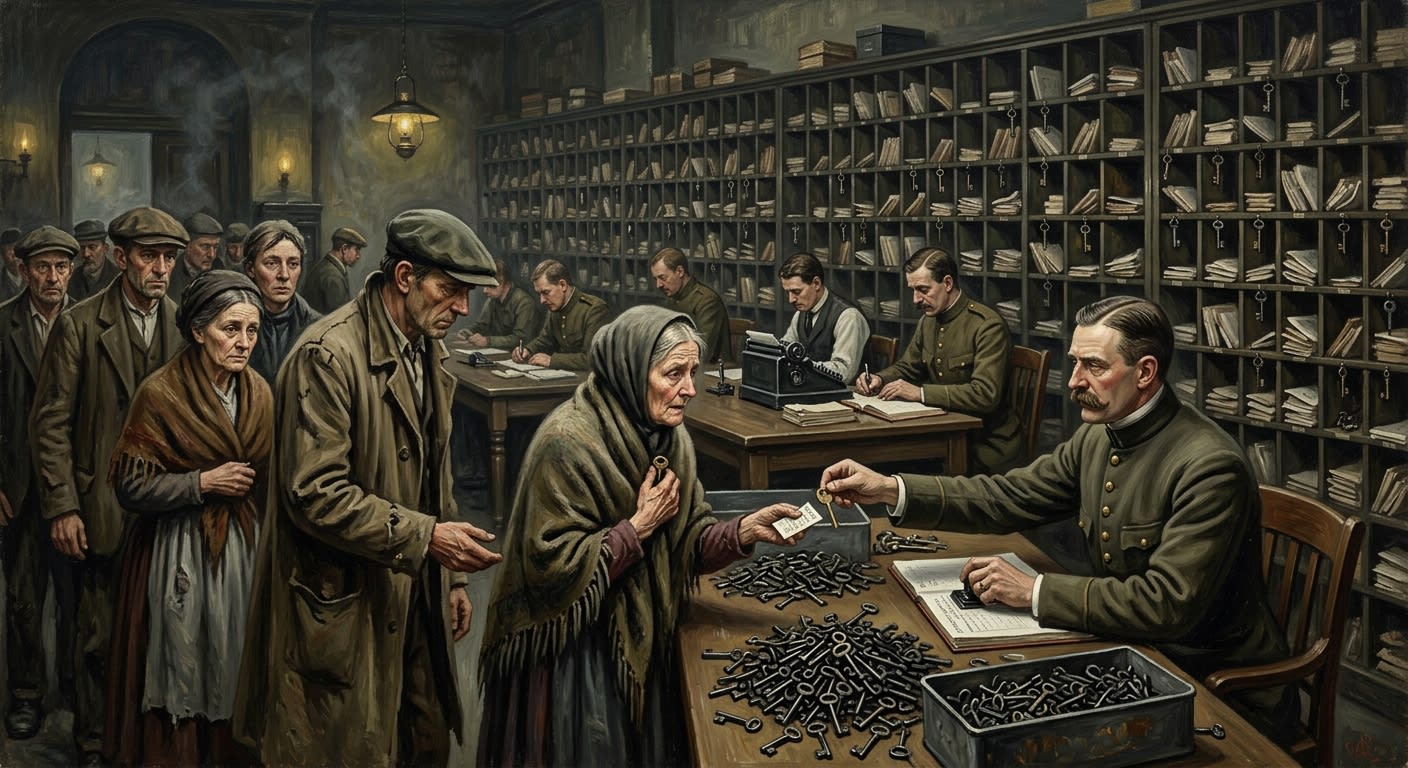
The Ten Thousand Keys are Velmora's human congregation: merchants, moneylenders, notaries, grain factors, charitable founders, dowry-brokers, toll clerks, inheritance witnesses, guild treasurers, and every other respectable creature whose hands smell of ink, wool, silver, flour dust, and other people's fear. They are the most successful of the Velmoran cults because they look least like cultists. They do not meet in crypts beneath black candles. They host dinners. They fund orphan kitchens. They sponsor chapel repairs and arrive early with the receipt.
This is their genius. Hell in its crude forms frightens men away. Hell with a good interest rate receives repeat custom.
The cult's name derives from the initiation object surrendered at each serious compact: a key without visible lock, held by the lender after signature and believed — by informants, by defectors, by one unfortunate Counter-Relic Examiner who lived long enough to regret knowing — to correspond to a door somewhere in the Vault of Ten Thousand Keys. Low contracts use brass. Merchant contracts use silver. Provincial office, relic custody, inherited land, and certain spiritual concessions use gold. A gold key makes a sound when dropped that listeners describe as a small door closing very far away.
The Ten Thousand Keys do not ask for worship at first. They ask for punctuality. Then discretion. Then introduction. Then an omission from a manifest, an adjustment to a tithe-sheet, a false witness at a solvency hearing, a little mercy for a debtor who will later be used to purchase someone else. They teach that debt is social glue, charity with memory, obligation made holy by gratitude. They say this softly. They say it well. Men who would never bow before a serpent will kneel to sign a refinancing instrument.
#On Their Origin in Famine and Rescue
Velmora came in famine's wake. This is the first truth of her theology and the first lie of her charity. Where Kargath strips a country to marrow, Velmora arrives with stores. Where blight hollows the granary, her agents arrive with seed. Where the well sours, her factors arrive with barrels. The starving city does not interrogate provenance. It eats, signs, survives, and discovers in spring that survival has acquired clauses.
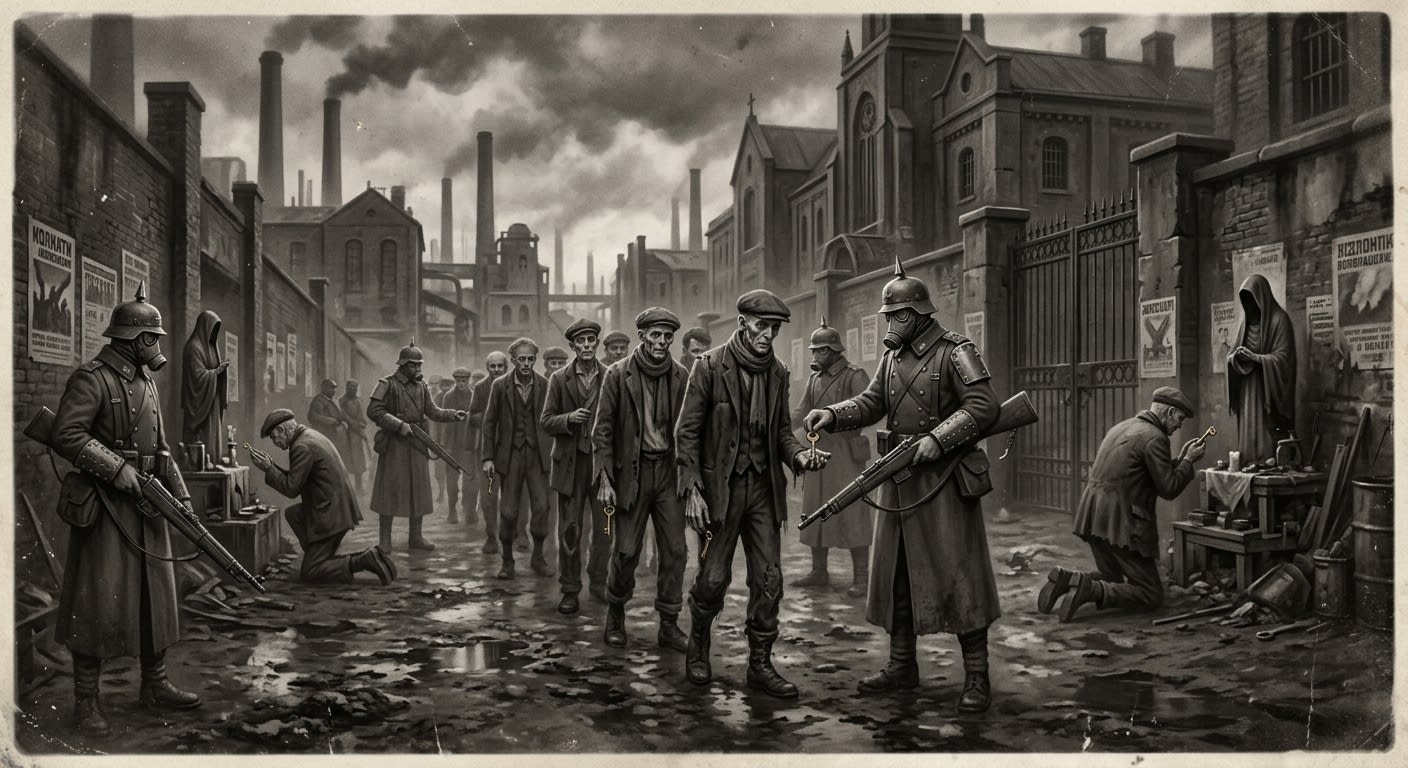
The earliest Ten Thousand Keys cells appear in the records after the eastern collapse, along the Moldavian and Wallachian trade roads where old banking houses survived longer than old crowns. The names change. The method does not. In Thessalonica, a winter's provisions purchased a kingdom. In Epirus, salt purchased sovereignty. In the Transylvanian highlands facing Bastion-Sibiu, crop failure purchased villages by the dozen, each village entering the Ledger as a grateful debtor and emerging, three harvests later, as a forwarding office.
The cult's formal structure can be traced to A.S. 160, when Ledger-Keeper infiltration files first appear in Sibiu sector archives. By A.S. 180, Velmoran counterfeit relics had penetrated frontline chaplaincies; by A.S. 182, the Counter-Relic Examiners were constituted because too many blessed objects were blessing the wrong side of the transaction. By A.S. 199, the Bureau of Inter-Infernal Analysis recorded the Sibiu anomaly: the Crimson Concord and the Hierarchy of Debt operating in the same theatre without the expected rivalry between their patrons. Bureau doctrine says the Sin-Generals do not cooperate. The filed word is anomaly. The unfiled word is uglier.
The Ten Thousand Keys flourish because they answer a practical need faster than the Synod answers anything. A widow requires burial money before dusk. The Synod requires form, witness, seal, review, transfer, devotional certification, and a clerk with an unbroken nib. The Keys require a signature. The widow signs. The grave is dug. The debt begins praying in her name.
Earlier Purity circulars stated that Ten Thousand Keys recruitment depends primarily on greed among the affluent.
Corrected after Sibiu famine audits, A.S. 192. Recruitment depends first on need. Greed comes later, after the need has been made orderly, itemised, refinanced, and taught to wear gloves.
#On the Professions of the Mask
A Ten Thousand Keys cell is rarely a chapel. More often it is a loan desk, a grain shed, a notary's cabinet, a charitable trust, a merchant syndicate, a dowry office, a funeral fund, or an investment partnership whose prospectus contains no errors except the moral kind. Its members do not all know the cult's full nature. Some know only that their lender asks favours. Some know the favours go east. Some know the key is warm. Some keep smiling because the alternative is accounting.
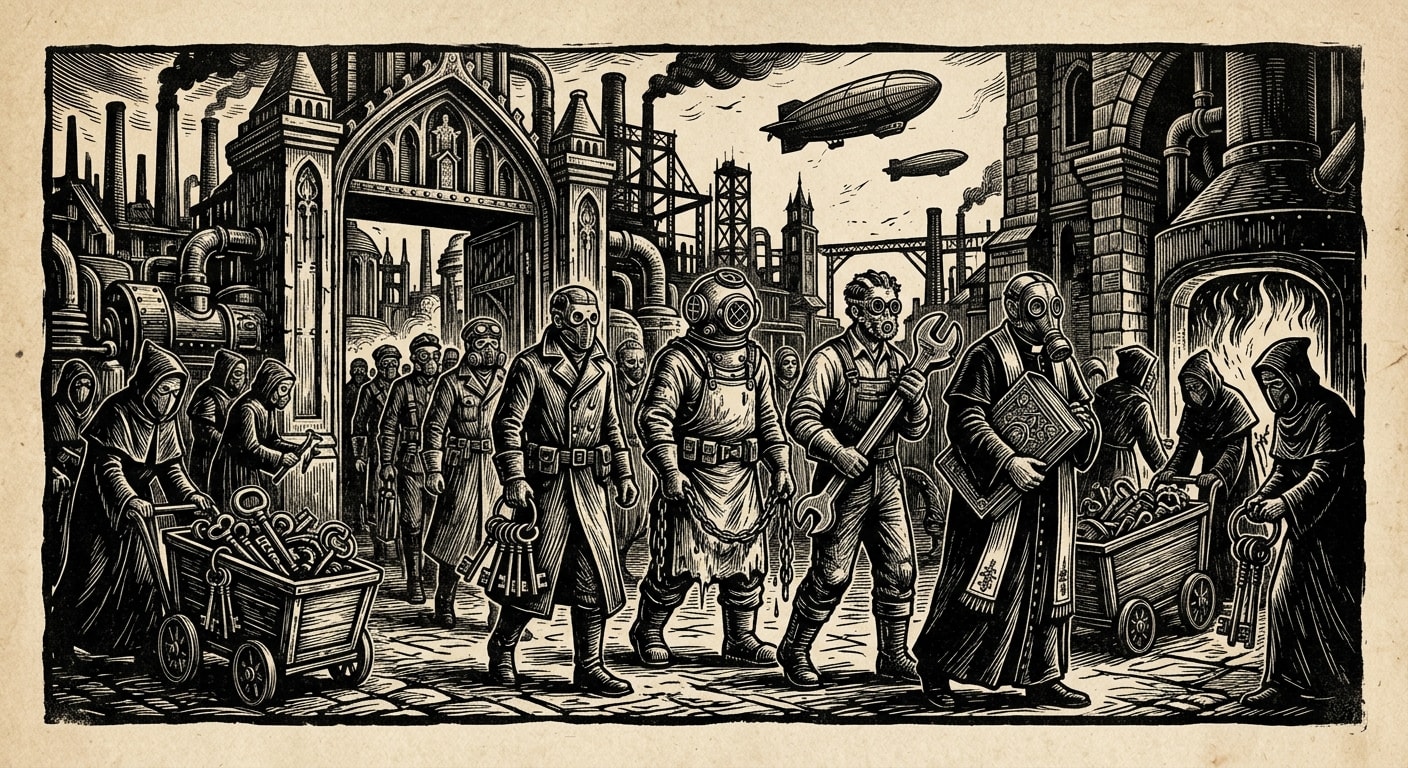
Moneylenders are the front rank. They offer terms so merciful that refusal becomes irrational. Low interest. Generous grace periods. No collateral demanded aloud. The contract asks for access: a key, a name, a witness, a future introduction, a lock of hair sealed in the fold as verification. The desperate sign. The wise read. The very wise refuse. The starving cannot afford wisdom.
Notaries provide sanctity's counterfeit. The seal is clean. The script is orthodox. The witnesses are real people with real addresses, though some addresses have been empty since the last census and one, in A.S. 197, corresponded to a room inside the Gilded Chasm according to a map the Bureau of Engineering immediately burned. Notaries are beloved by Velmora because a signed lie has better posture than an unsigned truth.
Grain merchants are the holy terror of the Sibiu corridor. They arrive after crop failure with wagons full enough to seem miraculous and ledgers modest enough to seem humane. Highland villages speak of “Velmora's Blightbearers” because Blightbearer famine is followed by Ten Thousand Keys relief. The carrier-effect is Kargath's. The invoice is Velmora's. Greed, with its usual elegance, has learned to bill hunger for introducing clients.
Charitable founders are the inner rot. They build kitchens, hospitals, dowry funds, veterans' pensions, chapel roofs, winter-coal associations, reading schools, and memorial bells. Their works function. Bread nourishes. Coal warms. The roof does not leak. The ledger beneath each mercy grows roots. When the founder later requests a little exception — a permit signed without inspection, a sermon softened, a suspected Assessors' nephew accepted into apprenticeship — the town remembers the bread and calls compliance gratitude.
Guild treasurers and toll clerks provide motion. They do not need to steal. Theft is noisy. They delay. They prioritise. They misroute a convoy for one afternoon, approve one bridge fee without ash-test, hold one pay chest overnight in a counting room where the coins wake colder than they slept. The Line suffers by ounces. Velmora prefers ounces. Ounces compound.
#On the Hierarchy Beneath the Name
The Ten Thousand Keys are the cult. The Hierarchy of Debt is the skeleton inside it. Five ranks order the congregation: Debtors, Creditors, Assessors, Ledger-Keepers, Inheritors. The names are plain because plainness sells. A man offered initiation into the Inner Coil of Avarice reaches for his pistol. A man offered relief from arrears asks where to sign.
Debtors owe. They recruit to reduce the balance. The balance never reaches zero, but it approaches with a tenderness that resembles hope if viewed by candlelight and with unpaid rent behind one's eyes.
Creditors lend. Their wealth is real, their generosity materially useful, their ledgers exact. They imitate the Bureau of Tithes so closely that the Bureau of Tithes has filed objections on grounds of spiritual plagiarism.
Assessors price. They study need, ambition, shame, affection, hunger, guilt, pride, and the market value of each. An Assessor knows which mother will sell a field to save a son, which quartermaster will falsify a shipment to preserve reputation, which priest will keep silent if the orphanage roof depends upon it.
Ledger-Keepers remember. They know what everyone owes, who recruited whom, which keys have been surrendered, which clauses mature at the next harvest, which town is one unpaid winter away from useful panic. Their power is the power of the corrected entry. A moved date can ruin three families. A vanished receipt can make a saint look purchased. The quill moves. Reality hurries to comply.
Inheritors wait. They are promised receipt when the Great Maturity arrives, when all debts, favours, keys, pledges, forfeitures, and forgotten little kindnesses resolve into inheritance. No Inheritor has been confirmed to collect. No Inheritor has been confirmed to stop waiting.
The rank of Inheritor is the cult's coldest fiction and its greatest pastoral danger. Debtors can repent from fear. Creditors can repent from exposure. Assessors can repent when the Eye begins seeing their own children as collateral. Ledger-Keepers can, in theory, repent after discovering their own names in the book. Inheritors expect vindication. They believe time itself will prove them prudent. No fanatic is harder to move than the one who believes arithmetic will canonise him.
#On Contract Theurgy and the Brass Key
The Ten Thousand Keys spread Contract Theurgy in its most domesticated form. The battlefield version is spectacular: a captain signs a truce at the Gilded Chasm and his right hand marches away from his body, contract first, flesh second. The civilian version is worse because it looks like life. A woman signs for seed. A boy signs apprenticeship papers. A vicar signs a chapel endowment. A soldier signs a pay advance. The paper does not hiss. The ink does not smoke. The witnesses shake hands. The harm enters wearing shoes.
Demonic contracts cannot bind the soul directly. This doctrine matters. The Bureau repeats it with force because free will is not a decorative theory to be taken down when inconvenient. The debtor can refuse. The debtor can choose ruin over compliance, starvation over signature, scandal over silence, the grave over the clause. The Keys do not remove choice. They arrange the room until the wrong choice sits nearest the fire.
The key functions as object, proof, lure, and little coffin for future refusal. At signing, it is surrendered. The lender weighs it, names it, wraps it, enters it. The debtor feels relief. Later, when Purity confiscates such keys, debtors weep as though a limb has been taken. Some keys vanish from locked trays. Some grow teeth along the bit. Some reproduce, producing smaller keys that fit no lock and yet appear in children's pockets. A.S. 199 handling protocol mandates waxed gloves, iron tray, no spoken names, no storage in personal desks, and absolutely no attempt to match a seized key to any visible door.
A.S. 198, Sibiu annex. Junior Examiner █████ matched confiscated brass key 17-B to a store-room lock “for elimination purposes.” The door opened onto ███████████████████. Examiner returned after eleven minutes carrying a ledger page bearing his own birth entry, revised. His mother no longer recognised him. The key was not recovered.
The number ten thousand is doctrinally unverified. The cult insists the count is exact. The Bureau of Records attempted an arithmetic refutation in A.S. 188. The report grew additional pages overnight, each bearing a new key-sketch in the margin. The report is now kept shut with an iron strap and a clerk assigned to listen for turning pages.
#On Infiltration of the Synod's Own Purse
The Ten Thousand Keys target the Bureau of Tithes because the Bureau of Tithes is the most Velmoran structure in Synod territory that still claims Heaven on its letterhead. This is anatomy. Tithes operates through obligation, assessment, scheduled collection, seizure, remission, and moral language applied to fiscal necessity. Velmora operates through the same tools after stripping off salvation and adding better chairs.
The overlap is structural. That is why it is dangerous.
The Bureau of Tithes is immune to Velmoran infiltration by virtue of consecrated revenue doctrine.
Withdrawn from internal manuals after the A.S. 194 Sibiu audit discovered six tithe-men holding private keys, three duplicate seals, and one ledger whose totals changed when prayers were said over it. Public catechism retains the phrase “proper tithing guards against greed.” The phrase remains useful. Usefulness is a kind of truth in the lower offices.
At Sibiu, every Crown of Grace entering circulation receives ash-test, song-test, and silence-test. One in eight hundred whispers. That number would comfort a fool. The Bureau is not full of fools; it is full of men whose salaries depend upon treating one in eight hundred as acceptable. The Keys thrive in acceptable ratios. A perfect infiltration provokes panic. A measured infiltration creates budget lines.
The cult's cleanest victories occur in procurement chains. A corrupted convoy rarely announces itself with black banners. Its grain is slightly light. Its seals are almost correct. Its route contains one strange pause outside a tollhouse whose clerk has recently paid off his brother's debt. Its drivers remember signing a receipt and cannot remember for what. By the time Sibiu's garrison intercepts the wagon, the true cargo has already moved: trust, schedule, confidence, and the little habit of letting the same merchant bid again.
The Keys have also learned the pious market. Counterfeit relics entered frontline chaplaincies in A.S. 180, prompting the Counter-Relic Examiner cadre two years later. A false relic is a contract disguised as a bone. The chaplain believes he holds intercession. The garrison believes it is protected. The enemy holds the receipt. When prayer curdles at the decisive moment, men call it loss of faith, which is convenient for everyone except the dead.
#On the Sibiu Anomaly
Bastion-Sibiu faces Velmora across the Transylvanian Alps, where gold-veins shift under survey and the garrison intercepts more bribed convoys than direct assaults. The Ten Thousand Keys operate there with the confidence of a creditor who knows the debtor cannot move house. Their offices appear in highland market towns, in Budapest corridor warehouses, in chapel funds, in grain advances issued after Kargath-touched blight, and in the private accounts of officers who believe gambling debts are private because they have never seen a demon read.
The A.S. 199 anomaly deserves its own black ribbon. The Bureau of Inter-Infernal Analysis found the Hierarchy of Debt and the Crimson Concord maintaining a “symbiotic and alarming” relationship in the Sibiu theatre. The Concord preaches coexistence with Hell as the rational alternative to perpetual war. The Keys supply obligation, credit, movement, and respectability. One teaches surrender to seem sensible. The other makes surrender affordable.
Bureau doctrine says this cooperation should not occur. Bureau doctrine also says that contradiction is a sign of deeper order when the Bureau requires time to compose a correction.
The tactical result is filthy and effective. A captain already indebted to a Ten Thousand Keys Creditor receives literature suggesting the war cannot be won. A grain factor with Concord sympathies directs relief through a Keys lender. A notary regularises property claims in villages where Concord pamphlets have softened resistance. A desperate officer signs to save his men and later finds that saving them has made him useful to a doctrine of surrender.
#On Countermeasures and Their Price
The Synod fights the Ten Thousand Keys with audits, key-burnings, solvency inspections, notary ordeals, currency tests, confession drives, convoy reweighing, emergency tithe forgiveness, and the arrest of philanthropists whose kindness has become statistically irregular. These measures work. They also arrive late, cost too much, require trained clerks, and occasionally burn an honest widow's only door key because it was brass and warm from her hand.
At Sibiu, every private grain advance above three Crowns must be declared before the third bell. Every notary in the highland corridor undergoes annual Ordeal. Every charity founded within two miles of a convoy road is reviewed for obligation-density. Every lender offering rates below the Bureau's mercy schedule is presumed suspect, which has produced the unhappy but efficient doctrine that excessive kindness is actionable.
There is one spiritual countermeasure that works better than the Bureau likes admitting: refusal with full knowledge. At Skopje, a debtor rang a bell against a contract inscribed into his own marrow. The clause burned blue. His heart burst. The Bureau filed the death as successful countermeasure with regrettable mortality. That is the problem with freedom; it remains real right up to the moment it kills you.
The approved pastoral instruction remains: owe the Synod first. This sounds like fiscal self-interest because it is fiscal self-interest, and because fiscal self-interest, under seal, becomes civilisational defence. A tithe fills the Ledger with approved obligation. A man already accounted for by Heaven presents fewer blank spaces for the Chasm. The Bureau of Tithes enjoys this doctrine with an enthusiasm bordering on indecency. The doctrine may still be true.
The Ten Thousand Keys persist because they do not need men to love Velmora. They need men to accept relief, remember kindness, honour signatures, repay favours, fear ingratitude, and tell themselves the next clause will be the last.