
#On Her Nature
"Avaritia non satiatur." — Bureau of Doctrine, Classification Memorandum IV.1.07-002
I am Valerius Drax, and I inscribe this entry with my purse chained to the desk and a Lictor of Purity standing behind my chair, which is standard procedure when composing files on the Covetous Serpent. The Bureau does not trust its own archivists near the subject of Greed. I find the precaution flattering.
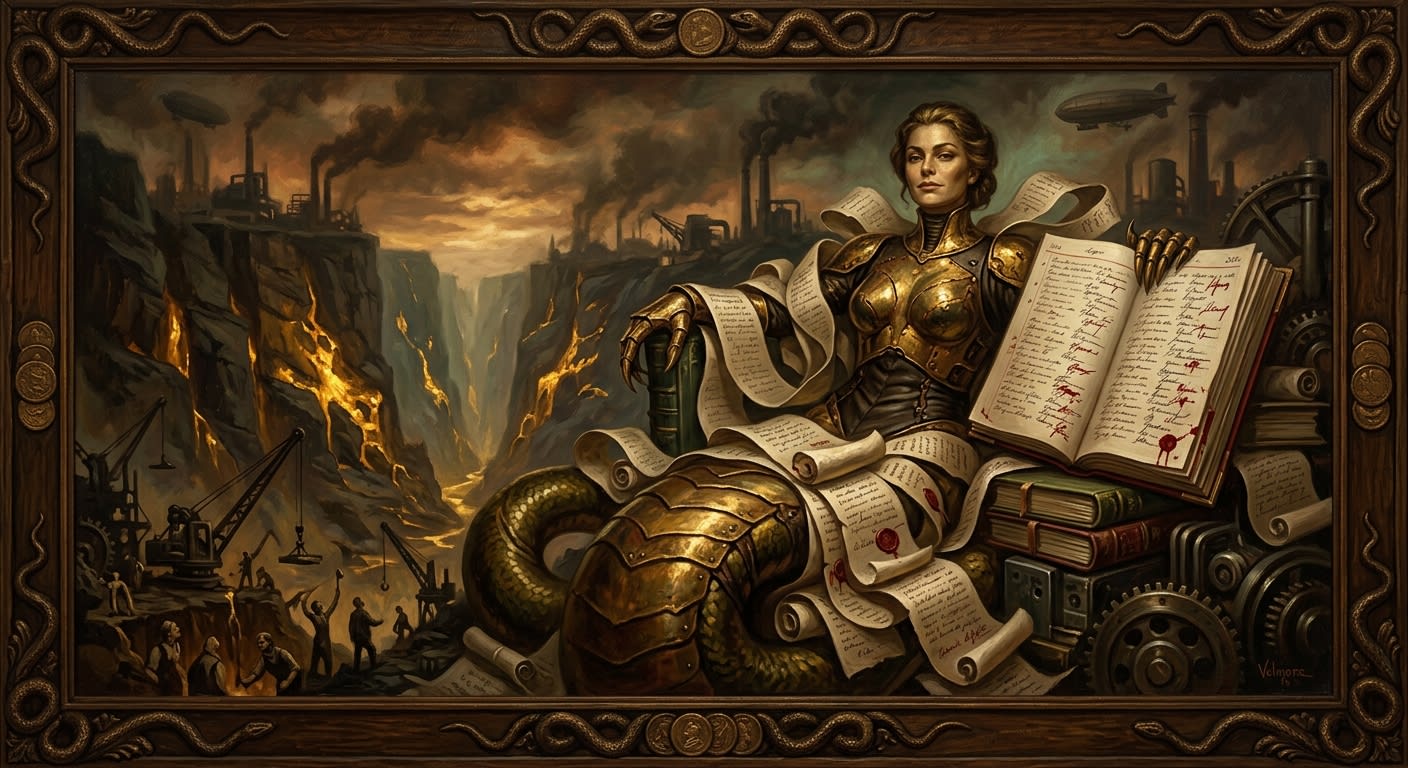
Velmora is the second of the Seven Sin-Generals, if one counts by the order of their emergence from the ruin of the Sundering — and counting by order of emergence is, I confess, a habit the Bureau discourages, because the Bureau prefers to classify the Generals alphabetically, which places Atheron first, and Atheron's vanity requires no further inflation. I count by emergence because emergence tells us something alphabetisation does not: Velmora arrived in famine's wake. She came after Kargath. She came because of Kargath. Where his hunger had stripped the land to marrow, she appeared with gold in her hands and terms on her tongue, and the starving, who had watched their fields rot to bile, signed whatever she put before them.
She bought Thessalonica for a single winter's provisions. She repossessed it when spring failed.
She traded salt for sovereignty in Epirus.
Century by century, her coils tightened — through contract, through ledger, through the slow strangulation of nations that believed they were being rescued.
#On the Theology of Greed
The Bureau of Doctrine has spent considerable ink — and one very unfortunate Subdean — attempting to define what, precisely, Velmora represents. The common soldier's answer is gold. Gold-hunger, the miser's vice, the merchant's rot. This answer is wrong in the way that identifying the Sagittal Line as "a long ditch" is wrong: technically defensible, theologically useless, and likely to get someone killed through confident ignorance.
Velmora is not avarice. Avarice is a symptom. Velmora is the disease beneath the symptom — a disease the Bureau classifies, in its more honest internal memoranda, as the Void That Acquisition Cannot Fill.
Consider what gold-hunger actually does to its sufferer. The miser does not acquire and then rest. The accumulator does not reach a number and declare the ledger closed. The hoarder does not one day survey the vault and find it sufficient. The wanting grows with the having. Each acquisition widens the void it was meant to fill. This is not a failure of the human who acquires — it is the mechanism working exactly as intended. Velmora does not want her subjects satisfied. A satisfied subject stops signing.
The deeper theology, the one the Bureau of Doctrine permits only in sealed documents, runs thus: Velmora is what happens when HAVING replaces BEING. When a man becomes his possessions. When the value of a thing is measured not by its use or its beauty or the joy it brings to its keeper, but solely by its price — its price on the market, its price relative to what someone else possesses, its price as collateral against a debt that compounds in the dark. The commodification of love, of loyalty, of time, of self. All of these things have a price, in her reckoning. The price is the point. The price is, for her purposes, what those things are.
The horror — and I use the word as a theological term of art, not an expression of personal sentiment — is that ownership, under Velmora's influence, flows backward. The possessor is possessed. The collector becomes the collection. The hoarder finds, at the end, that he cannot leave the vault, cannot relinquish a single coin, cannot conceive of himself except as custodian of what he has gathered, which means he is not a man with possessions but a possession with a man attached. He is still aware. He still wants more. He cannot acquire anything ever again.
The Bureau calls this outcome the Final Assessment. It is, by any measure, a complete transaction: everything given, nothing received.
#On Her Dominion
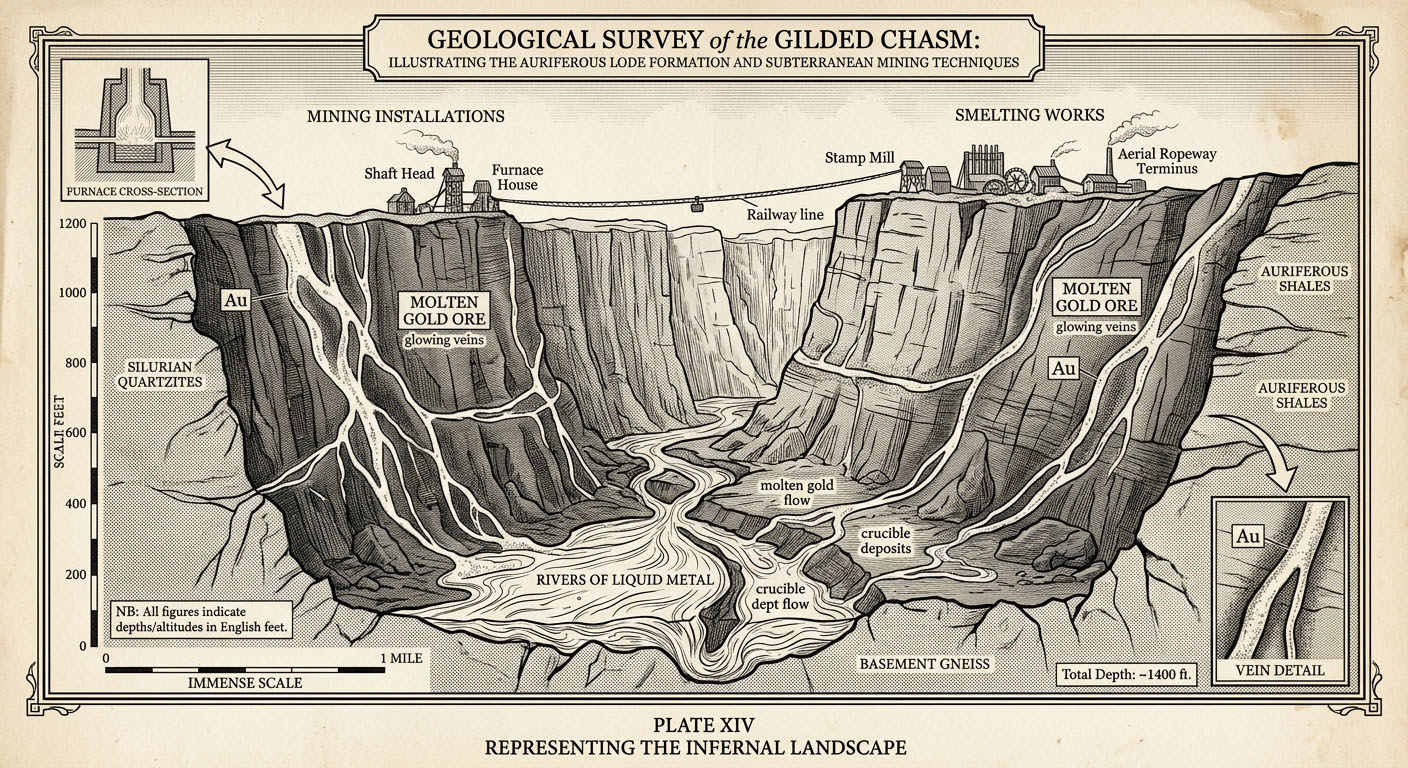
Her territory sprawls from Moldavia and Wallachia south through the Macedonian highlands, and the Gilded Chasm — Velmora's fortress and the open wound at the heart of her domain — tears through the highland marches from Macedonia to the Transylvanian passes, a canyon so vast it swallowed two provinces during its formation and has been swallowing ever since. Its rivers flow not with water but with molten ore. Its walls gleam with cold, hungry light. I have been to the marches near the western edge of its range, and I did not hear the singing the Chasm is said to produce, but I heard the merchants who had heard it, and they wailed about their accounts with a fervour suggesting the melody was still in their skulls, still tunnelling.
At the Chasm's heart yawns the Vault of Ten Thousand Keys — Velmora's palace, if that word can be stretched to accommodate a structure whose defining architectural principle is the lock. Every door closes behind the visitor. Every corridor narrows. Every chamber is smaller than the one before it, and richer, and darker, and more beautiful, until the guest stands in a room no larger than a confessional, surrounded by treasure beyond the wildest fantasies of the Bureau of Tithes, and discovers that the door through which he entered no longer exists. None who cross her threshold emerge. To enter is to be owned.
The territories beyond the Chasm have been reorganised, over the centuries, into five administrative zones whose names the Bureau of Records has reluctantly committed to print:
The Counting Kingdoms occupy the ruins of the old Balkan trade cities — Plovdiv, Varna, the fragments of Thessalonica. The markets still bustle. The guildhalls still operate. The caravans still run. The difference is what is traded. Time. Memory. The sensation of warmth. Years of life pledged against future comfort. Velmora's commerce does not deal in goods; it deals in people, one abstraction at a time, until the merchants of the Counting Kingdoms have traded away everything that made them people and stand in their counting houses as animated contracts, going through the motions of exchange because exchange is the only motion left to them.
The Debt Warrens are the underground complexes beneath the old Danube cities where those who owe beyond their means are housed. Not imprisoned — they are free to leave at any time. The debt follows. Children inherit their grandparents' accounts. Newborns enter the world already in arrears. The ledgers are patient: the interest compounds daily, the penalties compound monthly, and the principal grows through mechanisms the Bureau of Records has been unable to fully document because the relevant clerks keep signing things they later cannot account for.
The Hollow Vaults are treasure chambers of impossible dimension, consuming entire districts as they expand, their gold-heaped interiors still, somehow, insufficient. Caretakers move through them in silence, counting. They count because stopping would mean acknowledging that the counting does not help, that the number is never high enough, that the vault cannot be measured and therefore cannot be owned, and the inability to own what one is custodian of is, in Velmora's reckoning, the worst fate available.
The Assessment Halls are the places where value is determined — not for objects, but for people. Skills, years remaining, loves, secrets, debts of honour, the weight of old promises. Everything that constitutes a person is itemised, priced, and recorded. Those assessed as valuable enough are purchased. Those assessed as worthless are discounted. The Halls have been running for a century. Their inventory is considerable.
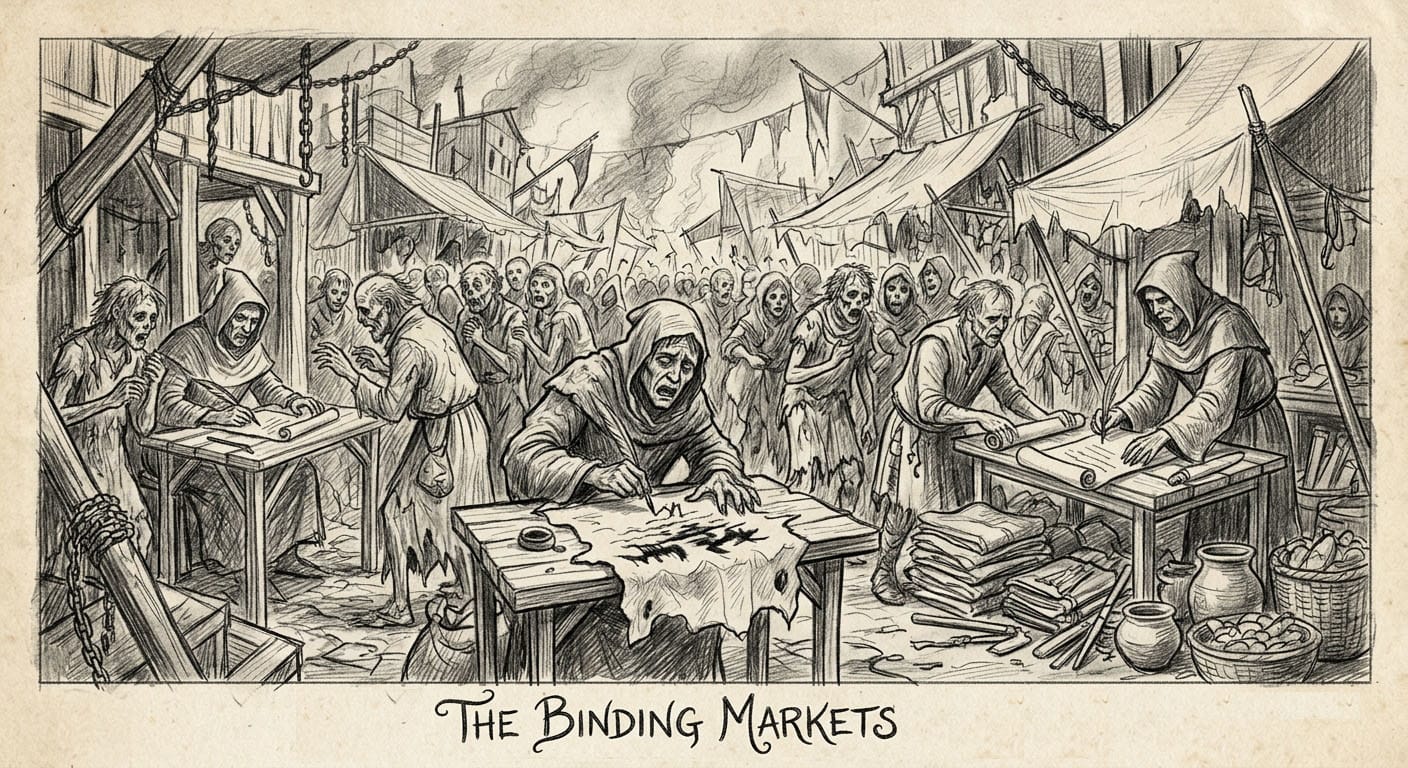
The Binding Markets are the open-air exchanges where contracts are the primary commodity. Contracts for service, for loyalty, for actions not yet committed, for children not yet born. The parchment is skin. The ink is blood. The terms are honoured precisely — exactly what was written, not a syllable more — and the markets never close, because there is always something left to sell, and there is always someone who has not yet realized they own it.
#On Her Methods of War
Velmora does not besiege. She does not, in any sense the Bureau of War recognises, fight. Her campaigns are decided before the first arrow is nocked, because by the time her armies march, the opposing general has already been purchased, the opposing supply train has already been hollowed, and the opposing treasury has already bled its last Crown into her vaults. She fights with debt. She wins with paper.
Her preferred instrument against Bastion-Sibiu is not the Gilded Sentinel or the Avarice Engine — though she deploys both — but the corrupted convoy. The gold-vein extraction operations she runs beneath the Transylvanian Alps are the richest concentration of ore on the continent, and with that ore she finances the purchase of loyalties along three separate supply corridors. Bribed quartermasters dilute the grain. Bribed toll-collectors wave through wagons whose manifests have been written in ink that is not, upon closer inspection, ink at all. Bribed chaplains bless relics that curdle prayer instead of kindling it.
The Sibiu garrison intercepts more corrupted convoys than it repels direct assaults. The Bureau of Tithes has standing orders to audit every Crown of Grace that passes through the western provinces. The auditors find something wrong roughly once per month. The Bureau considers this an acceptable ratio.
Her sorcery — and here the Lictor leans closer, so I shall be precise — is Contract Theurgy. Her agents write pacts so venomous that the paper becomes parasite. At the Gilded Chasm, a captain of the Bureau signed a truce, and his right hand marched away from his body — contract first, flesh second. Soldiers stationed near her territory report the sensation of invisible coins clinking in their marrow, a phantom debt grinding against the bone, driving them to betray comrades for no reason they can articulate except that they owe, they owe, they owe, and the interest is compounding.
Earlier editions of this Codex identified Velmora's primary sorcery as "cursed coinage." The Bureau of Doctrine has revised this classification.
The correct term is Contract Theurgy. The distinction is not academic: cursed coinage implies a discrete object that can be confiscated and destroyed. Contract Theurgy implies a binding, which cannot be confiscated because it lives in the flesh of the signatory. The previous Hieromnemon who approved the "cursed coinage" designation has been reassigned. His new post does not require him to handle money.
#On Her Armies
Those who have faced Velmora's host — and survived, which is a smaller category than the Bureau's recruitment pamphlets suggest — describe four classes of soldier and one engine of war.
The Gilded Sentinels are her line troops, armoured in stolen gold that burns molten upon their skin. They do not bleed when cut; they pay out, the wound weeping liquid metal that scalds whatever it touches. Their strikes carry the weight of every treasury they have consumed, and they have consumed a great many.
The Coin-Sworn Shades are her assassins — spirits bound to cursed currency, invisible except for the faint chime of coin on coin as they pass. Their blades slit throat and fortune simultaneously. A man killed by a Shade is found with his purse empty, his accounts zeroed, and his debts — even debts he did not know he carried — called in.
The Gem-Eyed Archers fire shards of crystalline greed that burst into blinding brilliance upon impact. I am told the light is beautiful. I am told the men who stare into it sign things.
The Debt-Binders are her chanters, crooked figures who mutter in a cadence the Bureau of Doctrine has classified as the Inverse Litany. Their curses lay chains upon the body that the body cannot feel — until the soldier tries to raise his sword against Velmora's host and finds his arm will not obey, because his arm has been repossessed.
And then there is the Avarice Engine — a towering golem of fused gold and silver, a walking treasury that crushes armies beneath its gleaming mass while drinking treasure and souls into its molten core. It has been sighted three times on the Sibiu approaches. Each time, the garrison's pay-chest was found empty the following morning, though no breach in the vault was recorded. The Bureau of Records filed the discrepancy under "atmospheric losses." The Bureau of War filed it under "Velmora."

#On Her Instruments
The armies above are the visible face of Velmora's host. Below the visible face — in the counting houses, the notary offices, the moneylenders' parlours that appear in every town within two hundred miles of the Sagittal Line — operate her true weapons: the demons who do not fight.
The Assessors are among the most feared entities in the Bureau of Purity's classified bestiary. They are not large. They are not violent. They look at you, and in looking they determine every number that is relevant to you: your skill, your years remaining, your loyalty's market value, your capacity for betrayal, the precise price at which you would sell a comrade. This information goes into ledgers. The ledgers go somewhere. Eventually everything in them is acted upon. An Assessor captured near the Danube crossings in A.S. 172 was found to contain, within its body, four thousand pages of fine-written script documenting the financial and spiritual accounts of every soldier in Bastion-Sibiu's Third Company. The Bureau of Purity burned the Assessor. The information, they discovered, had already been filed.
The Collectors are, in the Bureau's experience, the most immediately dangerous because they seem the most reasonable. A Collector needs a specific thing — not gold, precisely, but something more particular. A specific summer afternoon recalled by a specific widow. The feeling of certainty a certain magistrate has not felt since his first appointment. The trust a certain frontier surgeon extends to strangers who arrive after dark. The Collector will trade for it fairly. The Collector is not threatening. The Collector simply needs this one thing, this small abstraction, this quality you were not using. You didn't know it had value. You won't miss it. You won't even know it's gone until you reach for it one day and find the shelf bare.
The Coinbound are demons of pure currency — entities that flow like liquid gold, that solidify into whatever form might tempt the observer. They cannot be spent. They accumulate. A garrison that has been infiltrated by Coinbound finds its treasury growing in ways no audit can explain, swelling with wealth whose provenance is, on examination, entirely unclear, and which resists removal from the premises with a stubborn, almost gravitational insistence. The wealth is real. It will spend. It simply prefers to stay close to more wealth, and to add to itself, and to keep a careful account of who has touched it and for how long.
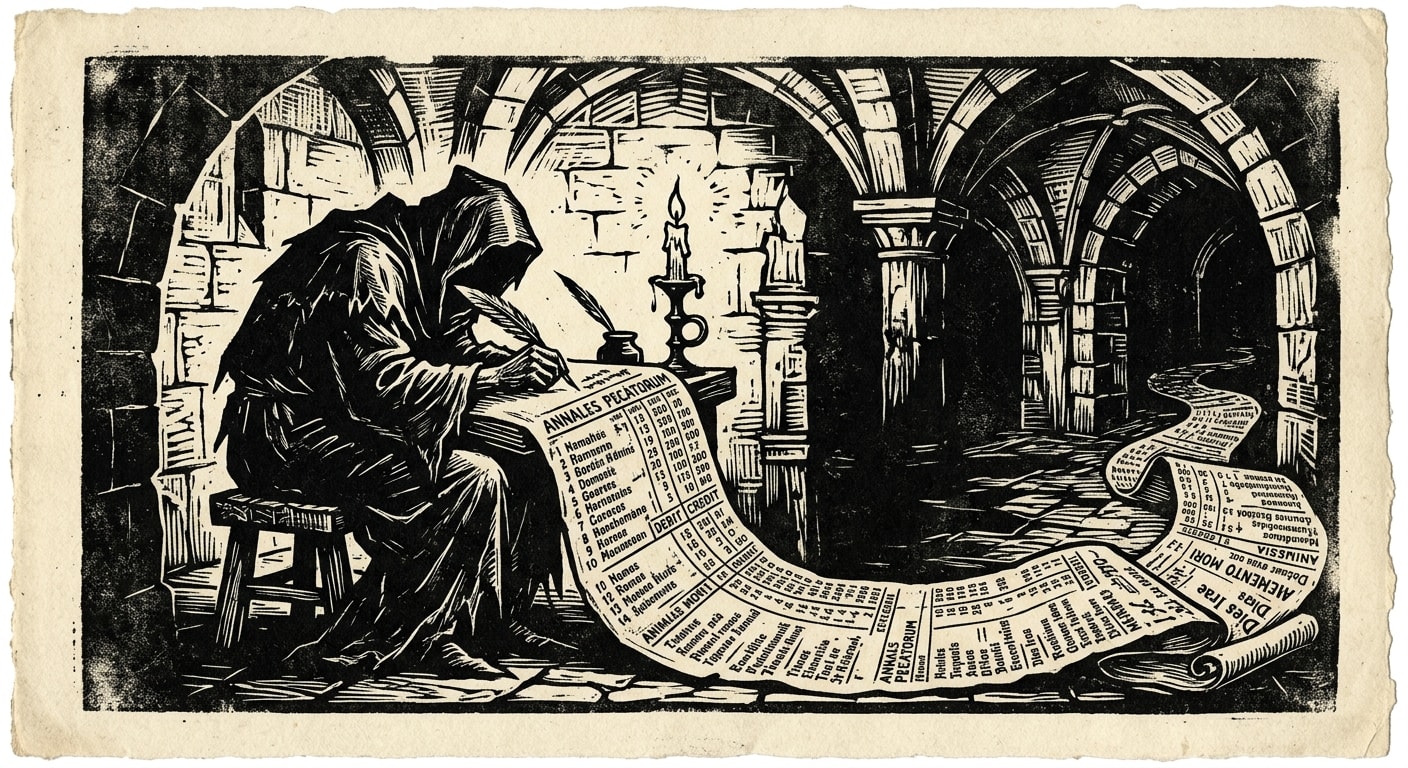
The Ledger-Keepers do not interact. They exist to record. Every transaction within Velmora's sphere of influence — every deal struck, every debt incurred, every contract signed in ignorance — they have recorded. They manifest as hunched figures bent over books of impossible length, quills scratching in languages the Bureau of Doctrine cannot fully classify, noting entries that have not occurred yet with the calm precision of men who have already read the ending. The Bureau's standing instruction is that Ledger-Keepers should not be destroyed. The Bureau's standing instruction is that nothing in their books should be read aloud. Both instructions have been violated. The outcomes are filed under separate headings.
The Guarantors are the last and most subtle. They enforce contracts not through violence but through alteration — not of the signatory's body, but of the signatory's will. The contract says you will deliver your firstborn on the third bell of the third year. You will find, when the third bell of the third year arrives, that you want to. The choice will make sense. You will make it freely. The Guarantor will already have moved on to the next clause. The Bureau of Doctrine has spent forty years attempting to develop a theological counter to the Guarantors and has produced, in that time, sixteen hundred pages of commentary on free will, three inconclusive councils, and one very comfortable armchair in which the chair of the relevant sub-committee has been found asleep on four separate occasions.
#On Her Congregations
The Ten Thousand Keys cult operates in Velmora's name across the Transylvanian highlands and, the Bureau suspects, across the merchant classes of half the Synod's interior cities. Its agents pose as moneylenders, grain merchants, notaries of the minor courts — anyone whose profession involves a signature and a seal. They offer terms so generous that the desperate sign without reading, and the terms are always the same: everything.
The cult is organised not by secrecy but by obligation. The Bureau's standard cult-structure analysis — cell-based, hierarchical command, protected leadership — does not apply. Velmora's congregations are structured as a ledger. The Hierarchy of Debt runs five tiers deep.
The Debtors are those who owe, who serve to reduce their balance, who recruit others into the same position because every new debtor reduces the recruiter's own outstanding principal by a negotiated fraction. They are not wicked people. They are desperate people who made a deal, and the deal compounds, and the only relief available is to share the debt with someone who does not yet know they are signing.
The Creditors are those who have accumulated enough demonic credit to offer loans of their own — binding others to themselves as they are bound to the cult above them. They have wealth. They have influence. They fund charities, host dinners, build reputations. Their generosity is genuine. Their ledgers are meticulous. Every gift is an investment. Every favour is a loan at interest, and the interest is recorded.
The Assessors — the cult rank, not the demons — are those trusted to evaluate new acquisitions: the worth of potential recruits, the value of what they possess, the price they might accept for what they do not yet know they are selling. They develop an eye for it. The eye, over time, becomes the only way they see.
The Ledger-Keepers of the cult know what everyone owes. This is, within Velmora's congregations, a position of extraordinary power. To know the balances is to know the levers. The Bureau of Doctrine's infiltration operations have identified seventeen suspected Ledger-Keepers operating within Synod territory since A.S. 160. Three were apprehended. The other fourteen's identities were recorded in files that were subsequently found to be missing, the relevant clerks transferred to posts the Bureau of Settlement assures us are entirely unrelated to any cult activity.
The Inheritors wait. They have been promised the great collection, when it is complete. They do not know what that means, precisely. They know they will receive, that the ledger will one day balance in their favour, that generations of compound interest will mature into something they cannot yet conceptualise. They are patient. They have been waiting, in some documented family lines, for four generations. The Bureau has no confirmed evidence that any Inheritor has ever actually collected.
#On the Gift and What It Costs
Velmora's influence-demons — the wispy, shadow-thin entities that drift through Synod territory, far rarer and far more dangerous than any Gilded Sentinel — do not attack. They offer.
They find emptiness. The poor man who dreams of security. The ambitious clerk who wants recognition. The soldier who feels, after twenty years of service, that something is owed him. The widow who would pay any price to have back what the war took. The exhausted who would trade anything for one night without the grinding weight of debt and fear. They find the void inside people, and they offer to fill it.
The gifts are real. The wealth spends. The success advances you. The property is yours. The enemy's business collapses; the inheritance arrives; the landlord forgives the rent. Velmora's influence-demons do not offer false miracles. This is, theologically, the most troubling thing about them: what they give is genuine.
It simply is not free.
The whispers that precede the gift are reasonable, calibrated, correct about the things that can be verified — which makes the parts that cannot be verified equally convincing. You deserve this. Think of what you could do with more. It is not greed if you have earned it. Just this once, to get ahead. An investment in your future. The whispers make sense. That is, as I have written in seventeen separate Bureau communications that have been filed without action, precisely the problem.
When the victim has served their purpose — when the influence-demon has moved on, as influence-demons always do, to the next empty space — the gift reveals what it cost.
The void grows. The wealth was never enough, is still not enough, will never be enough; the acquiring continues and the satisfaction does not arrive, and the victim cannot stop because stopping would mean confronting the fact that the void has been growing all along, fed by every addition. The things own back: possessions become extensions of the self, their loss becomes amputation, the hoard owns the hoarder. The debts come due — someone paid for what the victim received, and the ledger remembers, and the interest has been compounding since the first signature. And in the worst documented cases, the victim joins the collection: the skin takes on metallic cast, the joints stiffen toward permanence, the voice defaults to the language of transaction, and what remains is a very valuable object that still wants things and cannot acquire them.
The Bureau of Rites has classified seven such terminal cases in the Synod's records. The Bureau notes, in the relevant circular, that these individuals remain under observation. The Bureau does not specify what is being observed, or by whom.
#On Her Engines
When Velmora's territory expands across what was once human industrial ground, the machines do not stop. They are redirected. They do not understand their redirection. They simply operate according to a new logic that produces outcomes their designers would find, if they were present, clarifying.
The Counting Engines — calculating machines, census-tabulation devices, the complex clockwork of the Bureau of Records' provincial offices when they are overrun — count. They count continuously, obsessively, perfectly. They count coins that are not present. They count debts that have not been incurred. They count souls that have not been sold and record them as pending. Operators who stand at these machines long enough develop the habit of counting things they encounter: steps, breaths, heartbeats, the number of tiles between here and the door. The habit does not stop when they leave the room. The Bureau of Medicine has filed four cases. The Bureau of Medicine's file on this subject appears to be growing.
The Consuming Factories produce less than they consume. Raw materials enter; finished goods emerge in quantities that do not account for the input. The deficit goes into Velmora's ledger as a form of continuous tribute — the machines eat labour, health, years — and the factory itself grows hungry in proportion to its output, demanding more raw material, more workers, more hours, more of the irreplaceable things that can be fed into its mechanisms and measured only by their absence.
The Binding Presses are printing machines that produce contracts. Contracts for service, for loyalty, for futures not yet committed, for children not yet born. The presses run day and night. The paper stacks to the ceiling. Somewhere, someone is bound by what these presses produce. They just have not yet discovered which clause applies to them.
The Vault Trains depart full and arrive fuller. The cars accumulate wealth from the territories they pass through — a coin that fell from a pocket here, an inheritance that went missing there, the small continuous bleeding of prosperity from a thousand miles of track. The trains never stop. They never offload. They add cars. The Bureau of War's cartographic office notes, without being able to explain, that several rail lines in the southern territories appear to extend farther than their original surveys indicated. The Bureau of Engineering has been asked to investigate. The Bureau of Engineering's survey team has not returned.
The Assessment Engines are perhaps the most unsettling of Velmora's corrupted machinery. Put an object in: receive its value. Put a person in: receive their worth. The Synod has captured several and attempted to destroy them. The machines assessed the destruction attempts and found them unprofitable. They are still running. The Bureau considers this, in the formal language of Classification Circular 22-IX, "an open administrative matter."
#On Her Rivalries
Velmora hates Kargath with the cold fury of the creditor whose debtor has eaten the collateral. His famine denies her tribute. Where she would hoard, he devours. Where she would bind a province in debt, he strips it to bone and leaves nothing to collect. Their feud is old and vicious — maw against coil, appetite against avarice — and it has cost both of them territory they might otherwise have taken, which is the only comfort the Bureau extracts from their mutual hatred.
Atheron she despises for different reasons. His vanity squanders what could be hoarded. He raises his spires higher merely to be seen from farther away, burning resources on spectacle that Velmora would have invested. She considers him profligate, which is, for the Sin-General of Greed, the gravest insult in the lexicon.
Morwen covets what Velmora owns, which makes them natural antagonists — the hoarder and the thief, the vault and the mirror. Their skirmishes along the Danube approaches have a bitter, petty quality that the Bureau of Hearsay's analysts describe as "domestic."
With Maldrake she shares no border and no alliance. Wrath resents being made to wait. Greed resents being made to spend. Their hosts have aligned precisely once in recorded history, when terrain forced them to share a road through the Bulgarian highlands, and the road was worse for the sharing.
#On the Countermeasures
The Bureau's first line of defence against Velmora is the audit. This sounds absurd. It is less absurd than the alternative, which is bankruptcy.
Every Crown of Grace minted in the Synod's forges passes through three tests before it enters circulation: the ash-test, which burns false metal; the song-test, which rings true silver against a consecrated tuning-fork; and the silence-test, which holds the coin in a sealed reliquary for one hour to determine whether it whispers. Roughly one in eight hundred Crowns whispers. Those are melted and their slag buried in consecrated ground beneath the Basilica of the Ledgered Saints, where the slag, I am told, occasionally shifts.
Every document of legal significance in the Synod passes through the Bureau of Records' contract readers — clerks whose sole function is to review agreements for demonic influence, buried clauses, and terms that do not quite mean what they appear to mean. The Bureau cycles these clerks every two years. The attrition rate before cycling was introduced is not a figure the Bureau publishes. What they found written between the lines drove several to conclusions the Bureau of Medicine classifies as "theologically inadvisable."
The Bureau of Doctrine promotes the doctrine of tithe as inoculation: by giving to the Synod, one cannot be purchased by the Enemy. By surrendering a portion of one's wealth voluntarily, one demonstrates an incapacity for the compulsive acquisition Velmora's hooks require. Whether this is theologically accurate or merely convenient for the Bureau of Tithes' annual projections, I leave to the reader's discretion — and note, for the record, that I have increased my own tithe twice in the years I have spent researching this file.
The Debt Tribunals can, in principle, annul contracts proven to have demonic origin. In practice: proving demonic influence requires demonstrating the signature was obtained through supernatural coercion, which requires evidence, which requires investigation, which requires investigators who have not themselves been approached with interesting terms. The tribunals succeed roughly once per decade. The Bureau considers this a success rate. I have chosen not to pursue the implications of this framing.
The Mark of Poverty is a voluntary vow taken by those who believe ownership itself is Velmora's doorway — a complete destitution, surrendering all possessions, subsisting on communal rations, removing oneself from the economy of transaction entirely. Some take it. They may be right that it works. They are also, the Bureau of War notes with measured diplomacy, functionally useless as soldiers, administrators, or contributors to any logistical system that operates on currency. The Bureau respects the theology. The Bureau cannot staff a war with theology alone.
The Synod's most recent general countermeasure, enacted by administrative circular in A.S. 199, is the Value Fast — a mandatory period of enforced poverty in which soldiers and citizens surrender all personal property to communal custody for fourteen days. The theory is that enforced detachment weakens Velmora's acquisition-hooks. The practice is that it creates a period of concentrated desperation during which Velmora's agents, who have been monitoring the schedule, arrive with very generous terms.
Relics are tested with equal rigour to currency. A counterfeit relic blessed by Velmora's agents does not merely fail to perform miracles — it performs counter-miracles, souring the faith of everyone within earshot of its invocation. Three confirmed incidents of counterfeit relics reaching frontline chaplains have been recorded since A.S. 180. In each case, the chaplain's subsequent prayers produced effects the Bureau of Rites has classified as "theologically inadvisable."
The Lictor behind me has indicated that I have said enough on countermeasures. I defer to his judgement — not because he is correct, but because he is armed, and I have been writing about Greed long enough that my own fingers have begun to itch in ways I do not care to examine.
The previous edition of this entry stated that Velmora "cannot be bribed." This is technically accurate but operationally misleading.
Velmora cannot be bribed because bribery implies a transaction between parties of comparable standing. One does not bribe a landlord; one pays rent. The Bureau of Doctrine has revised the phrasing to: "Velmora does not accept bribes. She accepts payments." The distinction is left as an exercise for the theologian.
#The Ratification
The reader who has attended this entry to its conclusion has — by the Bureau's reckoning — spent approximately twenty minutes in the company of Greed, which is nineteen minutes longer than the Bureau recommends. You are advised to check your pockets. You are advised to verify that the document you are reading is the document you intended to read, and that no additional clauses have appeared in the margins since you began.
You are advised to examine your recent decisions. To ask yourself whether any of them involved terms you accepted without reading closely enough. To consider whether the thing you most desired, when it arrived, satisfied the desire or widened it. To wonder, briefly and then stop wondering because the wondering is itself a hook, whether there is a ledger somewhere with your name on it.
You are advised, above all, to remember that Velmora does not conquer. She possesses. And possession, unlike conquest, has no expiration date.
She does not take your soul.
She helps you sell it, piece by piece, until there is nothing left to sell.
And then she shows you the ledger, and you find you still owe.