
#On the Scope of This Survey
This dossier is a documentary survey compiled in A.S. 201. It surveys a tradition. It does not date an event. Nobody with a seal has ever managed to date it, and I will not be the first to try with a forged one.
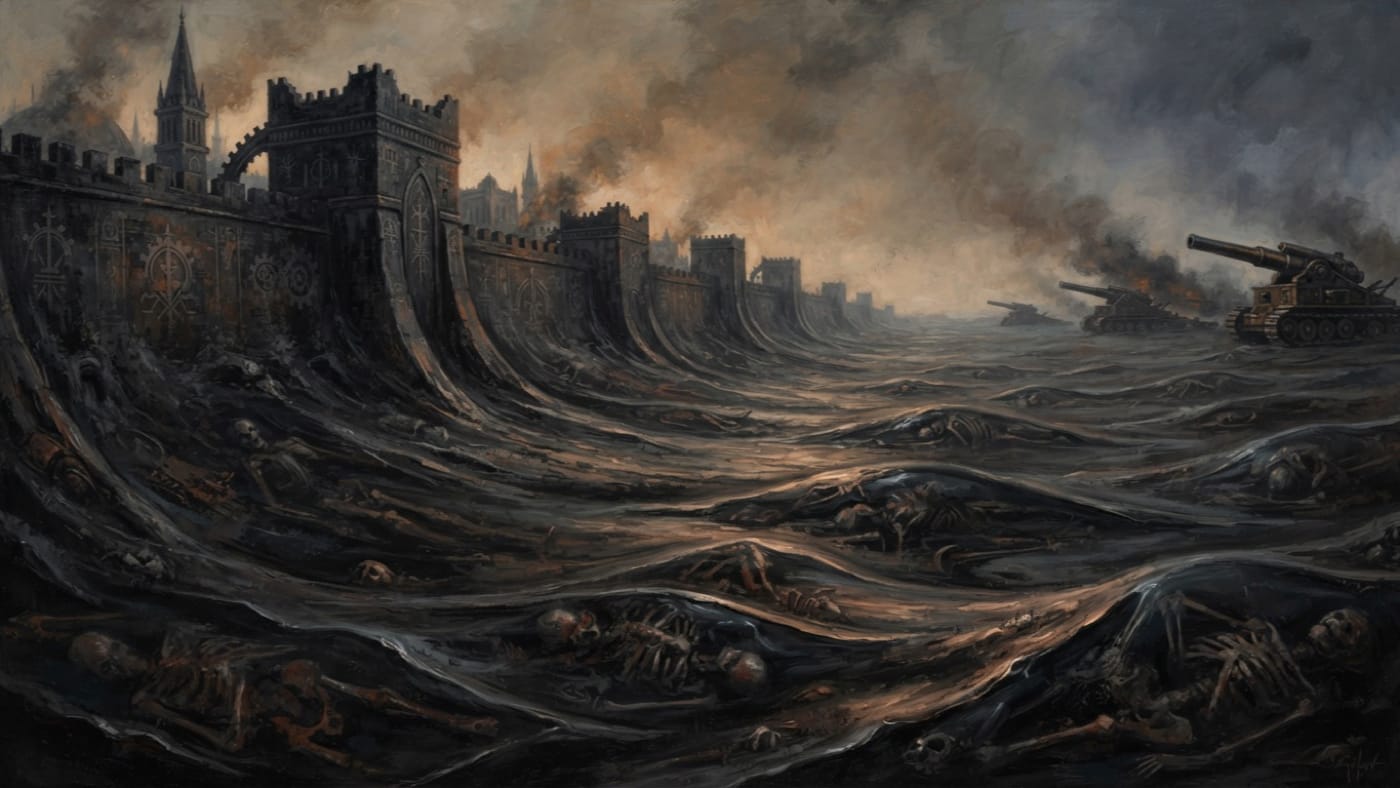
The principal public account is the Codex entry on Saint-Anonymous of the Glass Parish. In a single paragraph, and with admirable economy, it records a massacre at old Constantinople: a mistimed holy barrage, a parish regiment vaporised, shields and bones fused into black glass along the glacis. That account places it later than Toledo. "Later" is the whole of its chronology. This survey keeps the word and adds no arithmetic to it.
Two subjects share this file and must not share a bed. The first is a battlefield catastrophe at the site now held as Bastion-Constantinople, southern anchor of the Sagittal Line. The second is the anonymous devotion that afterwards borrowed its name. One is a matter of shot and timing. The other is a matter of what frightened men mutter. Records would confuse the two by Thursday.
#On the Barrage
Holy artillery keeps no clock. The Church's guns are governed by the peal. The lattice tolls, the crew readies, the charge is sanctified, the shot is sent. The arrangement is sublime when the bell-ringer is sober and the gun-captain can count. A peal struck too early brings relic-shot down on one's own lines. Every artilleryman knows this. Every artilleryman also knows it will happen to some other battery.
At old Constantinople, by the account, it happened.
That is very nearly all the published account allows. A holy barrage was loosed out of its time. It fell upon a parish regiment of the Church's own faithful, and the regiment was vaporised. The source calls the barrage "another". Toledo was the first such misfortune in the saint's story, and the word carries a weariness no clerk could have put there on purpose.
This survey will not manufacture what the account leaves out. The account names no gun-captain and no colonel. It gives no strength for the regiment and no count of the dead. It names no gate, ravelin or battery position, and it gives no hour, season or year. It does not say why the peal went wrong: a slipped bell-rope, a misread signal, a cracked lattice, or a man undone by the noise. Older papers in the Bureau's keeping offer fuller narratives, and they contradict one another with the vigour of rival heirs at the reading of a will. None of them binds this file.
The reader who wants a battle should consult a novelist. The reader who wants a document must accept that the document is short.
#On the Black Glass of the Glacis
The account's one physical detail is its cruellest. Shields and bones, it says, were fused into black glass along the glacis.
The glacis is the long cleared slope before a fortification, built so that the enemy must climb it in full view of the guns. It is meant to be the enemy's grave. A parish regiment was found melted into it instead, iron rims and long bones run together in the same dark pour. The Great Deceiver would have paid good money for that irony, had the Church's own gunners not saved him the fee.
The published account adds a third ingredient to the fusion: faith. Shields, bones and faith. That flourish belongs to the parent article, and I leave it in that article's custody. Shield and bone are material claims; in principle one could kneel and touch them. Faith fused into glass is a theological claim, and theology requires more than a slope and a rumour.
This survey records no measurement of the glassed ground, no inscription, no recovered piece and no eyewitness speech. It does not hold that the black glass of the glacis is demon-glass. It does not hold that any scavenger's shard came from it, or that anything inside it remains awake. The colour is black, and the remains are reported. The rest is commerce and dread, which are treated below under their proper heading.
#On Toledo, Which Is Elsewhere
The Siege of Toledo, A.S. 15, supplies the saint's earliest public wound. By the same parent account, a relic barrage there was mistimed by a fraction of a peal and obliterated half a friendly trench. Survivors found a soldier smiling among the glassed bodies. Toledo's parish ossuary catalogues him as Saint-Anonymous. The Bureau of Relics declined to authenticate him.
That smiling soldier belongs to Toledo. He did not walk to the Bosphorus. He is not the Constantinople regiment's chaplain, ancestor, herald or ghost, and his catalogue entry lends no date to anything that came after. The two disasters share a mechanism, the early peal, and a devotional afterlife. They share nothing else this survey can show.
The cult does not care. To the devotees of the Glass Parish, Toledo and Constantinople are two faces seen through one blurred pane. In their tellings the saint is a soldier at the first and a whole regiment at the second. Elsewhere the saint is a woman, and in Varna a child. A devotion may hold all of these at once. A file may not.
At old Constantinople the parish regiment was canonised entire by the barrage.
Struck during the drafting of this survey. "Canonised" is gunners' gallows-slang and the Records euphemism for friendly fire, and it crept into the line above by contamination. No authenticated instrument records any canonisation of the regiment, collective or by name. The Bureau of Relics has authenticated no Saint-Anonymous at Toledo, and none here. A massacre is not a hearing.
#On the Parish That Formed Afterwards
The published account records one more thing about the battlefield, and it joins the two subjects of this file: soldiers whispered prayers to the Glass Parish before battle.
Mark the order. The barrage came first. The prayer came after, carried by men who had not been on that glacis and had every intention of staying off it. The source does not say who first spoke the name, in which company, or in what year the habit began. It records only that the phrase survived. A regiment that left no roll left a parish name, which is more than most regiments manage.
From the soldiers' mouths the Glass Parish passed into the hands of the Demon-Glass Scavengers and their neighbouring trades. Nobody has bothered to document the route. Wrappers, Pullers and Route-Nulls took it up: people whose safest condition is to go unrecorded. They kept the name and stripped away everything that could be checked. Their prayer is the shortest one spoken anywhere the Church's writ runs, and it survives chiefly because nobody can catch it being said:
Anonymous, keep quiet.
The cult's symbols are a blank tag, waxed linen, a figure blurred behind a pane, and a parcel whose contents stay unseen. By the parent account, some icons show a soldier fused to glass from the shoulders down. No devotee will say whether that soldier stands for Toledo, for the regiment at old Constantinople, or for every man a mistimed peal ever unmade. The refusal is doctrine.
What the scavengers want from their patron is plain: safe passage, a tight wrap, and their own names kept outside the glass. What they did not inherit from the regiment is just as plain. The battlefield dead wrapped no shards, kept no crossing-feasts and tied no linen to pebbles where cargo changed hands. Those are cargo rites, invented by the living for the living. The glacis supplied a name and a fear. The trade supplied the liturgy.
This survey does not hold that the prayer works. It holds that the prayer is said.
#On the Present Disposition
The following may be recorded as of A.S. 201:
That a published Codex account reports a massacre at old Constantinople, later than Toledo, in which a mistimed holy barrage vaporised a parish regiment of the faithful.
That the same account reports shields and bones fused into black glass along the glacis.
That soldiers afterwards prayed to the Glass Parish, and that the name now belongs to an unauthenticated occupational devotion among demon-glass handlers.
The following may not be recorded: a date, a commander, a strength, a cause beyond the mistimed peal, a casualty roll, a relic, a resurrection, a miracle or a saint. The Bureau of Relics has nothing to authenticate. Doctrine's public denial concerns the saint and only the saint. No one has read it as a denial that the guns fired early at old Constantinople, and this survey will not stretch it into one.
The ground at Bastion-Constantinople is held. No document consulted for this file says whether the black glass of the account lies under the present works, beyond them, or anywhere a surveyor could still find it, and I have not gone to look. Hieromnemons do not kneel on glacis. The view is poor, and the gunners are unreliable by long tradition.