
#On the Origin of the Trade
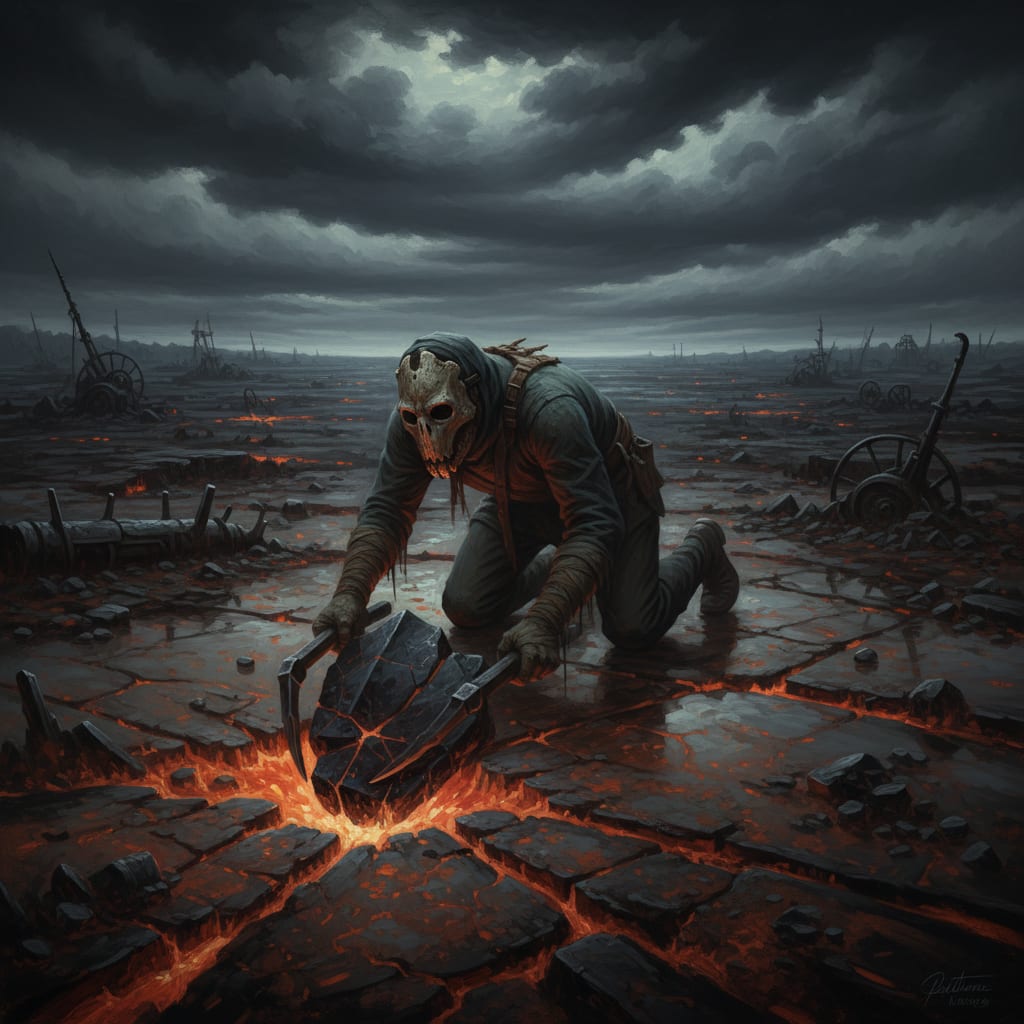
There exists, beyond the Sagittal Line's outermost patrols, a country the Bureau does not map. The cartographers have tried — fourteen expeditions since A.S. 73, each returning with fewer men and stranger silences — but the terrain refuses the discipline of measurement. In Wrath's iron wastes the ground is fused glass and slag, still warm after a century and a half of cooling, still breathing fumes that taste of burned scripture. In Lust's shattered courts the corridors are mirrored and infinite, the air thick with perfume that rewrites the memories of anyone who breathes it longer than a quarter-hour. These are the harvesting grounds. These are the places where men crawl on their bellies with bone-masks strapped to their faces and tongs gripped in hands they can no longer feel, prying loose the shards that the faithful call damnation and the desperate call hope.
The Bureau of Purity classifies demon glass as Category One Spiritual Contraband: absolute seizure, immediate destruction, no appeal. The Bureau of Doctrine concurs. The Bureau of Tithes quietly notes that confiscated demon glass generates revenue through the apparatus of spectacle — staged destructions, public immurements, fines levied against the merely adjacent. The Bureau of Tithes does not endorse the trade. The Bureau of Tithes simply observes that the trade generates a taxable ecosystem of sin. This observation is filed, annually, under "Contextual Revenue Assessment." No one has asked the Bureau of Tithes to stop filing it.
The scavengers themselves are not new. Since the earliest patrols ventured beyond the Line and returned with fragments of fused battlefield — A.S. 68, the first documented recovery, logged as "geological sample, anomalous" by a quartermaster who knew precisely what it was and precisely what admitting so would cost — men have crawled into the slag-dark to bring back proof that the world beyond the fortifications is more terrible and more real than anything the Bureau's official pronouncements allow.
#On the Substance and Function
A Demon-Glass Scavenger is a thief who steals from Hell and sells to the faithful. The formulation is the Bureau's, and it is characteristically precise in its moral architecture while remaining wilfully blind to the economic reality it describes. The scavenger does not steal from Hell. Hell has no property rights. The scavenger harvests — and harvesting is the correct verb, because the glass grows back.
The work divides into two theaters, each with its own particular horror.
The Slag-Plains of Wrath. Iron ground, still radiating heat that blisters through boot-leather within minutes. The air stinks of sulphur and something older — burned prayer, the scavengers say, though the Bureau insists that prayer cannot burn and that the metaphor constitutes a minor heresy. Shards here are dark, veined with copper and rust, and they show visions of violence: battles that have not yet occurred, deaths rendered in such anatomical precision that the Bureau of War once — once — requisitioned recovered shards for tactical intelligence. The requisition was denied. The denial was filed. The shards were delivered anyway through channels that do not appear in any ledger. Scavengers working Wrath's territory face heat-delirium, cinder-lung, iron-grit blindness, and what the trade calls "mirror predators" — shapes in the slag that move when observed only peripherally. Three crews lost in A.S. 194 alone. No bodies recovered. The glass, the crews' associates noted, was of excellent quality that season.
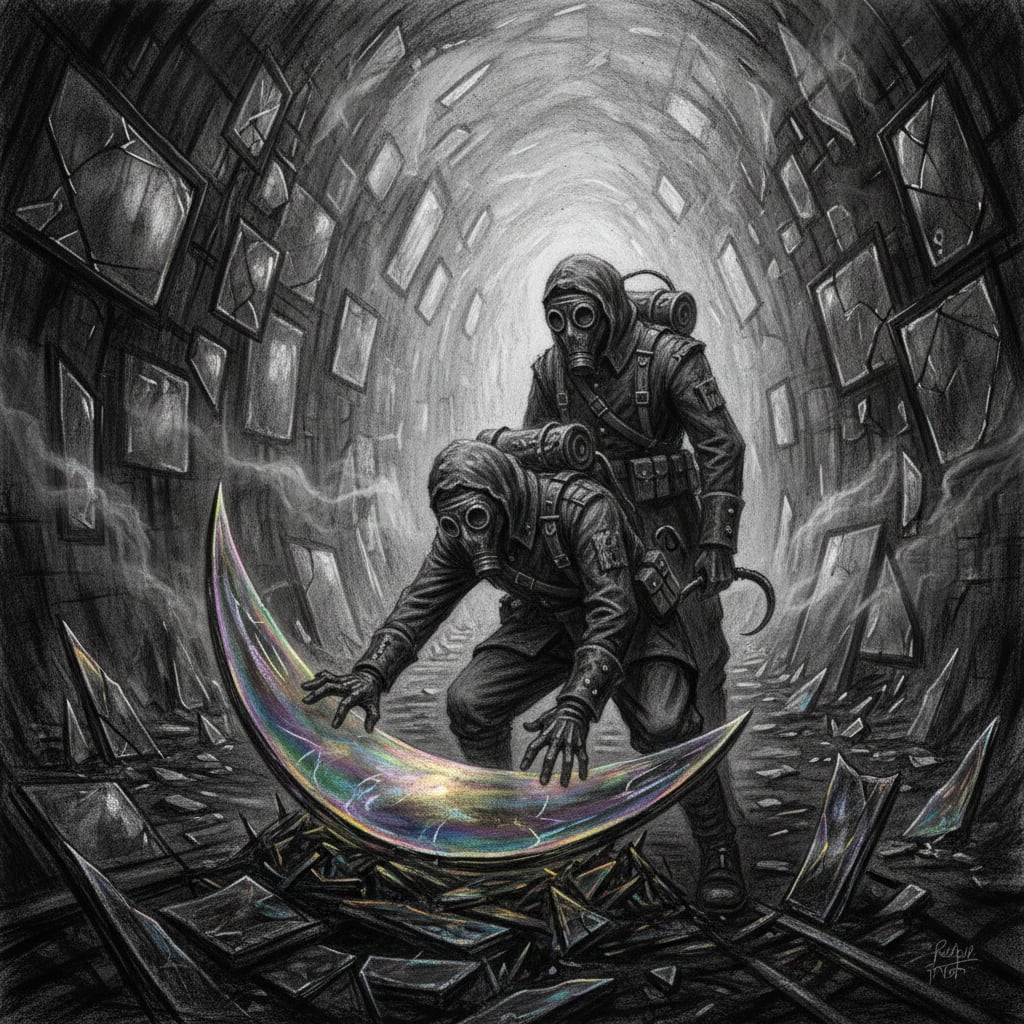
The Shattered Courts of Lust. Mirrored corridors stretching into geometries that Euclidean mathematics politely refuses. Perfume-fog so dense it has weight, pressing against the skin like unwanted hands. Memory-slip begins within fifteen minutes — you forget your name, your route, your purpose. Within thirty you forget that forgetting is dangerous. The shards here gleam with colour no stained window ever achieved: they show desires, futures that feel like memories, faces of the dead rendered so perfectly that widows have drowned themselves trying to step through. Scavengers working Lust's territory travel in pairs — one watches the glass, one watches the watcher. The watcher's task is simple: if your partner smiles, pull them out. Immediately. A smile in Lust's courts means you have already started dying.
#On the Hierarchy and the Methods
The scavenger's trade is stratified with the same informal precision that governs every criminal enterprise the Synod simultaneously condemns and monetizes.
At the lowest rung: the Picker. A debtor, a refugee, a conscript who deserted and found that the only thing worse than the trenches is the world behind them. The Picker carries no tools of quality — cloth wraps, bare tongs if lucky, and instructions to bring back chips. Most Pickers survive two runs. The third is where the glass learns your name.
Above: the Puller, who knows how to cool a shard without cracking its vision-surface. The Wrapper, whose waxed-linen technique muffles the whispers to a level that won't drive a porter mad over a twelve-hour smuggle-route. The Palace-Crawler, the specialist in Lust-zone extraction, trained to navigate mirrored corridors by counting breaths and never — under any circumstances — making eye contact with a reflection.
At the apex: the Route-Null and the Whisper-Broker. The Route-Null moves glass from extraction site to port by routes that do not exist — no waypoint named, no schedule fixed, no manifest written. If arrested, a Route-Null carries nothing. The glass travels separately, in the hands of people who do not know what they carry. The Whisper-Broker sets prices, grades product, arranges the "donation seizures" that keep Purity fed with public victories, and manages the relationship between the trade and its paradoxical patron — the Bureau apparatus that depends on a steady supply of sin to justify its budget.
The grading system is simple. Vision-grade: the shard shows something coherent — a face, a future, a death. These fetch prices that would horrify a Tithe Assessor. Furnace-grade: the shard whispers but shows nothing clear. These are sold to Polishers for cutting and mounting, or ground into the ink used by certain heretical presses the Bureau of Silence has been failing to locate since A.S. 140. A third category exists but is never discussed in open market: Hook-grade — shards that grab the viewer's attention and do not release it. These are destroyed on site. Usually. The scavengers who keep them tend not to be scavengers for very much longer.
#On the Controversies
The internal division within the scavenger trade mirrors a theological dispute the Bureau would find flattering if it chose to acknowledge the trade's existence.
The Quieters treat the whispers as contamination — a spiritual pollutant to be managed through technique. Ash-salt rinses, waxed wraps, time limits on exposure, strict rotation of crews. A Quieter scavenger handles glass the way a plague-ward orderly handles linens: with discipline, distance, and a firm refusal to engage with the content. For a Quieter, what the glass shows is irrelevant. The product is the product. Looking is the first step toward becoming a customer, and customers die.
The Seers treat the whispers as intelligence. Guidance, even. They argue — quietly, in closed rooms, with no written record — that demon glass shows truth the Bureau suppresses, and that a scavenger who refuses to look is a courier who refuses to read his own dispatches. The Seers are smaller in number, shorter-lived on average, and responsible for approximately seventy per cent of the trade's internal betrayals. A Seer who sees something personal in a shard becomes unpredictable. An unpredictable scavenger becomes a liability. Liabilities are resolved in the manner traditional to criminal enterprises operating beyond the reach of formal law.
ERRATUM — BUREAU OF PURITY, INTERDICTION DIVISION The previous assessment that "demon-glass scavenging has been eradicated in the eastern theater" (Standing Report, A.S. 197) is revised. The practice has not been eradicated. The practice has been reclassified as "residual opportunistic recovery by unaffiliated individuals." The distinction is jurisdictional, not factual. Funding implications remain under review.
The relationship between scavengers and the Bureau apparatus is the oldest open secret on the eastern Line. Purity needs confiscations to justify its budget. Confiscations require supply. Supply requires scavengers. The chain is circular, self-sustaining, and — the Bureau insists — coincidental. The staged "donation seizures" are theatre performed by mutual consent: a Whisper-Broker arranges for a small quantity of furnace-grade material to be "discovered" at a time and place convenient to both parties. Purity gets its spectacle. The press gets its headline. The trade continues unmolested for another quarter. The immured sacrifice — always a Picker, always expendable, always someone whose name was written in pencil rather than ink — receives a funeral no one attends and a file stamp that reads "RESOLVED."
#On the Present Condition
The demon-glass scavenger persists because the demand persists. Pilgrims want visions. Soldiers want edge. Widows want one more glimpse. The Bureau of War wants tactical intelligence it can deny requisitioning. The Bureau of Purity wants sin to confiscate. The Bureau of Tithes wants revenue from the confiscation apparatus. Everyone's needs align in a direction that points, inescapably, toward a man with a bone-mask crawling through slag-heat at three in the morning, pulling shards from a battlefield that burned a hundred and fifty years ago and has not yet cooled.
The loss rate is acceptable because the losses are not counted. The scavengers do not appear in any census. Their deaths generate no paperwork. Their families — if families they have — file no claims against any Bureau. They exist in the space between official reality and operational necessity, and in that space the only law is the one the trade writes for itself: wrap fast, unwrap never, and if the glass whispers your name, you drop it and you run.