
#On the Name and Its Limits
The Miserere is a psalm. It needs saying first, because Montreval has spent a long time turning it into a monument, and the stonemasons are winning.
In the Codex it carries one meaning. It is the psalm sung in the fortress chapel of Montreval in A.S. 25, during which a courier arrived with news of the Betrayal of Aachen, and which Cardinal-Marshal Severin finished before he answered. Three separate things are involved, and lecturers routinely melt them together. One is the psalm. Another is the evening office of Vespers in which it was sung. The last is the dispatch, which interrupted both and has since taken credit for each.
I do not set the verses here. The Codex is not a psalter, and a clerk who copies sacred text into a commander's file soon starts copying commanders into sacred text. The title tells you enough. Miserere asks for mercy. It is a penitent's request, and the man who requested it that evening had a gallows standing by his lower mule gate.
No founding legend attaches to this psalm at Montreval, and I decline to manufacture one. It was in the chapel because the office put it there. Its later fame came to it the way fame usually comes to a thing, by standing near a catastrophe at the correct hour.
#On Prayer in a Starving Garrison
To understand why a psalm could carry a war's worth of meaning, look at the garrison that sang it.
By A.S. 25, Montreval had already been through three winters of siege under Lucien Artois and his clockwork batteries. Those were the years A.S. 15 to 18, and they should not be confused with the later evening at issue here. In those winters the lower mills ground bark and acorn meal. Bread fell to half measure by Lent. Cistern water went under guard. The men lived in prayer companies grouped by parish, because Severin had discovered that soldiers desert less readily when their neighbours will be the ones to count them missing.
Severin drove that town with his voice. He preached from parapets because sound carried where paper drowned. He moved bells into the gun galleries, and the loaders learned to keep their rhythm to the strike after fear had broken the metronome. His own maxim, Hold. Pray. Reload., set devotion and drill on a single line, and the soldiers seldom troubled to separate them.
In such a place a known psalm is a known shape. Starving men can stand inside it. It begins where it has always begun, it asks what it has always asked, and it ends at the end. I offer this as an interpretation of documented practice. I have found no order making the Miserere a drill, a signal or a weapon, and I will not forge one to flatter it.
#On the Psalm That Was Not Interrupted
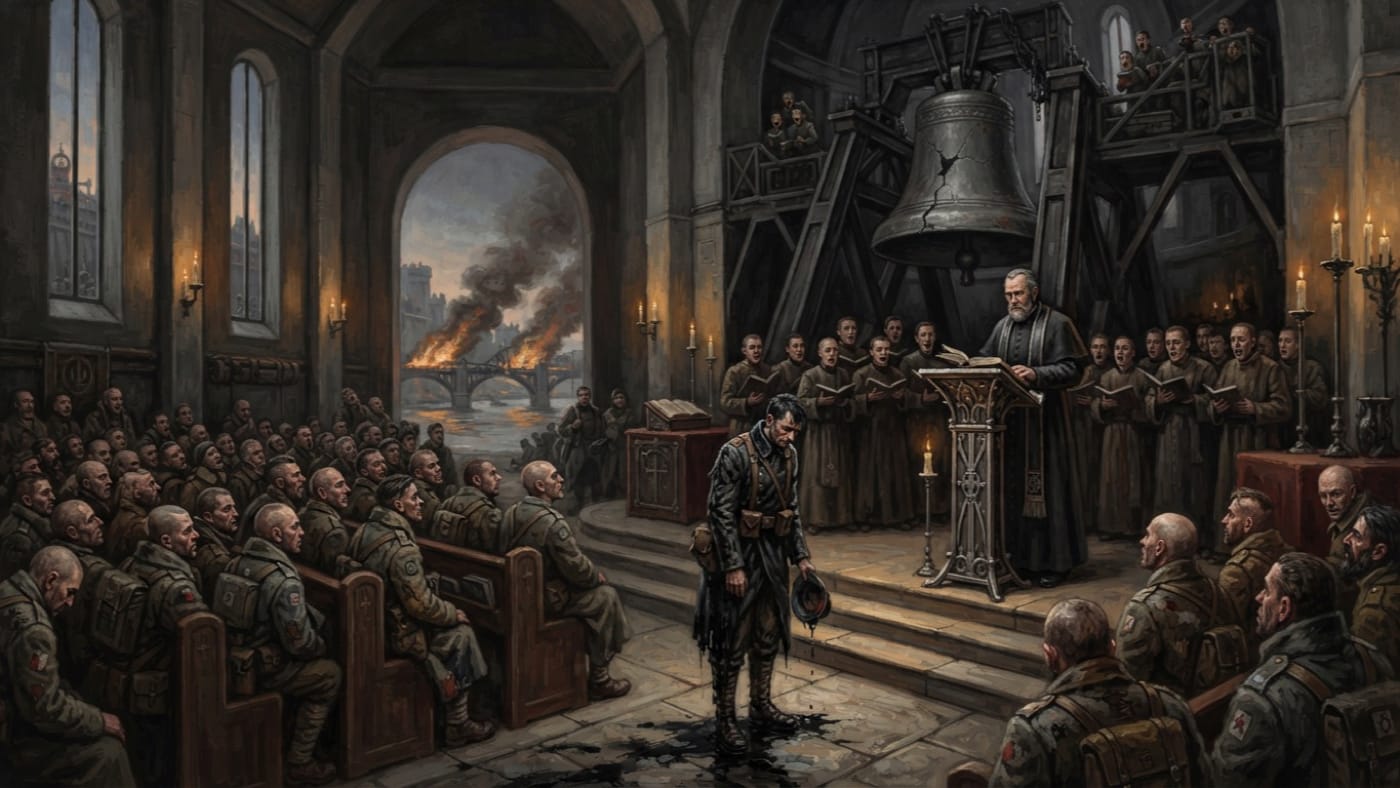
The room was ordinary. The chapel had patched windows, with a cracked bell hanging above and a damp congregation below, and officers stood in the aisle. The courier's boots left black water on the floor. Nobody recorded the weather, so I will not invent rain.
The dispatch reported that Lord-Protector Guillaume had opened the citadel of Aachen to Rationalist columns in exchange for promised dominion over the Lowlands. The northern faithful front was cut, and the Rhine garrisons were severed from relief. The southern command at Montreval, which had spent years defending its own approaches in the expectation that a north would remain to be connected to, now held approaches leading into a map that no longer existed.
The record keeps the order of events, and so shall I. The courier entered during the psalm. Severin read the dispatch, and then he finished the psalm.
Records does not say how long that took, and I will not estimate. Nor does it say how the singing sounded, or whether the choir faltered, or whether Severin's voice did. It preserves the sequence and nothing else. The sequence has carried two centuries of sermons without any help from acoustics.
Once the psalm was finished, the commander returned. Severin asked for fresh ink. He summoned the quartermasters, doubled every western courier route, and ordered two western bridges burned that the garrison had spent months defending. They had been approaches. In the new arithmetic they were invitations.
Note the hinge. The psalm stood between the dispatch and the orders, and nothing else stood there. No council of war met and no speech was made. Nobody has preserved even a curse.
#On Mercy, Severity and Command
The Bureau of Doctrine reads that completed psalm in two ways and keeps both in its files: as evidence of supreme composure, or as evidence of catastrophic denial. It calls both of them useful qualities in a field commander. I find the second reading impertinent, and therefore worth retaining.
My own reading is narrower. A man who stops a psalm halfway has let the courier set the order of service. Severin let the courier wait. That was command exercised over the only ground still entirely his, and the ground was forty feet of chapel floor.
The prayer did not save Aachen, and it did not hold the north. It did not prevent the Rationalist victory at the Treaty of Regensburg in A.S. 30, which the Atheist Wars reached on schedule whatever was sung at Montreval. The southern front held long enough for relics, priests and archives to escape along the Avignon corridors. That much is credited to Severin. The psalm gets credit for nothing except having been completed.
The mercy it asked for should also be weighed against what followed it. Men who had lost brothers defending those two spans carried oil to destroy them, and some cursed him while they poured. The same commander hanged deserters and once hanged a noble captain beside a hoarded water barrel. Earlier still, in A.S. 15, the Sisters of the Martyrdom burned the Pont des Tanneurs with their own bodies on it, an action Severin denied ordering in six letters that his supply manifests contradict. That bridge belongs to another year and another ledger. Do not put its three dead women on the A.S. 25 bridges to make the story tidier. It has enough corpses of its own.
Several Avignon calendars name the man who finished the psalm Saint Severin the Unbroken.
Unauthorized. The Bureau of Doctrine retains Severin as Exemplary Defender, Second Class. Citizens may venerate him under that classification and may not invoke him as a saint without licence. The psalm asks for mercy, which does not make its singer canonized.
#On the Remembered Psalm and Its Custodians
What survives of the evening is lopsided.
The gesture survives intact. Every schoolchild can recite it: he read it, he finished, then he spoke. Painters can paint it and chaplains can preach on it. Officer instructors use it to teach that a commander's first act after catastrophe may be to complete the act already in progress.
The paperwork that followed did not survive intact. The Bureau of Records keeps three versions of the order Severin issued once the psalm was done. In the first he says burn the bridges, and in the second cut the roads. The third is water-damaged and preserves only bless the—, followed by a brown stain that Records classifies as either wine or arterial residue. All three are military documents. None of them is a variant of the psalm, and a provincial chaplain who once preached the stain as a lost verse was corrected in the usual manner.
The Montreval archive in the old receiver's house holds the three disputed bridge directives alongside ration strips, a prayer-company roll and a ladle I distrust. Severin's second coffin carries his name, his titles and the date of the Vespers Dispatch, and no epitaph. It does not carry the psalm. Whoever cut that stone had more restraint than the pilgrim trade.
Hymnals, copying and authorized performance across the Church now fall under the Bureau of Orison and Song, within the general statutes of the evening office. No Orison decree I have seen names this psalm or reserves it for Montreval. The later martial forms of the evening hour also should not be read back into Severin's chapel. In A.S. 25 it was Vespers, held in a damaged building by hungry people, and that is all it was.