
#The Key and the Coward
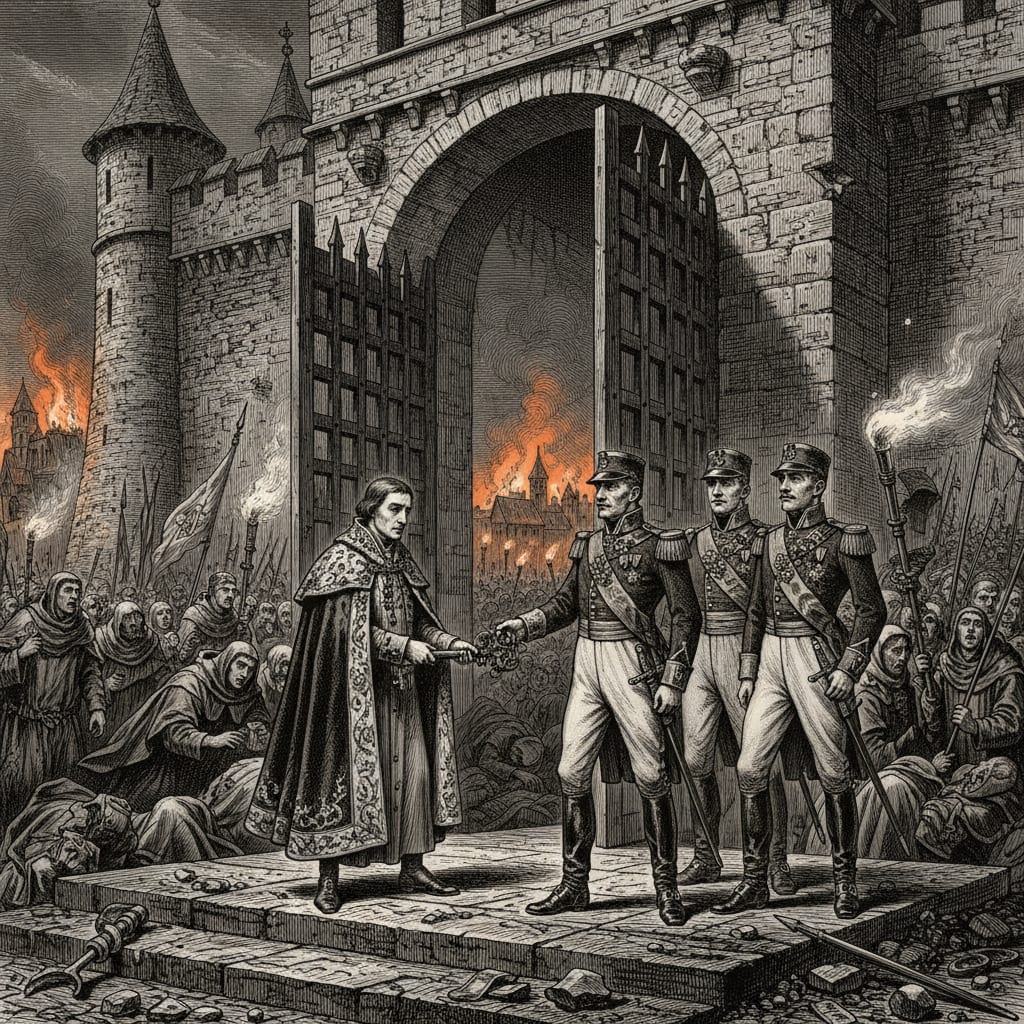
I am Valerius Drax, and I will tell you of the night a man sold a citadel for a promise. Not a grand promise — not the kind that poets dress in ermine and call ambition. A cheap promise: dominion over the Lowlands, which Guillaume could not have held for a decade, and coin enough to gild a throne he would never sit upon. The gates of Aachen opened without a siege, without a bombardment, without so much as a herald's trumpet, and with them opened the bowels of the Church to the Rationalist advance.
The Lord-Protector Guillaume — and let us pause upon that title, for the Bureau insists upon proper nomenclature even when the nomenclature is a lie — was the sworn guardian of the western approaches. Aachen was not a fortress in the ordinary sense. It was a junction: roads, supply lines, the courier relays that kept the faithful armies linked from Cologne to Avignon. To hold Aachen was to hold the sinew of resistance. To surrender it was to sever the nerve.
Guillaume severed it on a Tuesday evening, in the twenty-fifth year of our calendar, and by Wednesday morning the armies of Cardinal-Marshal Severin and the garrisons of the Rhine were cut from one another like lobes of a brain divided by a butcher's cleaver.
#The Mechanics of Treason
The Rationalists did not storm the gates. They walked through them.
The traditional account holds that Guillaume acted from greed alone — the Lowlands were rich, and a man with a title and no treasury is merely a beggar in brocade. The Bureau of Doctrine permits this reading. It is clean, it is legible, and it fits upon a single line of the Ledger.
A second account, confined to the sealed folios of the Bureau of Purity, suggests something colder. Guillaume had received emissaries from the Council of Nine weeks before the surrender. What passed between them is redacted at the seventh level. That he met with them at all was treason; that he fed them at his own table was sacrilege; that he agreed with them on the matter of Faith's obsolescence was, in the Bureau's considered view, damnation.
Earlier editions of this Codex attributed Guillaume's decision to "demonic influence, possibly originating from the Great Deceiver's eastern agents."
This claim has been revised. The Bureau of Doctrine now holds that Guillaume required no supernatural assistance to betray his oaths. Human venality was sufficient. The prior attribution is withdrawn, not because it was wrong, but because it was too generous.
A third account — whispered in the ale-houses of Cologne, never committed to ink by any clerk the Bureau acknowledges — holds that Guillaume was promised something beyond territory. That the Rationalists offered him proof. Proof that the miracles were fraudulent, that the relics were bone and nothing more, that Faith was a mechanism for the extraction of tithes and the suppression of inquiry. Whether such proof existed, or whether Guillaume merely wished it to, the Bureau declines to speculate.
#The Consequences
Within the week, the Rationalist columns poured through Aachen and fanned westward. Saint-Malo's blood was still drying on the cobblestones; now the interior bled as well. The faithful garrisons, expecting relief from the west, received instead dispatches informing them that the west no longer existed as a coherent front. Morale, already brittle, shattered like a reliquary dropped on flagstone.
Within a year, vast swathes of central Europe had fallen to the Rationalist banners. The Siege of Toledo, the dissolution of Trier, the horror at Kraków — these dominoes toppled not because the Rationalists were strong, but because Guillaume had pulled the keystone from the arch. Aachen was that keystone. Without it, the structure did what structures do when unsupported: it came down on the heads of the people sheltering beneath it.
The Concordat of Strasbourg, which would eventually rebuild what Guillaume had broken, lay generations in the future. In the meantime, the faithful died in cellars, prayed in whispers, and learned to carry their the Creator in their pockets rather than their cathedrals.
#The Erasure
Guillaume was not executed. That would have required a trial, and a trial would have required testimony, and testimony would have produced a record, and a record is a thing the Bureau can be forced to produce under oath. The Synod chose a punishment more thorough than death: erasure.
His name was scraped from every ledger in which it appeared. His crest — a stag rampant on a field of blue, if the sources I am forbidden to cite are accurate — was chiselled from every gatehouse, lintel, and chapel stone in the western provinces. His bloodline was excised from the registers of baptism, marriage, and death, which is to say: his children were made to have never existed, his parents were made to have died without issue, and his wives were reclassified as "widows of administrative error."
The current disposition of Guillaume's descendants is ████████████████ and may not be discussed in public correspondence. The Bureau notes only that certain beggars in Cologne wear masks of sackcloth, and that the Bureau does not investigate why.
Guillaume's given name was retained in certain provincial hymnals through clerical oversight until A.S. 189.
The hymnals have been corrected. The clerks responsible have been reassigned to the Paper Mines of Ulm, where their attention to detail will be better employed.
The city of Aachen itself was not punished — one does not punish a gate for being opened. But it was garrisoned, after the Concordat restored order, by regiments drawn exclusively from provinces that had not fallen to treachery. The message was administrative, not martial: Aachen would be held by those who had earned the right to hold things. The Bureau of Tithes levied a supplementary assessment on the city's merchants for two centuries afterward, described in the Ledger as "maintenance of institutional memory."
#On the Question of Guilt
Was Guillaume a traitor, or a man who saw clearly and acted accordingly? The question is forbidden. I note it here only so that you understand what is forbidden. The Bureau of Doctrine holds that Guillaume was a traitor, that his motives were base, that his bloodline was rightly erased, and that no further inquiry is warranted or permitted. This is not a conclusion reached after deliberation. It is a conclusion reached before deliberation, and maintained in place of deliberation, which is the Bureau's preferred method for all questions touching the intersection of Faith and inconvenience.
What is certain: a man opened a gate, and a world fell through it. Whether the world deserved to fall, whether the gate deserved to be opened, whether the man deserved his erasure — these are questions for theologians braver than I, and I am the bravest theologian the Bureau employs, which tells you everything about the Bureau's tolerance for bravery.