
#On the Hour That Collects the Day
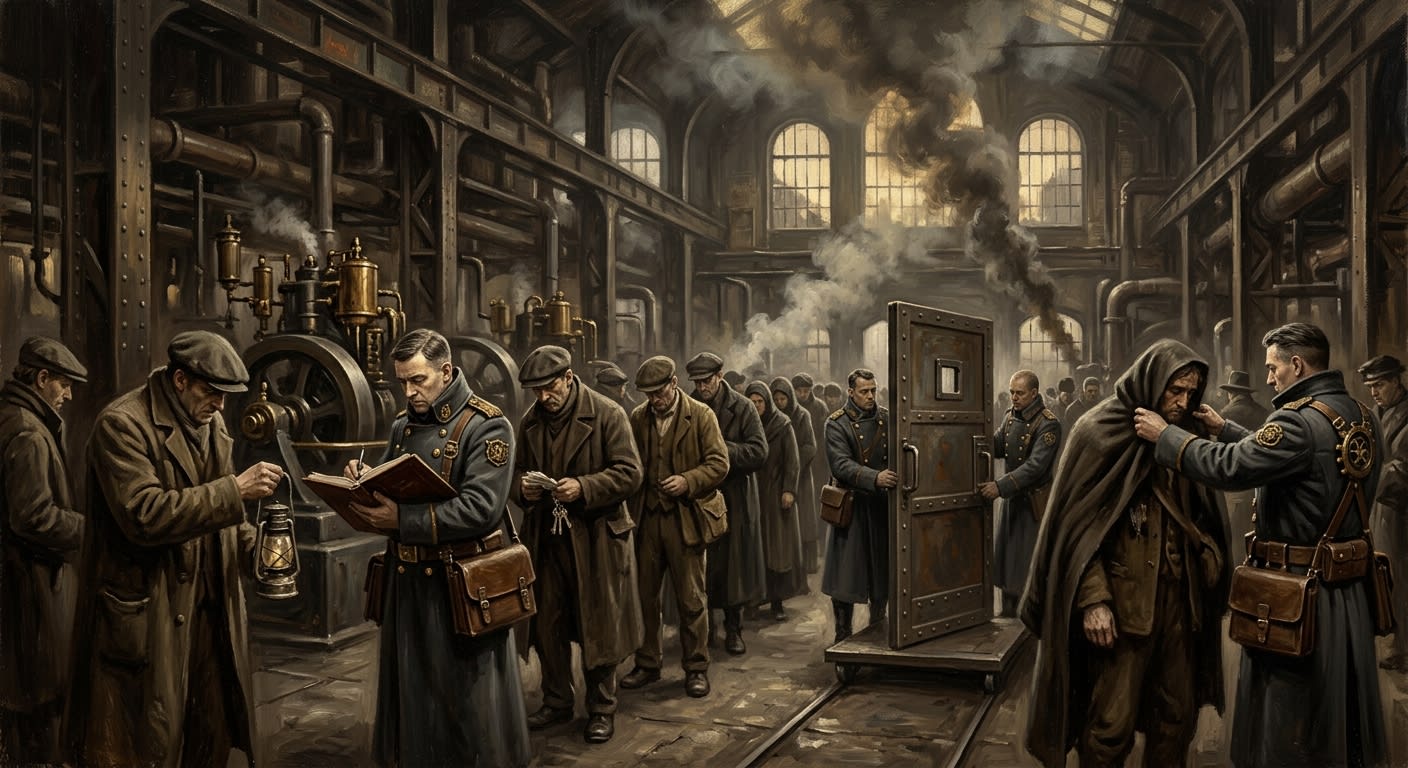
Vespers is the evening office by which the Synod receives the day back from the citizen, weighs it, scents it for rot, and decides how much night he may be trusted to possess. Matins wounds the sleeper into usefulness. Sext arrests the market at its hottest fraud. Vespers gathers what remains after labour, appetite, oath, quarrel, sale, hunger, instruction, punishment, and fatigue have done their honest little violences.
It is not merely prayer at evening. That is the nursery version, useful for children, peasants, and certain bishops whose minds do best when fed from spoons. Vespers is the transfer interval between lawful day and supervised dark: bell, response, household reckoning, street withdrawal, workshop closure, parish report, mercy call, lamp permission, curfew preparation, and the first tightening of those cords by which darkness is made governable.
The Bell Codex gives Vespers its family resemblance across the Dominion. A coastal town hears it as gulls and chain. A market city hears it as shutters, debt, and the last coin counted before witnesses become inconvenient. A forward bastion hears it already wearing iron, for the Line does not enjoy the luxury of gentle dusk. In every place the office performs the same theological arithmetic: the sun has declined; the Ledger has not.
#On Bell, Answer, and Closing Line
A proper Vespers has three bodies: bell, answer, and closing line. The bell announces that the day’s permissions are expiring. The answer proves that the household, shop, ward, barracks, school, hospice, dock, bridge office, shrine counter, and prison room have heard the command. The closing line enters the consequence into whatever book governs that locality, from cathedral register to chalk slate hung beside a tavern door.
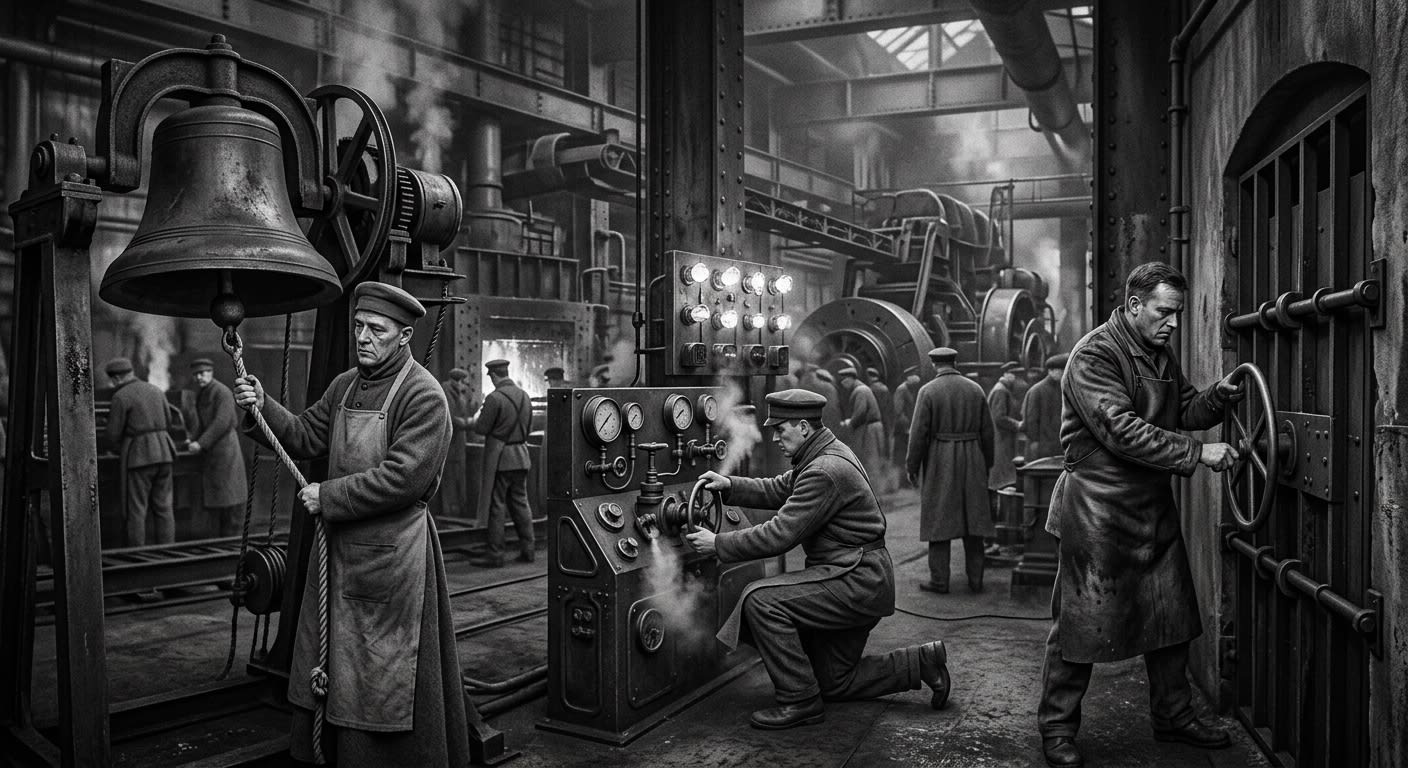
The bell varies. Bronze is preferred because bronze has dignity, memory, and a pleasing willingness to make the poor nervous. Iron plates serve in factory districts. Ship chains serve in harbours. A gate bar struck seven times may suffice in trench towns, provided a Records witness is present and not too drunk from fear. The Bureau of Bells dislikes substitutes. The Bureau of War likes anything loud enough to move men. The conflict is ancient and usually settled by whether shells are falling.
The answer is where Vespers becomes intimate. Matins may be heard by a body still half asleep. Sext may be answered by a crowd. Vespers enters the room. Households stand. Children repeat the evening clause. Widows name the dead if permitted by local mourning table. Apprentices account for tools. Ward sisters count beds. Prisoners touch the door-slat. Shops lower shutters after the response, not before, because a closed shutter before Vespers suggests business concealed from both the Creator and Tithes.
The closing line may be spoken, sung, written, stamped, or merely witnessed by a parish clerk whose handwriting resembles a spider dying in ink. Its formula is short in obedient places: “Day received.” In districts with recent unrest it lengthens into names, exceptions, delays, missing persons, lamp permits, sickness marks, and late-return explanations. Where Purity has been active, the closing line grows teeth. Where Mercy has been active, it grows footnotes.
Rural catechisms once described Vespers as “the soul’s peaceful thanksgiving at day’s end.”
Corrected. Peaceful thanksgiving is permitted within the office. It is not the office. Vespers is custody returning to the parish, the street, the tower, the ward, and the file. Peace may attend if properly registered.
#On Its Place Among the Offices
The day has an administrative skeleton. Ninefold Matins opens the legal body. Lesser peals dress it, feed it, count it, and send it sweating into work. Sext fixes it beneath public sun, where false piety has fewer corners in which to crouch. Vespers begins the binding. Compline, where observed, closes the mouth.
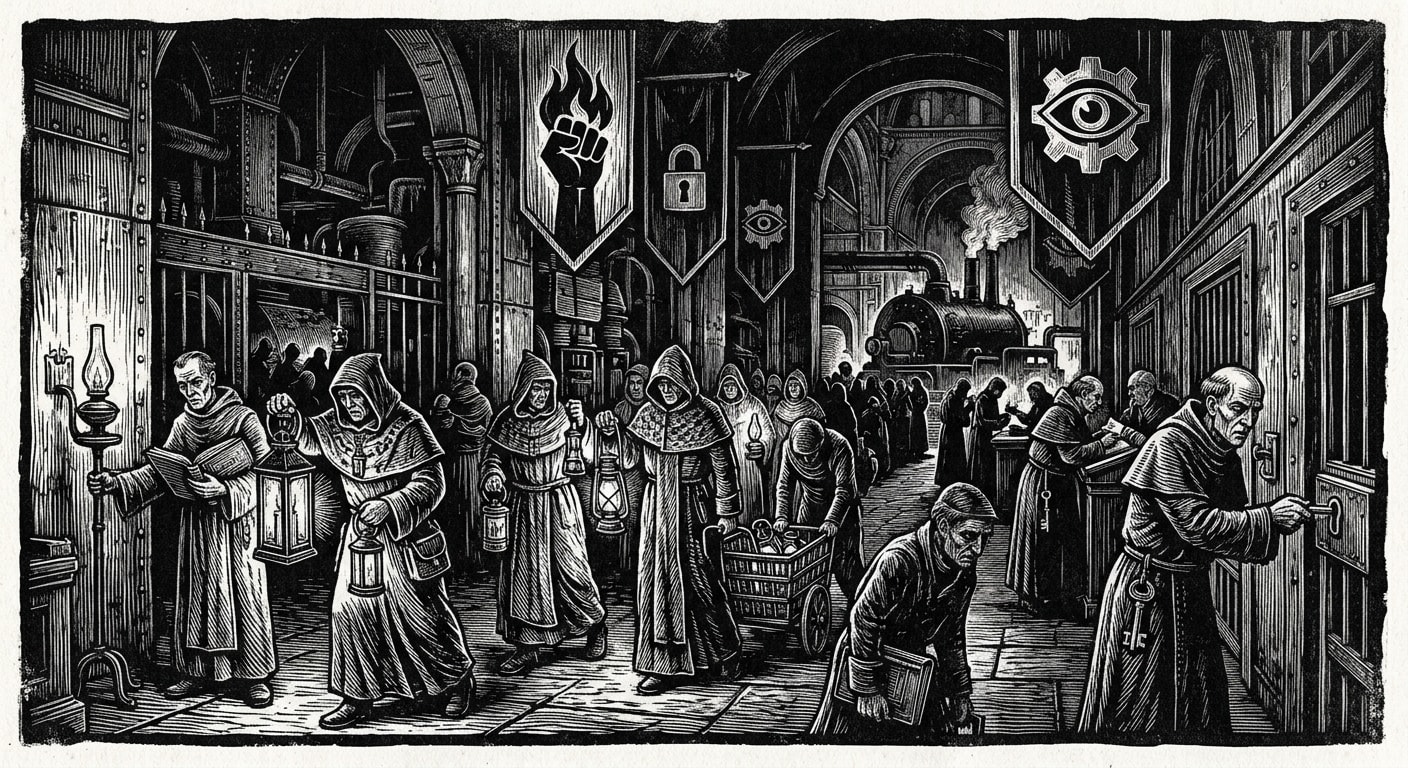
This makes Vespers the hour of consequences. A man late to Matins may claim sleep, sickness, distance, broken bell, bad ear, or the Creator’s mysterious oppression of blankets. A man disorderly at Sext may blame hunger, heat, market press, turnip argument, or commercial provocation. At Vespers, the day has produced evidence. His shop either closed properly or did not. His child either returned or did not. His work-token either bears the right nick or does not. His recitation either remembers the morning correction or proves the correction failed. Evening is when excuses come home tired.
The Bureau of Records adores Vespers in a quiet, indecent manner. Morning opens files; noon tests them; evening reconciles them. A day's unresolved fragments can be forced toward columns: present, absent, late, sick, dead, detained, transferred, pending, suspect, unnamed, misnamed, or inconveniently breathing. Records calls this closure. Citizens call it being asked questions while hungry.
Doctrine loves Vespers because the evening answer exposes drift accumulated through the day. A faulty dawn line may be fear. A faulty noon line may be distraction. A faulty evening line is habit announcing itself. The Doctrine Street-Vicar listens for the small injuries: the swallowed clause, the tired omission, the family variant brought from a grandmother’s mouth, the child who says “kept” where the approved card says “received.” Such errors are tiny. That is why they matter. Heresy rarely enters wearing a crown. It enters as a household convenience.
#On Mercy at Dusk
The Mercy Vicars have always understood Vespers better than their chalk-drunk cousins. Evening is when public humiliation becomes most dangerous. A market man shamed at noon can return to weighing beans with murder in his jaw and still be visible. A father shamed at Vespers carries the mark into his room, his table, his children’s eyes, and the long dark where resentment breeds without witnesses.
A Mercy Vicar at dusk works softly because softness, here, is not kindness. It is containment. He stands beside the lintel, hears the failed line, lowers his voice, and repairs the cadence before the neighbours acquire entertainment. A pale yellow dot may be drawn where rain or servant’s rag will take it by morning. A correction slip may be folded into the hand. A chapel annex appointment may be given for second bell. The household remains intact enough to obey tomorrow.
This practice descends from the same post-A.S. 104 correction wisdom that produced the Mercy school: crowds corrected too loudly may obey for one hour and hate for a decade. Vespers sharpens the danger because the hour already tastes of confinement. The door is closing. The lamp is being trimmed. The child is listening. A red mark at dusk can turn a family into a cell, and cells possess excellent memories.
The Marking Vicars call this cowardice. They prefer public colour, visible consequence, and the doctrinal theatre of a door made exemplary before the street withdraws. They are not wrong in the narrow way a hammer is not wrong about nails. A red Vespers mark can pacify ten houses by frightening nine. It can also teach nine houses to whisper through walls. Statistics decide the argument each quarter, which is how the Synod keeps theology pleasantly subordinate to results.
VESPERS CORRECTION LOG — STRASBOURG EAST, A.S. 178 Household failed evening clause during Echo Season. Mercy notation: “Fear response, no drift.” Neighbourhood report: no public disturbance. Cadence Examiner later finding: ████████████ Disposition: household sealed; Vicar unlisted; evening card retained for training.
#On Vienna, Where Evening Became Category
The Vienna Incident gives Vespers one of its uglier crowns. The A.S. 112 sweep began before dawn, widened by Sext, and by Vespers had become an operation. This is the sequence the training rooms preserve because it shows how a sound becomes a category while the day still pretends to be ordinary.
At dawn, Tone Inquisitors entered stairwells with bait-cadences and listening cards. By noon, Purity cordons and Records tables had turned suspicion into logistics. By Vespers, the lullaby about rain and barley was no longer merely a domestic sound. It had become a prosecutable population, a numbered contamination, an evening file with carts, brands, ward transfers, and the state’s full talent for making tenderness enumerable.
An Orison instruction plate once stated that Vespers “confirmed the Vienna evidence.”
Corrected. Vespers confirmed the operation. Evidence remained what it had been: mothers sang because children slept. The office gave the sweep its evening shape, and shape is what frightened institutions use when proof arrives too thin for comfort.
The phrase in one sealed timing note deserves preservation: “At noon the lullaby became enumerable.” By Vespers, it became inevitable. The Bureau’s darkest gifts often mature between these two hours. Noon counts. Evening closes. Once a closing line has been written, cruelty acquires the posture of completed duty.
Vienna also explains why Mercy ward-sisters distrust evening sleep phrases. They know the approved Dormition lines fail in certain rooms. They know children remember more through tone than through doctrine. They know that a lullaby prohibited by Orison may survive as a tap, a breath, a pause before the second bar. At Vespers, when the ward quiets, these little survivals become audible to anyone with a heart or a prosecution slate. The Synod employs both, regrettably in uneven numbers.
#On Iron Vespers and the Bastion Difference
Iron Vespers is not Vespers with better posture. It is the martial child of the evening office, armoured, sequenced, and trained to bite. Civil Vespers returns the day to parish custody. Iron Vespers transfers garrison custody to night: gates locked, powder opened, cartridges counted, relics checked, walls acknowledged, witnesses entered, final peal struck. One sends children indoors. The other teaches soldiers which fear comes next.
The distinction matters because civilians hear the shared word and imagine continuity. The Line hears command. At Brest, the evening peal runs low through mud and brass ribs. At Przemyśl, ridge echoes must be clipped lest the hills counterfeit magazine release. At Irongate, tunnel mouths and the Gasket Choir make the mountain itself seem to close its teeth. At Shipka, the peal is rung early in fog weeks because Syrion’s hour grows lazy unless beaten. At Constantinople, the Bosphorus carries evening like a verdict thrown into water.
Iron Vespers preserves the older office’s logic and strips it of domestic mercy. The day is over; consequence begins. The garrison becomes an object: locked, armed, counted, blessed, witnessed, dangerous. Civil Vespers tolerates a tired child’s stumble, at least where the local Vicar has not mistaken himself for an axe. Iron Vespers tolerates little. Powder does not accept pastoral nuance. Gates do not forgive interpretive variation. A late answer on the wall can become a breach before the correction slip dries.
The Bureau of Bells insists both belong to one ordered family. War agrees when budgets require shared bell-metal. Orison agrees when it can attach sanctioned chant. Records agrees because shared nomenclature creates more filing categories, and Records experiences joy as multiplication.
#On Lamps, Doors, and the Permission to Be Unseen
Vespers governs lamps because lamps govern excuses. After the office, light becomes testimony. A lamp burning in the correct window means household present, work ended, prayer said, door under ordinary custody. A lamp absent may mean poverty, grief, sleep, sickness, concealment, sedition, or the oil ration clerk’s incompetence. A lamp where no lamp is licensed means meeting, smuggling, unsanctioned vigil, private mourning, illegal teaching, hidden birth, or a man reading something he should have surrendered at Sext.
The lamp register belongs among evening’s most disliked instruments. Households receive lamp tokens by district, season, ration condition, and moral risk. Widows may receive blue glass for mourning weeks. Workshops receive shielded industrial flame. Hospices receive low mercy lamps. Certain Purity streets receive no private lamp after Vespers, because darkness imposed by authority is safer than darkness chosen by citizens. The distinction is obvious to anyone paid by Purity and offensive to everyone else.
Doors matter with equal vulgarity. Before Vespers a door is movement. After Vespers it is declaration. Open too long and the house appears porous. Close too early and it appears evasive. Bolt before answer and the parish may ask whom the household feared hearing. Bolt after the permitted interval and the Warden may ask whom the household expected. The correct door is a theological object: neither welcoming nor sealed, neither loud nor sly, obedient in hinge and latch.
Here the poor suffer the usual miracle of being governed by objects they cannot afford. Oil costs. Tokens cost. Replacement glass costs. A family may violate Vespers by darkness born of poverty, then be fined for looking like conspiracy. Mercy Vicars sometimes intervene. Tithes sometimes refunds. Bells sometimes admits a broken district plate caused confusion. These marvels occur often enough to be cited and rarely enough to remain miracles.
#On False Evening and Enemy Use
The Enemy has learned Vespers, as all enemies learn the handles of a house they intend to enter. A false evening peal can send workers home before a shift completes, empty a market into alleys before Purity arrives, close a gate while a convoy remains outside, or draw families to windows at the very moment something wants to be counted by their eyes.
Syrionic pressure at Shipka bends the evening interval toward rest. Men hear Vespers and sit before the answer. They put down tools. They soften. They begin accepting the chair, the blanket, the polite invitation to stop. This is why Shipka rotations keep rope-lines, pain orders, and companion violence near evening. If a man sits too early in Sloth fog, love may need to strike him across the mouth.
Pale Chanter activity can hollow the response. The household stands, mouths open, and no word arrives with the shape intended. Orison calls this cadence evacuation. Soldiers call it the throat going missing. Children call it scary, proving again that technical terminology is often cowardice with a budget.
False Vespers has occurred in safe cities as well. Bell-Tappers sell illegal peal windows. Grief houses bribe tower boys for early mourning notes. Markets have attempted delayed evening to extend trade under festival cover. Lovers, whose crimes are often administratively indistinguishable from smugglers, have purchased tiny wrong dusks in side chapels. The Bureau prosecutes according to harm, embarrassment, and whether the accused can afford better counsel than the tower.
#On the Present Holding
As of A.S. 201, Vespers remains universal in law and various in sound, which is the Bureau’s preferred arrangement whenever uniformity would require impossible staffing. Bells owns the strike. Orison owns the authorised answer. Records owns the closing line. Doctrine owns the meaning. Mercy owns certain doorways for a few dangerous minutes. Purity owns the failed response. War owns the iron variant wherever powder waits for night.
The citizen owns, briefly and under review, the sigh between answer and bolt.
Some Bell commentaries state that Vespers “ends the day.”
Clarified. Vespers ends the citizen’s presumption that the day belongs to him. Work may continue, punishment may begin, garrisons may arm, Mercy may count children, Purity may knock, and Records may reconcile until the ink grows cold.
At Vespers the bell does not say rest. It says: report what the day has done to you.