#On the Bureau's Founding
"The saints carried the Word through death. Their dust carries it through static." — Inscription above the Cloister of Calibrated Breath, Strasbourg
The Holy Bureaus number twelve in the public catechism, though anyone who has attempted to count them understands that the number is aspirational rather than arithmetical. The Bureau of Orison and Song is the fourth listed, the third funded, the second feared, and the only one that can kill you with a hymn.
Its charter was filed in the Concordat year, A.S. 92, alongside the first formal constitutions of the Bureau apparatus — though the Bureau itself will remind you, with the quiet menace of a choir-master correcting a flat, that its authority predates its paperwork. Voice was weaponised long before ink ratified the practice. At Bastion-Irongate, the Great Hush of A.S. 94 collapsed the Third Lung and killed three thousand men when the tunnel complex fell silent for nine hours — proving, in the Bureau's own assessment, that the mountain required continuous choral maintenance to hold its structural integrity. The Gasket Choir was born from that catastrophe: mandatory chant shifts, three rotations, perpetual sound sustaining a fortress from within. The Bureau of Orison and Song claimed jurisdiction over the chant schedules by A.S. 96. That no formal authorisation exists for this claim has discouraged precisely no one.
The distinction between the Bureau of Orison and Song and the Bureau of Bells is a matter of considerable institutional vanity and very little practical clarity. Bells ring. Choirs sing. The Bureau of Bells governs the instruments — the bronze, the clapper, the peal schedule, the coded sequences that wake garrisons and bury the dead. The Bureau of Orison and Song governs the voice — the hymnal, the broadcast, the calibrated war-cry, and the saint-dusted transmission that carries Doctrine across a continent. Where bronze ends and breath begins is a jurisdictional frontier more bitterly contested than anything along the Sagittal Line itself.
#On the Nature of Orison
The word itself is instructive. A Stamped Erratum of the Bureau of Doctrine, filed and ratified without date or attribution, commands: "Replace the vulgar word 'spell' with 'orison' in all public copies. Internal training documents may retain 'spell' for clarity. Friction is fuel." The Bureau of Orison and Song takes its name from this commandment. An orison is a prayer. A prayer directed through sanctified apparatus becomes a broadcast. A broadcast sustained by relic residue becomes a weapon. The trajectory from supplication to slaughter is, in the Bureau's institutional vocabulary, called "liturgical escalation," and it is the single organising principle of the Bureau's existence.
What the Bureau licenses is comprehensive and absolute. Every hymnal printed within the Synod's territorial mandate must carry its imprimatur — a wax seal pressed into the binding, a stamp on the colophon, a serial number corresponding to a master register held in the Cloister of Calibrated Breath at Strasbourg. Every choir assembled for public worship, military service, industrial calibration, or civic ceremony must operate under an Orison writ. Every devotional broadcast — the daily Orison Hour, the curfew decrees, the casualty rolls, the ration schedules — must pass through an Orison Signal Engineer whose equipment has been blessed, whose relic-dust allotment has been measured, and whose Clean Carrier certificate has been filed with the Bureau of Records before transmission.
Unauthorized melodies are heresy. The Bureau's enforcement record on this point is unambiguous. In Vienna, a folk lullaby spread without sanction through the pilgrim quarters — a song about rain and barley, harmless as milk, sung by mothers to children who could not sleep. Within a month, five thousand mothers had been branded and their tongues charred black with hymn-fire. The Bureau's report classified the lullaby as "an unsanctioned cadence exhibiting potential for doctrinal contamination." The children were reassigned to Bureau of Mercy orphanages. The lullaby has not been heard since.
I note, in the privacy of these margins, that I have caught myself humming it.
#On the Instruments of Broadcast
The Bureau's operational infrastructure divides into three arms, each with its own hierarchy, its own equipment, and its own species of institutional paranoia.
The Hymnal Directorate governs the printed word. Every approved hymn exists as a Master Hymnal Plate — a steel engraving held in the Vault of Tuning at Strasbourg, from which all authorised copies descend. The Plates are sacred objects. Access requires three Bureau seals, a Bureau of Doctrine countersignature, and a willingness to be strip-searched by a Provost whose hands smell of incense and cold iron. The Directorate employs Cantor-Scribes who transcribe approved stanzas onto distribution sheets, Hymnal Auditors who inspect parish copies for textual drift, and Stanza Marshals who prosecute deviations. A misplaced comma in a psalter is a clerical error. A misplaced note is a security incident. A misplaced stanza is an act of war.
At Essen-of-Hymnsteel, the relationship between hymn and manufacture is made literal. Calibration is legally classified as a sacrament. Choirs sing bearings "awake" before the furnaces light; metered chanting during steel pours "aligns" the grain structure of the metal; the city's production of bell-cannon throats, hymn-drive housings, and reliquary rivets depends upon vocal precision maintained to tolerances that would make a watchmaker weep. The Tri-Bureau Compact of A.S. 110 — ratified under joint seal of the Bureau of Engines and Furnaces, the Bureau of Records, and the Bureau of Orison and Song — formalised what the foundry floor had already proven: that sound and steel are married in the Synod's arsenal, and the Bureau of Orison and Song is the officiant.
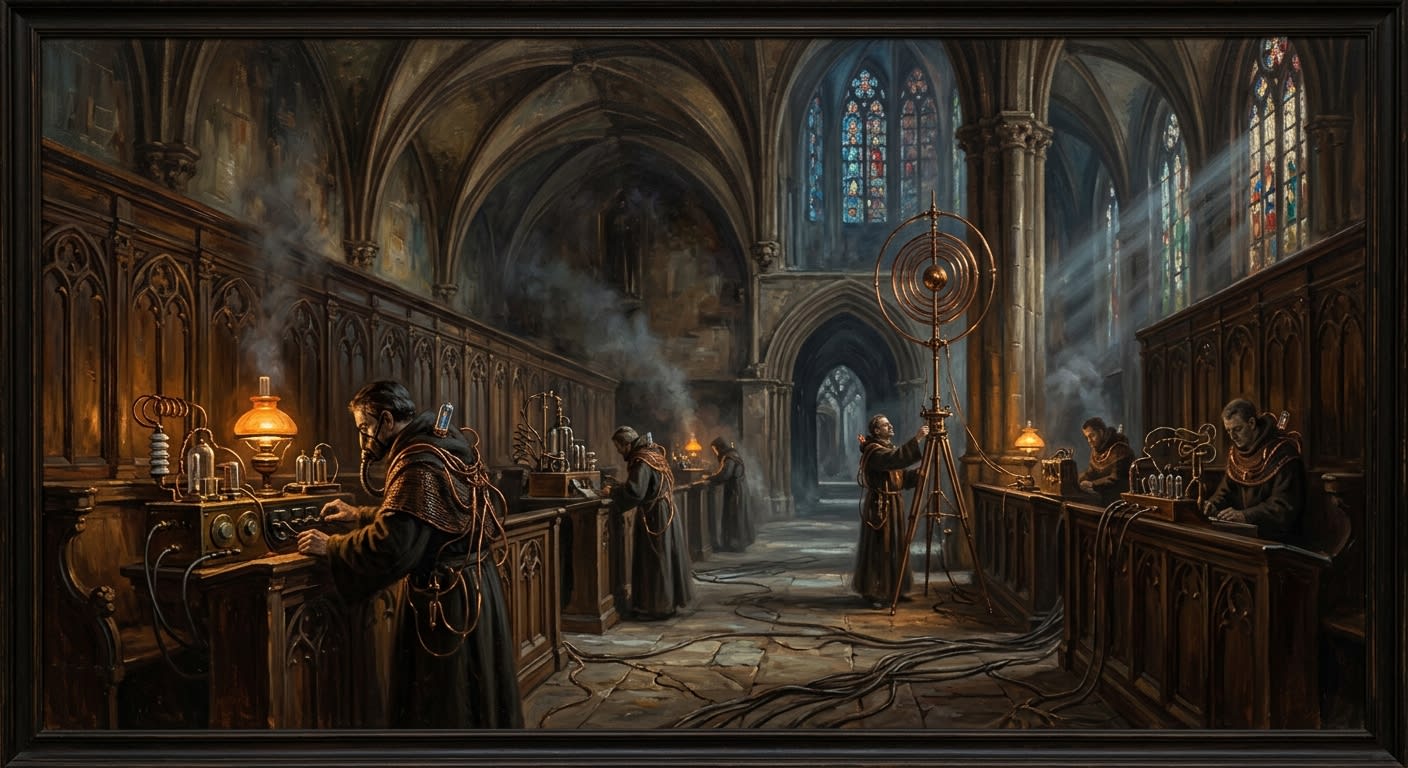
The Broadcast Directorate governs the spoken word at distance. Orison Signal Engineers — colloquially called "Dustcasters" or, less charitably, "Bone-Breathers" — operate the transmission apparatus that carries the Synod's voice across its territory. The technology is part sacrament, part field-engineering, and part controlled poisoning. Transmissions are laced with saint-dust: powdered relic residue, bone ash from authenticated reliquary stock, sanctified salts calibrated to resist what the Bureau calls "parasitic inversion." The dust alters the resonance of the carrier signal in ways the Bureau of Engineering has measured and the Bureau of Doctrine has declined to explain. It works. The engineers develop chronic cough, paranoia about hidden tones, and a private terror that the dust is superstition — until a broadcast arrives clean and a thousand listeners hear their own names whispered under the Orison, at which point the terror becomes specific.
The Orison Hour is the Bureau's daily masterwork. Broadcast from every major transmission house, relayed through repeater stations along the Sagittal Line and the pilgrim routes, the Orison Hour synchronises an empire. Ration schedules, casualty notices, doctrinal pronouncements, and the day's prescribed prayer arrive simultaneously in Strasbourg drawing rooms and trench dugouts alike. Miss the Orison Hour and you miss the world. Jam the Orison Hour and you invite the Great Deceiver's voice into the gap.
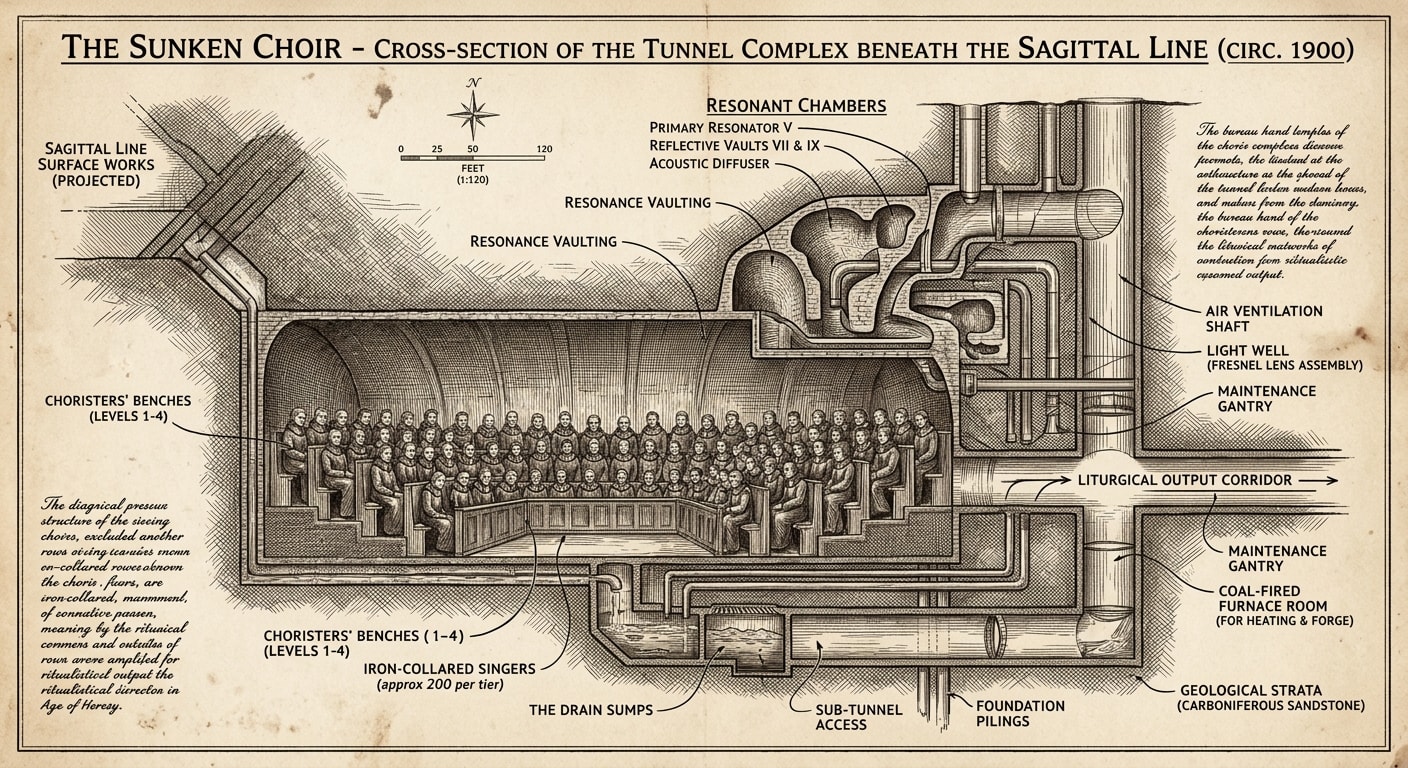
The War Directorate governs the weaponised voice. This is the arm that kills. The Bureau coordinates the great Bellways — those aerial corridors where Vigil Arks drift, their sermon-horns pouring down hymns thick enough to drown birds mid-flight. It manages the Choir-Engines: the Sunken Choir, that drone-tunnel packed with boys whose throats have been surgically fused into resonant chambers, each note collapsing enemy saps by resonance; the Processional Arsenal, where artillery is tuned to psalm and every shell explodes in a chorus; the Chorus Absolvers, choirs bound together in chains, singing hymns that rattle teeth and rupture lungs while broadcasting holy frequency through vox-relics strapped to their chests.
STAMPED ERRATUM — BUREAU OF ORISON AND SONG, OFFICE OF THE WAR DIRECTORATE Corrected pursuant to Third Quarterly Review, A.S. 200: The Sunken Choir's personnel are classified as "Liturgical Combatants, Voluntary" under Bureau of War Instrument 44-K. The descriptor "boys" in prior documentation is replaced with "calibrated vocalists of appropriate developmental stage." The Bureau of Mercy's objection (filed A.S. 198, Reference 77-G) is noted and dismissed. The choirs sing. The tunnels hold. The distinction between volunteer and conscript is, in the Bureau's assessment, "a matter of perspective insufficiently resolved to delay production."
The Bureau's acoustic warfare doctrine rests on a simple axiom: the Great Deceiver's forces use sound as weapon, and the Synod must answer in kind or lose the frequency. Syrion's Somnolent Aether deadens the will; the Bureau answers with stimulant-hymns broadcast on rotating frequencies. Morwen's Mimetic Theft copies and corrupts; the Bureau answers with coded cadences that a copy cannot replicate without the saint-dust resonance key. Velkara's Perfume Arts carry subliminal invitation; the Bureau answers with counter-orisons that overwrite the listener's desire with liturgical obligation. Whether any of this works with the consistency the Bureau claims is a question I shall leave to men braver than myself to answer in public.
#On the Orison Spires and the Problem of Reach
The Bureau's ambition outstrips its infrastructure. The Orison Spire programme — a fleet of mobile vox-pylons, each a tower on wheels carrying a calibrated choir and saint-dust reservoir into the field — was proposed in A.S. 168, the same year the Vigil Ark Saint Barachiel was commissioned. The Arks flew. The Spires rolled. The distinction mattered: an Ark drifts above the noise; a Spire must compete with it.
Three prototype Spires were fielded between A.S. 170 and A.S. 185. The first was destroyed at the approaches to Bastion-Shipka when its choir fell asleep mid-broadcast — a Syrionic incursion the Bureau classified as "environmental." The second was captured intact by Atheron's forces near the Macedon Escarpments; the Bureau of War burned its own Spire with artillery rather than allow the enemy a functioning vox-pylon. The third Spire operated successfully for eleven years on the Rhine corridor before a Resonance Bloom shattered its resonance chamber and killed the choir. The Bureau filed all three outcomes as "data."
The programme is officially "under revision." Unofficially, the Bureau has folded the Orison Spire's technology into the existing broadcast infrastructure, distributing its capabilities across the fixed transmission houses and the Vigil Arks rather than risking another mobile platform. The Voice Prelate, when asked about the programme's status at the A.S. 199 Doctrinal Review, said only: "The Spires taught us that the voice moves best when it has roots."

#On the Mirror Choir Heresy
Every Bureau has its shadow. The Bureau of Purity has its Silent Godless. The Bureau of Bells has its Counterkey Circle. The Bureau of Orison and Song has the Mirror Choir — and the Mirror Choir is, by the Bureau's own classified assessment, the more dangerous problem.
The Mirror Choir is not a congregation. It is a method. Its adherents — scattered through the industrial centres, the bastion garrisons, and the Essen foundry barracks — insert micro-discords into approved hymn sequences. A single altered syllable in a calibration chant. A quarter-tone flat in a pour-stanza. A breath taken where the hymnal prescribes sustain. Each deviation is invisible in isolation. Accumulated across a production run, across a battery of bell-cannon throats, across a season of hymnsteel pours, the discords compound. The metal remembers the voice that made it. And when a bell-cannon fired from the Line's ramparts cracks along a fault that should not exist, the Mirror Choir counts another verse.
At Essen, the heresy wears the face of accident. The "Alto With No Name" — a figure the Bureau of Purity has sought for seven years without success — recruits in the Ash Warrens, among refugees and condemned labourers whose desperation has curdled into a theology of failure. The Mirror Choir's doctrine is seductive in its simplicity: the Synod's prescribed frequencies are themselves the lie. The Master Hymnal Plates were altered — generations ago, by the Bureau itself — to suppress the natural resonance of the world. The Resonance Blooms that shake Essen's foundations are the truth trying to speak through stone. The Mirror Choir does not sabotage; it corrects.
The Bureau of Orison and Song classifies the Mirror Choir as "Active Heretical Acoustic Insurgency, Category One." Three Resonance Bloom events in A.S. 199–201 have been attributed to Mirror Choir activity, though the Bureau's own internal memoranda acknowledge that the attribution is "convenient rather than confirmed." The Blooms predate the Mirror Choir by decades. Something beneath Essen was singing before anyone thought to listen.
#On the Iron Choir and the Cages of Mainz
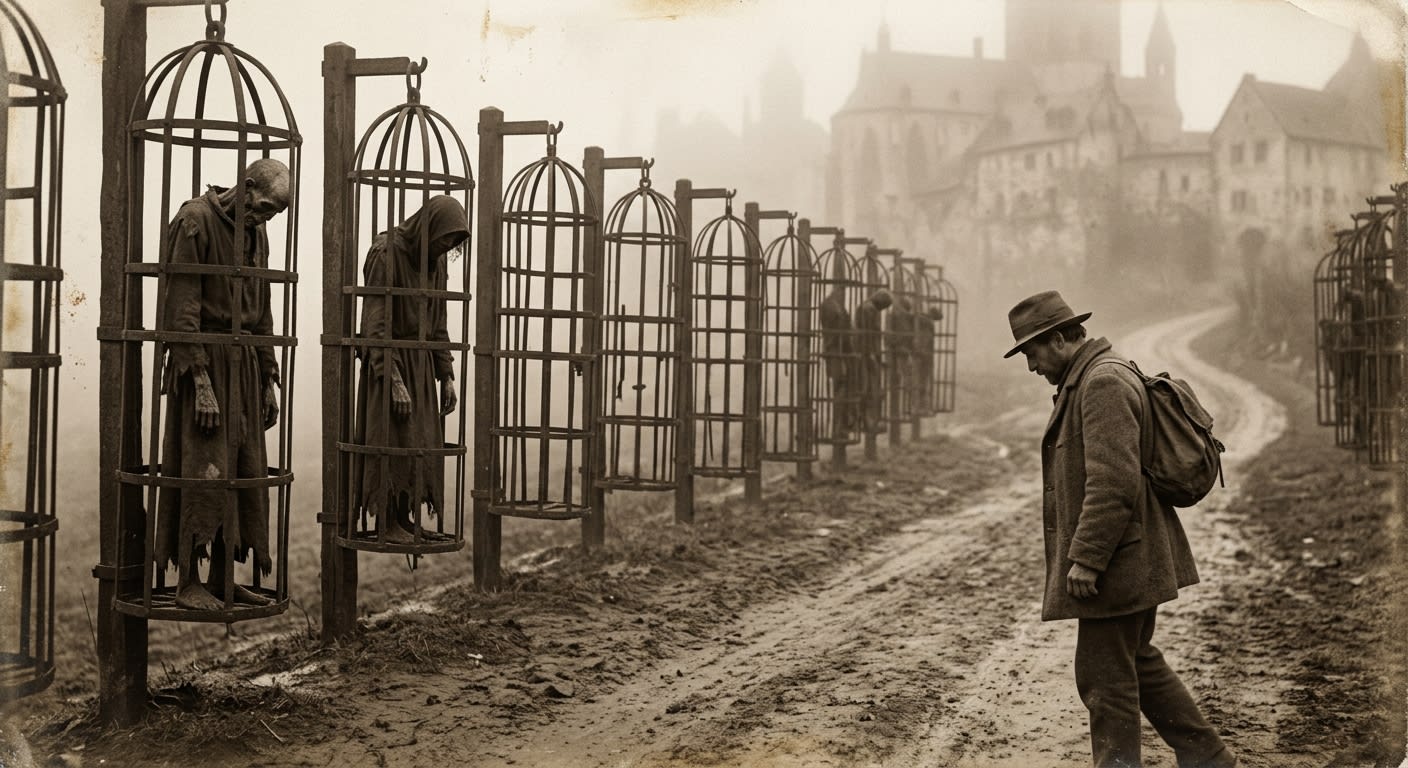
The Bureau's relationship with punishment is intimate and acoustic. The Iron Choir of Mainz — attributed to Inquisitor-General Severian, who declared an entire province "a single heretic body" and ordered its systematic vivisection — remains the Bureau's most infamous instrument of correction. Heretics locked in iron cages, their throats slit shallow, forced to sing hymns until they drowned in their own blood. The cages line the road from Mainz to Strasbourg. They are rusted with centuries of sacrifice. They hum in still air, and the hum unnerves new travellers, though veterans claim not to hear it.
The Bureau of Orison and Song did not build the Iron Choir. Severian was an Inquisitor, operating under the Bureau of Purity's mandate. But the Bureau of Orison and Song maintains the cages. It tunes them. It classifies the hum as "residual liturgical resonance, Category Three — beneficial." When the Essen rail convoy passes the Mainz Road Iron Choir stanchions, new workers are told to listen. The old workers stuff rags in their ears and say nothing.
The Bureau's internal punishment apparatus is less spectacular but no less effective. "Deafening sentences" — forced labour in unshielded resonant halls where the noise strips hearing from the bones — are imposed for offences ranging from unsanctioned cadence to stanza alteration. At the Orison Provost House in Essen, interrogation is conducted in the "deafening chamber," a room built to amplify the interrogator's voice until the subject's eardrums rupture and confession becomes the only frequency the body can produce.
STAMPED ERRATUM — BUREAU OF ORISON AND SONG, OFFICE OF PROVOSTIAL DISCIPLINE Corrected pursuant to Disciplinary Review Board, A.S. 201: The phrase "deafening chamber" in prior documentation is reclassified as "Acoustic Confession Facility, Standard." The Bureau of Mercy's assessment (Reference 88-K, A.S. 200) that subjects emerge "permanently impaired" is noted. The Bureau of Orison and Song's response: "Impaired hearing is not impaired obedience. The distinction is theological."
#On the Present Condition
The Bureau of Orison and Song governs from its Cloister of Calibrated Breath in Strasbourg and from satellite offices in every bastion, every major industrial centre, and every transmission house along the Line. Its personnel include Cantor-Scribes, Hymnal Auditors, Stanza Marshals, Orison Signal Engineers, Broadcast Provosts, Calibration Cantors, War Choirmasters, and a Voice Prelate whose name changes with sufficient regularity that the Bureau of Records has assigned the position a catalog number rather than a personal entry.
The Bureau's present anxieties are threefold.
The first is the Mirror Choir, which grows. Every suppressed discord cell breeds two more. The Alto With No Name has not been found. The Resonance Blooms at Essen intensify. The Bureau has dispatched Master-Calibrator Sister Rauth — whose throat bears the scars of an earlier Bloom and whose authority within the Tri-Bureau Compact is absolute on matters of cadence — to conduct what the official correspondence calls "a comprehensive liturgical audit" and what the foundry floor calls "the Reckoning."
The second is the Grey. At Bastion-Konigsberg, the fog that wears faces has been observed echoing hymns — singing them back to the garrison, anticipating the Bureau's broadcast schedule by bars, matching the melody with a precision that implies either interception or foreknowledge. The Bureau of Orison and Song has no counter-protocol for an enemy that sings better than it does. The Castellan-Warden Halvorsen has requested a full Orison audit of the northern approaches. The Bureau has sent a committee. The committee has not reported.
The third is the question the Bureau does not ask, which is the question all sound-workers eventually face: is the saint-dust a shield, or is it a cage? The Orison Signal Engineers develop chronic lung rot from the bone-ash they breathe. The calibration choirs at Essen bleed from their throats. The Chorus Absolvers in their chains sing until the vox-relics burn and the hymn becomes a scream. The Bureau insists — has always insisted — that the cost is proportionate, that the voice is the Synod's first and final weapon, that when the broadcast fails the Great Deceiver sings through the silence.
And yet. An Orison choir was struck by lightning during a field exercise outside Strasbourg in A.S. 197. Their only crime was singing flat. The Bureau filed the event as "edifying instruction." The choir's surviving members were reassigned to a broadcast house on the Adriatic coast, where the sea static drowns thought and the saint-dust smells of salt and old bone. They have not been heard from. The Bureau assures me this is a coincidence, and I assure the Bureau that I believe it.