
#On the Weekly Inspection
Once a week, by mandate of the Toll Chapter, the residents of the Archivolt Causeyworks go to the Namewash Cloisters and report themselves. The occasion is called Namewash Night. No one is summoned to it by name, which in this city counts as a courtesy. No one who means to keep crossing bridges stays away from it either, and that is the point of the arrangement.
What a resident brings is a "name doubt." The term is municipal and very elastic. It covers a register that disagrees with the voice reading it, a permit the canal damp has bled illegible, an entry on a parapet that its bearer cannot account for, and the plain suspicion that something is wrong with the name a person answers to. The mandate asks only that the doubt be submitted. It does not ask whether the doubt is sound.
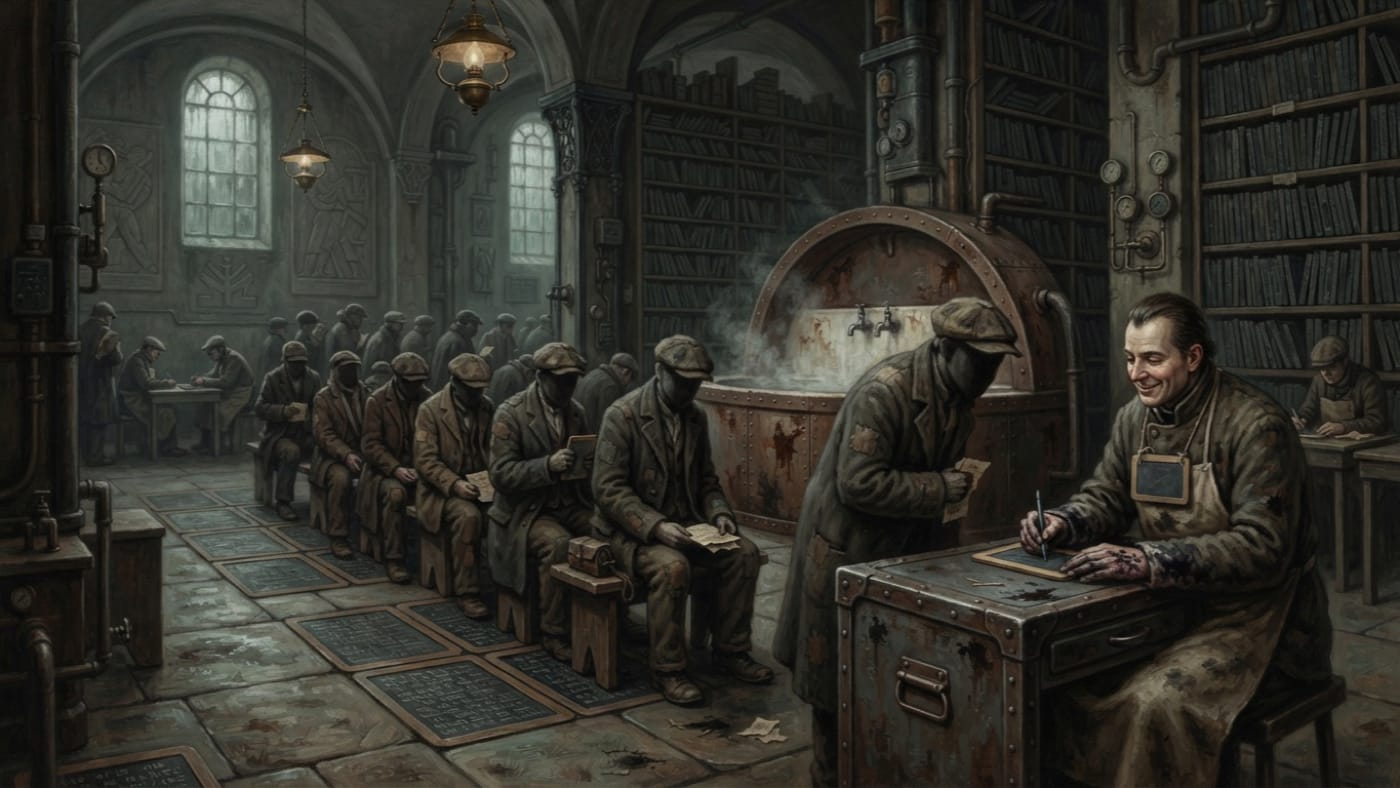
The Cloisters receive these doubts in a quarter that smells of soap lye and ash. The survey supplements list the house's instruments as soap, slates, surveillance, confession stacks and correction writs. The dedicated survey describes the rite as one the whole population performs unwillingly. My own report of A.S. 201 called it preemptive self-surveillance. Both descriptions are accurate. The first is about the residents, and the second is about the design.
#On Confession in Slate
The resident states the doubt, and a namewash clerk records it. The clerk wears ink at the cuffs and a slate tag at the collar, and writes in slate. The Causeyworks distrusts paper for reasons any canal rat could give you. The supplements describe the Namewasher as a type rather than a particular officer: one who smiles kindly while writing your confession into slate. I have no reason to doubt the smile. It costs the house nothing.
Some confessions are etched into tiles and set into the cloister floor. Others go to the confession stacks. The survey does not say how the stacks are ordered, how many slates they hold, or who besides the house can open them, and I supply none of those particulars. That they exist is enough. That they keep their contents is the reason they exist.
Next comes the washing. The survey calls it ritual scrubbing and gives no formula, posture or sequence for it. I will not write liturgy for a soap-house. After scrubbing, the name is re-verified and handed back. Sometimes it comes back corrected. Sometimes it comes back exactly as it went in, and the resident has spent the evening and a tithe confirming what they already carried.
Either way, the resident leaves with a name and without the doubt. The doubt stays behind. Before that evening it was private, a worry in someone's head about a permit or a parapet. Now it is a statement in slate, made voluntarily under mandate, in the resident's own words. A worry is nothing a court can use. A signed admission of uncertainty about one's own identity is evidence.
Next week's residents wait their turn on benches set over last week's confessions.
#On What Washing Can Change
Washing touches a name, but the name passes through several hands, and the Cloisters own only one of them.
The Cloisters cleanse and re-verify. Name verification and correction of the paper registry belong to Chief Scribe Mael Arct of the Bridge-Scribe Collegium, whose fingertips do more governing than most magistrates' seals. Crossings belong to Canon-Toller Edris Vane at Toll Crown. Inscription belongs to the masons of Master Mason Lysa Korr. These are four separate jurisdictions. A resident who leaves the Cloisters on Namewash Night has satisfied the first of them and none of the others.
The distinction that matters most is between paper and stone. The Bureau of Doctrine forbids the erasure of lawful stone, and civil law fines anyone who scratches at an inscription. When an entry is corrected, the original stays where it was cut and a reconciliation is carved beside it. Both remain, and every pedestrian who crosses can read them side by side.
Take a hypothetical case, offered as illustration and not drawn from any file. A resident's name stands on a parapet with a debt beside it. The resident confesses a doubt, is washed, and gets the name back corrected. If the registry accepts the correction, the paper may now say something new. The parapet still says what it said, with a second entry at most. The debt has not dissolved. Washing does not guarantee passage at Toll Crown, and it gives no protection under any arch. What the resident has gained is a washed name on paper. What the Cloisters have gained is that resident's confession.
#On the Price of Clearance
Name-clearing is paid work. Confession carries a tithe and clearance carries a fee. A resident without coin may pay the fee in labour, which the Toll Chapter is glad to accept, since labour cannot be clipped, counterfeited or smuggled out through the Undervaults. The survey posts no tariff, fixes no number of labour-hours, and does not say whether every weekly submission is charged alike. I enter no sum.
What the money buys is the chance of being recognized, and in the Causeyworks recognition is how one eats. Crossings require a registered name or an expensive number in its place. Children learn to answer to their registry numbers before they learn their catechism, and parents are right to teach them in that order. A doubtful name means a slow reading at the window and a permit held over. For a bargeman it means mooring paid by the hour while his crew waits at the Mouth-Sluice. Compared with all that, the tithe is the cheap option.
So the bargain is this. The resident pays to provide testimony. The house is paid to receive it and then keeps it. The survey gives the Cloisters' public purpose as the cleansing of identity and guilt. The stacks show what else it accomplishes.
#On Names Beneath the Arches
"If the arch repeats your name, leave — someone just wrote your ending." — A resident of the Causeyworks, as recorded in my A.S. 201 report
The reason for all this anxiety stands overhead. Certain arches of the city respond to spoken names. Water levels shift when a banned syllable passes under a keystone. Inscriptions sweat lime. Candles gutter in pulses that the Collegium calls atmospheric and the Saintspan Quarter calls liturgical. The Saintspan is the worst of them and the most visited. The phenomenon is classified as Name-Resonance Architecture, Category Three, Pending. The appropriate desk has not yet determined whether the Creator moves in those arches or the Great Deceiver hides in them, and I would not wish to rush the desk.
The Name-Resonance phenomenon is attributable to "mineral moisture interacting with vocal vibrations in enclosed stone environments."
Withdrawn, as already entered against the A.S. 194 assessment of Inspector Corris. The phenomenon stands at Category Three: Pending. The Inspector stands elsewhere.
The residents' precautions are specific to the stonework. They refuse nicknames. They do not whistle under the Saintspan. They consider it reckless to speak any name twice in fog, their own included. None of these customs comes from the Cloisters, and the survey records no response from the cloister floor. A confessed name walks home under the same arches as an unconfessed one, and the arches do not check the stacks.
The Mortar Saints work the other side of the same trade. They carve names struck by the Index Damnatus into public stone so that those names will outlast the men who struck them. The Cloisters correct names on municipal paper and keep the confessions in slate. Both trade in permanence, from opposite ends. No document places the Saints on the Namewash benches, and I will not seat them there.
#On the Present Observance
The Causeyworks has been tightening since A.S. 199, when a banned name was found inside a keystone cavity of the Stitchbridge. That year dates the discovery. It does not date the carving. Crossing inspections are longer and tolls are higher. In a city where a held permit means a doubt, Namewash Night has lost none of its business.
Canon-Inquisitor Silex Marrow now holds Bureau of Purity authority to unseal keystones in the Saintspan Quarter. The Toll Chapter petitioned against his assignment. The Bureau of Records raised jurisdictional objections. Purity overrode both. The audit has no recorded outcome. The Night goes on each week regardless, because the mandate has not been withdrawn and the doubts keep coming.