
#On the Nature of Bridges That Keep Accounts
"Stone forgets nothing." — The only proverb in the Causeyworks that is also a threat.
I have inspected the Archivolt Causeyworks twice. The first visit, in A.S. 197, I arrived by barge through the Mouth-Sluice and was greeted by a toll warden who asked my registered name, my destination, and the weight of my ink. The second visit, in A.S. 201, I arrived by the same sluice and was greeted by the same warden, who asked the same questions in the same order, because nothing in the Causeyworks changes except the names of the people who owe it money — and those names, once carved, do not change either. They only accumulate.
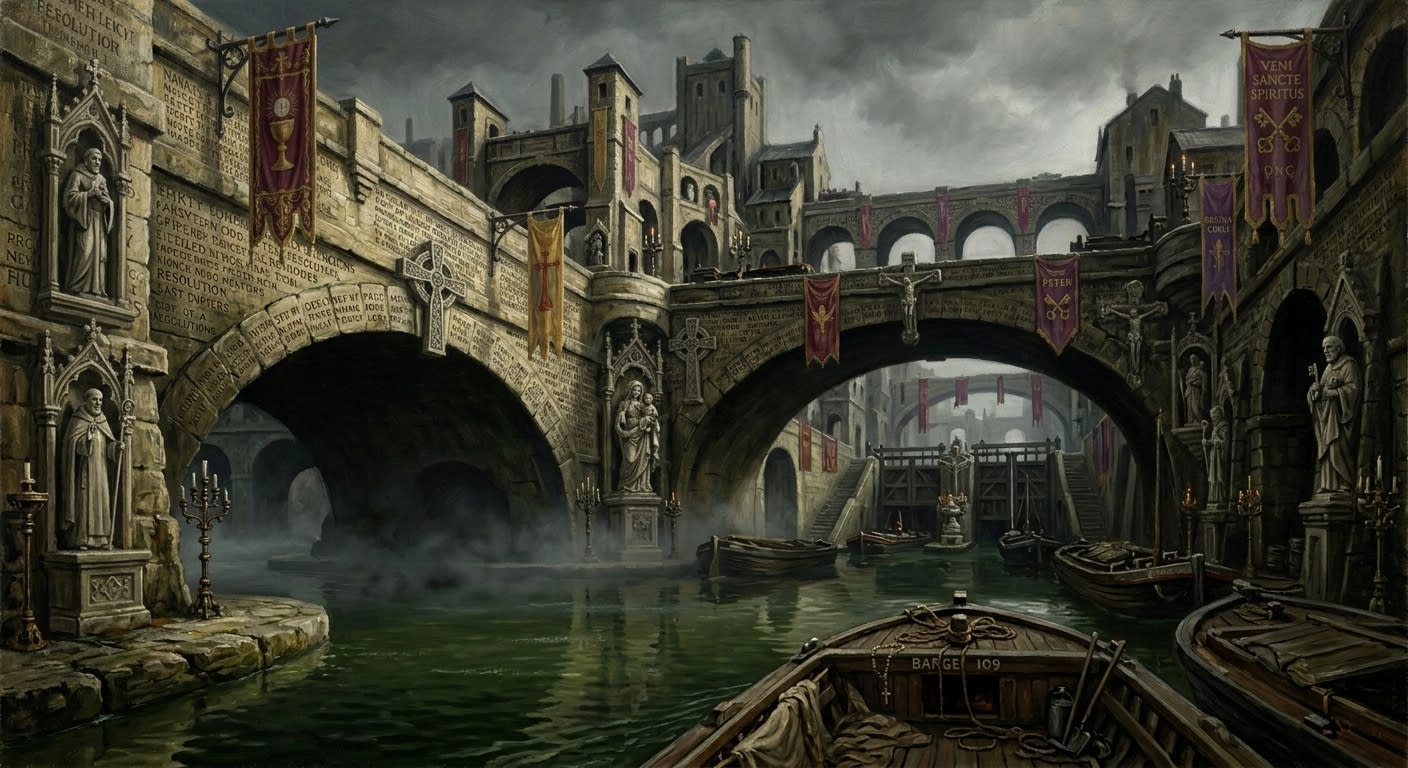
The Causeyworks is a canal city. I state this plainly because the Bureau of Records classifies it as a "Toll Transit Municipality (Aquatic)" and the Bureau of Doctrine classifies it as a "Bridge-Ledger Archive of Secondary Jurisdictional Authority," and between these two designations one can lose the simple truth: it is a city where people live on bridges, under bridges, and in the service of bridges, and where every bridge is also a court of law.
The canals converge at three spines somewhere in the River-belt interior, two to four days inland from the Saffron Bastion by road, depending on weather, papers, and the current mood of whatever toll warden occupies the Mouth-Sluice. Three canal arteries join at a junction marked by the Triple Lock — a staircase of water-gates that lifts barges from the lower courses to the upper pools, and which has drowned more men than the Sagittal Line's southern redoubts, though with less ceremony and no posthumous stamp. Below the Lock, the Candlewick Palatinate sends its wax shipments upriver. Above, the Ration Parliament of Wexel sends grain down. Between them, the Causeyworks takes its cut from everything that floats, walks, or attempts to be forgotten.
#On the Founding
The Archivolt Causeyworks was chartered in A.S. 82, following the Synod's determination that the River-belt's toll revenues were being lost to what the Bureau of Tithes termed "informal waterway administrations" — which is to say, armed barges levying their own crossing fees and drowning the inspectors sent to audit them. The Bureau of War offered to solve this with cannon. The Bureau of Records offered to solve it with paper. The Bureau of Tithes offered to solve it with a city.
The site was chosen because three canal spines already converged there — a natural choke where barges must queue and where queuing barges can be counted, taxed, and inspected with a minimum of exertion by the Synod and a maximum of suffering by the taxed. A wooden toll station had existed since the years of the Great Retreat, maintained by river families who charged passage in fish and silence. The Concordat of A.S. 90 swept these families into the Synod's administrative embrace, which is to say it requisitioned their toll posts, formalized their debts, and hired them as employees of the infrastructure they had built.
The first stone bridge was laid in A.S. 84. The Bridge-Scribe Collegium was constituted in A.S. 92, when the Synod determined that paper toll records rotted too quickly in the canal damp and that a more permanent medium was required. The masons of Essen had just demonstrated that inscriptions could be load-bearing — that a bridge need not merely carry traffic but could record it, permanently, in the keystones and parapets of the span itself. The Collegium adopted this principle with the fervor of men who had discovered that architecture could be made to do the work of clerks, and that stone, unlike clerks, never asks for a pay increase, a transfer, or a pardon.
By A.S. 110, at the time of the First Continental Levy, the Causeyworks had grown from a toll station to a city of seventy thousand. Every major span bore inscriptions. Every inscription bore a name, a sum, a date, and — in the case of debts — a resolution or the conspicuous absence of one. The stone ledger had become the city's true government: not the Toll Chapter, not the Collegium, not the Lock Authority, but the carved record itself, immutable and visible to every citizen who crossed it.
#On the Geography of Inscribed Stone
The city is wet. I state this with the same professional obligation that compels a physician to note that the patient is dead. Everything in the Causeyworks is wet — the air, the stone, the paper, the bread, the morale. Fog sits under the arches like a congregation that has forgotten why it came. A fine mineral mist the locals call "ledger-drizzle" deposits a white crust on every inscription, so that the city's debts appear to be slowly growing fur.
The city arranges itself along the canal spines in a pattern that is half-linear, half-ringed — long causeways of bridgework connecting circular junctions where the arches thicken into vaulted galleries. Eight districts, each with its own smell, its own jurisdiction, and its own particular way of making one's life administratively intolerable.
Archivolt Row occupies the central spine and houses the Bridge-Scribe Collegium. Here the permits are written, the names verified, the identities confirmed or — in a process the Collegium calls "correction" — revised. The smell is wet parchment and chisel dust. The sound is of quills scratching and, underneath the scratching, the faint tap of masons making entries permanent.
The Triple Lock sits at the junction of the three canal spines and is the city's throat. It is operated by the Lock Authority, whose wardens control the water-gates, the bell schedule, and therefore the movement of every barge, cargo, and person who wishes to pass from the lower courses to the upper pools. The Lock drowns people. The Lock Authority categorizes these drownings as "lock incidents" and files them with the Bureau of Records, which categorizes them as "transit attrition," a phrase that manages to make death sound like a filing error.
Toll Crown is the gatehouse district: courts, tribunals, and the offices of the Canon-Toller. The master seal of the Causeyworks is stored in a hollow pillar in the Toll Crown Gatehouse. Three people know which pillar. Two of them are liars and the third is Canon-Toller Edris Vane, whose voice sounds like a lock click and who has never repeated a name aloud in the presence of witnesses.
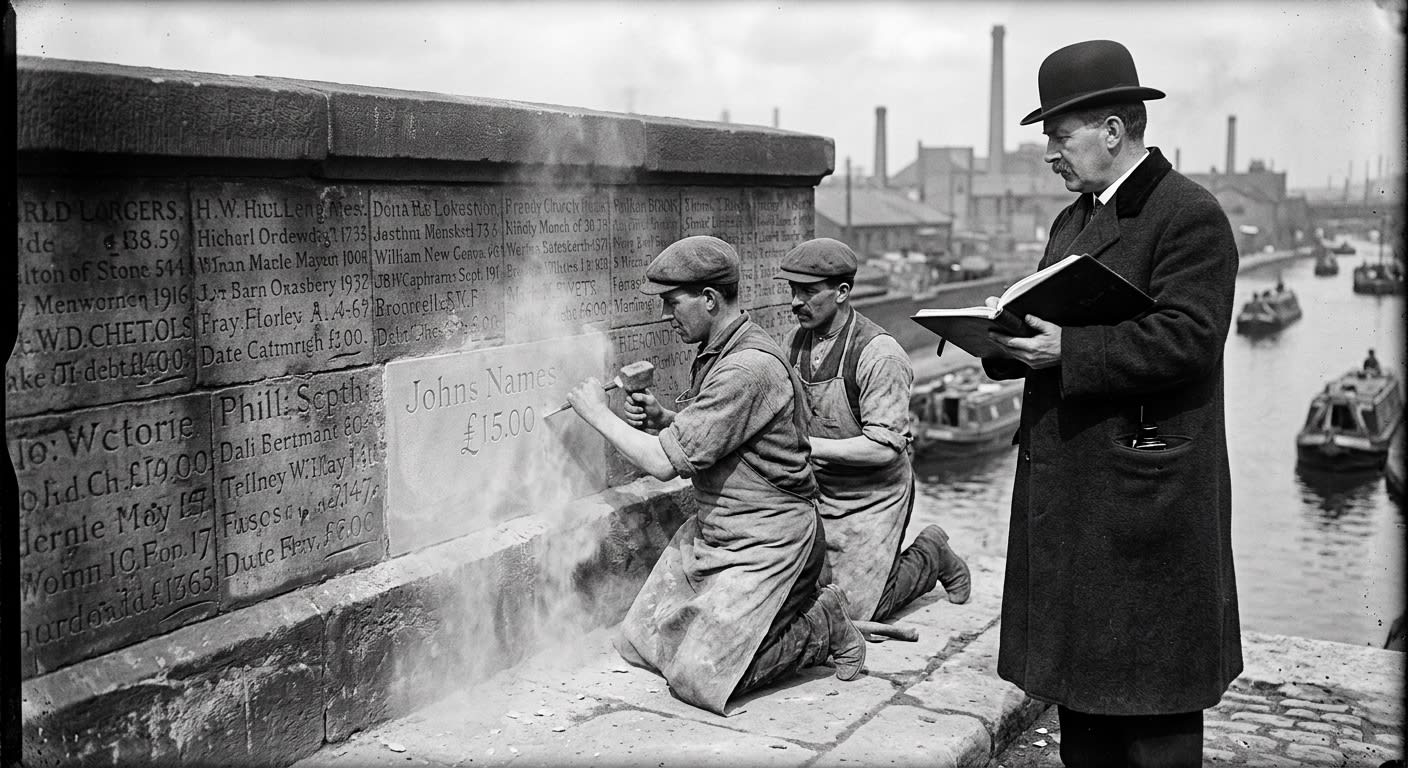
Stone-Ledger Yards are where the masons work — the lime-stained artisans who carve names, sums, debts, and resolutions into the parapets of the city's bridges. Their guild, the Stone-Ledger Masons' Lodge, controls what is carved and what is removed, which in the Causeyworks means they control what is real. Paper lies. Mortar tells. The locals say this. The masons know it.
Barge-Lip Market hangs off the canal edges on wooden platforms that sway with the current — a permanent market where trade occurs in fish, tar, cheap spice, and the understanding that everything here is, in some technical sense, a bribe.
Namewash Cloisters provide the city's distinctive confession service: the ritual scrubbing and re-verification of identity. Citizens submit themselves for "name hygiene" inspections, their confessions are etched into slate tiles set into the cloister floor, and their identities are returned to them — sometimes corrected, sometimes not. The Cloisters smell of soap lye and ash and the particular variety of despair that comes from realizing that your name is not entirely yours.
The Undervaults extend beneath the arches into a dripping labyrinth of illegal habitation, smuggling routes, and the black market the locals call the Undervault Bazaar. The runners who navigate these tunnels are called Mudkeys, and they can tell by echo alone whether the footsteps behind them belong to a provost, a customer, or a name-resonance event that is about to make the ceiling weep lime.
Saintspan Quarter clusters around a single arch — the Saintspan — which the faithful believe performs miracles and which the Bureau of Doctrine has classified as a "Category Three Structural Anomaly Pending Theological Assessment," a designation that has been pending for nine years and will continue to pend until the Bureau determines whether the arch's behaviour is divine, demonic, or merely architecturally inconvenient.
#On the Stone That Speaks
This is the matter that required my inspection.
The Causeyworks suffers — or is blessed by, depending on which faction is filling one's ear — a phenomenon the Bureau of Alchemical Standards has classified as "Name-Resonance Architecture." Certain arches amplify spoken names into physical effects. Water levels shift when a banned syllable passes beneath a keystone. Inscriptions sweat lime in response to voices. Candles gutter in rhythmic pulses that the Bridge-Scribe Collegium insists are "atmospheric" and that the Saintspan Quarter insists are "liturgical."
The Saintspan is the worst of it — or the best, depending. The third rib of its vault has been documented producing healing effects in the presence of properly registered names and catarrhal effects in the presence of improperly registered ones. Pilgrims cluster beneath it. Miracles are claimed. The Bureau dispatches raid squads. The raids disperse the pilgrims. The pilgrims return. The Saintspan continues to sweat lime and heal catarrhs and ignore the Bureau's assessment schedule.
I asked Canon-Toller Vane whether the resonance was divine or demonic. He said it was "architectural," by which he meant it was profitable and he did not wish to investigate further.
What is known — and I record this as Warden of the Ledger, with the authority vested in me by the Bureau of Doctrine and the reluctant co-signature of the Bureau of Alchemical Standards — is that the resonance correlates with inscribed names. The arches do not merely carry names. They listen to them. And certain arches, of which the Saintspan is the most prominent but by no means the only one, have begun to respond.
Earlier assessments by the Bureau of Alchemical Standards, filed under the hand of Inspector Corris (A.S. 194), attributed the Name-Resonance phenomenon to "mineral moisture interacting with vocal vibrations in enclosed stone environments."
Inspector Corris has been reassigned. The phenomenon has been reclassified to "Category Three: Pending." The reclassification is permanent.
#On the Economy of Permanence
The Causeyworks runs on toll revenue, which is to say it runs on the principle that nothing moves through the River-belt without paying — in coin, in cargo percentage, in labor hours, or in the currency unique to this city: the stone entry fee.
A stone entry fee is the charge for having one's name, debt, or resolution carved into a bridge parapet. It is the most expensive transaction in the Causeyworks and the most feared, because a stone entry is permanent. Paper debts can be lost, falsified, or eaten by canal rats. Stone debts fossilize. A man who owes the Toll Chapter six crowns will find those six crowns carved into the span he crosses each morning, visible to his neighbors, his creditors, his wife, and the provosts who patrol the causeways looking for entries marked "UNRESOLVED."
The stone entry system has produced a secondary economy of identity management. The Namewash Cloisters charge for "name corrections" — the process by which an identity can be audited, cleaned, and re-verified. Chief Scribe Mael Arct, whose ink-stained fingertips are the most powerful instruments in the Causeyworks after the masons' chisels, controls the verification process. He can "forget" a name for a price. He can "remember" one for a higher price. He cannot un-carve a stone entry — nobody can, not legally — but he can ensure that the paper registry reflects a version of reality more favorable than the one inscribed in lime and granite.
Master Mason Lysa Korr occupies the third point of the Causeyworks' governing triangle. Her chisel is older than her registry entry, a fact she mentions with the frequency and satisfaction of a woman who knows that her tool will outlast every bureaucrat who attempts to regulate its use. Korr controls what gets carved and what gets removed — though "removal" in the Causeyworks is a theological impossibility that the Bureau of Doctrine has explicitly prohibited. One does not erase stone. One "reconciles" it, which means the original entry remains, a correction is carved beside it, and both versions persist forever, arguing with each other in granite for the edification of pedestrians.
The black market operates from the Undervaults and the Barge-Lip, selling forged passes, lock-route maps, banned-name fragments, and the occasional keystone sliver — a portable hiding place carved from bridge cavities, used to smuggle letters, identities, and forbidden syllables. Keystone slivers are the Causeyworks' most distinctive contraband: architecture broken into portable secrets.
#On the Heresy of Architecture
The Bureau of Purity maintains a standing interest in the Causeyworks, and that interest has a name: the Mortar Saints.
The Mortar Saints are a heretical network embedded in the Stone-Ledger Masons' Lodge — or adjacent to it, or beneath it, or perhaps inseparable from it, depending on which interrogation transcript one reads. Their method is simple and, the Bureau of Purity concedes, elegant: they carve banned names into public stone. A forbidden lineage embedded in a keystone. A heretic's identity encoded in the decorative ribbing of an arch. A name the Index Damnatus has struck from the record, restored in granite where it will persist for centuries, visible to anyone who knows how to read a bridge.
The Mortar Saints call this "immortality-by-masonry." The Bureau of Purity calls it "embedded heresy infrastructure" and has requested authorization for a comprehensive stone audit of the Saintspan Quarter seventeen times since A.S. 194. Authorization has been denied sixteen times on grounds of "structural risk" and once on grounds of "jurisdictional overlap with the Bureau of Records, whose co-seal is required and whose co-seal has been delayed pending review of the review procedure."
The danger is real. In A.S. 199, a banned name was discovered embedded in a major span — the Stitchbridge, the city's primary junction, through which every barge and every pilgrim passes. The name had been carved inside a keystone cavity, invisible from the walkway but positioned so that every foot passing above it pressed weight onto the forbidden syllables. The Bureau of Alchemical Standards team dispatched to examine it reported that the resonance emanating from the Stitchbridge had increased forty percent since the name's estimated date of embedding.
Raids increased. The Toll Chapter imposed emergency crossing inspections. The Mortar Saints went quiet — which is their standard response, and which the Bureau of Purity correctly interprets as preparation rather than retreat. Somewhere in the Causeyworks, masons are still carving. The arches are still listening.
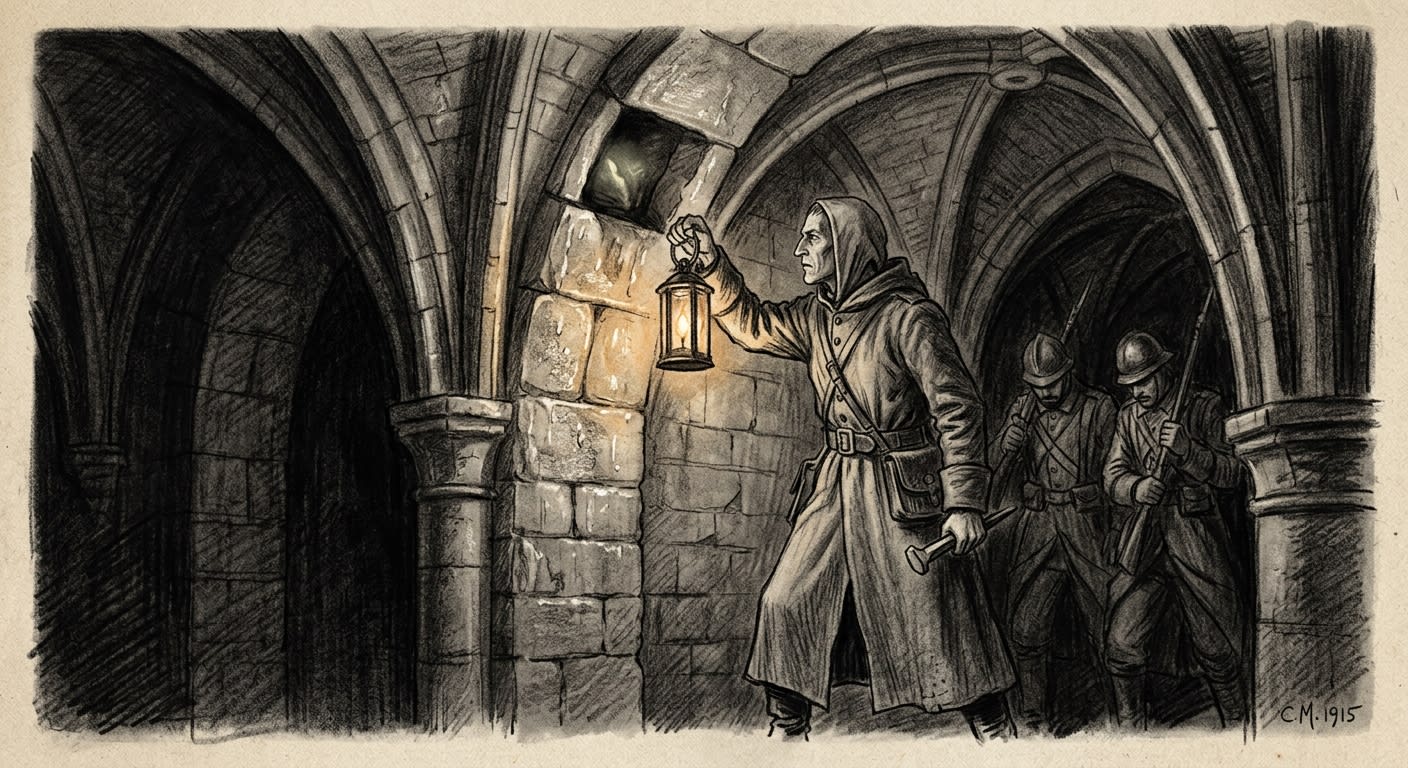
[EXCISED — BUREAU OF PURITY SEAL, REF. 2201-ARCH-RESONANCE] The Canon-Inquisitor dispatched to audit the Saintspan's ribs has authority to unseal keystones. ████████████████████████████████ ████████████████ if the ribs contain what the Bureau suspects they contain, the structural implications extend beyond the theological. The arches were not designed to resonate. Something taught them.
#On Daily Life in a City of Ledgers
One hundred and eighty-five thousand souls reside in the Causeyworks, swelling by several thousand during barge seasons when lock-labor drafts pull men from the marsh-quarry villages and the canal's lower courses. They eat fish stew, canal bread, and onion mash. Citrus peel is a luxury. Real coffee is a rumor. Spiced river rum is the currency of the Undervaults, where it serves simultaneously as drink, bribe, and antiseptic.
The daily rhythm is governed by the lock bells. Dawn brings the barge queues and the opening of the scribes' windows along Archivolt Row. Midday brings the toll crush — the period when the courts hear "name disputes" and the masons carve new entries into the parapets. Curfew brings the chains: heavy iron links dropped across the canal mouths, sealing the waterways against unauthorized night traffic and transforming the Undervaults into the city's true commercial district.
Children in the Causeyworks are trained to answer with registry numbers. Nicknames are forbidden — not by law, exactly, but by the practical understanding that an unregistered name spoken under the wrong arch can produce effects that range from a fine to a lime-sweat event to the attention of the Bureau of Purity. Namewash Night occurs weekly: citizens submit "name doubts" for inspection, a ritual of preemptive self-surveillance that the Toll Chapter mandates and that the population endures with the particular resignation of people who have learned that their identities belong to the stone they walk on.
The taboos are specific to the architecture. Whistling under the Saintspan is forbidden. Scratching at inscriptions carries a fine equivalent to three months' toll revenue. Speaking a name twice in fog — any name, including one's own — is considered reckless in the same way that loading a cannon and pointing it at one's foot is considered reckless: technically legal, universally discouraged, and occasionally fatal.
#On the Present Condition
The Causeyworks is tightening. The Stitchbridge discovery of A.S. 199 provoked a security response that has not relaxed: crossing inspections are longer, toll fees have increased, and the Lock Authority has imposed "safety closures" with a frequency that the barge unions characterize as extortion and that the Lock Authority characterizes as prudence. The Undervaults swell with those squeezed out of the legal economy. The Mortar Saints recruit from the squeeze.
Canon-Toller Vane holds the crossing access. Chief Scribe Arct holds the names. Master Mason Korr holds the stone. Between them, the city functions — or persists, which is the Causeyworks' version of functioning.
The fear, the genuine fear that I observed during my second inspection and that I record here with the dispassion appropriate to my office, is Canon-Inquisitor Silex Marrow. Marrow has been assigned to the Causeyworks with authority to unseal keystones in the Saintspan Quarter. The Toll Chapter has petitioned against the assignment. The Bureau of Records has raised jurisdictional objections. The Bureau of Purity has overridden both, because the Bureau of Purity does not negotiate with stone, and because Marrow is the kind of inquisitor who brings his own chisel.
If Marrow opens the Saintspan's ribs, he will find what the Mortar Saints have put there. And what the Mortar Saints have put there will either prove that the arches are divine, demonic, or something the Synod's theology has no category for — which is, in the Causeyworks, the most dangerous verdict of all.
The city stands on water and lives by stone. The stone keeps accounts. The accounts keep the city. I have verified this arrangement twice and find it, on balance, orderly — which is the highest compliment the Bureau of Doctrine extends to anything that is not the Bureau of Doctrine itself.