
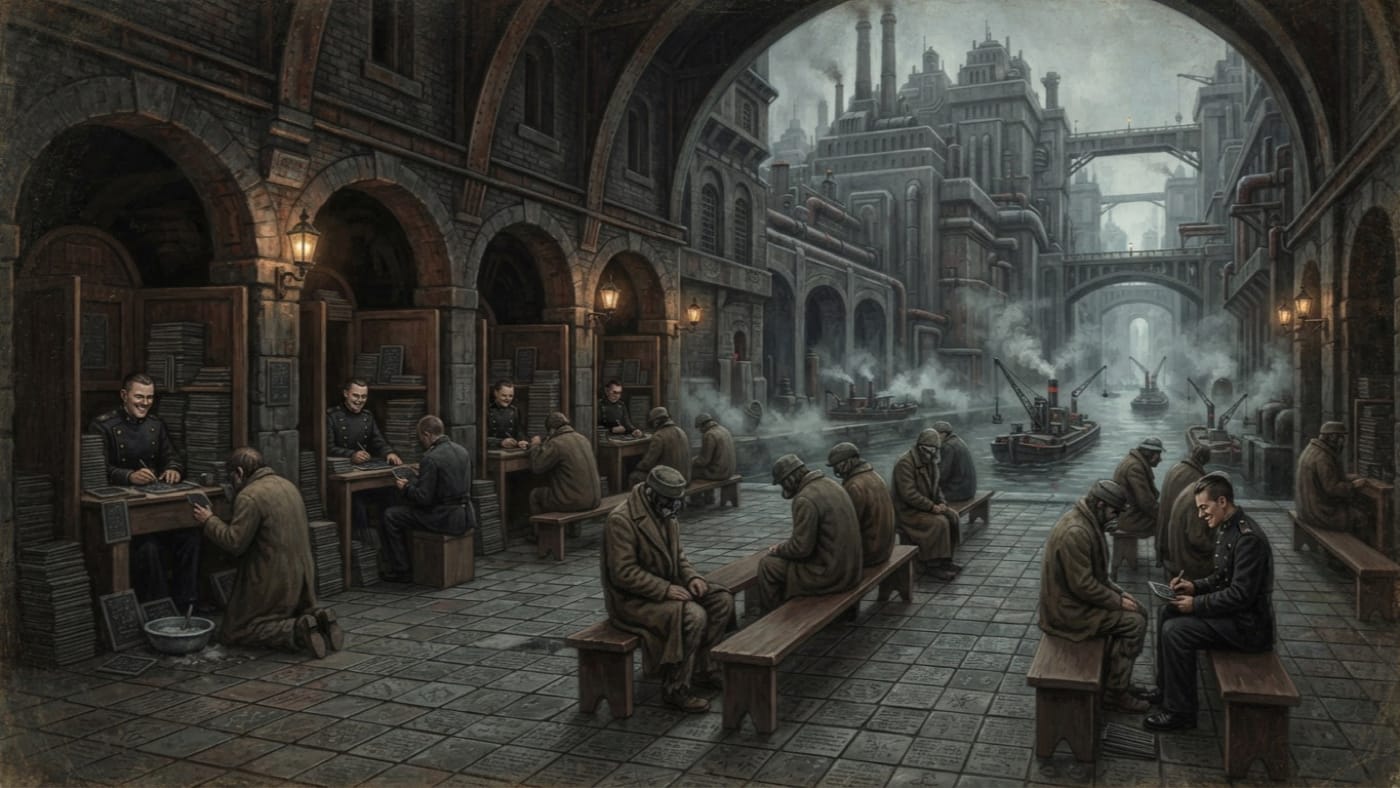
#On the Namewash Quarter
namewash (n.): confession and correction, in that order. — Causeyworks usage, as entered in the municipal survey
Of the eight districts of the Archivolt Causeyworks, the Namewash quarter is the one that smells clean. A visitor should distrust it for exactly that reason. Soap lye and ash hang in the arcades. Beneath them is the usual canal smell of damp stone and wet paper. The quarter lies in the River-belt interior with the rest of this city, two to four days inland from Saffron Bastion, and nothing within reach of those canals has ever been entirely dry.
The Cloisters stand across the canal from Archivolt Row. The lock bells reach them on schedule. On working days the chisels of the Stone-Ledger Yards reach them too, a distant tapping that the residents on the Namewash benches hear the way other congregations hear an organ. The floor under those benches is slate, and the slate has writing on it.
This account draws on my second inspection of the Causeyworks, in A.S. 201, and on the supplements filed with it. The Cloisters are an institution and a district at once: the house occupies the quarter, and the quarter lives off the house. Its public purpose is the cleansing of identity and guilt. Its instruments are soap, slate, surveillance, confession stacks and correction writs. I list the soap first out of courtesy.
#On Confession and Re-verification
A resident comes to the Cloisters because their name has fallen into doubt. The causes are municipal and dull: a register that disagrees with a voice, a permit the damp has bled illegible, a debt flag nobody remembers raising, a neighbour's report. On the Row, a doubtful name gets its bearer read slowly at the window. In the Cloisters, it gets an inspection.
The inspection is called name hygiene, and the house conducts it like a physician who already suspects the disease. The resident's name is checked against their papers and against their own account of themselves. Then they confess. They state what is wrong with the name, or what they fear is wrong with it, or what they did while carrying it, and a namewash clerk records the statement in slate. The supplements describe the Namewasher, a type rather than any particular officer, as one who smiles kindly while writing a confession into stone. I have no reason to doubt the smile. It costs the house nothing, and the slate keeps everything.
Some confessions are etched into tiles and set into the cloister floor, where later petitioners sit above them and wait their turn. Others go to the confession stacks. The cleansing rite follows, with lye, ash and water. The survey records no gesture, formula or posture for it, and I will not invent one. The Bureau of Doctrine has liturgy enough without writing more for soap-houses.
After cleansing, the name is re-verified. It may come back corrected. It may also come back exactly as it went in, which the house counts as a finding and the resident counts as a lost afternoon. If the matter needs the city's recognition, the resident is given a referral card and walks back across the canal to the Bridge-Scribe Collegium.
Namewash Night comes once a week, by mandate of the Toll Chapter. On that night residents bring their own name doubts for inspection without being summoned, so the population examines itself before any scribe has to. The benches fill. The file fixes no weekday for it. The city has never needed one written down.
#On What a Correction Can Alter
Three separate hands touch a doubtful name, and the Cloisters own only the first.
The Cloisters cleanse and re-verify. They do not recognize. Recognition belongs to Chief Scribe Mael Arct. His desk on the Row decides whether a correction writ is issued and whether the paper registry will accept the washed name. If a correction is to reach stone, a clerk chalks it onto a correction slate, and a runner carries the slate to the Yards of Master Mason Lysa Korr, whose masons cut the new entry beside the old one. Chalk on a transmission slate and etching on a confession tile are different marks, made by different houses for different reasons. A resident who confuses the two will pay for both.
Nothing lawful is removed. The Bureau of Doctrine forbids the erasure of stone, and civil law fines anyone who scratches at an inscription. Take a resident who leaves the Cloisters clean, carries the card to the Row and obtains a writ from Arct. The next morning they will walk to work over the older entry and the correction cut beside it. The quarter's trade is sometimes called "banned-name scrubbing." The phrase describes a confession and a paper revision. It uncarves nothing, and it protects no one beneath any arch.
What a correction can alter is the paper, and in the Causeyworks the paper is what the window reads. A washed name that Arct recognizes can cross, trade, inherit and be paid. A name flag may be lifted from it or left in place. A confessed debt does not dissolve. It attaches to whichever name the registry now recognizes, and the registry takes care that it does. At Toll Crown, Canon-Toller Edris Vane may still refuse passage to a man whom both the Cloisters and the Collegium have certified. Soap does not open a lock-gate.
Correction is a minor administrative clarification of registry orthography, having no bearing on the identity, lineage or legal person of the petitioner.
Withdrawn, as already entered in the Collegium accounts. Correction is identity revision. It changes who the petitioner is on paper. The earlier identity remains in stone, and the slate preserves the lineage of the change. The circular's author was reassigned to the Namewash Cloisters and now works in the one quarter where the distinction is charged for by the tile.
#On the Price of a Clean Name
Name-clearing is paid work, and the Cloisters are paid to do it. Confession carries a tithe. Clearance carries a fee. A resident without coin may pay the fee in labour, which the Toll Chapter prefers in any case, since labour cannot be clipped or counterfeited. No tariff is posted. The file gives no standard sum and no standard duration, and I set down none.
The fee is the smaller payment. The confession is the larger one. To be cleansed, a resident has to say what is wrong with their name, and saying it creates a record in slate that did not exist when they walked in. The house calls this pastoral continuity. If the resident returns next season, the Cloisters will already know their difficulties, which saves time for everyone. If they never return, the stacks still know them. I have walked the provincial archives of the Bureau of Records, and I say with professional admiration that I have seldom seen a house gather so much testimony at so little cost to itself. The residents pay to provide it.
The dependency closes the circle. The Collegium sends its doubtful cases to the soap, and the soap sends them back with a card. A resident who refuses the Cloisters keeps the doubt. On the Row a doubt means a slow reading and a held permit, and a bargeman paying mooring by the hour while his crew waits at the Mouth-Sluice. Few refuse. The benches are full on ordinary days and fuller on Namewash Night, and everyone on them sits above someone else's confession.
The survey's place-entry for the Cloisters lists its hazards in one word: disappearances. It gives no names, no count and no cause. I enter the word as the survey gives it.
#On the Present Condition
The Causeyworks has been tightening since A.S. 199, when a banned name was found inside a keystone cavity of the Stitchbridge. That year dates the discovery. When the name was carved is not on file. Crossing inspections have grown longer, tolls have risen, and the Collegium's windows now turn down more petitions than they grant. Every petition the Row turns away is a likely occupant of a Namewash bench.
Spoken names cause particular anxiety here because certain arches respond to them. Water levels shift, inscriptions sweat lime, and candles gutter in pulses. The phenomenon is classified as Name-Resonance Architecture, Category Three, Pending, and "pending" carries its ordinary meaning. The appropriate desk has not yet determined whether the Creator moves in those arches or the Great Deceiver hides in them. No response has been recorded from the cloister floor, and I record none. Even so, a resident who has confessed a doubtful name still walks home under the arches, and the arches do not consult the stacks.
Canon-Inquisitor Silex Marrow holds a Bureau of Purity warrant to unseal keystones. Its stated scope is the Saintspan's rib cavities, comparison cuts at the Stitchbridge, tool marks in the Stone-Ledger Yards and the Collegium's correction slates. Records has appealed. The appeal is pending, and the warrant has not been stayed. The confession stacks of the Namewash Cloisters are not in its schedule. No officer of the house has been charged, and no audit has been completed.
As of A.S. 201 the house is open, the benches are occupied and the lye is fresh. The floor grows one tile at a time.