
#On the Northern Country
"The road does not ask who paid for it." — carters' saying, Seine valley
Northern France appears in no charter. No bishop is enthroned over it and no officer signs in its name. The Bureau of Records, which will register a single loaf if the loaf is suspicious, has never registered a region that everyone can find and nobody can bound. Ask three clerks where northern France ends and you will get four answers and a fee schedule. It is a geographical expression: the Channel coast, the Norman river country, the plains that drain toward the Seine, and the roads that run toward Flanders and Champagne. Most of it sits in Zone 1 of the western heartlands, deep in Synod-held country and a very long way from the Sagittal Line. Reims, for reasons of cathedral and commerce, is filed under Zone 2, and the Bureau does not take kindly to anyone treating that as a mistake.
The ordinary country carries on without a regional crest. Carts go to river quays, barges go down to Rouen, and herring boats come into Calais under the guns. Parish bells mark out the hours, the tithe districts, and the line past which a man stops being a neighbour and becomes a traveller with papers to show.
This entry is cross-filed under Aachen, which is not a French city. It is a German road knot at 50.8 degrees north. Northern France has never forgiven it for being somebody else's disgrace and its own catastrophe at once.
#On the War Already Present
Treat the French faithful as innocents sleeping until A.S. 25 and the Bureau of Doctrine will correct you, firmly and in writing. The war came to France well before it came through Aachen.
The French persecutions began with proclamations, and proclamations never satisfy anyone who owns a knife. The mendicant friars were expelled from France and walked the roads until they disappeared into the Ardennes. The Rationalists declared them disbanded. Peasants say their chants can still be heard under the moss at dusk. Rationalist scholars called it wind. That wind keeps to the Latin office with remarkable discipline. Somewhere in the same grim chronology the old annals put the Procession of Silence: pilgrimage banned, and penitents' tongues cut out "to prove superstition mute." Parishes in Normandy still keep a tradition, attributed and undated, of villages remembered chiefly for what went missing from them: no singing at family tables, no lullabies, no grace said aloud.
In A.S. 10 the Republican Guard slaughtered the pilgrims at Saint-Malo, out on the Breton coast. That is west of this entry's country, but the whole of France heard it. Rationalist scribes called it self-defence. Survivors said the sky cracked.
Then Rouen, A.S. 24. The Cauterization gutted the cathedral. The Rationalist account blames arsonists running loose. Witnesses said the fire moved as if it had a mind, crawling up the nave and stopping before each altar. The Bureau has not settled whether that was sorcery or the Creator refusing to let sacred things be stolen whole. The Bureau has settled one point: Rouen's stones still shed soot in the rain, and any visitor who wears white to the cathedral close deserves what happens to the collar.
#On the Roads Opened at Aachen
When Guillaume surrendered Aachen in A.S. 25, then, he did not bring war to northern France. He gave it a supply line.
The gates opened at midnight on the Feast of Saint Bartholomew. The motives the record assigns him do not agree. One account says he sold out for coin. The account preserved in the Bureau's histories says his price was dominion over the Lowlands. A third tradition, which Doctrine permits to circulate and declines to endorse, says something whispered to him first. This entry takes no side, because the Bureau has not taken one, and I have no wish to get ahead of the Bureau in public.
Colonel Verdane wanted the city whole and got it whole: the stores intact, the courier stables taken with their horses, the bridge warrants captured before anyone could burn them, the chapel bells silenced before they could call help. Siege engineers can do without much. They cannot do without a road knot that comes with its own fodder. Cologne, Liège, Maastricht and the Lowlands all met at Aachen. Whoever held that gate decided which way the carts went, and the carts now went west.
The published entry for Aachen gives the consequence plainly, and I repeat it as filed. Within a week the northern faithful front had broken. Within a year the Rhineland, the Lowlands, and much of northern France were under the Broken Cross. Much of it. A great many parishes and roads, and towns whose names the occupation clerks spelled badly. The Bureau keeps no list of every French village taken and no timetable of occupation. Anyone who produces one should be asked where he got the paper.
Earlier Bureau chronologies placed the Betrayal of Aachen in A.S. 66.
Corrected by order of the Bureau of Records. The Betrayal of Aachen took place in A.S. 25, one year after the Cauterization of Rouen. Copies still carrying the earlier year are to be struck through in red and kept, not burned. A burned error can come back. A struck error stays where it is and does as it is told.
What followed in the north was administration, which is worse than battle because it never stops. Printed notices went up on church doors. Confiscation inventories were signed in sacristies. The roads were cleared and the bread came regularly, and some of the people who ate it were grateful, which is the most humiliating part. The Betrayal did more than open one gate. It made occupation look orderly.
Rationalist administration was already running when the Treaty of Regensburg made the Republic formal in A.S. 30. Regensburg added no new soldiers. It added signatures. Fifteen years of the Republic followed, and in the French north those years were tidy, well lit, and thoroughly Godless.
#On the Country Re-entered in the Ledger
The Sundering came on 1 November A.S. 45. Reason's tidy roads were suddenly full of things the Republic's filing system had no column for. The hidden Church had been there all along, in cellars and lofts and in the heads of old women who knew the responses. Now it came out into the open, and not all at once. Some parishes rang their bells within days. Others waited a year to see who would be hanged for ringing first.
Northern France has no liberation day. Several towns claim one, and two claim the same one. The Bureau of Festivals has declined to choose. What the record does show is an uneven recovery: new offices taking in duties they had not yet been given names for, and the long slow business of turning emergency into law. Only in A.S. 90 did the Concordat of Strasbourg settle the constitution and convene the formal Synod. It was signed over the graves of the men whose work had made it possible. The dead make excellent co-signatories. They never ask for amendments.
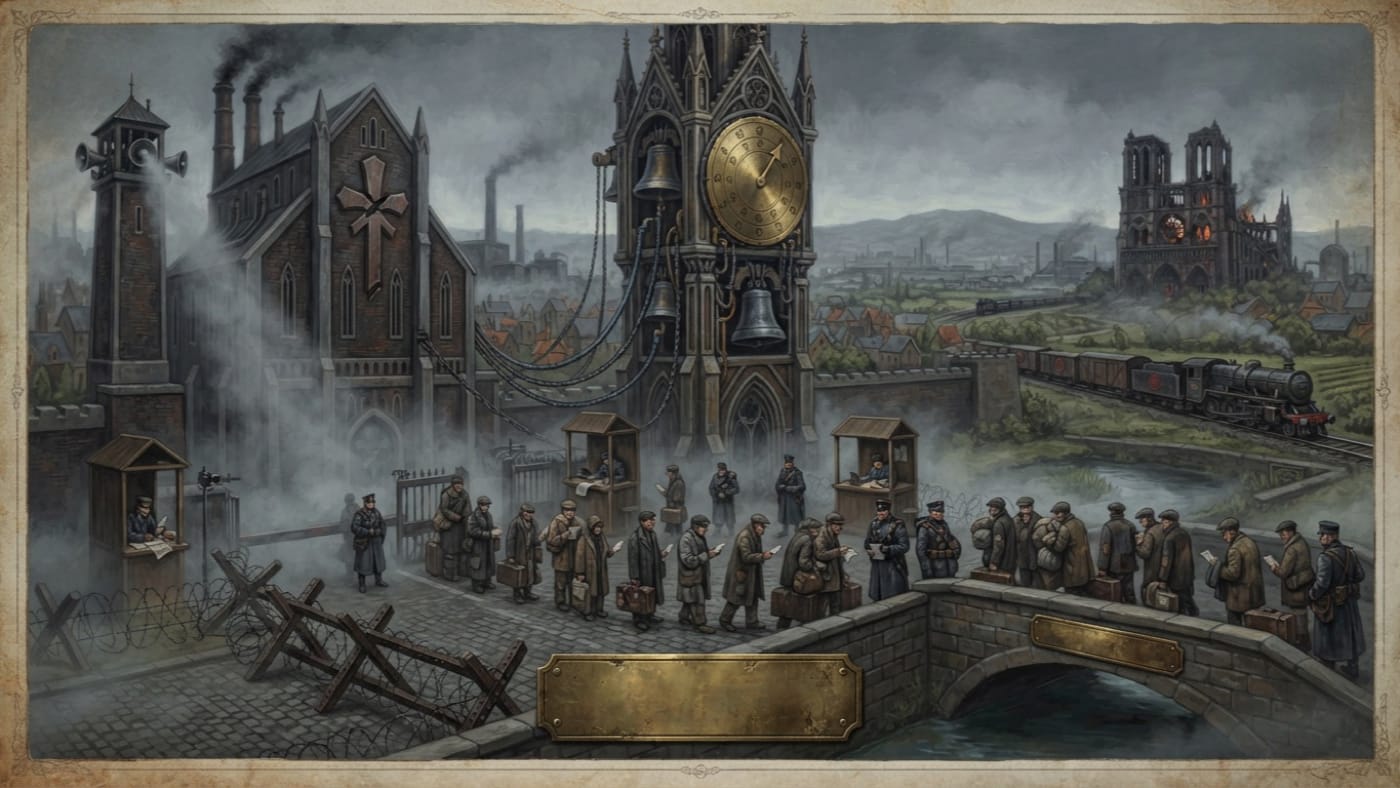
How far that settlement reaches into ordinary life is best seen at Rouen. The city's Ash-Banks take deposits of bone-dust into vaults that smell of lime and incense. Withdrawals are paid in bread, salt, or absolution tokens. Mourners queue there with the same faces they bring to a grain merchant, because that is roughly what the place is. On the Bridge of Saint Cuthbert, brass plaques carry the names of people who crossed without paying tithe. Clerks polish them every morning so the names catch the light. Peasants say the plaques whisper prayers. Records calls it a wind anomaly. Rouen has had a good deal of wind over the centuries, and some of it was on fire.
These are Rouen's practices and nobody else's. A hamlet in the Picard chalk has neither an ash vault nor a bridge of shame. It has a priest, a confessional, a tithe roll, and someone in the next lane who notices things for a small stipend. That is enough.
#On the Coast and the Present Custody
At Calais the country stops and the paperwork goes on.
The Chalk Redoubt guards Channel shipping from a white headland. Its gun galleries are cut back into the cliff, and four breakwaters called the Teeth narrow the harbour mouth. It is not one of the seven bastions of the Line. The war it watches comes by water. Across the Channel lies the British Crown, independent, armed, and sovereign over its own shore, and the Synod's relations with it are polite, wary, and carefully tolled. Nothing going across or coming back is free. Sea passes are issued at the windows of Salt Tribunal Row, where the air smells of vinegar ink and old rope and the seal-justices read a cargo manifest the way a confessor hears a young man's sins.
Below the offices are the Net Quays. Fishermen, salvage crews and diver-launch hands work there in salt-rotted wool and spend the best years of their lungs among chalk dust. Their families live in the Chalk Warrens, the worker tunnels cut into the cliff, where the lamps are rationed and the domestic saints are not. When the fog bell sounds its sequence, civilians stop where they are, and the appointed readers go up to the Script Wall for the compulsory readings. Records maintains that the markings on that wall are weather. The quays do not say otherwise where Records can hear them, and that is the closest thing to consent anyone will get on that coast.
The danger at Calais is the Undertide. It belongs to the coast. It does not mean the eastern front has crossed France. Anyone who says it does at a dinner in Strasbourg will be corrected before the fish course and reassigned before the cheese.
Inland the custody is quieter and closer. Paris once gave the Republic a fashionable vocabulary for its contempt. Today the Bureau of Purity polices it heavily, and its black-market trade in absolution stays alive because a city that size always has more guilt than its clergy can process lawfully. Everywhere else, from the Norman orchards to the Picard chalk, the system is the familiar one: diocesan jurisdiction, tithes, passage papers, confession, and the steady attention of people paid to notice.
Northern France was lost through a German gate. It came back by bell, by tithe, and by paper, slowly, parish by parish and quay by quay. Whatever the Bureau files under its name today is held, counted, read aloud in the fog, and polished every morning.