
#On the City That Faces the Wrong Way
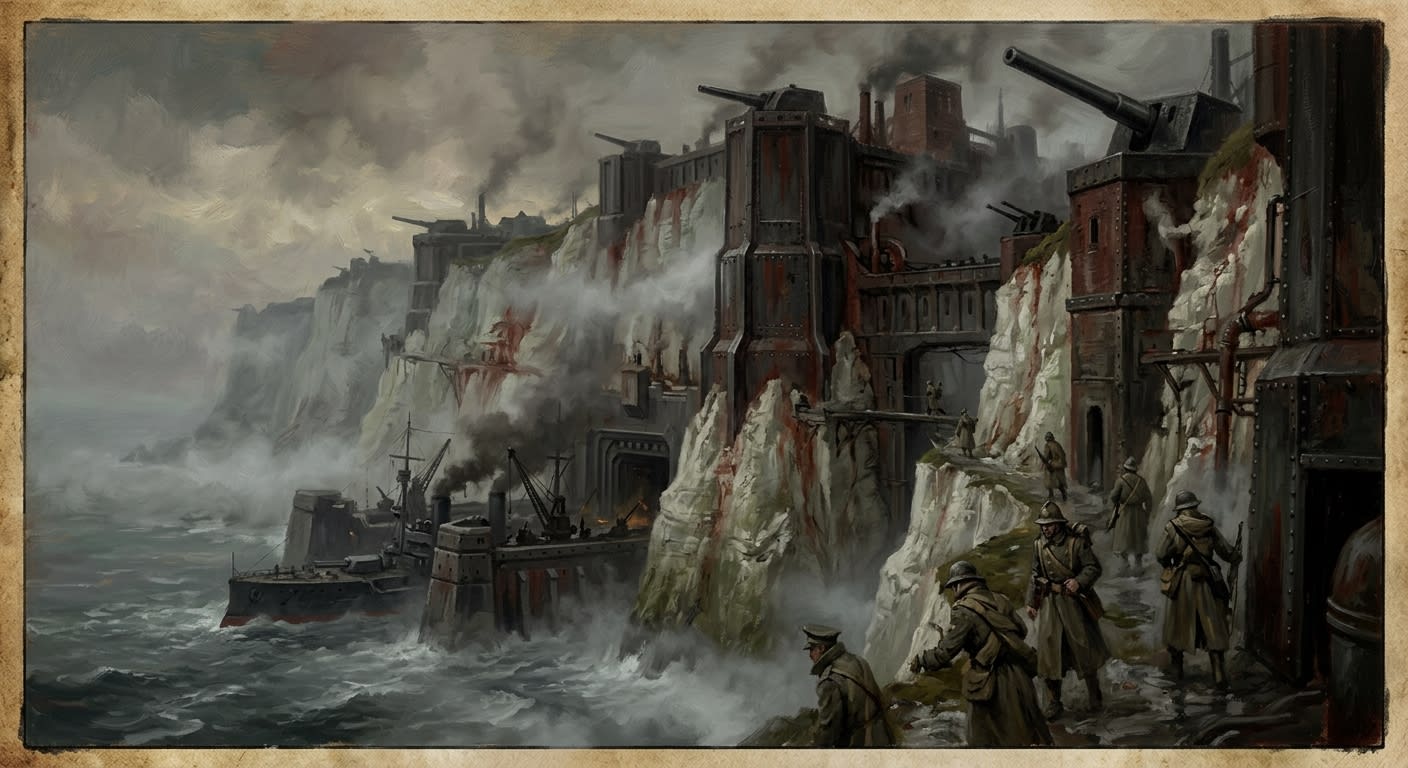
Calais is what happens when a safe coast develops teeth. The official designation, in the tidy little hand of men who have never listened to fog spell a drowning, is the Chalk Redoubt of Calais: a western coastal installation, Zone 1, carved into white cliff, guarding Channel shipping, facing the water between the Synod and the British Crown rather than the Sagittal Line. It is not on the Line. It has the manners of a fortress and the nerves of a hospice.
The first mistake outsiders make is relief. Calais is west. Calais is deep in the heartland. Calais is far from Kargath's marshes, Maldrake's iron, Syrion's fog, and the long eastern arithmetic by which infantry becomes statistics. Then the sea speaks. Relief is a fragile doctrine.
Calais stares west because the Channel has become a theological inconvenience with tides. British ships cross it with bell-masts and infuriating competence. Synod packets cross it with permits, prayers, and men who pretend not to watch the water too closely. Beneath the cliffs lie sea caves, chalk tunnels, quarantine pens, smuggler arteries, and the old wrongness that the garrison calls the Undertide. Above them stand gun galleries, the Crownline, Salt Tribunal Row, the Teeth breakwaters, and seventy feet of chalk where fog writes names.
#On the Founding and the Great Breach
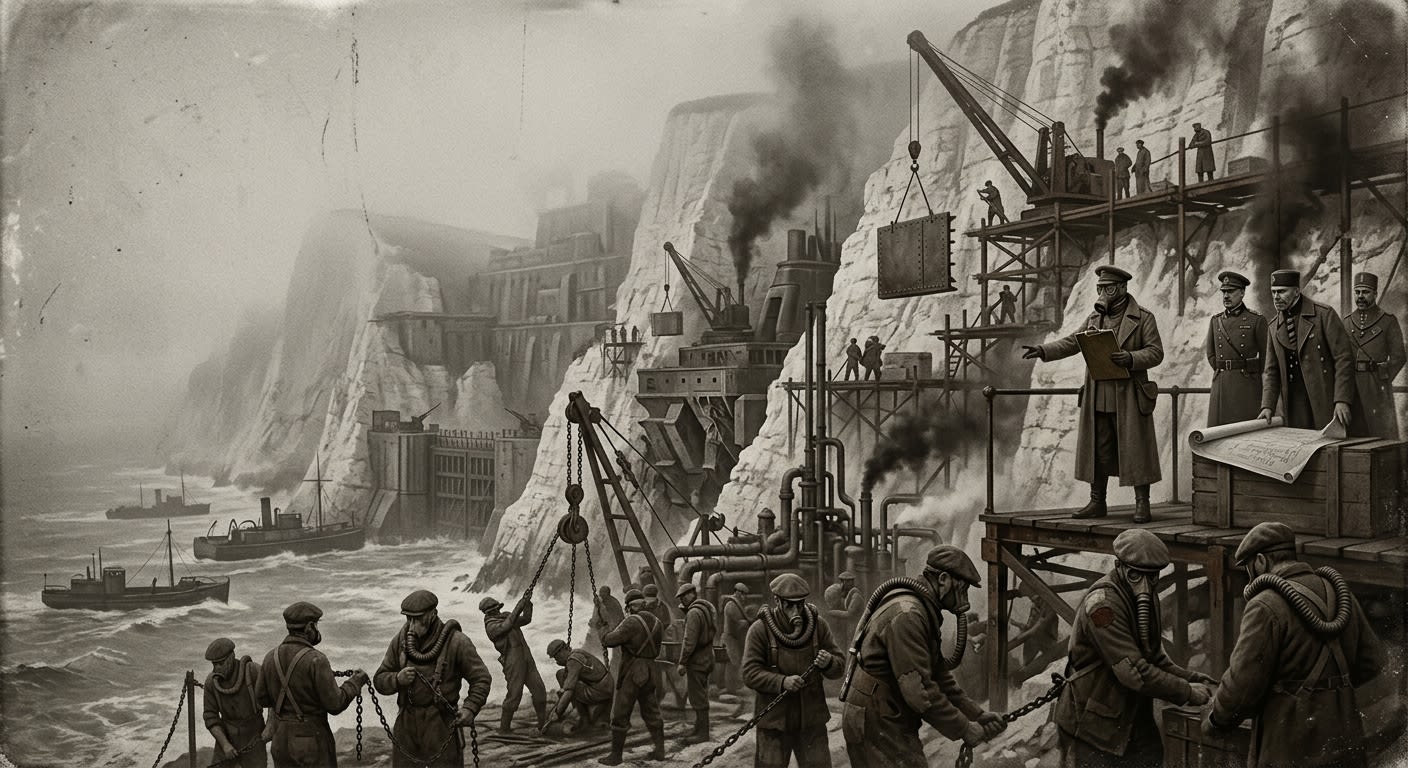
The Bureau of War requisitioned the chalk headland in A.S. 69, four years after the Line hardened into its north-south spine. Fishing vessels had returned with vocabularies rearranged. Manifests bore dates weeks in the future. One cargo of salt arrived dry, sealed, and signed by a captain whose body had been buried in Dover the previous Lent. Strasbourg sent engineers. The engineers carved gun galleries into the cliff and told themselves that artillery could correct the sea.
Several frontier maps labelled Calais “western Line anchor.”
Corrected under Geographic Harmonisation A.S. 201. Calais is a coastal redoubt and Channel installation. The Line begins at Bastion-Königsberg and runs south to Bastion-Constantinople. Calais is a tooth in the western mouth, not a vertebra in the spine.
The Synod Coastal Chapterhouse (Unregistered) followed in A.S. 70. The Great Breach followed in A.S. 71, because the universe has a taste for humiliating new institutions before their paint dries. During a west-hush, the sea caves opened inward. Watchmen returned walking and already drowned. Lamps moved under the harbour without hands. Black brine seeped from chalk ceilings. Hundreds died before a makeshift bell-choir drove the things back with signal bells, cracked cannon rims, powder ladles, and one chapel handbell now locked in the Index Damnatus for excessive acoustic efficacy.
Afterward the fog came in. The chalk wrote names. Calais acquired its sacrament.
#On the Wall and the Night Reading
The Script Wall lies between the Gun Galleries and the Crownline: seventy feet of exposed chalk, damp, white, and official enough to attract committees. On clear nights it is stone. On fog nights it becomes a ledger with poor handwriting and excellent aim. Names bead from condensation. Legal names, baptismal names, dock names, lovers' names, names kept between mother and child. If read, the name remains a warning. If unread, it sinks.
When the fog descends, the Fog Bell Tower strikes three short, one long, three short. Readers take their stations. Lantern-bearers angle light against chalk. Chalk Scribes (Unregistered) kneel with waxed slates. Doctrine copyists stand behind them, because no fact in the Synod is real until copied by someone frightened of being blamed for it. Captain Lute Auvray assigns the rosters. Her pencil decides whose throat the night will spend.
If a name sinks, the harbour answers. A skiff fails to return. A diver's rope goes slack. A child wakes in the Chalk Warrens (Unregistered) with saltwater in his lungs. A boat docks with the correct crew number and the wrong faces. This is why every household in Calais owes voice and sleep. Taxation, here, is breath.
READING INCIDENT — ROSTER 14-F, A.S. 188 Recognized name: ██████████████ Relation: daughter Reader abandoned position before final consonant. Name partially sunk. Harbour west-hush began within seven minutes. Three lamps extinguished underwater. Recovered body count: █████ Disciplinary finding sealed; reader reassigned to Silent Steps maintenance.
The Silent Steps (Unregistered), corridors near the Wall where speech is forbidden under penalty of beating, were created after the Unread Uprising (Unregistered) of A.S. 187. Calais built enforced silence around its compulsory reading surface. The irony is architectural. Naturally, the Bureau filed it under design.
#On the Teeth, the Pens, and the People Below
The harbour mouth is guarded by the Teeth: breakwater fortlets built from iron, chalk-lime, and the calcified remains of the first Undertide entities recovered after the Breach. The Bureau of Alchemical Standards recommended self-derived calcified remains in saline immersion as a repellent medium, then requested transfer inland. The bones remained. The men were wiser than the report and less durable.
Beyond the Teeth the Undertide waits in fog-bound water. Draggers crawl along the harbour floor. Bellies rise under hulls and persuade wood to open. Larger processional masses press against the pilings with a patience that offends every doctrine of animal stupidity. The Gunline Choir keeps seven repulsion sequences under lock. Cantor-Major Pell sleeps with the chart. Sensible man. A chart that prevents the sea from climbing your stairs is worth more than most officers.
The Undertide Divers, called Black Lungs, descend into the sea caves with brass throat plates, salted knives, rope bells, and the expression of men and women who have learned that courage is mostly repetition performed underwater. Diver-Captain Sain answers questions about what he has seen by asking whether the questioner can swim. Ila “Kelp,” his second, laughs underwater. The Bureau of Purity declines to investigate this on jurisdictional grounds, by which it means fear in a clean collar.
Bodies recovered from failed dives go to the Undertide Pens. Bodies not recovered are entered twice: once in the casualty ledger, once in the Wall watch book, because lost divers often appear in chalk within seven nights, written low enough that the reader must kneel in surf-water to speak them. Calais has perfected bureaucracy on its knees.
Old quarry testimony claiming the sea caves were wrong before the A.S. 71 Breach was dismissed as folk memory.
Clarified. The testimony remains inadmissible, but subsequent events have granted it the rank of extremely inconvenient accuracy. The Bureau congratulates the dead witnesses on their improved evidentiary posture.
#On Passes, Smugglers, and the Salt Tribunal
Calais runs on passage. A sea pass (Unregistered) is worth more than coin, because coin cannot cross water, cannot calm a quarantine clerk, cannot make Seal-Justice Corvin Hald (Unregistered) forget what his ledger has already enjoyed knowing. Salt chits, lantern tokens, ration stamps, oath-notes, Iron Crowns from Dover, and Synod paper all circulate through the quays. The true money is permission to leave.
Salt Tribunal Row smells of vinegar ink, old rope, wet wool, and civic blackmail. Confessions attach to pass applications. Cargo seals attach to confessions. Denials attach to both. A fisherman seeking clearance for a dawn launch may discover that his grandfather's unlicensed bell-song, sung during a storm thirty years ago, has acquired interest. Calais does not forgive. It itemises.
Beneath the Chalk Warrens, the Grey Keel Syndicate works the boat tunnels: forged passes, cave maps, quiet exits, name edits, downgraded inspections, and the kind of mercy that comes wrapped in tarred cloth and costs three months' wages. Their rumored leader, Skiff-Sister Lune, smells of perfume and tar. The Tribunal calls this evidence of capital offences. The Divers call it a professional credential.
#On Dover, Britain, and the Western Water
Across the Channel lie the Dover Chainworks, one day by crossing when fog, bell-lanes, British mood, and the sea's private opinions permit. Dover sends chain, net-cord, blessed rope, naval fittings, and replies that answer nothing useful beyond the invoice. Calais sends salt fish, lime, pass-seals, repair timber, and men with too many questions. The British refuse Synod audit authority with a courtesy so consistent it has become a fortification.
The Cathedral Ships and British bell-masts keep the open water safer than any continental officer enjoys admitting. Their bells make fog retreat from the hull. Their captains give no tuning charts. The Bureau of Bells would gnaw its own desk for those specifications, and I have advised the Bureau against it only because the desk is antique.
Calais depends on Britain and resents dependence with the discipline of a hungry bishop at a borrowed table. The Channel is buffer, trade route, threat, sacrament, and insult. On calm mornings, the harbour looks almost ordinary. Ordinary water is the sea's best disguise.
#On the Present Amber Seal
As of A.S. 201, Calais remains under Amber status. The Wall writes nightly in fog season and with increasing discourtesy in clear weather. Inland chalkscript has appeared three hundred yards from the cliff, on doorframes in the Warrens, in rooms where no fog should have entered unless fog has learned to file for residence. A child was removed to the Pens after his name repeated across seven lintels in seven spellings. The lintels remain under guard. The child remains under wording.
Commander-Prior Sabelle Morn governs from the Crownline and trusts nobody, a qualification I admire in any administrator stationed above a mouth. Auvray assigns the readers. Hald sells legality by the stamp. The Gunline Choir keeps the sequences. The Black Lungs go under. The Unread insist that the readings feed the sea, that every spoken name stabilizes a relic interface the Synod installed and cannot confess, that Calais is not defending the coast but baiting it.
The Bureau has condemned this proposition, forbidden investigation into it, impounded supporting rubbings, sealed three cabinets beneath the Salt Tribunal, and assigned additional readers to the Wall. The machinery continues. The fog arrives. The names bead. Calais reads.