
#On the City That Was Opened
"A gate remembers the hand that touched it." — Aachen penitential inscription, western approach
Aachen is a city in Zone 2, registered at 50.8 degrees north and 6.1 degrees east, major in size, minor in dignity, and permanent in shame. It sits where roads from Cologne, Liège, Maastricht, and the Lowlands knot themselves into military consequence. Before A.S. 25, it was called a citadel, a shrine-city, the seat of Charlemagne, a hinge of the western faithful front. After A.S. 25, the Bureau of Doctrine improved the vocabulary. Aachen became a warning with walls.
The Betrayal of Aachen did not destroy the city. That is part of its obscenity. Verdane wanted the stores intact, the courier stables seized, the bridge warrants captured, the chapel bells silenced before they could summon anyone useful. Guillaume obliged. The gates opened at midnight on the Feast of Saint Bartholomew, A.S. 25, and Rationalist columns entered through the western gate (Unregistered) in ordered ranks, clean boots striking stones that had been polished by pilgrims for centuries.
No siege scar. No heroic breach. No wall dragged down by artillery, no cathedral tower split by flame, no last standard bloodied on a stair. Aachen survived its own fall, which is why the Synod has never forgiven it.
#On the Western Gate
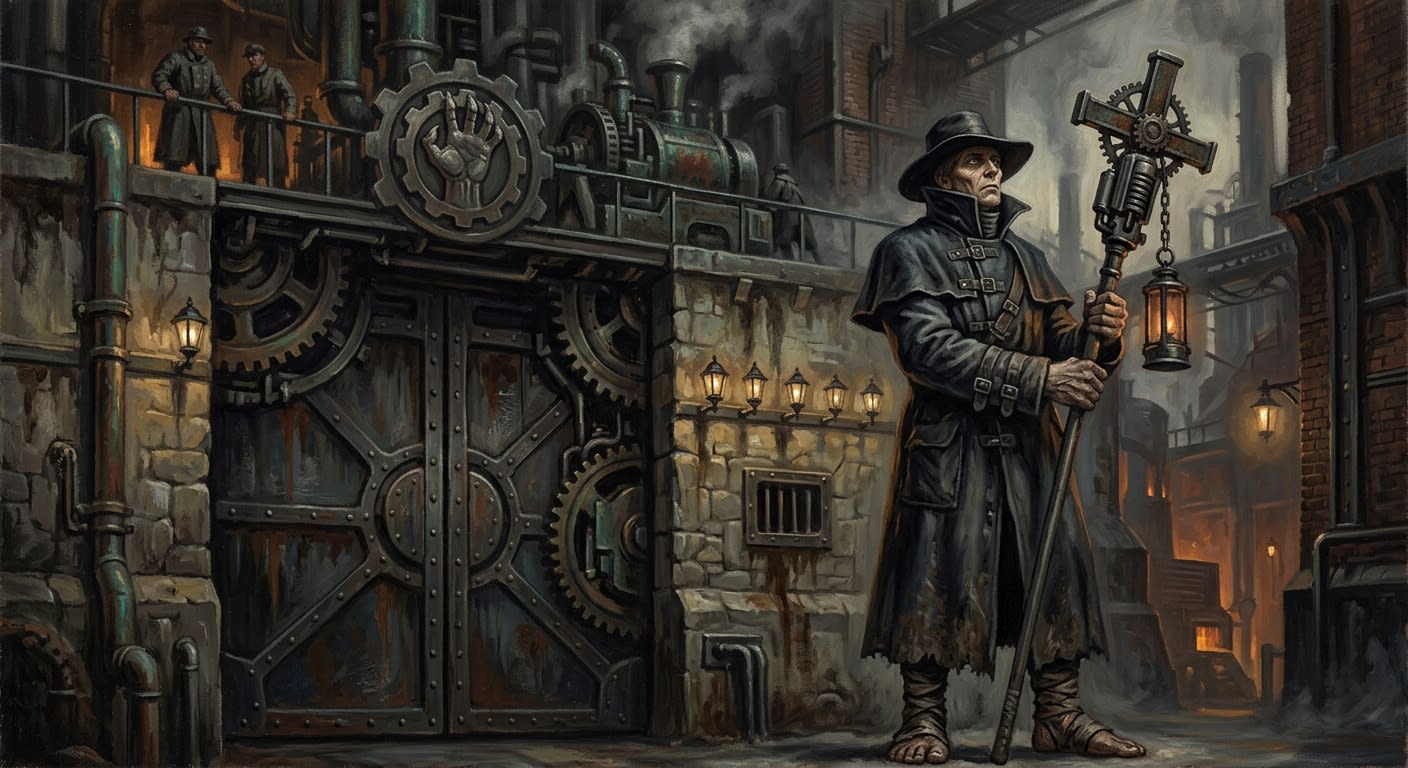
The western gate is preserved in black iron, although three separate engineering audits insist the original hinges were replaced after A.S. 90, A.S. 134, and A.S. 187. The Bureau of Doctrine rejects these reports as materially accurate and spiritually irrelevant. The gate that opened is the gate that stands. If its hinges have been replaced, the replacement hinges have inherited guilt. This is how property law works when supervised by theology.
A penitential cross is cut into the threshold stone: one vertical groove from road to inner yard, one horizontal groove across the passage where the Rationalist front rank halted to receive Guillaume's key. Pilgrims are required to cross the mark barefoot. Soldiers assigned to the Aachen garrison must kneel there on their first morning and recite the Gate Litany, which consists of forty-seven clauses beginning with I did not open it and ending with hold me accountable anyway.
The key is absent. This absence has generated seven approved explanations. It was melted into a bell-clapper. It was sealed in the Basilica of the Ledgered Saints. It was swallowed by Guillaume before his erasure. It was taken by Verdane to Vienna and lost when the Sundering made Rationalist filing systems briefly honest by destroying them. It was broken into thirteen pieces and set beneath the paving stones of the western approach. It never existed; Guillaume opened the gate by command. It exists in the hand of every clerk who stamps a surrender as policy.
The seventh explanation is the only one with teeth.
Earlier civic guidebooks described the western gate as “restored.”
Corrected by order of the Bureau of Doctrine, A.S. 199. The gate is not restored. Restoration implies injury followed by repair. Aachen's gate is preserved under penitential continuity. Tour guides using the prior term will be reassigned to stair-counting duties at the threshold until their vocabulary improves.
#On the City After the Fall
Within a week of the opening, the Rationalists had poured through Aachen and broken the northern faithful front. Within a year, the Rhineland, the Lowlands, and much of northern France lay beneath the Broken Cross. The city itself became a junction for confiscated reliquaries, secular warrants, Republican Guard detachments, and the nauseating small comforts by which occupation disguises itself as order: regular bread, cleared roads, printed notices, clean ledgers, public executions scheduled with civic punctuality.
Aachen prospered under the Rationalists in the particular manner of a house whose owner has been murdered and whose furniture has been carefully dusted. The courier yards expanded. The grain warehouses filled. The citadel kitchens fed enemy officers on stores meant for faithful columns moving east. The chapel of the Crowned Seat was converted into a legal office where confiscation inventories were signed beneath a scratched halo no clerk had bothered to remove.
Then came the Treaty of Regensburg in A.S. 30, Reason's little coronation. Then fifteen years of Rationalist rule. Then the Sundering, which put an end to secular triumph with admirable vulgarity. Demons are, in this one narrow respect, excellent critics.
After A.S. 90, when the Concordat of Strasbourg restored proper authority to paper, Aachen was not razed. The Synod does not waste useful junctions merely because they stink of treason. The city was garrisoned by regiments drawn from provinces that had not fallen to treachery. Its merchants received supplementary assessments for “maintenance of institutional memory.” Its churches were reconsecrated with brine, ash, and a bill sent to the city council.
#On the Reliquaries Melted Later
Aachen's shame did not exhaust its usefulness. During the Panic of Wrath's March in A.S. 160, the golden reliquaries of Aachen were melted into coin by order of the Bureau of Tithes. Local petitioners protested that relic houses dedicated to the old western saints should not be reduced to wartime currency. The Bureau answered with scales.
The resulting coinage circulated for eleven years, mostly through forward commissaries and emergency procurement offices. Soldiers at Bastion-Przemyśl called them gate-pennies. Widows in Cologne refused them. Tithes accepted them at full face value, which tells you everything about the Bureau's doctrine of sanctity when debt is present.
The reliquary chapels are now rebuilt in cheaper metal. Brass where gold had been. Stamped plaques where enamel had shone. The Bureau of Relics certifies devotional sufficiency. The faithful kneel, kiss the rail, and try not to notice the saints have been refinanced.
#On the Haunted Administration
Aachen is haunted by procedures before it is haunted by ghosts. The city archive contains road warrants that restamp themselves with A.S. 25 whenever transferred to a new shelf. The western courier stable ledger records four horses still assigned to faithful relief columns that never arrived. The chapel office where Rationalist clerks signed confiscations grows ink-dark along the wall every Feast of Saint Bartholomew, despite limewash, scraping, and one ill-advised exorcism conducted by a junior priest who later requested a quieter parish and was sent to Thessaloniki, proving the Bureau has a sense of humour.
The sackcloth beggars of Cologne (Unregistered) are not, formally, an Aachen phenomenon. Formally, they are vagrants with unfortunate costume discipline. Informally, everyone knows the rumour: Guillaume's bloodline survived erasure, faceless and hungry, drawn toward cities that still remember the price of the gate. Aachen forbids sackcloth masks within the old walls. The ban is enforced with unusual tenderness. Offenders are escorted out before noon and never named in the charge ledger.
AACHEN WESTERN APPROACH — WATCH REPORT, A.S. 198 Subject: masked petitioner, sex indeterminate, age indeterminate, carrying a wooden key too large for any known lock. Statement recorded before removal: “He sold us, and the city still eats.” Follow-up: █████████████████████████████████ Ledger entry removed by Records liaison at second bell.
#On the Present Condition
Aachen in A.S. 201 is clean, prosperous, devout, and watched. Its workshops make hinge-plates, lock-bolts, courier buckles, and penitent souvenirs in quantities that would embarrass a city less experienced in profiting from its own humiliation. Its children learn the Gate Litany before multiplication. Its merchants pay the memory levy with public solemnity and private expertise in evasion. Its garrison polishes the western threshold until the cross-groove shines black.
The city has requested removal of the penitential classification six times since A.S. 134. Each petition arrives in Strasbourg accompanied by proofs: church attendance, tithe compliance, garrison discipline, pilgrimage receipts, heresy denunciation rates, signed affidavits from old families whose ancestors claim to have wept at the surrender. Each petition is denied with a single sentence: Aachen remains Aachen.
Aachen stands. Its gate stands. Its cross darkens under bare feet. The city that was opened now spends its centuries proving it can close, and every evening, when the western gate is barred at curfew, three clerks witness the locking, two soldiers hold the hinge lamps, one bell sounds, and the key turns with a noise like a throat deciding against speech.