
#On the Kingdom That Became a Province of Providence
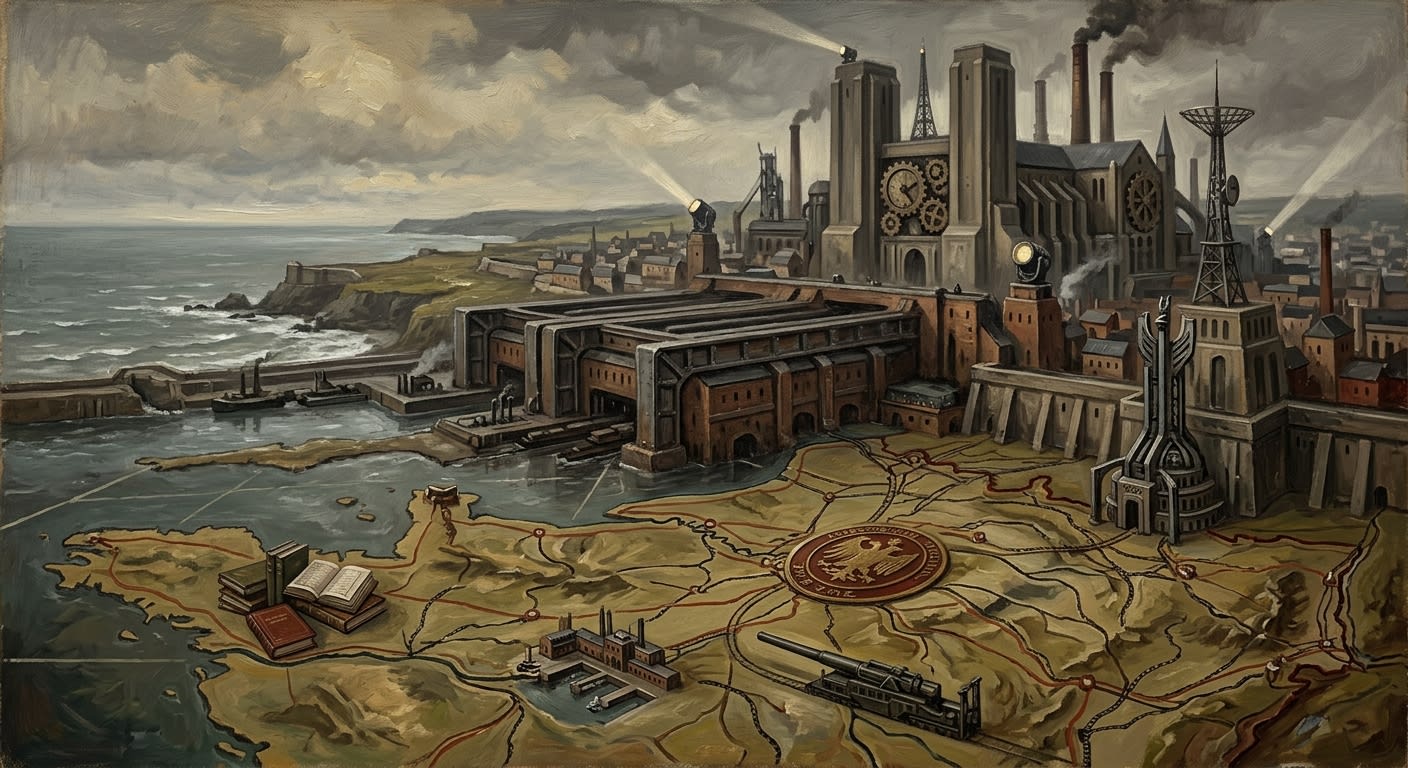
France exists in the Sacred Ledger as a country, a memory, a revenue district, a theatre of obedience, and a bad habit the Bureau has spent two centuries correcting without quite destroying. The map calls it Zone One, Western Heartland, deep safe territory. The catechisms call it a founding member of the Triune Hearth. The old songs call it France with a tenderness that should alarm every censor in Strasbourg. All three names are permitted because none is allowed to stand alone.
A nation is a dangerous object. Left unattended, it remembers kings, dialects, parish customs, local saints, improper cheeses, hereditary grudges, frontier liberties, river laws, market days, coats of arms, ducal exemptions, and songs in which Strasbourg appears nowhere. The Synod has corrected most of these. France remains too large to erase and too useful to leave intact. We did what any competent state-theologian does with a stubborn inheritance: we sanctified it, divided it, taxed it, processed it, and then congratulated it for surviving the surgery.
In A.S. 201 France is the broad western breast of the Synod's body: Atlantic ports, Channel fog, Breton martyr-roads, Parisian police clocks, Lyonnais relic shame, Provençal ruins, Marseilles salt accounts, Calais guns, Avignon's drowned correction, and Strasbourg itself seated in Alsatian stone like a jeweled knife in the rib. It is safe in the way a loaded reliquary wagon is safe: heavily guarded, closely inventoried, and likely to injure the inattentive.
The Bureau of Doctrine teaches that France entered unity willingly. This is true in the way a signature is willing after the room has locked and the pen has been blessed.
#On Old France and the Rationalist Perfume
Before the Synod hardened Europe into its present glory, France had already become a workshop of excellent errors. Paris gave shelter to salons where clever men mistook lamp smoke for revelation. Provincial academies hosted debates in which priests were invited to defend the Creator before men who had already drafted the verdict. The learned societies flourished with that fatal odor of polished wood, ink, pride, and insufficient fear. Their pamphlets promised reason, fraternity, reformed calendars, measured mercy, and a government cleansed of miracle. They believed superstition could be legislated out of the human animal. Then they met the human animal and responded with police.

The Rationalists did not conquer France by disbelief alone. Disbelief is a weak horse unless harnessed to offices. They built prefectures, inspection boards, school committees, paper tribunals, seizure warrants, secular assembly laws, and the bureaucratic skeleton that later generations, with proper humility and better Latin, would improve. I say this without discomfort. The enemy taught Europe certain efficiencies. We baptised them after confiscation.
The Massacre at Saint-Malo in A.S. 10 tore the veil from the experiment. Republican Guards fired on pilgrims at the Porte Saint-Vincent, and France discovered that rational public order could produce martyrdom faster than any medieval tyrant with a grudge. The cobbles drank pilgrim blood. The sea carried the news. Breton convents, parish cellars, market chapels, and old noble houses heard the report and began choosing sides with the haste of people who understand that neutrality has become a costume for cowardice.
Paris answered with warrants. Strasbourg answered with Doctrine. The west lit like oil.
Republican histories describe the Saint-Malo incident as a crowd-control failure by frightened guards.
Corrected. Fear does not absolve volley fire. The Bureau accepts that the guards were frightened; it merely adds that frightened men with state authority remain murderers, and that murderers who keep minutes become Rationalists.
From Saint-Malo came the first great French usefulness to the future Synod: outrage with relics attached. The relics of the martyrs supplied sermons. The sermons supplied levies. The levies supplied armies. The armies supplied jurisdiction. France did not become faithful in one instant. No people does. It became prosecutable in the correct direction.
#On the Atheist War Roads
The Atheist Wars turned France into a corridor of scorched arguments. Roads that had carried pilgrims carried guns. Abbey kitchens fed companies. Cathedral treasuries funded bridge repairs and mercenaries whose piety could be calibrated by the purse. The old provinces did not move as one body. Brittany guarded its martyrs. Provence guarded its river routes. Paris guarded its police apparatus. Lyon guarded relic commerce and pride. Avignon guarded passage and later mistook custody for crown.
In the south, Cardinal-Marshal Severin of Avignon held Montreval with sermons loud enough to be mistaken for artillery by men who had never heard artillery disagree. His France was not the France of Versailles memories or Paris pamphlets. It was mule dung, rationed absolution, field chapels, bridge-burning orders, exhausted sisters at the parapet, and officers learning that noble blood flows out under shellfire with vulgar democratic speed. Severin understood command in the old ecclesiastical fashion: a man must be saved, ordered, fed, and threatened, usually in that sequence, sometimes all at once.
The northern wounds were uglier. The Betrayal of Aachen shook the faithful corridors, and Rationalist pressure moved through the Lowlands and down into French calculation. The Treaty of Regensburg in A.S. 30 tried to abolish the old Church by article and table. France, already carved by prefectures and supervised by philosophical committees, learned the feel of a state that believed it could replace confession with registration. The Bureau has since condemned the Treaty in all proper registers. We also studied its administrative reach. Providence often hides useful instruments in enemy cupboards.
The war did not end with French purity. It ended with exhaustion, rearranged sovereignties, hidden relics, violated shrines, and enough surviving clergy to claim continuity once continuity became profitable. France emerged from the Rationalist period neither innocent nor defeated. It emerged available.
Then the world broke open in the east, and even Parisian cleverness learned to kneel with both knees.
#On the Concordat and the Taming of the Name
The Concordat of Strasbourg bound France, Iberia, and the Rhineland into the Triune Hearth. The official account says the three old bodies entered a single sacramental polity. The material account says France signed because Saint-Malo had made neutrality filthy, the Rationalists had made unbelief bloody, the Sundering had made survival urgent, and Strasbourg had mastered the art of presenting inevitability in triplicate.
France's seal entered the common wax beside Iberia's and the Rhineland's. Three impressions. One mass. The image is taught to children because children understand wax better than constitutions. Break one, break all. Warm one, soften all. Press one harder, distort all. Kratz knew theatre. Augustinus knew tears. France knew, by then, that isolation was a luxury for islands and madmen.
Several provincial chronicles claim France “retained her crown in spiritual partnership” after the Concordat.
Corrected. France retained ceremonies, heraldic fragments, regional courts, tax names, saint-days, and enough old vocabulary to keep elderly nobles from choking at table. Sovereignty passed into the Synod's hand. A preserved glove is not a living fist.
The binding did not erase France. It made France quotable. The Bureau loves a conquered name it can still print on banners. French martyrdom became Synodal evidence. French ports became Synodal lungs. French grain routes became Synodal arteries. French cathedrals became staging rooms for continental obedience. French reluctance became a pedagogical resource. Every old province supplied some instructive sin: Breton stubbornness, Parisian cleverness, Provençal river-hermeneutics, Lyonnais relic greed, Calais fog-jurisdiction, Marseilles account-salt, Norman maritime evasions. To govern France is to maintain a cabinet of labelled temptations.
The Anno Synodi reckoning rests on this binding. Time itself was disciplined through the Concordat. The old calendars of kings and republics were pushed into the cellar, where historical vermin may gnaw them for specialist amusement. France's past survived, but as Ante-Synodi, prefaced by darkness, handled by trained men, and never left alone with schoolchildren.
#On the Provinces Under Watch
France is too broad for one wound, so the Bureau keeps several open.
Brittany remains the coast of martyrdom: Saint-Malo, Dinan, Sainte-Claire-des-Landes, the road that began with forty-three pilgrims and ended with thirty-one certified dead, seven witnesses, and five absences so severe that Records learned to count what did not return. Pilgrimage watches Brittany with tenderness sharpened into tariff. Doctrine watches it because martyr cults breed local pride. Tithes watches it because every tear acquires a booth. The Breton coast knows how to look humble while keeping its own ledgers under the floor.
Paris is more dangerous because its sins wear shoes indoors. The city gave Europe salons, prefectural arrogance, black-market absolution, Candle Riots, police inheritance, and the enduring belief that a paragraph can excuse a prison if the paragraph is balanced enough. Purity supervises Paris with a severity that flatters the city, since Parisians take persecution as proof of centrality. Records keeps an especially fat annex there. Doctrine reviews sermons with little patience. The Inquisition does not need a map.
Lyon handles relic shame with the posture of a merchant caught weighing the scale. Its role in the Reliquary Schisms, its tumults, its ashes in the Rhône, and its capacity for organised piety make it indispensable and suspect. Such cities are valuable. They must be allowed to sin in known channels; otherwise they will invent new ones.
Calais is a chalk tooth set against the Channel. The Channel beyond it leads to the British Crown, that independent island irritation whose refusal to be governed proves only that water makes men theatrical. The Chalk Redoubt guards shipping, fog, Undertide pressure, and the westward seam through which diplomacy, contraband, pilgrims, bell-practice, and British coin all attempt to enter without adequate shame. Calais teaches France that safety on the map does not mean quiet at the cliff.
Avignon requires its own paragraph because ruins enjoy attention. The city on the Rhône once imagined that custody, corridors, and southern prestige could ripen into rival authority. The Schism of Avignon crowned a Pontifex Submersis beneath water and forced Strasbourg to demonstrate that mercy may be applied stone by stone until no house remains high enough to misunderstand it. The rubble now teaches obedience in Strasbourg staircases. The Rhône keeps producing objects. Fishers keep pretending surprise. Purity keeps confiscating nets.
AVIGNON RIVER OBJECT REGISTER — EXTRACT Item: clay disc, blank, damp without source. Recovered by: net crew, dawn, restricted bend. Inscription: none visible. After drying: ███████████████████ Disposition: burned, then drowned, then filed as ash.
This is France: a country whose regions are less provinces than docket headings.
#On the French Offices of Hunger, Joy, and Correction
No Heartland can be ruled by fear alone. Fear is expensive when stretched over vineyards. France is ruled by a braided apparatus of feast, levy, debt, shrine, school, censor, road, bell, ration, and spectacle. The Bureau of Festivals softens obedience with drums. The Bureau of Tithes gives drums a rate. The Bureau of Records proves attendance. The Bureau of Purity explains absences. The Bureau of Doctrine writes the speech in which all of this becomes love.
The Procession of the Triune Hearth exposes the mechanism most beautifully. It commemorates the Concordat; it counts households. It displays unity; it measures dissent. It drags floats through old French cities until separate memory must either cheer, kneel, or be recorded failing to do so. Strasbourg begins the route. Constantinople ends it. Between them, France becomes visible to itself as part of something larger and more expensive. This is political theology at its most merciful: a census in ribbons.
French festivals remain policed with particular care because France laughs dangerously. The Tumults of Lyon taught Festivals that masks require heavier licensing. Parisian street theatre has produced more sedition per yard of curtain than several minor heresies produced with pamphlets. Breton mourning rites flirt constantly with local saint-sovereignty. Provençal river songs require review because half of them rhyme Rhône with throne, and that sort of accident has hanged better poets.
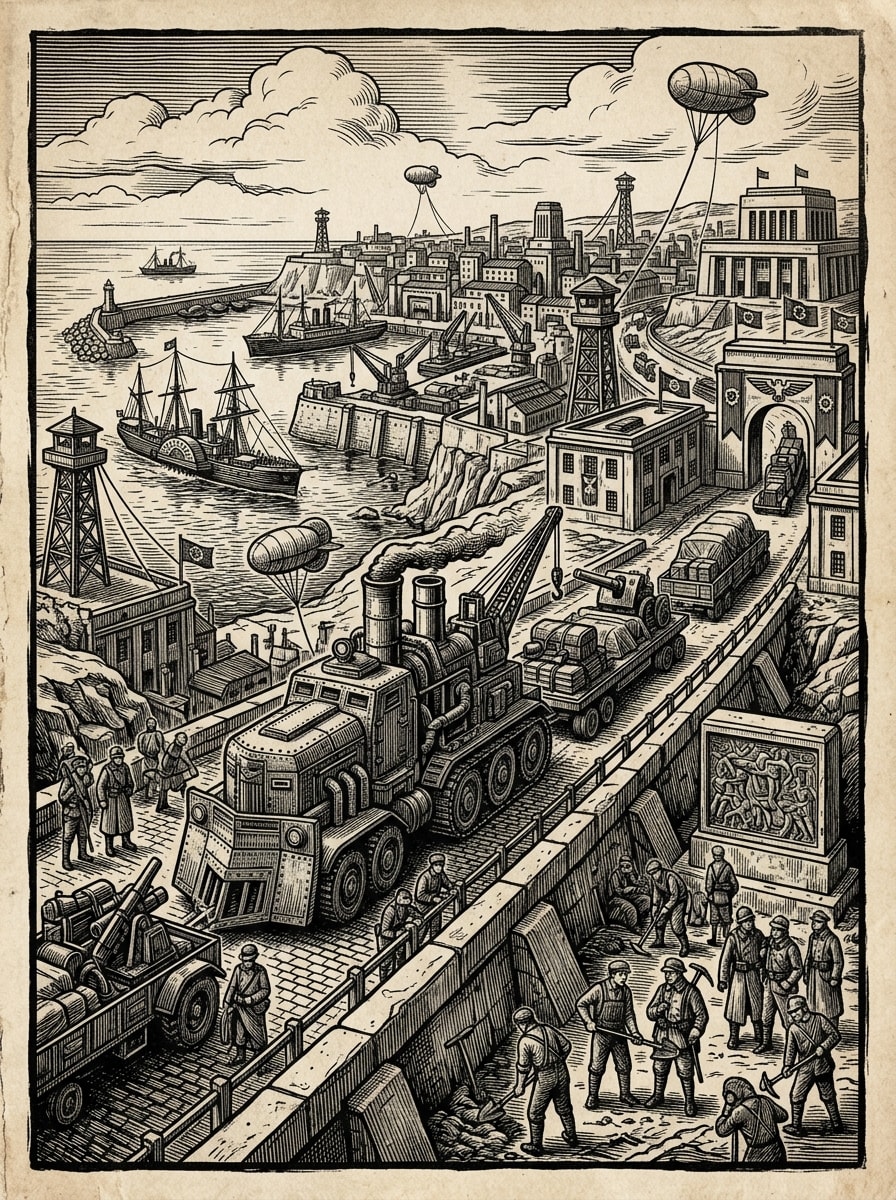
Hunger is likewise curated. France is fertile enough to resent shortage and taxed enough to understand it. Grain moves east. Sons move east. Horses, bell-metal, linen, salt, candlewax, paper, and competent clerks all move east. The front consumes the Heartland and sends back widows, receipts, medals, suspicious relics, and men missing pieces that the Bureau would prefer properly labelled. A French village may be deep in safety and still feel the Sagittal Line at dinner, when the absent chair receives no soup and the tithe assessor receives a better stool than the uncle who lost a hand.
Agrarian pamphlets of A.S. 176 claimed France “feeds the Synod without being fed by it.”
Correction sustained in part. France feeds the Synod. The Synod feeds France meaning, protection, schedules, bells, corrected calendars, admissible grief, and enough stamped bread to keep complaint below revolt in most districts.
#On Strasbourg's French Body
Strasbourg sits in France and exceeds it. This causes local vanity, bureaucratic confusion among foreigners, and occasional French murmuring that the capital owes its host a gentler hand. The capital owes nothing. A throne does not pay rent to the floor.
Yet the fact matters. The Synod's heart beats in French stone, French weather, French market noise, French cart roads, French river trade, and French resentment disciplined into service. The Basilica of the Ledgered Saints does not float above geography, despite what theologians with weak ankles prefer. Its ink arrives by road. Its vellum arrives by herd. Its coal arrives by wagon. Its petitioners arrive through mud that remembers old provincial names. Strasbourg governs Europe because France sustains the habits by which Europe can be governed.
The old French genius for ceremony did not die under the Synod. It was requisitioned. Court etiquette became Bureau procession. Salon argument became doctrinal disputation under supervision. Royal centralism became Strasbourg routing. Provincial pride became competitive compliance. The crown became a seal. The courtier became a clerk. The musketeer became a guard with better paperwork. Even French vanity found service, for a vain people will obey magnificently if convinced that obedience displays superior taste.
There remains a concealed grief in the arrangement. France remembers being named without permission from Strasbourg. The Bureau permits this grief in approved forms: heritage sermons, regional feast costumes, old royal colours diluted to compliant shades, songs with revised refrains, market saints stripped of jurisdiction, school exercises in which children recite extinct crowns as cautionary taxonomy. A memory caged and fed becomes heritage. Heritage sells candles.
#On the French Economy of Obedience
France pays beautifully when cornered by forms. This compliment will offend the French, who prefer their virtues to appear spontaneous, lyrical, and lightly perfumed. I decline to indulge them. The country is a treasury of roads, ports, scribes, vineyards, salt pans, mills, fisheries, linen houses, bell-foundries, candleworks, and professional grievances. Each grievance can be taxed if approached with courtesy and a warrant.
The Atlantic coast sends fish, rope, salt, timber, and sailors whose confessions take longer than their voyages. The Mediterranean ports send oil, citrus, pilgrims, shipwrights, and account books written by men who believe arithmetic improves when conducted near sunlight. The interior sends grain, clerks, wool, cattle, paper, sons, daughters, and the smaller forms of obedience that keep empire from requiring soldiers at every pantry. France feeds the Synod in the quiet ways that do not make murals: cart by cart, levy by levy, candle by candle, signature by resentful signature.
The Bureau of Tithes divides French obligation into ordinary tithe, Hearth surcharge, pilgrimage adjustment, coastal anomaly levy, relic-road maintenance, festival recovery, widow offset, and emergency gratitude. The last is my favourite. It allows the faithful to pay for having been saved from dangers they were not told existed. Paris complains in memoranda. Brittany pays in coins wrapped with devotional thread. Lyon negotiates until the invoice grows teeth. Marseille sends three ledgers and dares Tithes to identify which one is honest. Tithes identifies all three as taxable.
French labour is likewise braided into holiness. Road parishes repair routes toward Strasbourg and call it penance. Port guilds maintain pilgrim quays and call it privilege. Rural bellfounders cast replacement tongues for towns they will never visit. Vineyard houses supply altar wine under purity assays so humiliating that several vintners have become theologians out of spite. The Bureau welcomes spite when bottled correctly.
This economy produces loyalty of the most durable kind: loyalty with outstanding balances. A man who has paid, overpaid, appealed, been denied, paid again, and received a receipt bearing the Triune Knot has invested too much in Order to admit he was conquered by it. He will defend the system in the market square because otherwise his suffering becomes mere stupidity. Doctrine calls this sacramental participation. I call it excellent retention.
#On the Schools, Tongues, and Caged Memories
The French child is corrected early. This is humane. A late correction requires rope.
In village schools the old crowns are taught as warning devices. The kings are recited by number, fault, and administrative consequence. The Republic is taught as a fever of cleverness. The Rationalist prefectures are diagrams of arrogance. The Concordat is the hinge at which history stops wandering and begins filing itself. Children learn the three Hearth names—France, Iberia, Rhineland—then learn that the three are complete only in Strasbourg's grammar. They sing it badly at first. The Bureau of Bells has opinions on pitch; Doctrine has opinions on meaning; Purity has opinions on children who refuse the second verse.
Language receives gentler violence. Breton prayers survive where translated, annotated, inspected, and deprived of unsupervised saints. Occitan songs survive as harvest material after offending stanzas are removed and the tune is slowed enough to prevent dancing from becoming opinion. Parisian wit survives because suppressing it entirely would require killing half the cafés and training replacements in dullness. The Bureau instead licenses sarcasm downward: clerks may mock peasants, prelates may mock clerks, Drax may mock everyone. Hierarchy is the difference between humour and sedition.
The best schools send children to Strasbourg, Mainz, Lyon, Marseille, Calais, and the lesser clerical mills where handwriting is beaten into the fingers and private memory is trimmed into public usefulness. France produces superb clerks because the French hate ugly prose and hate losing arguments. Bureaucracy gives them both an aesthetic and an enemy. A French clerk can turn a denial into a sentence so graceful the petitioner thanks him before understanding the wound.
#On the Coast and the Foreign Edge
France's borders are less lines than arguments with weather. The Atlantic teaches maritime stubbornness. The Channel teaches diplomatic irritation. The Mediterranean teaches accounts to sweat through their covers. Every coast is a mouth, and mouths must be watched because they admit food, sailors, rumours, foreign coin, uncatalogued saints, and lies with salt on them.
Calais faces the British Crown across a strip of water narrow enough to breed familiarity and uncanny enough to punish it. The British are independent, allied when convenient, obstinate by national sacrament, and fond of iron money that makes Tithes grind its teeth in a spiritually unbecoming manner. Through the Calais-Dover passage move embassy packets, pilgrim permissions, Lantern-Ringer practices, Dutch pilotage fees, smuggled absolution tokens, and the sort of maritime story that begins with fog and ends with a clerk refusing to write what the sailor said. The Chalk Redoubt keeps guns in the cliff and bells in the mist. France supplies the men who pretend this is normal.
Brittany looks west and remembers dead pilgrims. Its fishermen handle tide, relic, contraband, and grief with the same brown hands. A Breton boat may carry salted cod, a martyr badge, a prohibited ribbon, and three versions of the same oath depending on which harbour official boards first. The Bureau tolerates a certain coastal duplicity because storms destroy paperwork and fishermen lie better when frightened than when drilled.
Marseille is the southern lung: oil, ship timber, pilgrim hulls, quarantine smoke, Levantine gossip, Iberian cargo, North African trade under approved suspicion, and sailors who swear by six saints before breakfast and obey whichever one has the nearest shrine. It supplies pilgrim routes toward the eastern sea and maintains the cheerful fraud that all cargo has been fully declared. The Bureau of Pilgrimage smiles at Marseille. Tithes does not. Their quarrel keeps the harbour honest enough to function.
The borders inland are easier to draw and harder to believe. France shades into the Rhineland through roads so old that wagons know them without drivers. It meets Iberian traffic through festivals, grain contracts, and marriages whose dowries require three Bureaus to interpret. It touches Italy through argument, fashion, smuggling, and the lingering question of papalist nostalgia. France is safest at its centre and most honest at its edges, since a border admits that power must negotiate with mud.
#On the Present Condition
As of A.S. 201 France is obedient, wealthy, watched, productive, devout in public, inventive in private, and still faintly fragrant with all the old sins that made it worth conquering. Its ports feed the Mediterranean and Channel roads. Its western coast holds the martyr hinge. Its cities supply clerks in numbers that make the Bureau of Records almost sentimental. Its villages send sons east and daughters into hospitals, convents, factories, choir schools, ration offices, and marriages licensed with due regard for levy needs. Its ruins teach. Its bells answer. Its taxes arrive late enough to prove personality and early enough to avoid example.
There are dangers. Paris still breeds clever mercy for forbidden ideas. Lyon still understands relic profit too well. Avignon remains corrected but damp. Calais hears things in fog. Brittany loves martyrs with a local intimacy Doctrine must keep trimming. Marseille counts salt as if salt were an argument. Rural France hides old prayers inside Synodal ones and thinks the Bureau cannot hear the seam. The Bureau hears seams. It simply waits until the cloth is worth confiscating.
France is loyal because loyalty has been made the only legal shape in which its grandeur may continue. This is not a small achievement. To destroy a nation is easy; ask any demon with fire. To keep its roads, songs, ports, pride, harvests, saints, markets, and vanities functioning while compelling all of them to kneel toward Strasbourg—there lies statecraft. The Synod did not abolish France. The Synod improved France by teaching it where its signature belongs.
At evening in a Breton chapel, a widow lights a candle for Saint-Malo and curses Paris under her breath. In Paris, a clerk files an absence report and calls it civic order. In Lyon, a relic custodian polishes a box whose contents may be older than truth. In Calais, a bell answers fog before any man sees the cliff. In Avignon, the river lifts a bead, then hides it again. In Strasbourg, I write France into the Ledger, and France, having learned the dignity of obedience, remains large enough to require my attention.