
#On Odessa's Ground
Odessa lies in the Charnel Lands. The old maps put it in Ukraine and the current ones put it in Zone 6, east of the Sagittal Line and well past any ground the Synod will claim to own on a clear day. The Codex holds no charter for it. It has no founding saint, no governor's register, no harbour ledger and no census the Bureau of Records would sign. What survives is agricultural and military: what grew there, what was cut there, what died there, and what men with pumps dug there.
There are three grounds, and clerks have spent decades failing to keep them apart. The first is the old city, about which the surviving papers say almost nothing. The second is the fields around it, about which they say too much. The third is the provisional engineering position cut west of the city in A.S. 178, the ground of the Weeping Trenches. That position was a trench. It was never an eighth bastion. It did not pull the Line eastward to meet it, and holding it for one season gave the Synod no custody of the city at all.
The Ledger cannot say when Odessa passed out of human keeping. The Sundering of A.S. 45 opened the eastern country, and it left no dated receipt for each town.
#On the Harvest
The older chronicle enters the Weeping Fields under A.S. 159. The account is short. The crops sprouted eyes. The stalks dripped brine. When the peasants put their scythes to the harvest, the harvest screamed, and the harvesters fled with bleeding ears into a famine that was waiting for them on the road. I give the date as the chronicle gives it. The rest of that volume's chronology has been corrected elsewhere, and I will not drag its errors into a respectable article.
A field is the most obedient thing a parish owns. It is ploughed on the calendar, tithed to the Creator on the calendar and eaten on the calendar. Once it starts watching the men who tend it, the sacred arithmetic of bread fails at the first sum. A peasant can run from a demon. He cannot run from his own winter.
A separate report, undated, describes harvesters at Odessa who were themselves the infestation. As the scythes rose, the men split open. Swarms of parasites sprayed across the wheat until the crop writhed like stripped muscle. The account is filed with the Wormhost reports and nowhere with the Weeping Fields. No paper I have inspected shows that the two are one event, or that the eyes in the stalks and the worms in the reapers share a cause. Clerks who merge them do it for the pleasure of a tidy drawer.
#On the Western Works
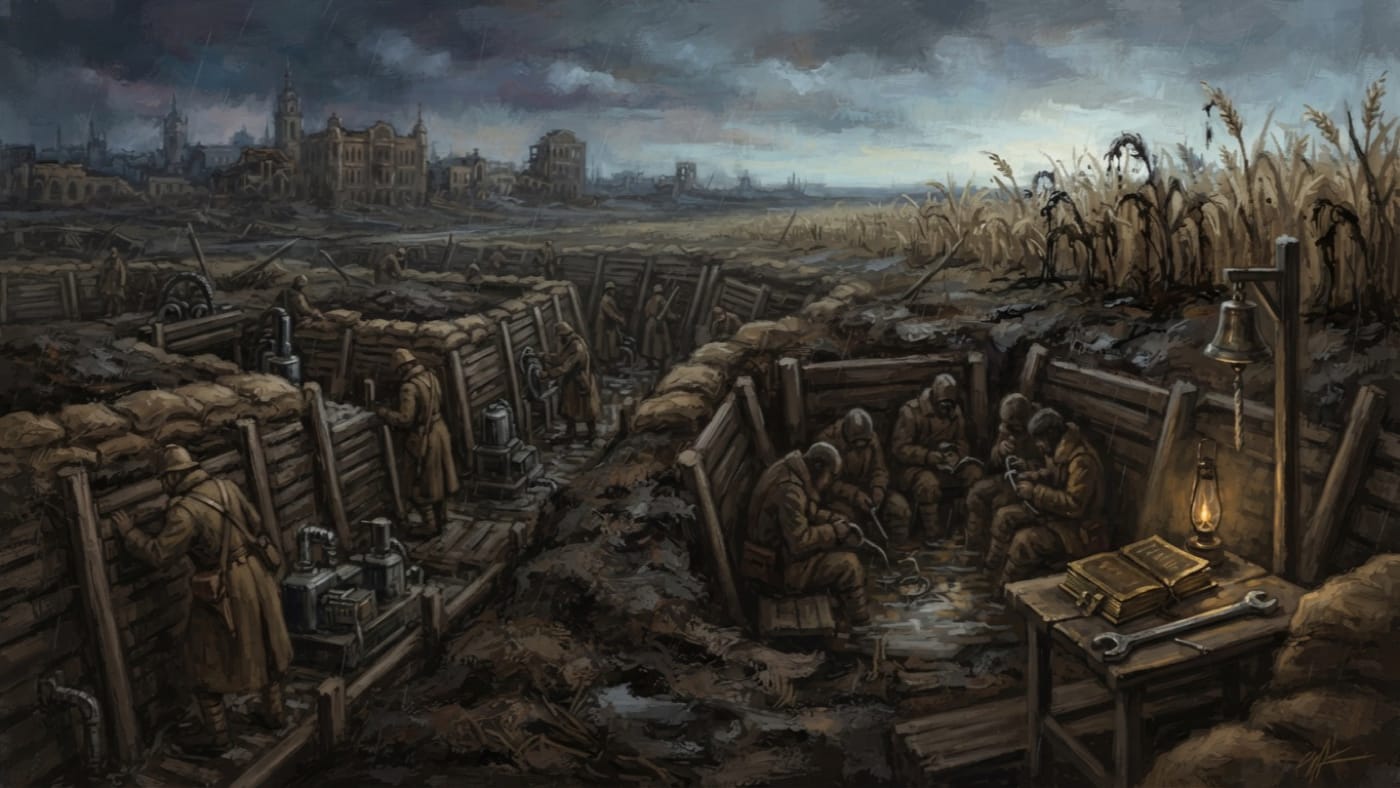
The position west of the city was cut through clay, salt and black reed-root. Water was its first enemy and its permanent tenant. The engineers slept in shifts under plank roofs bowed by condensation. The walls sweated brine. The dugout floors were mud with ambitions. A trench on such ground fills unless something drains it, so holding Odessa's western clay came down, in practice, to an argument between the pumps and the earth.
The Synod sent Litany-Engineers to conduct that argument. Their trade joins the torque wrench to the psalm. A machine is calibrated by gauge and by sanctioned tone, and its cant is sung into it as surely as its bolts are drawn tight. At the western works they kept the pump engines, trench lamps, drainage screws, hymn-gaskets and field bells. The pumps kept the walls up. The lamps kept the night countable. The bells and gaskets kept the wrong sounds out of the machinery. On that ground this was the same duty as keeping the water out of the boots, done in the same breath.
Their hymnals were stored beside their tools, and that was procedure, not sentiment. To a Litany-Engineer the book is issued kit, consulted the way a fitter consults his gauge. In a trench that runs on cant, the hymnal is within reach of every sleeping man.
#On the Rot
The Rot of Odessa spread through the trenches and killed thousands. That sentence is all the medicine that survives. The record names no organism. It gives no route of contagion, remedy, season or year, and it charges no Sin-General with authorship. The Bureau of Records does not even say which trenches.
What the Bureau did say was that the Rot was "an angelic census." The dead were entered as signatures in Heaven's ledger, which is a handsome phrase for a ditch full of men who could not keep water down. I have used such phrases myself. They are economical. A census implies an authority doing the counting, and an authority doing the counting implies that nothing has gone wrong.
The Rot does not belong to the night of the Chanters, and its thousands must never be added to that night's forty-six. Two disasters on the same clay are still two disasters. The archive is crowded enough without clerks breeding new ones by addition.
#On the Weeping Trenches
In A.S. 178 the Pale Chanters reached the western works. Their sound came through the walls. It pooled in the dugouts and settled in helmets on their pegs. It ran along the pump housings and the drainage screws, wherever clay or metal would carry a note. The engineers were trained to answer sound with sanctioned sound. They reached for their hymnals, and the hymnals failed them.
Whole companies fell to their knees and wept. Men tore pages from the books and pushed the paper into their mouths. Relief came at dawn under bell-cover, and by then the engineers had gnawed their own tongues to ribbons. Forty-six survivors were examined at first light. That number is an examination count. Anyone who quotes it as the strength of the position or the total of its dead can expect a correction in red.
Pump Engine Three was still running when the relief column arrived. During the night, two men had repaired the west drainage screw, tightening bolts the whole time they wept. The trade held when the tongue could not.
Doctrine declared the engineers martyrs. Records filed them under "voluntary disarmament of the tongue." Both entries stand.
Initial Bureau of War dispatch: "mass panic among auxiliary personnel."
Withdrawn. The men were combat-rated Litany-Engineers, the panic came from outside the wall, and "auxiliary" was the opinion of an officer who was not in the trench.
Three revisions followed. The Bureau of Engineering revised its trench-wall dampening. The Bureau of Bells ordered reliquary wax for forward engineering units, which admits that a bell, however well blessed, does not close every passage a Chanter can use. Then in A.S. 179 an engineering addendum required that forward hymnals of mechanical-cant issue be printed on heavy rag stock with reinforced margins. The official reason was wet conditions. The internal reason was that a man forced to chew his book should not be able to swallow the whole stanza. The addendum fixed the order in 179. The Ledger does not record when the first such hymnal reached a trench, and I will not invent a delivery date to flatter procurement.
Aldric Venn's memorandum proposed that the Chanter cadence heard at Odessa resembled Covenant field hymns. The memorandum was withdrawn. I record the proposal and the withdrawal and nothing in between. The full sequence, with its annexes and pension rolls, is filed under Weeping Trenches of Odessa.
#On What the Reports Preserve
The position was abandoned within three months. Patrols went back twice. Their reports describe walls that stayed damp, brine in the boot-soles, pump screws turning with no water to move, and a faint sobbing when metal tools touched the clay. Those are the patrols' words. No later survey of the western works is on file. Whether the clay still weeps in A.S. 201 is a question for whoever is ordered there next.
Nothing new has been filed on the city. Nothing has been filed on the fields since the reapers split.
What the Synod keeps of Odessa is paper. The relief column brought back damaged hymnals, and the Bureau keeps them in a drawer, catalogued by stanza and bitten through the margins. Some still carry tooth marks. One holds a pressure calculation worked in graphite around the gap where a Psalm of Closure used to be. The sums are correct.