
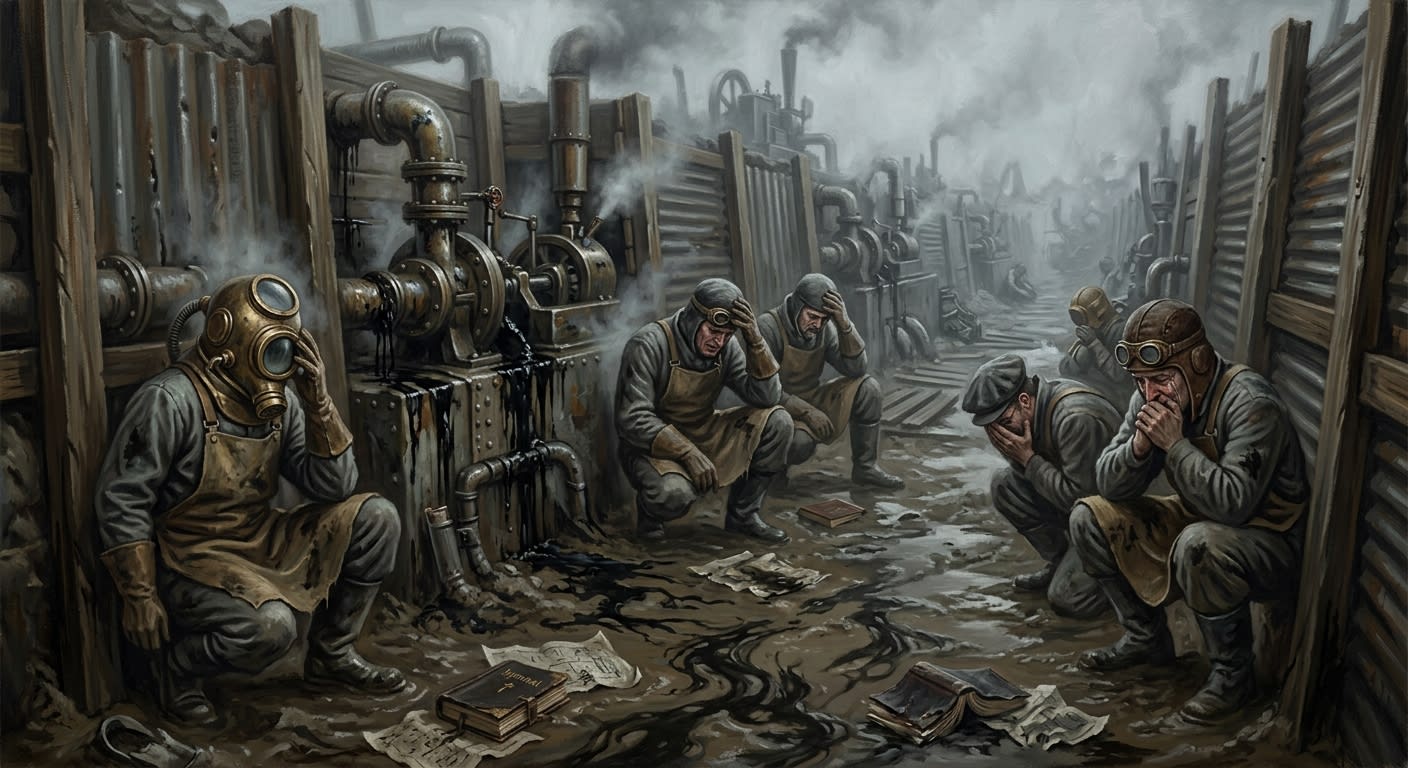
#On the Trench-Line East of Odessa
The Weeping Trenches of Odessa belong to A.S. 178, though the earth there had been practising for decades. Odessa's fields had sprouted eyes in earlier years. Crops had screamed under scythes. Harvesters had fled with ears bleeding, and the peasants who remained learned the local catechism of the Charnel Lands: wheat may watch, soil may hunger, brine may remember names better than the Bureau of Records.
By A.S. 178 the Synod held a broken trench-line (Unregistered) west of the old city, an engineering scar cut through clay, salt, and black reed-root. The position was not a bastion. It was worse: temporary, underfunded, overblessed, and expected to hold until a superior officer could discover which Bureau had authorised its abandonment. Litany-Engineers were stationed there to maintain pump engines, trench lamps, drainage screws, hymn-gaskets, and the field bells that kept fog, vermin, and despair in their assigned proportions.
The engineers slept in shifts beneath plank roofs sagging with condensation. Their hymnals were stored beside their tools. Their tongues, that most abused instrument of their profession, had been roughened by diesel cant, ignition psalms, and the little black jokes men make when the mud reaches the second rib. They were useful men. Naturally, the Enemy spent them carefully.
#On the Sound in the Walls
The Pale Chanters were heard before they were seen, if seen is the word one may use for a shape glimpsed between reed-fog and shell smoke. Their voices did not arrive as a battlefield hymn, a cry, or a trumpeted challenge. They seeped. That is the word in twelve depositions, all copied by different clerks, all later corrected into sanctioned terminology by men who dislike vivid nouns because vivid nouns have witnesses inside them.
The sound entered through trench walls. It pooled in dugouts. It settled in helmets hung on pegs and in tin cups of cold tea. It moved along pump housings, through drainage screws, under the boards where exhausted men had laid their heads. The engineers had heard foreign harmonics before. Their profession was built around engines that answered back, pipes that carried tones they had no right to carry, and generators that sulked unless sung to in the right register. They reached, by habit, for their hymnals.
That was the mistake.
They opened the books and found the letters wrong. Familiar letters, arranged in the wrong order. The Psalms of Ignition (Unregistered) bent toward lullaby. The Canticle of Stable Pressure turned tender. The closing hymns, those blunt little mechanical prayers intended to persuade pistons to stop sulking and behave like pious metal, began to read like apologies addressed to the engines, the mud, the dead, and some listener under the trench who had been waiting with priestly patience.
Men fell to their knees. They did not pray. They wept. Whole companies shook with a sobbing exhaustion that no chaplain could arrest and no sergeant could beat out of them. A few tried to sing over the Chanter seepage and produced only wet clicks. Others tore pages from the hymnals and stuffed them into their mouths, as though the paper could block the passage by which the sound had entered the body.
MEDICAL ANNEX — ODESSA RELIEF, A.S. 178 Subject group: surviving Litany-Engineers, forty-six examined at first light Common symptom: lingual trauma, hymn-memory disturbance, compulsive page ingestion Repeated written phrase recovered from six slates: “THE WALL IS SINGING WITH MY MOUTH.” One slate continued after confiscation. Hand absent. Chalk moving. ████████████████████
#On the Tongues
Relief arrived at dawn under bell-cover. The engineers were alive. Their tongues were not. Each man had gnawed his own tongue to ribbons, and the word ribbons survives in the earliest medical note because the attending Ward-Sister had not yet been corrected by a Records clerk. Later copies prefer “severe self-inflicted lingual subdivision.” The Bureau's appetite for cleanliness is, as ever, obscene.
The scene offended every tidy category. They had not deserted. They had not refused orders. They had not died. Their hands were intact. Their tools lay where they had been dropped. Pump Engine Three was still running. The west drainage screw had been repaired during the event by two men who apparently continued tightening bolts while weeping hard enough to blind themselves. One died three days later when he tried to recite the ignition cant and produced blood where the third stanza should have been.
Initial Bureau of War dispatch described the incident as “mass panic among auxiliary personnel.”
Withdrawn. The personnel were combat-rated Litany-Engineers, the panic was externally induced, and the phrase “auxiliary” was inserted by an officer whose own command post sat five miles behind the trench and contained upholstered chairs.
Doctrine declared them martyrs. Records filed them under “voluntary disarmament of the tongue.” The phrase remains one of the Ledger's most perfect little crimes: every word legal, every implication false. Voluntary, because the teeth were their own. Disarmament, because a Litany-Engineer without a tongue loses half his issued kit. Of the tongue, because the Bureau knows how to point at the wound while refusing to name the knife.
#On the Revisions
The Weeping Trenches forced three reforms, two denials, and one profitable confusion. The Bureau of Bells ordered reliquary wax issued to forward engineering units, though the Odessa survivors kept writing that they could still hear the walls through wax, cloth, pillow, prayer, sleep, morphia, and the cheerful lies of doctors. The Bureau of Engineering revised trench-wall dampening protocols, adding hush-powder to certain clay mixes and quietly asking whether pump housings should be treated as acoustic conductors. Doctrine answered by asking whether Engineering had considered repentance.
The third reform concerned hymnals. Field hymnals issued to Litany-Engineers after A.S. 179 were printed with wider margins, not for notes, as the public procurement sheet claims, but so distressed men could tear and chew the paper without losing the entire page of cant. A practical mercy. A grotesque one. The Theocracy's favourite kind.
Aldric Venn later cited Odessa in his withdrawn memorandum on Chanter origins, arguing that the cadence heard in the trench walls matched Covenant field hymns too closely for comfort. He was correct in the arithmetic, which made him dangerous in the usual way. His transfer to the Paper Mines of Ulm corrected the man without correcting the figures.
A Records summary stated that all Odessa survivors “recovered sufficiently for non-verbal service.”
Clarified. Sixteen entered maintenance posts. Nine entered Mercy wards. Seven were reassigned to silent inspection duties. Four vanished between pension rolls. Ten remained in barracks because no Bureau would accept custody of men who cried whenever mortar dried.
#On What Remains
The trench-line was abandoned within three months, then reoccupied twice by patrols too junior to refuse and too unlucky to be forgotten. Their reports describe damp walls, brine in the boot-soles, pump screws moving without water, and a faint sobbing when metal tools touch the clay. One corporal drove his bayonet into the wall and claimed the trench sighed around the blade. He was reprimanded for damaging fortification material.
No memorial stands at Odessa. Memorials require stable ground, approved access, and a version of events a preacher can survive reciting. Instead, the Bureau keeps a drawer of damaged hymnals from the relief column. The bitten pages are catalogued by stanza. Some still carry tooth marks. One carries an entire pressure calculation written in saliva-darkened graphite around a missing Psalm of Closure.