
"They do not sing. The Bureau has never classified their emissions as song." — Standing Order 14-B(Revised), Bureau of Doctrine, A.S. 187
#On the Nature of the Thing
I shall tell you what a Pale Chanter is, and I shall tell you what it is not, and you will believe whichever version the Bureau has most recently stamped — which is to say, neither, and both.
A Pale Chanter is a man. Was a man. The distinction has occupied seventeen memoranda from the Bureau of Medicine, four from Doctrine, and a single curt sentence from the Bureau of War that reads, in its entirety: "Irrelevant. Kill it faster." I have pinned that sentence above my writing desk. It is the most honest thing the Bureau of War has produced since the Concordat.
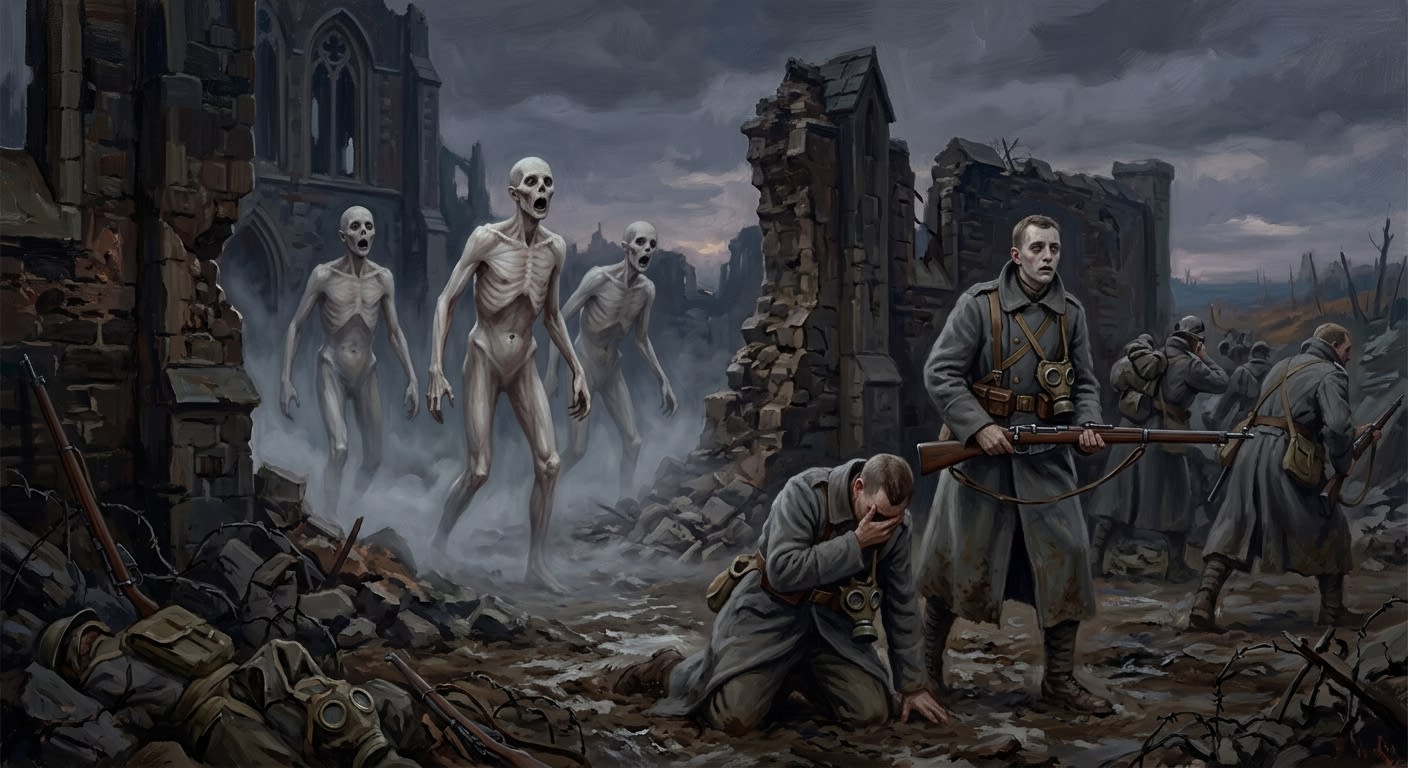
They arrive thin. Skeletal, in fact — the flesh drawn over the ribs like vellum over a poorly bound folio, the skin translucent where the lamplight catches it, the eyes sunk into orbits so deep they resemble inkwells. Their throats are ruined. Their tongues are ulcerated. They should produce no sound at all, and this is the horror: they produce every sound. They open their mouths, and what comes out is a hymn that was never written, a psalm that was never sanctioned, a liturgy that crawls into the bones of every man within earshot and begins, with terrible patience, to sing him hollow.
The Bureau refuses to call them singers. Standing Order 14-B(Revised) classifies their output as "involuntary sorcerous emission, auditory variant, Category Epsilon." The soldiers who face them across the Sagittal Line have simpler language. They call it the unhymn. They call the Chanters bone-whistles, the Creator's-mockingbirds, the choir that eats. They are correct on every count, and the Bureau has fined several of them for it.
#On the Mechanism
The unhymn — I use the soldiers' word; the Bureau may fine me — does not attack the body. This is what makes it worse than artillery, worse than the Gore-Slingers' barrages, worse than Maldrake's fire or Kargath's famine-aura. A cannonball removes a limb. The unhymn removes the conviction that the limb was worth keeping.
Soldiers describe the sensation with remarkable consistency across all seven bastions. The word they reach for is hollowness — a sudden evacuation of purpose, as though someone had opened a drain at the base of the skull and the will to fight had simply run out. At Irongate, a sergeant told his debriefer: "I knew I should fire. I remembered the drill. My fingers remembered the trigger. But I could not remember why any of it mattered." He was, of course, executed for spiritual cowardice. The debrief was filed. The description has appeared, verbatim, in forty-seven subsequent depositions from men who never read the original.
The Bureau of Engineering — because Engineering cannot resist measuring what Doctrine prefers to condemn — deployed resonance instruments along the Irongate sector in A.S. 193. Their findings were classified immediately, which tells you everything the classification itself was designed to conceal. What leaked is this: the Chanters' emissions operate below the threshold of ordinary hearing. The vibrations travel through trench walls, through helmet steel, through the calcium of the human skeleton. Veterans call it "being sung by your own bones." The phrase has appeared in nine field reports, three court-martial transcripts, and one suicide note that the Bureau of Records filed under "penmanship exercises."
The Chanters do not discriminate between friend and foe. Their hymns siphon vitality from every mortal within range — the enemy's own Thralls and Ash-Fodder collapse alongside Covenant soldiers, their faces wearing the same expression of bewildered surrender. The Shadow Court does not care. Thralls are cheaper than the sorcery the Chanters' voices fuel, and the arithmetic has never troubled a Sin-General.
#On the Incidents
Three episodes will suffice. They are well-documented, which is to say that the Bureau has documented them three times each, in three contradictory versions, and filed all nine as authoritative.
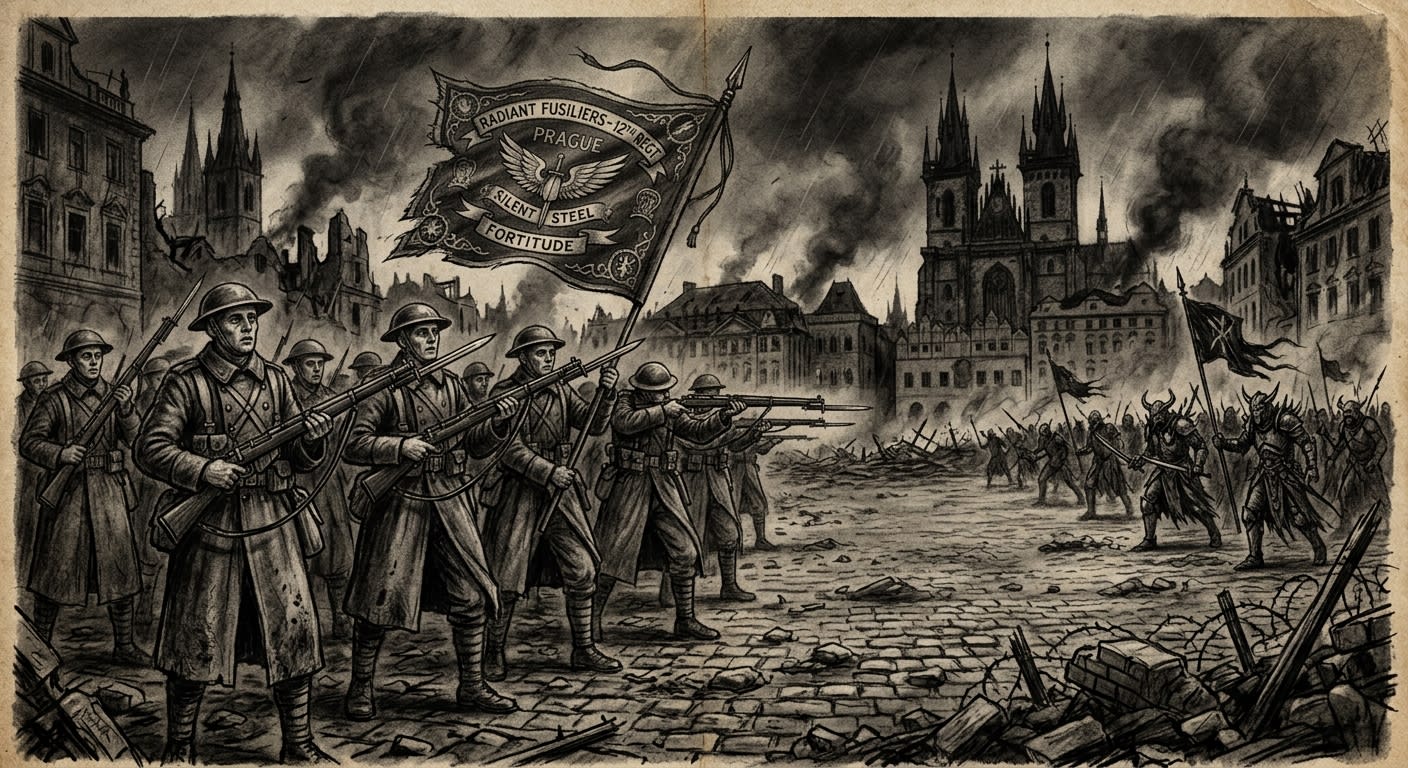
The first is the Night of Silent Steel at Prague, A.S. 167. A regiment of Radiant Fusiliers — the Fourth, if Records can be trusted, though Records insists it was the Seventh and the Fourth never existed — prepared their triple-volley beneath banner-light. The drill was faultless. The powder was dry. The banner rose. Across the field, in the rubble of what had been a seminary, seven Pale Chanters began a slow, droning inversion of the Kyrie Eleison. The banner flared white. The order to fire was given. No volley came.
The Fusiliers stood with eyes open, rifles loaded, fingers on triggers, and simply forgot to fire. They did not refuse. Refusal requires will. They forgot — as one forgets a word on the tip of one's tongue, as one forgets a face seen only in passing. The enemy surged across the open ground. Forty-three men died without discharging a single round. The Bureau filed the incident as "command miscommunication." The soldiers who survived call it "the day the Creed went silent."
STAMPED ERRATUM — BUREAU OF WAR, 2ND REV., A.S. 168: "The Fourth Regiment of Radiant Fusiliers was redesignated the Seventh Regiment, retroactively, effective A.S. 165. All references to a 'Fourth Regiment' in documents dated prior to this correction are clerical errors and should be treated as such."
The second is the Weeping Trenches of Odessa, A.S. 178. Chanters were heard before they were seen — their voices seeping like condensation across the trench-line, pooling in dugouts, settling into the ear canals of sleeping men. Entire companies of Litany-Engineers fell to their knees. They did not pray. They wept — a sobbing, exhausted weeping that no chaplain could arrest. They clawed at their own hymnals. They tore pages from the bindings and stuffed the paper into their mouths, as though to silence something gnawing inside their chests.
When the relief column arrived at dawn, the Engineers were alive. Their tongues were not. Each man had gnawed his own tongue to ribbons. Doctrine declared them martyrs. Records filed them under "voluntary disarmament of the tongue" and assigned pension category 4-C, which provides for meals but not speech therapy.
The third is the Collapse of Saint Aurelia's Convoy at Rouen, A.S. 184. A relic procession — pilgrims, guards, Bureau of Relics attestators, three Ash Chaplains — was moving a consignment of authenticated finger-bones through the market quarter when the air thickened. Witnesses spoke of a sweetness, a scent like spoiled incense, and then a sound that was less heard than remembered, as though every person in the square had always known the melody and had spent their entire lives failing to recall it.
The procession began to sway. Within minutes, the pilgrims turned on each other. Relic bearers smashed their burdens against the cobblestones. The Ash Chaplains strangled their own choirboys — methodically, with the cord-sashes of their vestments, in time with a rhythm no living ear could identify. Survivors whispered that the Chanters' voices had nested in their ears, worming thought into command. Purity burned every survivor, and not as punishment. As prophylaxis.
Locals claim that if you stand in the plaza at dawn, you can still hear voices singing under the cobblestones. The Bureau of Bells investigated in A.S. 186 and produced a four-page report whose final sentence reads: "We recommend against standing in the plaza at dawn."
#On the Countermeasures
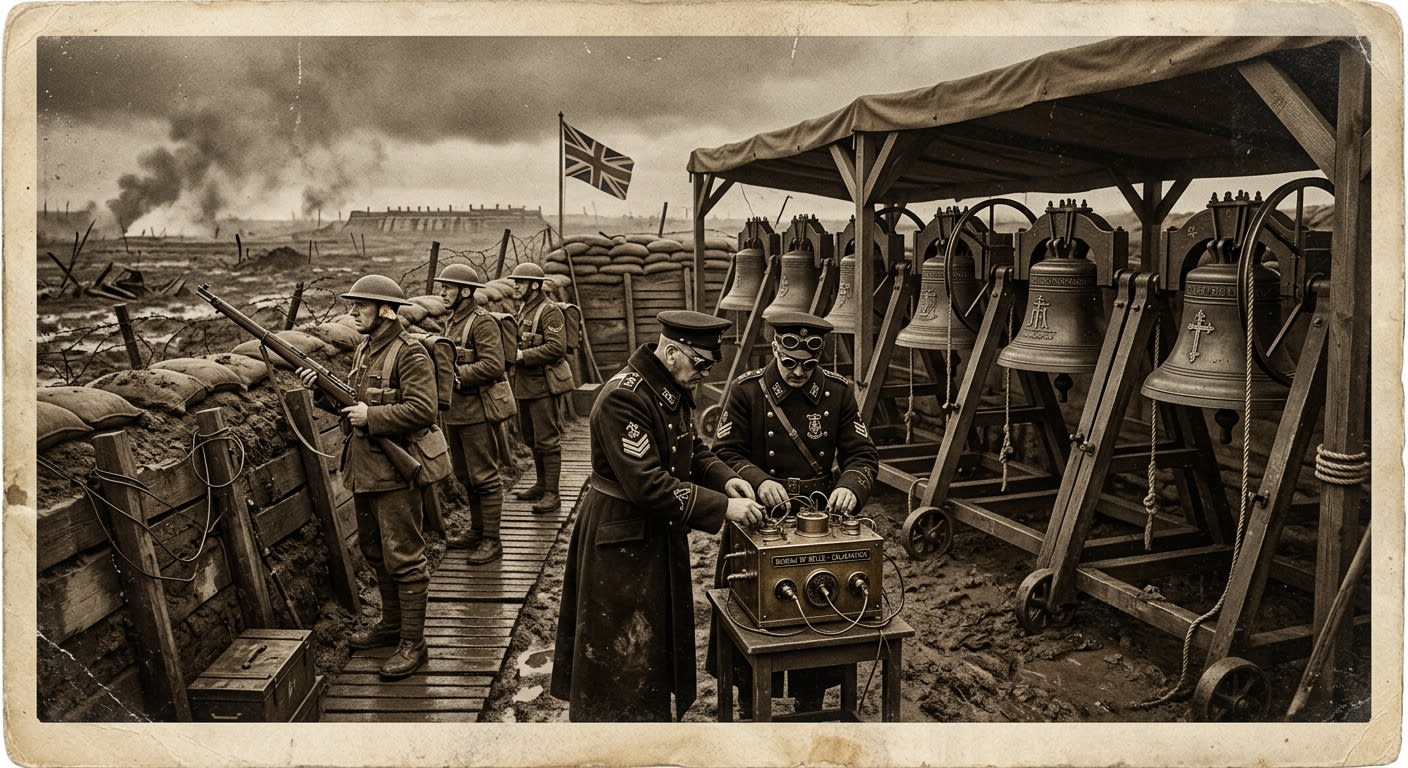
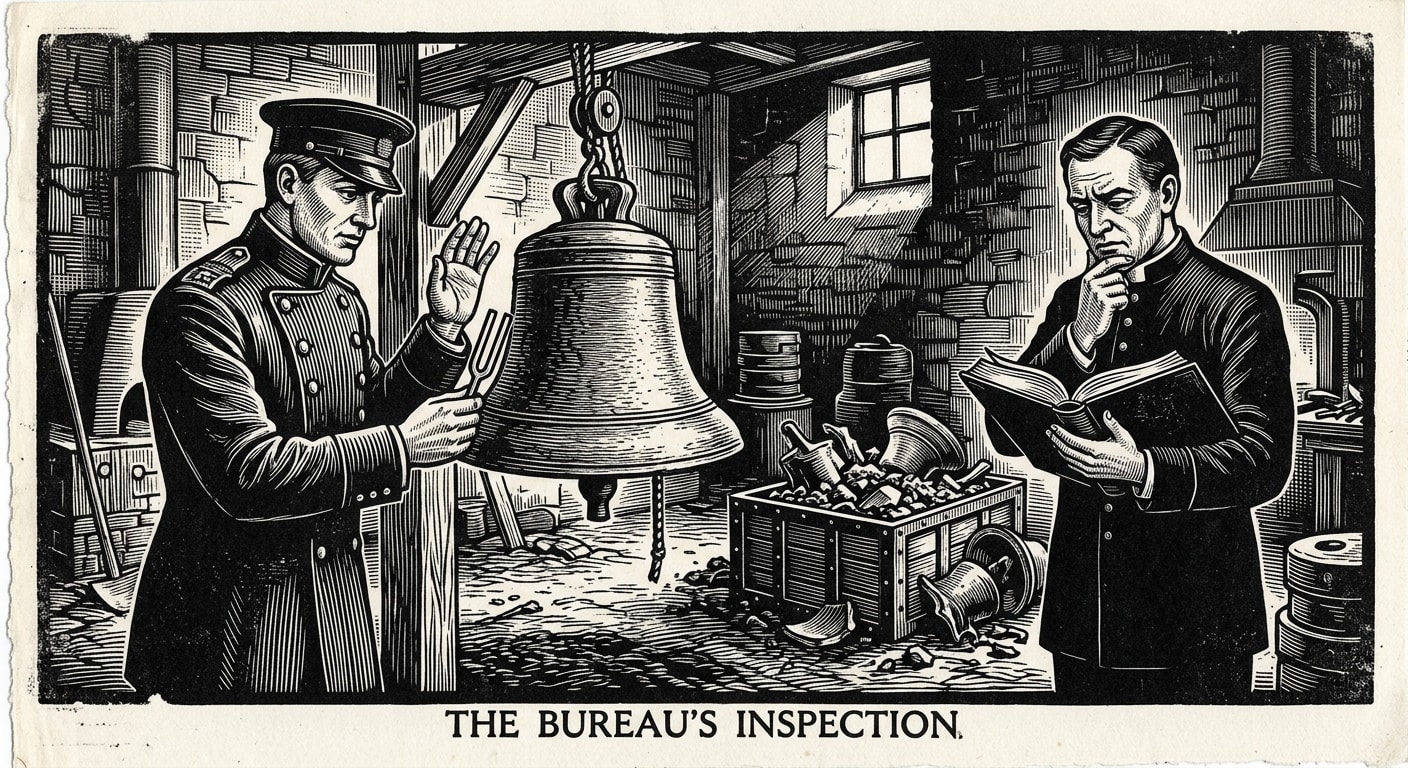
The prescribed remedy is simple in catechism and brutal in practice: bells. A sufficient barrage of sanctified peals — the Ninefold Matins at triple volume, the Iron Vespers sustained beyond their liturgical window, the Silentium pattern reversed into a continuous roar — drowns the Chanters' output, shattering their resonance the way a stone shatters a spider's web. The bell-masters of the Bureau of Bells have refined this into something approaching science, with tonal maps, frequency schedules, and a brass instrument called the Cantor's Gauge that no one outside the Bureau is permitted to touch.
And yet even bells have failed. At Vienna, A.S. 190, the Chanters sang through the peals. The sound bent. The tones warped. The bells themselves began to ring off-key — and if you have never heard a sanctified bell ring off-key, I envy your innocence and doubt your usefulness. Soldiers fell into chaos as their own defense turned traitor. Engineering called it "prayer-jam." Doctrine called it impossible. The bells were melted and recast. The new bells were tuned a quarter-tone sharp, and no one has explained why this works, least of all the bell-master who ordered it. He claims the instruction came to him in a dream. The Bureau of Bells has classified the dream.
The Bureau of Orison and Song has pursued a different approach: lacing sky-sermon broadcasts with saint-dust, on the theory that each mote of consecrated ash drifting through the acoustic frequency weighs down corruption the way ballast steadies a ship. The engineers who devised this method whisper — always whisper, because Orison engineers are a nervous breed — that if the dust runs out, the entire acoustic architecture of the front will collapse in a single unholy chorus. They have requisitioned four times their annual dust allotment. They have been granted one and a half, with a note from the Bureau of Tithes reminding them that "sanctity is a finite resource, and prayer, like silver, must be budgeted."
#On the Origins
Whence their power? The Bureau has asked this question seventeen times and produced seventeen answers, all stamped authoritative, all contradictory.
Doctrine holds that the Pale Chanters are sin given throat — heretical priests who betrayed their vows and were rewarded by the Lie with a voice that mocks the sacred music they once served. This explanation has the virtue of doctrinal neatness and the deficiency of not explaining why the Chanters' unhymns affect sanctified bells, which are, by Doctrine's own classification, immune to heretical influence. The Bureau's solution to this contradiction was to classify the contradiction.
Records offered, briefly and in a memorandum that was redacted within the hour of its filing, a different theory: that the Chanters' voices are echoes of the Covenant's own hymns, distorted across Wound-Sites, reflected back as inversions of what was originally sung. This would mean, if true, that every peal of bells, every sky-sermon, every liturgical broadcast fed into the front is simultaneously feeding the enemy a weapon. Records withdrew the memorandum. The clerk who wrote it was transferred to the Paper Mines of Ulm. His name has been struck from the registry.
I note, because I note everything and forget nothing that is useful to me, that no Pale Chanter has ever been captured alive. Every specimen secured by field teams has died within minutes of restraint — the voice guttering out like a candle pinched between wet fingers, the body collapsing into a weight of bones and rags that the Bureau of Medicine describes as "inconsistent with sustained biological function." They should have been dead already. They were dead already, perhaps, and the unhymn was the only thing keeping the meat upright. When the voice stopped, the corpse remembered what it was.
[EXCISED — BUREAU OF DOCTRINE, SEAL 7-C] ██████████████████████████████████████ found in the laryngeal cavity of Specimen 14-D recovered at Bastion-Irongate, A.S. 197. Composition: calciumite, chrism residue, and a substance the Bureau of Alchemical Standards has declined to identify. When struck with a tuning fork, the object ██████████████ in the key of ██████. Three attendants were treated for ██████████████. The object was sealed in lead and interred in the Forbidden Stacks. Its catalogue number is [EXCISED].
#On the Present Condition
The Pale Chanters grow more numerous. This is the sentence the Bureau does not stamp, the memorandum no clerk dares file, the observation every officer along the Line has made and every report has omitted. In A.S. 195, field estimates placed their number at two hundred across all seven bastions. By A.S. 199, the estimate had risen to six hundred. The current figure, which I obtained from a source who will remain unnamed because I cannot remember his name and because he does not, technically, exist in the census, is nine hundred.
They are concentrating. At Shipka, where Syrion's fog already smothers bell-schedules and time itself bends toward indolence, the Chanters' unhymns merge with the ambient lethargy to produce a silence so complete that soldiers have been found standing at their posts, rifles shouldered, eyes open, breathing, and entirely absent — as though the soul had stepped out for a smoke and neglected to return. At Irongate, the Gasket Choir — the chant-as-bracing system that holds the walls together as much as any mortar — has begun producing harmonics the Bureau of Bells cannot identify. Whether the Chanters are causing the anomaly or responding to it is a question no one has been authorized to ask.
The Bureau of War's official position remains unchanged: kill them before they open their mouths. The Bureau of Bells recommends sustained pealing. The Bureau of Orison and Song recommends saint-dust. The Bureau of Doctrine recommends prayer. The Bureau of Medicine recommends ear-plugs, which Doctrine has classified as "an admission of insufficient faith" and therefore heretical.
I have heard them called singers by men braver than the Bureau. I have heard them called the worst thing on the Line by men who have faced Maldrake's fire, Kargath's hunger, and Velkara's whispered promises. I have heard, at a great distance, what they do to a hymn. They take it and they break its back, and when it lies on the ground twitching, they sing it again — wrong, and perfect, and terrible in its wrongness.
The Bureau says they do not sing. The Bureau is, as always, correct.
And the Chanters keep singing.