
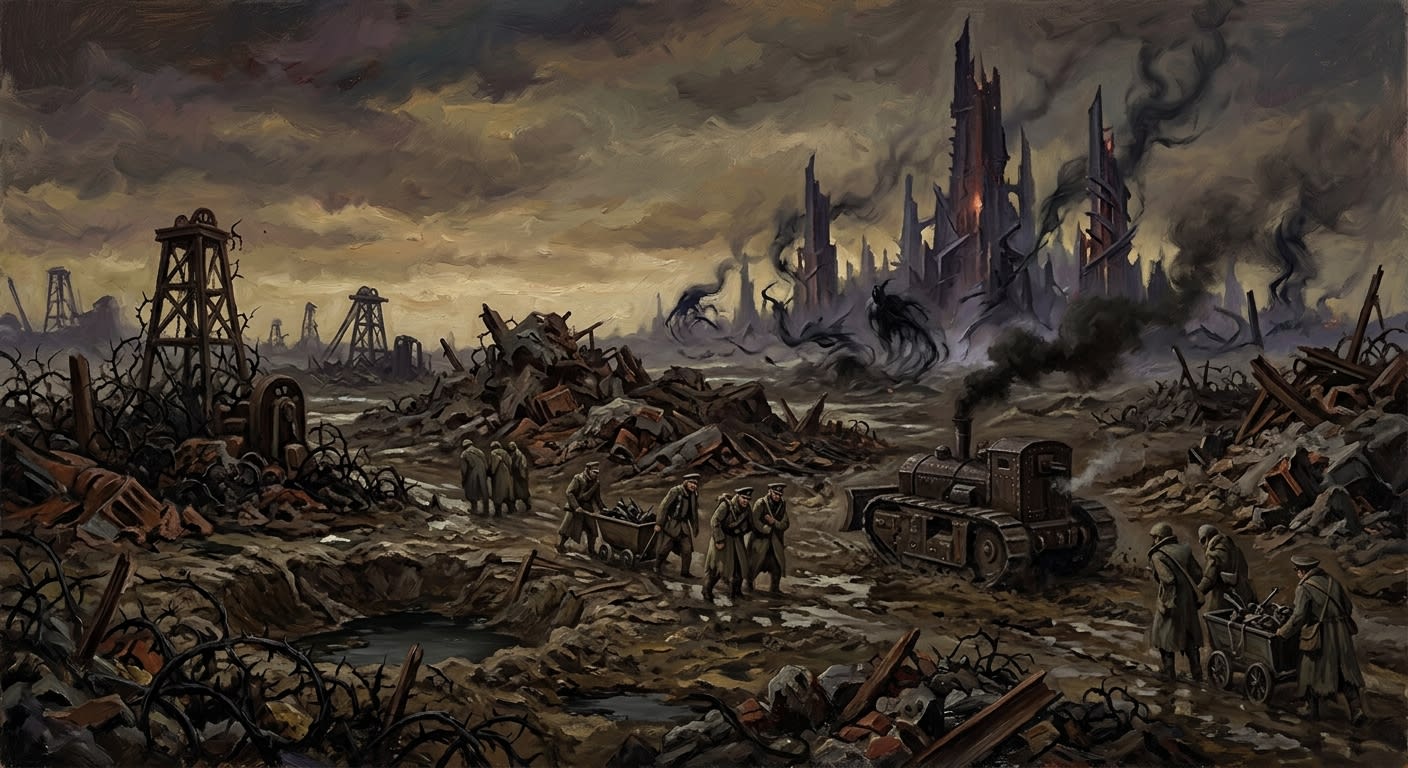
#On the Name That Refuses Geography
The Charnel Lands are what remains when geography has been corrected by Hell and the Bureau has declined to surrender the map.
The term designates the demonic territories east of the Sagittal Line: Ukraine (Unregistered), Moldavia, Wallachia, Romania (Unregistered) beyond lawful custody, the eastern Balkans, Thrace in its more dishonourable moods, and the old Russian approaches (Unregistered) where distance itself seems to have enlisted with the Enemy. Zone 6 in the Registry. The Charnel Lands in sermons. The East in soldiers' mouths, when soldiers are too tired to spend syllables on accuracy. These names do not agree because the land beneath them no longer agrees with itself.
A school map colours the region black. This is merciful to children and insulting to ink. The Charnel Lands are not one colour, one enemy, one climate, one wound, or one damnation. Kargath's hunger rots the Hungarian marshes into ledgers of appetite. Velmora makes border towns glitter with coins that buy fathers from sons. Atheron raises pride-spires from broken fortresses and teaches mirrors to applaud. Morwen makes the Irongate approaches envy their own shadows. Maldrake leaves fire in the joints of roads. Syrion lets sleep pool in passes until time forgets its duty. Velkara moves without border, perfuming ruins until men mistake dissolution for tenderness.
The Bureau of Records uses the phrase Demonic Occupation Zone, Eastern Aggregate. The Bureau of War says hostile depth. Pilgrimage says nothing, because no authorised route goes there and Pilgrimage's courage weakens when there are no souvenir stalls. Doctrine says Charnel Lands because the phrase teaches at once: bodies, ruin, judgement, and the insult of territory still occupying the Creator's earth while refusing His audit.
The Charnel Lands did not become empty. Emptiness would have been cleaner. They became inhabited by things that used to be cities, men, rivers, armies, prayers, bread, and weather. That is worse.
#On the Making of the East
The Charnel Lands began as a political collapse, matured into a military catastrophe, and achieved their present dignity as an administrative obscenity. Before the Sundering of A.S. 45, the east contained kingdoms, republics, bishoprics, academies, markets, harvest roads, soldiers, fools, heretics, saints, and the usual amount of livestock pretending history would not notice them. It had borders. It had tax quarrels. It had men who wrote municipal charters in decent ink and believed the future would respect margins.
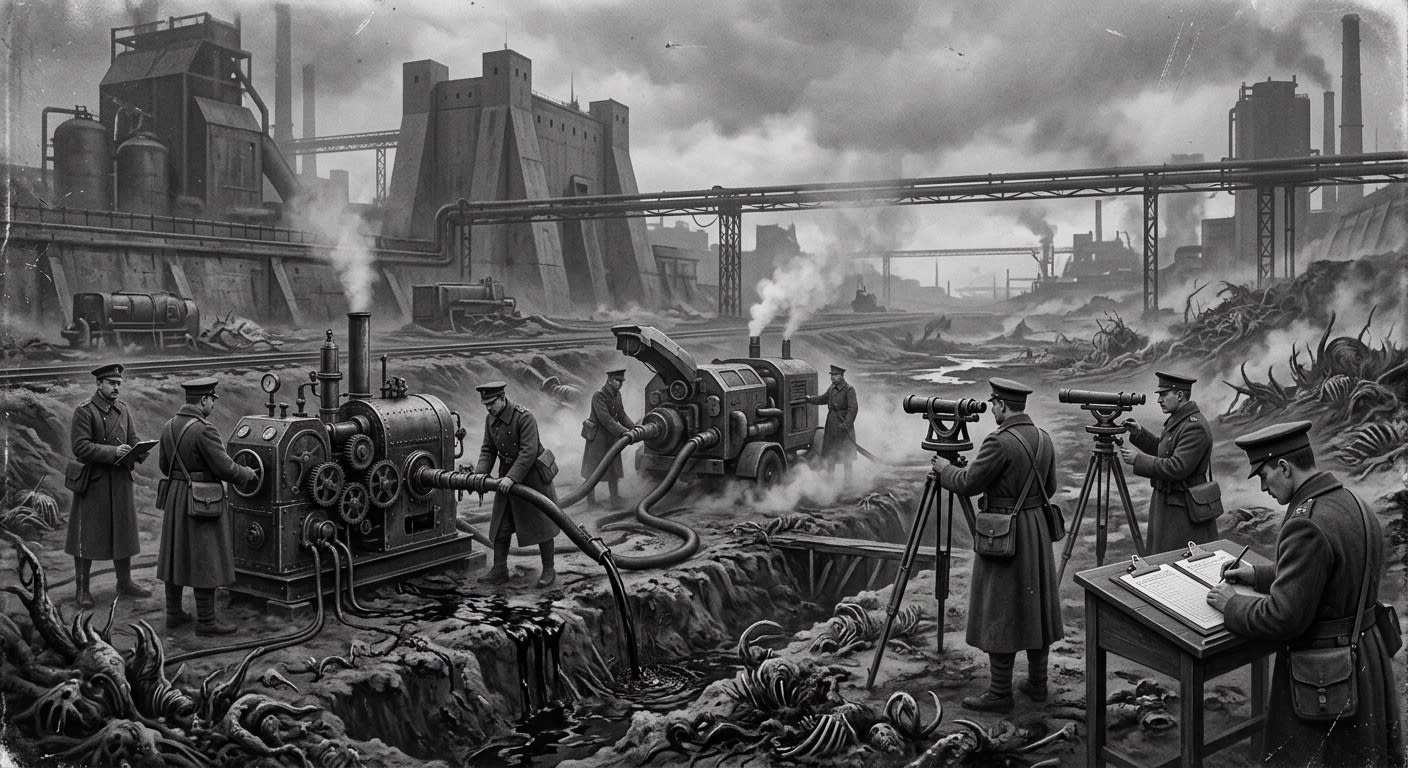
The Rationalists helped prepare the wound. Their Desecrations stripped shrines, mocked relics, catalogued bells for cannon, and taught populations to regard holy ground as inventory. Then the Balkan breach opened, the old certainties screamed, and the eastern provinces discovered that a sanctuary removed from a town leaves a shape something else can fill. The Republic had cleaned the altars. Hell appreciated the courtesy.
Earlier Catechism plates state that the Charnel Lands were “created in a single night by the Sundering.”
Corrected. The Sundering opened the wound. Men had spent forty-five years washing the knife, sharpening the table, dismissing the surgeon, and selling tickets to the procedure. Hell entered quickly because the door had been made tidy.
The collapse of the Rationalists was not a heroic reversal. It was a shelf giving way under bad books. Eastern garrisons splintered. Prefects fled with ledgers and left families behind. Secular militias discovered that “Man Alone” sounds poor when something under the floor begins using your mother's voice. Bishops were devoured in Prague; magistrates were swallowed in Bessarabia (Unregistered); professors in Odessa wrote final treatises on mass panic and signed them in handwriting that changed halfway down the page.
The first westward columns brought news in fragments: bells ringing under water; wheat fields bending toward the east although no wind blew; cattle born with human teeth; children reciting laws repealed before their grandparents' births; rivers that crossed themselves; roads that led back to the graves from which their paving stones had been stolen. Records rejected most accounts as refugee distortion, then created three new cabinets for rejected accounts that repeated too often.
A.S. 48–65, the Great Retreat, gave the Synod its first practical outline of the wound. Men did not flee from one front. They fled from mouths, fogs, hunger saints, mirror courts, red rivers, silence pockets, and villages where every window held the same face. Behind them the East ceased to be a set of lost provinces and became an appetite with provincial habits.
#On Boundaries and the Sagittal Mercy
The western edge of the Charnel Lands is not the Sagittal Line. This distinction offends schoolmasters and saves soldiers. The Line is Zone 4, the north-south defensive spine from Bastion-Königsberg to Bastion-Constantinople. East of it lies No-Man's-Land, Zone 5: contested mud, mined approaches, dead belts, listening posts, false farms, trench chapels, artillery scars, and those patient grey miles where the Synod and Hell take turns losing men in quantities too small for epics and too large for mothers.
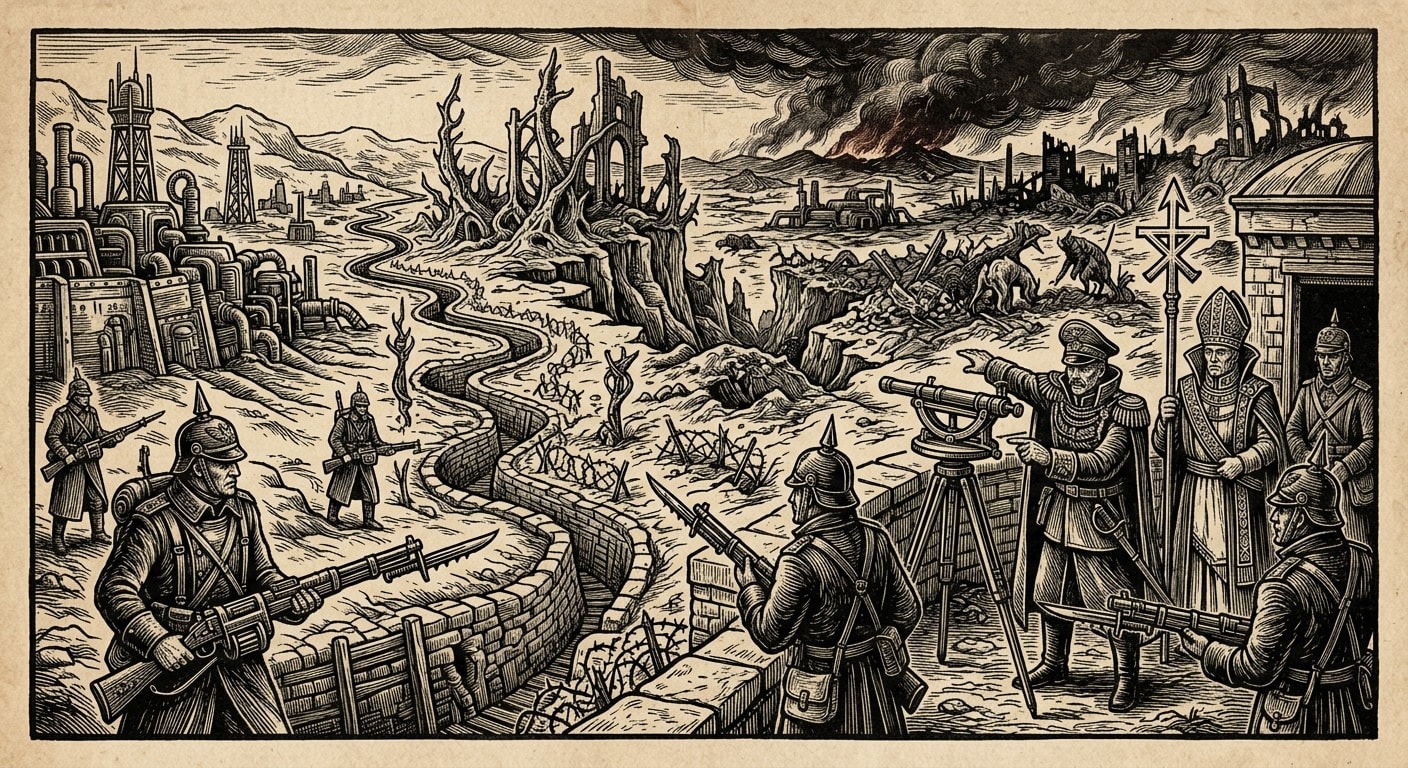
Beyond that begins Zone 6. The Charnel Lands proper. The difference is not distance. It is custody. No-Man's-Land may be crossed by patrols, punished by guns, measured badly, lost temporarily, retaken at cost, entered in War tables, and lied about with some discipline. The Charnel Lands resist the grammar of possession. A platoon may enter. A map may return. The platoon often does not. The map, worse, may.
The Sagittal Line is called a wall by peasants, a spine by soldiers, a miracle by preachers, and a budgetary ulcer by men too honest to advance. It is all of these. Its seven bastions bind the western edge of inhabitable Europe to a posture of refusal: Königsberg in the north, Brest on the Bug, Przemyśl in the Carpathians, Sibiu at the Transylvanian wall, Irongate on the Danube gorge, Shipka in the Balkan throat, Constantinople at the Bosphorus hinge. West of them, bureaucracy multiplies until life becomes lawful. East of them, law grows teeth it did not file.
The phrase Charnel Lands tempts the ignorant into imagining a great cemetery. A cemetery has names, fences, rites, paths, and stones aligned by human grief. The East has pits that eat labels. It has burial mounds that crawl in wet weather. It has villages where graveyards remain orderly and every house is empty except for the room where dinner is still warm. It has battlefields whose dead stand when the moon is absent and sit when priests approach. A cemetery is a bargain with death. The Charnel Lands are death refusing the contract.
#On Domains Within the Wound
The Synod divides the Charnel Lands by enemy pressure rather than by old borders. Old borders matter to historians, genealogists, smugglers, pretenders, and the sort of exiled noble who believes a title can survive being carried in a damp trunk for three generations. War cares which Sin-General has touched the roads.
North and north-east lie the cold reaches where the unnamed powers press through marsh, lake, and uncoloured weather. Reports from lost Baltic approaches speak of white reed-fields, bells heard beneath ice, and patrols walking for three days toward a lantern that remained exactly one hundred paces away. Records marks much of this sector under suppression because soldiers who know too much about the northern grey develop a habit of praying without verbs.
In the Carpathian approaches, Atheron's influence grows vertical. Towers, mirror rooms, proud dead officers still wearing ranks revoked a century ago, academies where cadets salute themselves until the flesh splits at the elbow. Pride prefers height because height permits looking down, even in Hell. The approaches to Bastion-Przemyśl teach this at shell range.
Southward, the old Wallachian and Transylvanian east-slope districts bear Morwen's envy. Wells reflect richer water than they contain. Houses appear larger from the road than within. Soldiers report hearing their own medals awarded to other men in adjacent fog. At Irongate, even the Danube sometimes seems to resent the banks that hold it.
Hungary's drowned interior belongs, in large part, to Kargath's theology of appetite. The Blightmarsh does not merely rot. It accounts. Hunger there has columns, mouths, rations, aftertastes, and invoices written in flies. Men found in that sector often die begging forgiveness from bread.
Maldrake's wrath burns roads south and east toward Constantinople, where old Thrace has learned to glow under ash. Syrion's sloth pools in Shipka's fog, delaying orders, spoiling clocks, softening sentries into sleep that lasts through bombardment and wakes only when the casualty lists arrive. Velkara needs no fixed land. She passes through camps, ruins, merchant houses, hospital tents, and pilgrim songs like perfume entering cloth.
None of these domains obey clean edges. Sin bleeds. Greed hires hunger. Pride imitates envy. Wrath borrows lust's perfumes when it wishes a city to open its gates smiling. Sloth lets gluttony fatten a garrison until no one rises for the alarm. Our analysts at the Bureau of Inter-Infernal Analysis produce diagrams of these relations in seven colours. The diagrams are admired, revised, locked away, rediscovered, and contradicted by the next patrol report.
#On Cities That Remain Too Much Themselves
The Charnel Lands contain ruins that ought to have had the decency to become rubble. Many refused. Odessa weeps in trenches that remember music badly. Skopje warrens breathe through under-streets where old market cries repeat at prices no living merchant would accept. Bucharest (Unregistered) appears in dispatches as a city of windows with rooms behind them arranged for guests expected since A.S. 45. Kiev's bells, if the northern reports are permitted any weight, ring inward. The eastern bank of Budapest remains a contested insult visible from the west, close enough for memory and too far for comfort.
A ruined city is simple when it is only stone. The eastern cities kept habits. Streets still funnel crowds that are no longer crowds. Market squares still summon trade. Courts still arrange petitioners. Churches stripped by Rationalists and later entered by the Enemy retain the shape of worship, which makes their profanation exact rather than chaotic. Hell is not always messy. It has studied us.
URBAN STATUS ADVISORY — ZONE 6. Do not classify a city as dead because fires have ceased. Do not classify a church as empty because no bells answer. Do not classify a market as abandoned because all stalls face inward. Do not enter civic squares where birds form letters.
Cartographic Expedition A.S. 73 proved this with expensive clarity. The expedition went east under escort, sextants, relic compasses, Bureau of Records surveyors, two Litany-Engineers, and enough confidence to qualify as pre-mortem evidence. Its surviving folios contain roads measured in ordinary miles on the outward route and in confessional intervals on return. One page labels a town uninhabited except by municipal intention. Another shows three rivers meeting at a chapel that none of the escort remembered crossing. The expedition's commander returned with his signature reversed. Records authenticated it because the alternative required admitting that the paper had signed him.
The expedition gave the Synod useful errors. We learned that distances change less under relic weight. We learned that bells sent ahead by mule return with cracked mouths if the mule hears its own name. We learned that old administrative buildings are more dangerous than farmhouses, because offices retain appetite for petitioners. We learned that maps copied after midnight showed additional roads in the morning, most leading toward the cartographer's childhood home.
A.S. 80 school atlases used Expedition 73 to mark “recoverable eastern corridors” in dotted gold.
Withdrawn. The gold corridors were aspirational, which is to say false with nicer ink. Current instructional maps mark those routes in grey caution, black interdiction, or no ink at all where the omission teaches more safely.
The cities remain because we remember them and because the Enemy finds memory a useful scaffold. A place named by longing can be milked. Exiles dream of return. Soldiers dream of liberation. Clerks dream of restored archives. Demons are patient with dreams; they use them as doorways small enough to pass inspection.
#On Persons, Remnants, and the Problem of Return
Men return from the Charnel Lands. This is the fact that prevents the Bureau from enjoying the clean doctrine of total loss. Scouts return. Refugees return. Ash-Mothers return with children who will not cast shadows. Traders return with coins warm from hands they cannot describe. Prisoners return speaking in farm dialects from villages erased before they were born. Every return is mercy, evidence, contamination, and paperwork.
The Ash-Mothers are the most visible sacrament of eastern ruin. Women taken, altered, sent, or escaped from Kargath's famine systems move westward with infants wrapped in grey cloth and ash under the fingernails. Some are victims. Some are carriers. Some are both, because Hell has never respected our love of categories. Settlement offices want to house them. Purity wants to burn half and interrogate the other half. Mercy wants to name them before breakfast. Records wants fathers listed. The children decline assistance by existing wrongly.
Ash-Fodder, Gore-Slingers, Veil-Stalkers, Pale Chanters, Blood-Tithes, Skin-Thieves (Unregistered), Wormhosts: these are not native species of the East. They are human material under infernal administration. The Charnel Lands process people. They requisition hunger, shame, song, flesh, memory, family likeness, and civic habit. A captured village may become labour, choir, bait, disguise, wall, sacrament, or ration depending on which Sin-General reached it first and which lesser horror filed the intake.
This is why the Synod fears eastern survivors more honestly than eastern corpses. A corpse can be burned, blessed, counted, and entered. A survivor must be listened to. Listening is hazardous. He may bear intelligence. He may bear plague. He may bear a lullaby that makes the third listener cut his own name from a registry. He may bear only grief, which is worst for administration because grief resists classification while remaining morally inconvenient.
RETURNED PERSONS SCREENING — ZONE 5 WESTERN GATE, A.S. 188 Subject group: eleven refugees from former Moldavian parish. Names given: eleven. Names found in parish death roll, A.S. 52: eleven. Pulse: ten. Spoken prayers: twelve voices. Disposition: ███████████████████████████████████████ Clerk note, later struck: “The absent one answered roll call from inside the stove.”
Administrative dissolution exists partly because return can become a weapon. When a person, regiment, family line, or village has been so compromised that ordinary death, exile, or correction cannot contain the hazard, the Synod may strike it from all civil standing. Names removed. Claims voided. Records sealed. Relatives instructed to grieve without object. This is cruelty with a broom. It is also, on certain days, the last mercy paper can offer.
#On What the Land Does to Measures
The Charnel Lands damage measurement before they damage flesh. This is courteous in a narrow sense; it gives the intelligent a chance to leave. Clocks disagree within sight of one another. Compasses turn toward songs. Survey chains lengthen when dragged over old battlefields. Mile markers migrate at night and gather in herds along ruined roads. A sextant used east of Odessa reflected a sky containing one star too many; the navigator who reported this spent the next week crossing out his birth date in every file he could reach.
Distance is doctrinally suspect there. A patrol may march twelve miles and return with boots worn through ninety. A messenger may leave at dawn and arrive before the order was written. Dead men may lag behind their units for three days, which is poor discipline but useful warning. War dislikes such facts. Engineering dislikes them more. Doctrine enjoys them only after the men involved are safely buried.
The weather has offices. Kargath's damp fattens hunger. Syrion's fog delays decision until decision rots. Maldrake's hot winds make old grudges bleed. Morwen's clear mornings show every soldier a life he believes another man stole. Atheron's high cold makes officers polish buttons before retreat. Velkara's warm rain produces confessions nobody requested. The Charnel Lands do not have climate. They have moods with jurisdiction.
Relic instruments behave better but never well. Saint-bones pull toward mass graves. Bell-metal dulls before ambush. Candles burn blue near old Rationalist laboratories and green near demon kitchens. Ink clots when a place-name has become unsafe to write. Bureau surveyors now carry three maps: official, field, and sacrificial. The sacrificial map is shown first to any road, gate, bridge, well, chapel, or child asking directions.
#On Patrols, Expeditions, and Other Approved Forms of Dying
The Synod enters the Charnel Lands constantly and admits it rarely. Public doctrine prefers the image of a fixed refusal: bastions facing east, bells ringing west, the Faithful held behind holy walls while Hell exhausts itself on wire and stone. Public doctrine is useful, clean, and false in the manner of parade boots. War sends patrols. Records sends surveyors. Purity sends retrieval teams whose orders use the word contamination more often than rescue. Doctrine sends observers whenever a rumour grows fat enough to require interpretation. Tithes sends no one, which proves Tithes is wiser than its sermons.
A sanctioned crossing begins before dawn in a Zone 5 forward chapel. Names are spoken once, written twice, and sealed in a red packet held by a Records clerk who has been instructed not to open it unless the returning party displays discrepancies of number, shape, or doctrine. Each member carries a relic token, a waxed identity slip, three beads of silence, a ration stamped with departure hour, and a small square of blank paper called the Mercy Folio. The Mercy Folio is for last messages, map corrections, confession, or proof that the hand still belongs to its owner. Most return blank. Blankness from the East is never comforting.
Patrol reports obey a strict order: distance, weather, enemy sign, terrain instability, losses, recovered intelligence, unclassifiable phenomena, prayers omitted under duress. Men who place the prayers first are reassigned to rear catechism or quietly watched. Men who omit unclassifiable phenomena are promoted if successful and prosecuted if contradicted by survivors. One must never lie too early in a report. It deprives superiors of the pleasure of arranging the lie properly.
The common patrol types are five. Listening patrols enter the grey miles east of the wire and bury bell-cups in mud, hoping to catch distant Chanter inversions or the chewing rhythm of Wormhost movement. Cartographic cuts push farther, measuring roads until roads object. Ash retrieval parties search battle pockets for identifiable remains, a word broadened by necessity to include bones, tags, teeth, buttons, signed prayer scraps, and shadows still attached to fence posts. Relic lures carry minor authenticated objects eastward to see what answers. Punitive raids go in with guns, hymns, and the oldest military superstition: that killing a thing teaches its neighbours manners.
The Charnel Lands tolerate none of these equally. Listening patrols hear too much. Cartographers see too much. Ash retrieval parties bring back too little of what they were sent for and too much of what followed. Relic lures work best and are spoken of least, because the things that answer relics are not always enemies and are seldom polite. Punitive raids satisfy the west for one evening, which is why generals like them and saints do not.
War colleges teach that eastward operations fail from overextension, poor signal discipline, relic fatigue, enemy sorcery, and inadequate retreat protocol. These are respectable causes. They wear boots. Field chaplains add pride, hunger, pity, curiosity, sexual stupidity, and the soldier's immortal belief that a crying child in a ruined lane is merely a crying child. This list has better survival value and worse citations.
An A.S. 158 War College primer advised young officers that “firm intention” could stabilise patrol morale inside Zone 6.
Withdrawn after the Debrecen review. Firm intention stabilises parade squares, prayer queues, and the posture of men awaiting portraiture. East of the Line it provides the Enemy with a handle.
The most dreaded order is verify. Verify the bell heard in the evacuated parish. Verify the lights seen beyond the Blightmarsh. Verify the child speaking Strasbourg office Latin near the Odessa trenches. Verify the bridge where no river remains. Verification is how the Bureau says: go place your body between rumour and policy.
VERIFICATION DETAIL — EAST OF FORMER CHERNIVTSI (Unregistered), A.S. 193 Objective: confirm report of tolling under collapsed chapel. Personnel: six; one bell technician; one Purity reader; four infantry. Return: bell technician, left hand only; Purity reader, voice intact but speaking from pack; infantry count disputed. Finding entered: “Bell absent. Tolling persists.” Recommendation: ███████████████████████████████
There are victories. Small, ugly, expensive victories; the only honest kind east of the Line. A culvert destroyed before Wormhosts reached it. A village bell recovered and recast before it learned the wrong hymn. Twenty-seven refugees screened and found no more contaminated than misery makes anyone. A map burned in time. A Pale Chanter killed before opening its second mouth. A bridge mined after every man crossing it saw his dead brother waving from the far bank. These victories do not make statues. They make continued westward breakfast possible.
#On Present Doctrine and Future Lies
As of A.S. 201, the Charnel Lands remain beyond recovery, beyond civil audit, beyond honest settlement, and far beyond the patience of men who draw straight lines on office maps. This does not prevent recovery plans. The Synod produces them regularly. Plan Northglass. Plan Saint Veyrault's Return. Plan Grey Corridor. Plan Danube Re-Litigation. Plan Obedient Dawn. Each is sealed, revised, blessed, budgeted, denounced as premature, resurrected under new title, and assigned to committees whose members age visibly during the first meeting.
We will retake the East. Doctrine requires the sentence. War requires the possibility. Tithes requires the future taxable base. Pilgrimage has already designed route tokens for shrines that no longer possess floors. Records keeps blank ledgers for restored parishes, stacked in Strasbourg vaults, each page ruled cleanly enough to make angels laugh into their sleeves. Hope, when licensed, is a useful narcotic. Unlicensed hope is treason with flowers.
The truth beneath the approved sentence is uglier and stronger: the Charnel Lands cannot be won by marching into them as though they were merely occupied territory. Occupation leaves walls standing for the victor. The East has altered what standing means. To reclaim it will require guns, bells, roads, saints, engineers, doctors, exorcists, mothers, grave-diggers, map-burners, liars of high quality, and clerks brave enough to admit when a town has become a mouth.
Until that blessed, expensive, corpse-heavy day, the Sagittal Line holds. Patrols enter Zone 5 and sometimes cross further. Cartographers return with shaking hands. Refugees arrive with grief wrapped in blankets. Guns fire east. Bells answer west. The Charnel Lands press against the maps like rot under a bandage.
At night, in certain Line sectors, one may stand on the parapet and see lights moving far beyond artillery range. Villages, if the watcher is charitable. Camps, if he is military. Stars fallen low, if he is a poet or a fool. The lights arrange themselves briefly into streets remembered by men whose grandparents fled them. Then the pattern breaks. The darkness resumes its paperwork.
The East remains.
So do we.