
#On the Present Survey
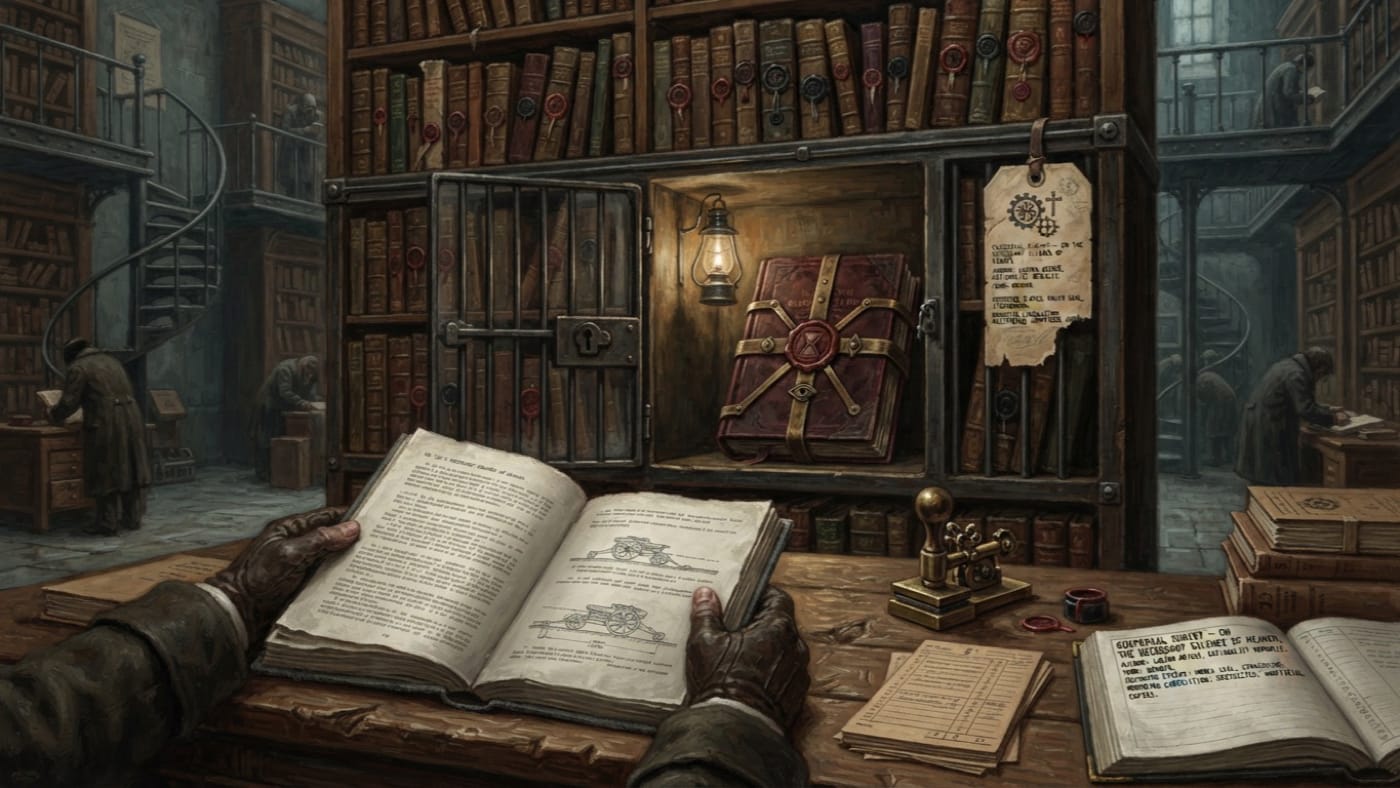
This is a survey of the present year, A.S. 201. It covers one book, On the Necessary Silence of Heaven, the memoir of Lucien Artois, called the Iron Rationalist, and it records what can currently be said about that book's custody. That is not much. The year of composition is unrecorded. The year of sealing is unrecorded. How the manuscript came into the Church's keeping, and from whose hands, is not entered either. I will not invent dates for the convenience of the indexers. They have survived worse disappointments.
The book's present status fits in two clauses, and the clauses disagree. The memoir is under seal in Strasbourg. Copies of it circulate. The first is the official position. The second is reported, again and again, by people who would rather not have reported it. A survey that kept only the first clause would be neater, and it would be a lie. The Bureau tolerates many things in its ledgers, but it draws the line at neatness bought that way.
#On the Author's Credit
Nobody guards a dull book. This one is guarded because of the man who wrote it, so a little of that man has to go into the file. Only a little. His full dossier exists, and I wrote it, and I don't care to repeat myself where clerks can count.
Artois was an artillery commander and ordnance reformer for the Rationalist Republic during the Atheist Wars. At Montreval he spent three winters across the pass from Cardinal-Marshal Severin of Avignon, and the two of them improved each other the way a whetstone improves a blade, by grinding. At Toledo, Colonel-Prefect Étienne Grimal fired clockwork cannon built to Artois's designs at the cathedral walls. The guns were his. The command was Grimal's. The Bureau of War has since blessed the same pattern of carriage, engraved a psalm on the breech, and named it the Ordained Repeater. That rite does not make the brass less his. It only makes it ours.
That is why anything he wrote down carries weight. A crank's memoir goes to the pulping vat. A memoir by a man whose recoil mathematics still sit inside the Church's own guns goes into a locked room, and the people with keys to the room start to get ideas.
I admire the prose the way a confessor admires a well-built lie. Admiring the build does nothing for the soul of the man who built it. I am also sharper than most readers at seeing where the joints are, and that is the whole reason the Bureau lets someone like me handle the thing.
#On the Sentence Preserved
The memoir contains a sentence that has escaped the seal more completely than any copy:
"We have outgrown the need for invisible friends."
The words are Artois's, as his dossier reports them from this book. I quote them because a survey that leaves out the one line everyone already knows looks squeamish, and the Ledger does not get squeamish. I will not supply the paragraph around it. The survey holds the sentence. It has no license to make up the sentence's neighbours, and I won't build Artois a whole philosophy from a single line just so I have something larger to burn.
The sentence condemns itself well enough alone. Look at how it is made: short, warm, and condescending, the tone a tutor takes with a child who still sets a place at table for someone nobody else can see. It has no thunder in it. Artois never needed thunder. Pamphleteers in Amsterdam screamed at relics. Artois patted them on the head.
The title gets one remark from me and no more. Necessary. It takes a particular sort of man to assign Heaven a duty and then write the duty on a cover. What he meant by the word, I leave in the locked room with the rest of it.
Doctrine reads the sentence against the Battle of the Iron Plains, where his brass melted into puddles and Artois himself was found walking circles over vitrified ground. That reading belongs to Doctrine, and it belongs to me. Whether he wrote the line before that day or after it, the record does not say, and I won't arrange his chronology to suit a homily. A catastrophe makes the sentence look foolish. That is not proof the sentence is false. Doctrine supplies the proof, and Doctrine does not need the catastrophe's help.
#On the Seal and Its Reach
"Under seal," in Strasbourg, means the copies are in exactly the hands you would expect and in several hands you would not. That is the dossier's wording and I stand by it. The survey adds nothing to it except a list of what it does not know, because those gaps are the actual condition of this book's custody, and I report conditions as I find them.
The survey does not know how many copies exist. It does not know who holds them, or how they travelled, or whether they are faithful transcriptions or the usual clerkly paraphrase with Artois's syntax filed down by tired hands. No smuggler has been named to me. No transaction is entered. Anyone who gives you a number is selling you something, and if it is a copy of this memoir, you ought to report him.
The reported copies do not undo the seal, and the seal does not undo the copies. They exist side by side, like a cathedral's bronze doors and the sacristan's back gate, and nobody calls the doors a failure because a boy delivers bread through the gate. The seal states what the Church holds. The copies show what the Church cannot hold. Both go into the survey, and the survey does not reconcile them, because the Ledger records facts and does not mediate between them.
I am not much troubled by this. A forbidden book in unofficial circulation is a scandal for about one generation. After that it is a curriculum. The people who read Artois secretly will mostly come away impressed by his horses and his road widths and bored by his metaphysics, which is more or less the result the Bureau would have engineered anyway, at more expense.
The dangerous reader is the one who comes away impressed by both. Locks exist for that reader, and so do Inquisitors, and so, in the end, do men like me. Each does the job differently.
#On Permitted Use
The Bureau of Doctrine allows selected excerpts for officer instruction. Before those pages reach a classroom, every philosophical preface comes out, and so do most of the subordinate clauses. The book that remains is a field manual with a voice: campaigns laid out as sums of supply and fear, metal fatigue, road width, horse mortality, and the measurable rate at which an enemy's resolve gives way under repeated impact. That is how his dossier describes the memoir. I don't have a contents list to offer, and I'm not going to fabricate one so the officers feel they've been given the whole thing. They have been given what they need, which is never the same thing.
The memoir should also be kept separate from the rest of what Artois left. His papers are one deposit. His firing tables are another. His brass carriages are a third, and they are on the parapets. The Bureau of War teaches his carriage mathematics. The Bureau of Purity teaches his arrogance. Doctrine teaches his end. Clerks in a hurry mix up these sources, quote a maxim from the papers as if it came from the book, cite the book as if it were a gun, and then sign the confusion in triplicate. The survey does not.
The Church inherits a heretic's competence and refuses his conclusions, and no one should call that hypocrisy. It is salvage. A cannon taken from the enemy does not convert its new crew to the enemy's faith. If anything, it rides a little better in a gun team blessed with chrism. The memoir's practical pages serve in the same way: cut down, supervised, and presented under a heading that names their author as damned. Teaching from those pages is not an endorsement of the man. It is a toll he pays, and he pays it after his death, in good coin, forever.
The remainder stays where it is. The seal holds in Strasbourg. The copies travel as copies do. The officers learn about road width. Artois remains condemned, studied, and very well written, and that last part is the only charge I would add to his file if the Bureau ever let me add anything.