
Survey of present practice — A.S. 201. The first collection and the institution's founding year are unrecorded.
#On What Is Counted
On every feast day of the Church in Strasbourg, certain of the faithful are called forward and asked for a breath. One breath. They give it into a small glass vessel, the vessel is closed, and the breath passes out of the congregant's keeping and into the custody of the Bureau of Records. It will stay there as long as the Bureau does, which is to say forever.
The older devotional books call this the Tithe of Breath. The Bureau likes its sacraments to sound like inventory, and it calls the resulting collection the Pneumatic Census. Both names describe the same feast-day offering from opposite ends of the jar: the congregant tithes, and the clerk counts. I have never heard anyone at the Basilica insist on one name over the other. I have heard a great many people at the Basilica insist on things.
The congregants are selected. I say this plainly because the lower parishes have a rumor that every soul in the city must one day exhale for the Synod. The rumor is false, or at any rate it is unrecorded. The Bureau has not told me who is selected or by what measure. I am an Archivist of Doctrine. I am not consulted on everything, merely on everything that matters.
#The Passage of a Breath
The rite is brief. A breath does not take long to give, and the Church has never wished to keep the faithful from their soup.
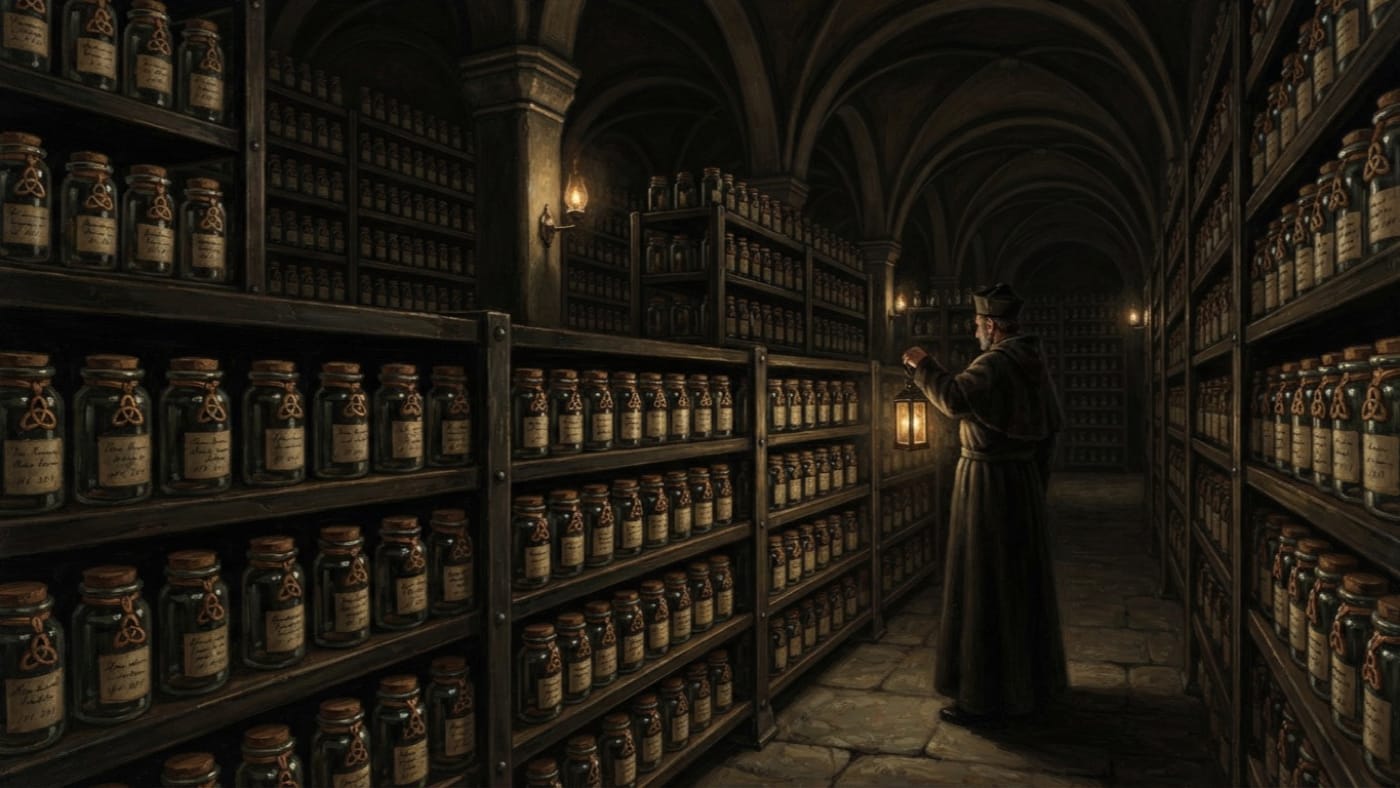
The congregant breathes into the reliquary jar. The jar is closed and sealed with beeswax, and the Triune Knot is pressed into the soft wax: three loops bound into one, the figure Synod sermons call "the threefold clasp of Mercy, Order, and Sacrifice." The wax takes the impression cleanly and holds it better than most congregants hold their catechism. Once it cools, the breath is shut behind a sign of the Church's own unity. The Knot faces outward so that any clerk passing the shelf can see at a glance that the jar has not been tampered with, or at least not tampered with clumsily.
Each jar bears a label with a name and a date. Nothing more is required. The name says whose breath it was, and the date says which feast received it. Together they turn an exhalation into an entry, and the Bureau understands entries far better than it understands lungs.
From there the jar goes down.
In my account of the Basilica, I described the Pneumatic Census as "a tally not of names but of exhalations."
This was elegant and wrong. Every jar carries a name. The Census is a tally of exhalations and of names, and the Bureau of Records would no sooner shelve an anonymous breath than an anonymous baptism. I regret the elegance.
#The Breath Vaults
The jars are archived in the catacombs of the Basilica of the Ledgered Saints, beneath the streets of Strasbourg. Pilgrims who come to the city for the Cathedral seldom ask to see them. I will not tell you how deep they lie, because no one has given me a depth to tell.
What I can describe is the repetition. Thousands of small glass vessels stand in rows along the catacomb corridors, shelf upon shelf. Each has its plug of wax, its pressed Knot and its slip of handwriting. Lamplight runs along the curved glass and makes a whole corridor glitter like a reliquary chapel that has been told to wait in a queue. The devotional books speak of "tiny clouds suspended in glass." I have walked those corridors with a lamp. Some jars show a faint bloom. Most show only the shelf behind them.
Visitors routinely confuse two collections, so I will separate them once. The Census of the Living, on the second sub-level, is ink: every baptized soul indexed by diocese, parish and tithe-class. The Pneumatic Census is glass, and it indexes only the feast-day breaths of those selected. Whatever the two may share, they are filed separately, and in the Basilica separate filing is the nearest thing to a theological distinction.
The uninitiated are astonished by the Bureau's composure. A breath is the least durable thing a body produces, yet the Bureau treats it as a holding to be shelved, labeled, sealed and accounted for. The clerks of Records walk among the jars just as they walk among the ledgers upstairs. They wear the same expression too, the look of men who have never once been surprised by the contents of a container.
#On the Famine Reserve
Ask the Bureau why it keeps these breaths and it will answer with a doctrine of providence. The exhalations, it says, are preserved against famine years, when "oxygen for the faithful" may be rationed. The faithful breathe in plenty and deposit their surplus, and in the lean years the Church will have it laid by.
The argument has real beauty, and I have defended it from pulpits. The Church stores grain against hunger, tallow against winter and recantations against relapse. Why should it not store breath against suffocation? A prudent Synod lays up every necessity, and no necessity is needed more often.
The Bureau's eloquence ends exactly where a petitioner's questions begin. Has oxygen for the faithful ever been rationed? The Bureau will neither confirm nor deny it. Has any jar been unsealed in a lean year and its breath given back to a lung that needed it? I can find no requisition. Nothing in any folio I have been shown explains how a breath is to be drawn out of a sealed jar and given to a stranger. Nor does it say whether the stranger receives the named donor's breath or simply that of whoever stood nearest the shelf, or whether a clerk or a priest breaks the wax.
The Bureau has recorded, to the letter, how a breath goes into custody. It has recorded nothing of how a breath comes out.
I do not call that a defect. A reserve that is never drawn on is never depleted. By any audit the Bureau would recognize, a reserve that is never depleted is a success.
#The Matter of the Faint Breath
On one feast day a child was called forward to breathe into her jar, and her breath was judged too faint.
I do not know her name, and I would not print it if I did. Her street, her parish, the feast and the year are all missing from what has reached me. I do not know how faintness was measured either. A clerk may have held the jar to a lamp and seen too little cloud, or listened, or simply watched a small chest rise less than he thought it ought to. The record has no interest in the instrument. Its interest is the verdict.
Her family was fined for weak faith.
Observe how neatly the Bureaus divided the labor. The Bureau of Records recorded the fine, because an unrecorded fine is a rumor. The Bureau of Purity enforced it, because an unenforced fine is a suggestion. The Bureau of Doctrine, my own Bureau, whose seal I carry, declared the precedent sound, so that no one could mistake it for an accident. Three offices of the Church examined a small girl's exhalation. Each found its own work in it, and none of them found the child.
The reasoning is easy to reconstruct, and I have reconstructed it for Doctrine's students more than once. A child cannot owe a fine, but a household can. Faith is taught at the hearth, so a faint breath testifies against the hearth. The child's lungs were entered into evidence, and her parents were found liable for them.
I have read far crueler precedents, and I have filed a few. Still, I admit that of all the matters in my keeping, this is the one I am most often asked to justify, usually by people who read no other precedents. I justify it, because that is my office. I do not know the amount of the fine, and I have never asked.
#The Jar on My Desk
I have given my own breath to the Census. I say so in case any reader imagines that the Hieromnemon of Strasbourg exempts himself from the observances he defends. He does not. I filled my jar on a feast of no particular significance and sealed it with my own hand. I pressed the Knot into the wax myself, because I trust no junior clerk with my exhalations.
The jar sits on my desk between the inkwell and the sand-caster. When I hold it to the light I see nothing.
I do not mean that it is broken. The wax is whole and the Knot is sharp. The label is in my own hand, with my name and a date I am in no danger of forgetting. The jar is sealed, entered and in order. Yet held to the window it looks exactly as it did before I breathed into it. The Bureau assures me that faith, like breath, is invisible, and the assurance has not improved with repetition.
I have thought about sending it down to the catacombs to stand with the thousands. The Records clerks would accept the transfer, shelve it, stamp it and keep it in perpetuity, and I would no longer have to look at it while I work.
I keep it on the desk.