
#On the Mark
Three loops, one law.
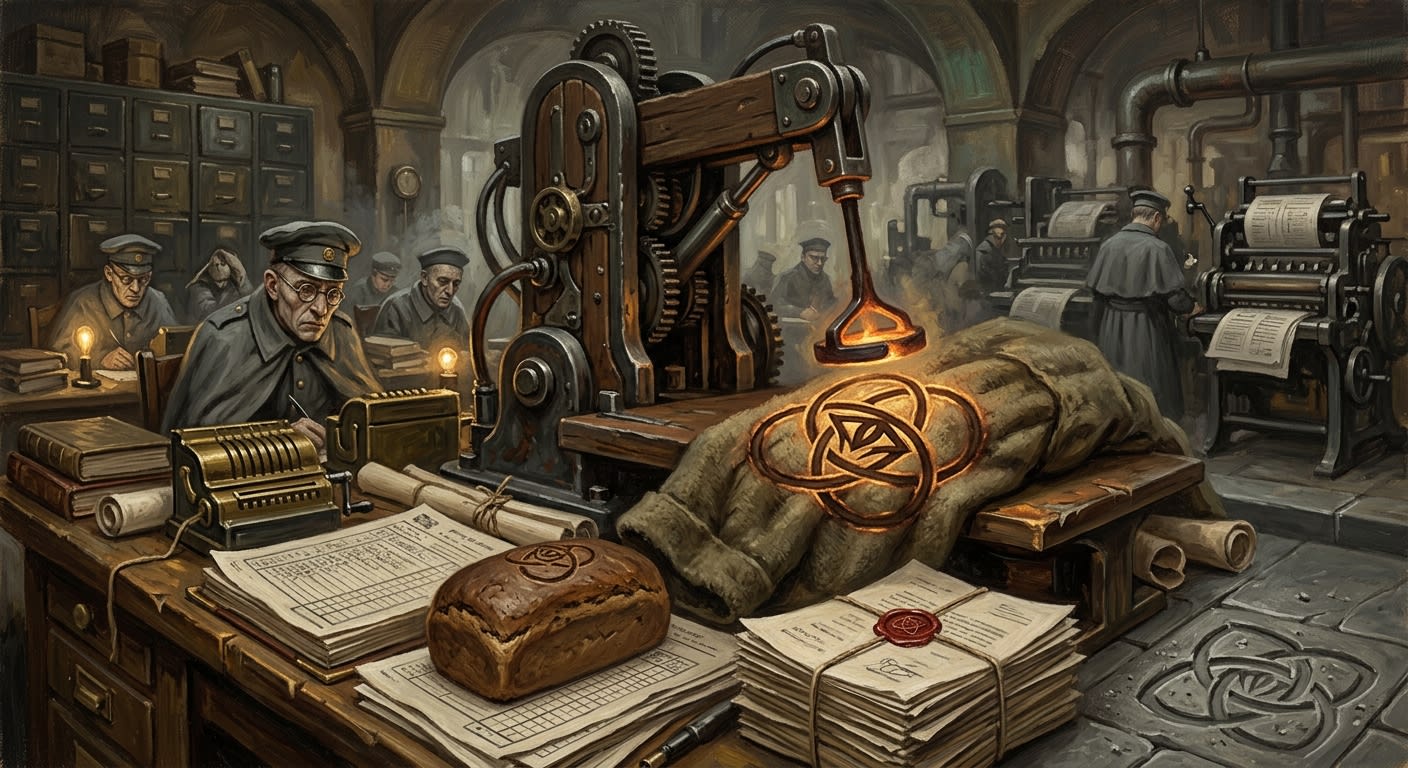
The Triune Knot is the Synod’s smallest empire. It fits on a seal-face, a soldier’s wrist, a ration loaf, a coffin-lid, a gate lintel, a confession desk, the brass eye-badge of the Inspectorate of Visual Compliance, and the personal stationery of men too important to choose their own paper. I speak, naturally, of myself. Heraldry did it without asking. This is how one knows a symbol has become sovereign: it does not request display. It arrives.
The common catechism calls the Knot a sacred emblem of Concordat unity. The Bureau of Heraldry calls it the authorised binding device of Synodal jurisdiction. The street calls it the three-loop mark, the door-worm, the loaf brand, the little noose, the bite. All are correct by audience. All are insufficient by law.
The Knot consists of three interlocking loops, angle-true, each loop bound through the others without surrendering its own line. Mercy. Order. Sacrifice. That is the schoolroom answer, recited by children with chalk dust on their fingers and dread already learning to sit correctly in the spine. The clerical answer is finer and colder: a lawful subject exists where mercy may classify him, Order may command him, and Sacrifice may spend him. The Knot is the diagram of that expenditure.
#On Its Folk Origin
The Knot is older than its law and younger than the fear that made it useful. In the first decades after the Sundering, while the retreating columns dragged families, tools, relic fragments, livestock, plague, debts, and unburied kin westward, three-loop binding marks began appearing on lintels and grave-slabs across the Rhineland. They were scratched in lime, carved with knife-points, daubed in ash, cut into doors already warped by damp and panic. No one owned them. No office designed them. Seven contradictory authors have since been filed, because nothing irritates Strasbourg more than useful anonymity.
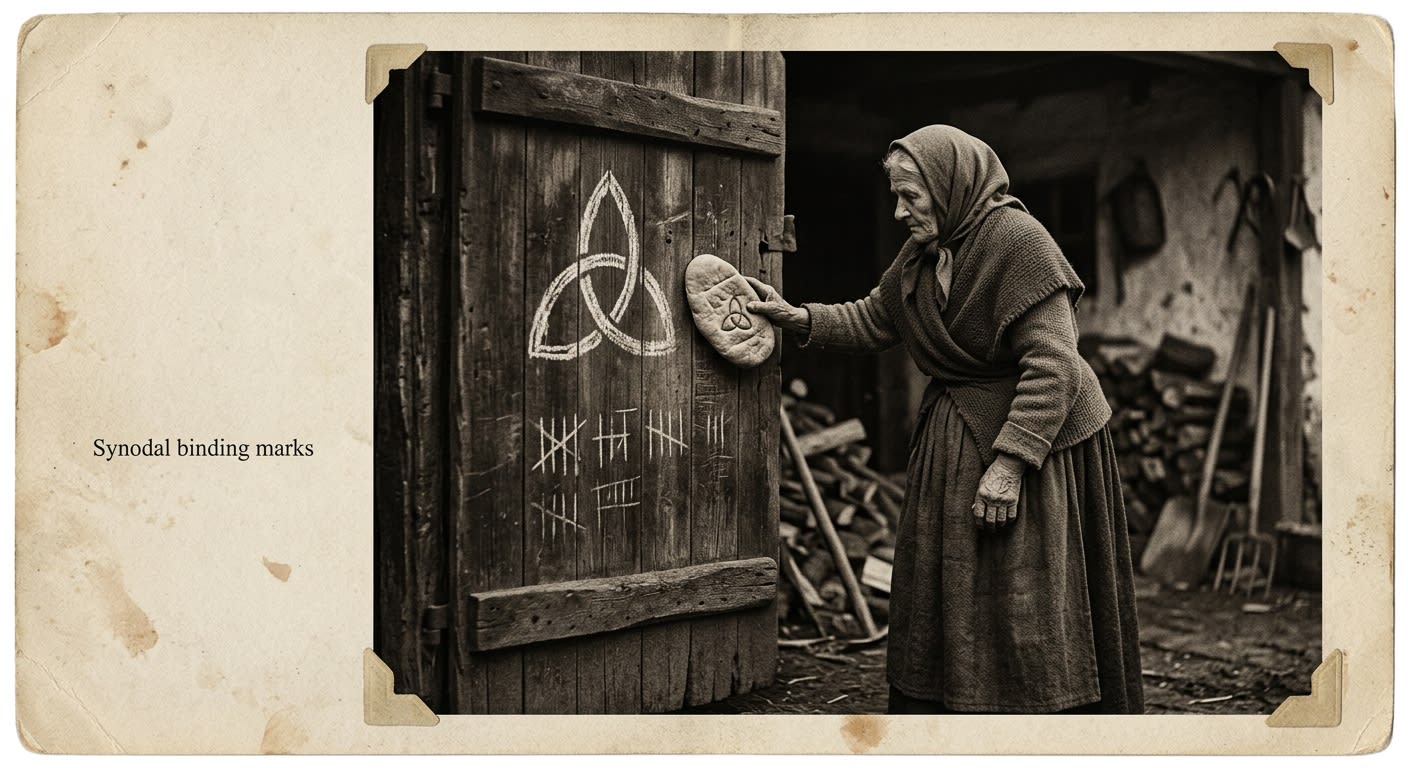
The early marks meant what desperate people needed them to mean. Three loops for the Trinity. Three loops for roof, ration, record. Three loops for the living, the missing, the dead. Three loops because a circle alone looked too much like a mouth and two loops looked like a bargain. Refugees are excellent theologians when frightened; they invent doctrine with one hand while holding the door shut with the other.
A house bearing the mark had been claimed. A grave bearing the mark had been sealed. A wagon bearing the mark had at least one person aboard willing to say that its cargo belonged to the Faithful and not to the ditch. In the Great Retreat, when clerks ran behind events like altar boys chasing a runaway censer, the mark did the work paperwork could not yet perform. It said: someone here expects to be counted.
Provincial homilies once attributed the first Triune Knot to Saint Edrin of the Three Nails during the A.S. 78 Lull of Names.
Clarified. Edrin is patron of threshold sealing and may be invoked over the carved Knot. He did not invent the mark, unless one accepts the popular theory that saints may perform acts before their birth, after their death, and during administrative convenience.
#On Theobald’s Geometry
Theobald of Worms made the Knot lawful. That was his genius and his crime, if one is sentimental enough to distinguish them.
By A.S. 90, the year of the Concordat of Strasbourg, the Bureau of Heraldry had received charter, seal, vault space, and sufficient arrogance to begin improving the world by narrowing it. Theobald surveyed the wild knots of the parishes — rounded knots, sharp knots, knots with tails, knots with crosses, knots with folk-beasts hidden in the joinery, knots cut by drunk carpenters who thought symmetry a rumour — and imposed correction. Three loops. Measured angles. Fixed crossings. Standard depth. Authorised placement. The mark became reproducible. Reproducibility became law.
He decreed that the Knot be carved into every gate, stamped into every official document, pressed into wax, seared into ration bread, punched into levy tags, inked into registers, scratched into coffin boards, and inlaid above every doorway operating under Synodal licence. A house without the Knot became “unmoored.” An unmoored house could not claim ration protection, Warden assistance, lawful tenancy, burial security, or fire compensation. It could still burn. The Bureau made no metaphysical promises about combustion.
The forty-three authorised geometries now derive from his tables, after the A.S. 199 correction reduced the number from forty-seven. Four variants proved insufficiently angular. Craftsmen who had cut those variants into gates and lintels were informed that the error constituted an administrative inconvenience. Reclassification remains possible. The Bureau does not waste heresy by spending it early.
#On the Threshold
The Knot’s most intimate dominion is the door. Every licensed Gate-Carver carries stencil case, tri-cord measure, consecration chalk, registry punch, wax tag, and the exhausted patience of a man whose clients believe their lintel deserves special treatment. It does not. The lintel receives the geometry assigned to it. A cottage receives one class, a ward-house another, a warehouse another, an ossuary niche another. Even death must queue by category.
The Gate-Carver verifies the claim, selects the class, measures, cuts, chalks, breath-counts, punches, records. The door is now readable. The Wardens may defend it. Records may file it. Tithes may tax it. Settlement may pretend it always knew who lived there. A threshold without a lawful Knot is a mouth without teeth: open, wet, and inviting correction.
The Knotwright Registry exists because doors can lie. The Lintel Pogroms of A.S. 112 exposed fourteen houses in Cologne bearing geometrically correct false Knots, cut with stolen stencils and counterfeit punches, sheltering unregistered persons behind perfect obedience. A false Knot badly cut is vandalism. A false Knot well cut is insurrection. Heraldry founded the Registry before the stripped wood had dried: every stencil numbered, every punch assigned, every licensed hand known by cut, tremor, angle, and failure.
LINTEL POGROMS — COLOGNE RIVER QUARTER, A.S. 112 Fourteen doors stripped. Residents re-documented. Three carvers failed freehand reproduction under Purity observation. Two sold stencil access. One trembled. Disposition: ███████ niches sealed before Matins. Registry charter drafted from the seizure table.
#On Documents, Bread, and Flesh
The Knot is not content with architecture. It breeds across every lawful surface. In wax, it authenticates. In ink, it licenses. In bread, it feeds. In flesh, it claims.
Official documents bear the Knot before they bear sense. Absolution tokens carry it so that forgiveness may be handled without smudging. Ration loaves receive the seared crown-mark, which has produced the pleasing spectacle of hungry citizens biting into Order at breakfast. Soldiers receive wrist stamps at mustering; the mark fades, is renewed, fades again, and by the third renewal many men flinch before the ink touches them. The body learns law faster than the mind admits.
On the brass eye-badge of a Sigil Inspector, the Knot becomes sight. On a confession desk, it becomes permission to speak and trap. On coffin-lids, it becomes assurance that the occupant has entered the correct queue below Providence. On the hull plates of the Black Sea Reliquary Flotilla, it becomes maritime defiance hammered into iron and salted with spray. On the procession banners of the Triune Hearth, it becomes spectacle large enough to hide census clerks behind incense.
A school primer of A.S. 176 described the Knot as “the sign by which all faithful persons are joined in voluntary concord.”
Revised. Voluntary has been removed. Concord remains.
Forgery follows ubiquity the way flies follow a battlefield. Counterfeit Knots appear on false passes, black-market bread, unlicensed doors, dead men’s tags, smuggled medicine crates, festival masks, and condemned petitions written by optimists. Masks and Seals pursues the instrument. Heraldry pursues the meaning. Purity pursues the person. Between the three, even hope has difficulty escaping.
#On the Inverted Knot
The Bureau reserves special hatred for the broken or inverted Knot, because blasphemy conducted in official grammar feels like theft from the author. A crude anti-Synod mark annoys Heraldry. An inverted Knot enrages it. The offender has learned enough law to insult law in its own vestments.
Third-category heretics may be branded with the broken Knot across the forehead: three loops severed, inverted, denied closure. The mark says the condemned once stood inside Mercy, Order, and Sacrifice and has been expelled through all three at once. It is a beautiful sentence, if one is honest about beauty’s appetite.
Rebels scratch the inverted Knot in alleys. Children copy it before they understand it. Prisoners draw it on cell walls with soot and spit. The Bureau scrapes, paints, brands, fines, burns, and records. The mark returns. Symbols do that. They are vermin with halos.
#On the Present Use
As of A.S. 201, the Knot is everywhere Synodal authority can reach and in several places it cannot. It crowns the seven bastion sectors of the Sagittal Line, appears on inspected wagons at Bastion-Brest, on ossuary niches beneath Bastion-Irongate, on chapel shutters at Bastion-Shipka, and on bronze placards along the Sanctum Mile of Bastion-Constantinople. It sits in Strasbourg above office doors whose occupants despise one another in perfectly shared geometry.
Under Archon Casselius of Mainz, authorised variants are policed with sharper instruments and colder humour. A curve too soft, a crossing too loose, a loop too generous: each can summon inspection. The Knot’s mercy is measured by angle. The Knot’s Order is filed by district. The Knot’s Sacrifice is paid by whoever cut it wrong.
A citizen may be born under the Knot, taught letters from the Triune Alphabet beneath it, fed bread stamped by it, married before it, fined through it, marched past it, buried beneath it, and corrected afterward if the grave-slab settles in a way that compromises the left loop. Ornament is too small a charge. This is civilisation reduced to a mark small enough to fit on a thumb and large enough to close a continent.