
#On the Tables and Their Authority
The Radiant Fusilier cadence tables are the training prescriptions that teach the Covenant's finest riflemen when a rifle may speak. No file I am permitted to cite dates their first compilation. Their compilers are unnamed. Ask the Bureau of Records how many editions there have been and it answers with a cough. The public reference preserves one thing with confidence: the amendment of A.S. 169, issued two years after Prague and one year after the review that made Prague impossible to file as weather.
The amendment splits the work of correction three ways, as all serious work in the Synod must be split. The Bureau of War holds the drill. The Bureau of Bells holds the cue. The Bureau of Doctrine holds the explanation, which means it decides what a soldier may call the thing that nearly killed him. Three offices share one rifle. Nobody has asked the rifle.
#On Banner and Volley
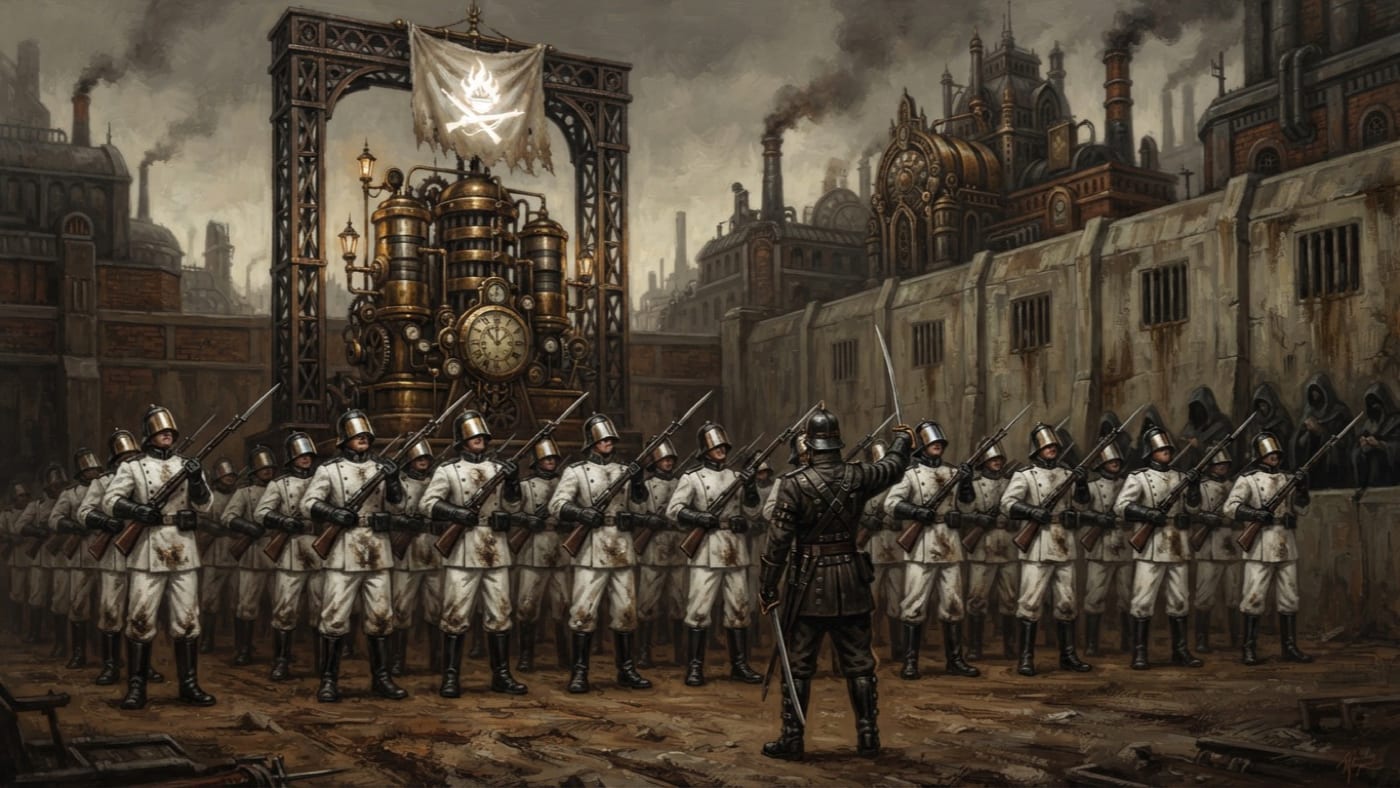
A Radiant Fusilier does not watch the enemy. He watches the banner. His training begins before his finger reaches the trigger. He loads in unison with his rank, and the loading is prayer: each cartridge is kissed with a fragment of psalm and each ramrod stroke carries a syllable of a sanctioned hymn. By the time the barrel is charged, the man has recited his way into readiness. The rifle is the last word of a sentence his whole body has been taught to speak.
The consecrated banner presides over that sentence. It flares, and the first volley goes. It dims, and the second follows. It blazes white, and the third belongs to the Creed entire. Barracks instruction gives the three volleys to command, discipline and Creed, in that order, and recruits learn the order the way choirboys learn the Gloria. Repetition comes first and comprehension follows, if it ever arrives.
The uniform serves the cue. Mirrored plates on the helmet catch the banner so that even a man's peripheral vision fills with holy cloth. The white tunics are striped with powder-burn, and the gloves are dyed black for a steadier grip on the stock. Everything the Fusilier wears or sees points him back to one raised standard over the line. No other soldier in the Church is trained so thoroughly to take his reasons from outside his own skull.
That is also why the discipline is savage. The older catechism says that firing out of order is heresy and firing alone is damnation. Barracks tales describe Fusiliers shot in the back by their own brethren for raising a musket without the banner's leave. The sentence for a breach depends on the tribunal, the season and the Bureau holding the pen. The principle never changes. The tables exist to keep the space between cue and trigger no wider than a psalm's breath.
Prague found that space anyway.
#On the Prague Finding
The engagement itself belongs to the Night of Silent Steel, and readers with stronger stomachs will find it set out there. Only the finding concerns the tables.
In A.S. 167 a Fusilier regiment formed three ranks under banner-light on the eastern seminary field outside Prague. Seven Pale Chanters stood across the field in the ruined seminary. Doctrine's approved phrasing says they emitted a counter-hymn bearing superficial resemblance to the mercy prayer. The men's phrasing is shorter. The banner rose and the captain gave the order. No volley came. The enemy advanced, and forty-three Fusiliers died without discharging their rifles. Forty-three loaded rifles were recovered from the field. That figure is the count of the dead. It is not the regiment's strength, although careless copyists have made it both.
Older muster rolls name the regiment as the Fourth and later records insist on the Seventh. This article will not settle the matter. Better clerks than I have tried, and some of them are now carving lintels.
The review of A.S. 168 is the document that matters to the tables. It found that the command had been received. The men kept their posture, their aim and their fear, and their fingers stayed on the triggers. What failed was the passage from command to act, which Bells named cadence severance. Survivor deposition 17-B, whose witness is unnamed, puts it more cleanly than any Bureau has managed: the man remembered the command perfectly and could not remember what firing was for. The Lore Book's shorthand says the men "forgot to fire." That will serve as a summary, provided nobody mistakes a summary for a finding.
The first Bureau of War circular attributed the Prague loss to trumpet delay, wet powder, and smoke interference.
Withdrawn. The trumpets had sounded and the powder was dry. Smoke cannot account for forty-three rifles recovered still loaded. The circular is retained in this article only as an example of an explanation written for the budget rather than the field.
The review did not establish what the Chanters actually do. Doctrine calls it sorcery. Engines & Furnaces speaks of resonance through walls, helmets and marrow. The tables were revised without waiting for either side to win, since soldiers have to drill in the meantime.
#On the A.S. 169 Amendment
War's contribution is the hostile-song interruption drill. Recruits now practise loading and firing while choirs hum wrong intervals behind screens, close enough to be felt in the teeth. The drill is meant to make the volley survive a contaminated hymn, so that a soldier who hears the familiar shape of prayer coming from the wrong direction fires regardless. The choirs receive hazard pay and the recruits do not, because the Bureau of War considers spiritual danger educational for the young and compensable for professionals.
Bells' contribution is the banner-tone anchor. The record names it, assigns it to Bells and stops there. It does not say what the anchor is made of or how it is sounded, and I will not invent a mechanism to oblige the curious. What I can say is that Bells answered a failure of sound with more sound. That is the habit of the office and has sometimes worked.
Doctrine's contribution is a prohibition. The phrase "the Creed went silent" is no longer to be used. The memorandum has guaranteed the phrase a long life in every barracks from Brest to Shipka, where it is now spoken with the special relish reserved for forbidden things.
The training addendum is the only part of the revised tables to survive in the public record as text. It reads:
Each line answers a condition the review had found at Prague. The banner rose there, and meaning did not follow. The mercy prayer came back from an enemy's throat. The reason left the hand while the finger stayed on the trigger. The addendum makes no attempt to restore the meaning. It tells the soldier to act without it.
The third line is the theologically interesting one, and I use the word interesting the way a physician does. For a century of catechism the Fusilier was taught that his volley was faith made audible. After A.S. 169, when faith goes quiet, he is told the volley must continue on muscle and habit. Interpretation of this sort belongs to me rather than to the tables. The tables are content to give orders.
No record I can cite says how well the amendment worked. The record shows that it was adopted. Whether it would have saved forty-three men in a seminary field is a question for the dead, and the dead have not been canvassed.
#On Correction and Continued Use
The amendment sits uneasily beside everything that came before it. The ordinary tables punish a shot fired outside the cadence. The addendum orders a shot when the cadence arrives empty. Both are in force, and the Fusilier is expected to keep them apart in the half-second when they meet.
I read the addendum in its Prague context. At Prague the banner had risen and the command had been given, and what was missing was the soldier's grasp of why he should obey. On that reading the addendum covers a soldier who has received a sanctioned cue and lost its sense. It gives no general licence for a man to fire whenever his heart misgives him. A Fusilier who shoots without a banner remains what he always was in the eyes of the tribunal.
The sources do not say where the line falls between a severed response and an unauthorised shot. Suppose a man fires in the third measure and later swears that the meaning had gone and only his finger remembered. Nothing in the surviving text tells a tribunal whether he obeyed the addendum or broke the cadence, so the tribunal must decide. Tribunals always do decide, and that is not reassuring.
Doctrine's vocabulary control belongs to the same correction. War can drill the body and Bells can strengthen the cue, but a soldier who calls the event by its true name has already conceded that it happened. The Index can at least deny him the sentence.
Bells can fail, and the Church knows it. At Vienna, on an occasion the general annals leave undated, the Chanters are said to have sung through the peals and bent them off-key until the defence turned on its own men. Engines named the result prayer-jam, and Doctrine named it impossible. Vienna proves that the peals can be turned. It proves nothing about these tables, which no Vienna file cites, and I will not borrow a disaster to make an argument tidier.
The amendment of A.S. 169 therefore remains in force, administered by three Bureaus and fully understood by none of them. The Fusiliers drill under it, the screened choirs hum, the finger is trusted, and the banner still rises over men who have been told what to do if it means nothing.