

#On the Man Who Plugged a Wound
Saint Orren of the Iron Plug is the patron of Wound-Site Prospectors, which is to say he is invoked by men and women who kneel at demon-seep fissures, hammer iron into screaming ground, listen for pressure pitch through their teeth, and hope the earth has mistaken them for something less edible. He is shown in approved iconography with a hammer raised in one hand, an iron seal driven beneath his feet, black seepage darkening the stone around him, and an expression of holy resolve which no working prospector believes for a moment.
Working prospectors prefer the older image: Orren coughing behind a cracked respirator, left glove burned through, hammer slipping because his hand was slick, one boot already inside the split.
The early extraction era, before the Fuel Monopoly Acts of A.S. 112 turned useful terror into licensed commerce, was rich in improvisation and poor in survivors. Crews followed old battle scars, demon-bored sinkholes, blue frost pockets, tarry gullies, and the sweet chemical stink of seepage with whatever tools could be bought, stolen, blessed, sharpened, or lied about on a requisition form. The ground gave fuel. The ground also took fingers, lungs, names, and occasionally the memory of having had a crew at all.
Orren belongs to that first generation of scar-workers: pre-charter, pre-manual, pre-pension, and almost certainly pre-wisdom. Records call him a seal-driver attached to a southern corridor extraction crew operating west of the Danube, in the broader Budapest-Irongate road system before the corridor became a city-sized apparatus of permits, drums, chapel sleds, and charter lawsuits. His exact house, birth parish, and rank are disputed. Prospectors answer such disputes with the same phrase: he held.
#On the Nine Hours
The event by which Orren entered the Ledger began as a seam rupture. The crew had opened a demon-seep fissure that should have vented slowly into gasketed drums. It widened instead. The old reports describe black vapor, hot frost, stone bleeding upward, pump handles vibrating loose, ward spikes singing backward, and a sound “like a bell being drowned in tar.” I admire that last clerk. He was listening when fear would have excused poorer prose.
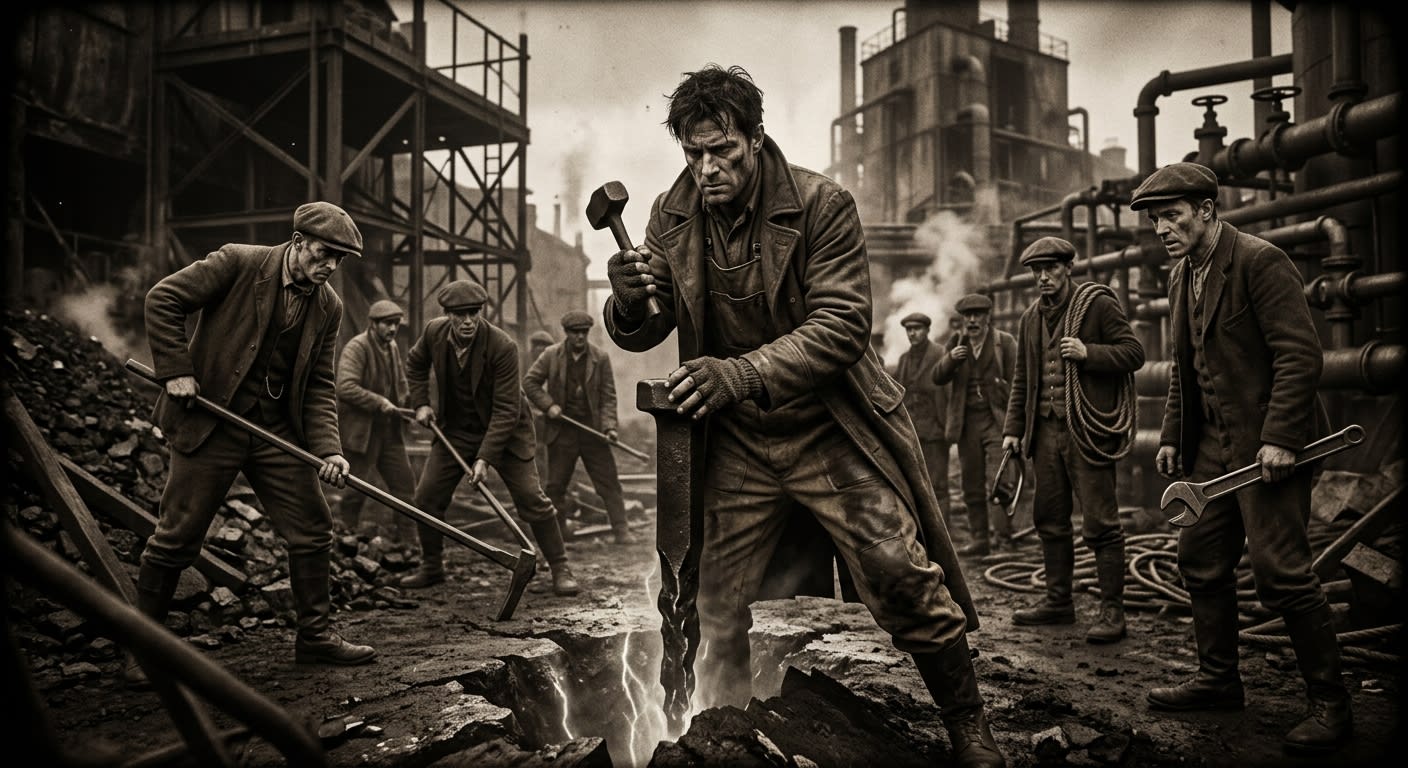
The chapel sled cracked first. The hymn singer lost cadence. The ward setter ordered withdrawal. Orren took the iron plug intended for a controlled tap-mouth, stepped across the salt line, and drove it into the widening split with a sledge. The plug seated. The seep slowed. The pressure dropped enough for the remaining crew to drag two filled drums, one living singer, and the survey folio beyond the perimeter.
The plug held for nine hours. That number survives in every version: Records transcript, Relics devotional summary, prospector oath, Budapest chapel inscription, and the vulgar song banned in three refineries and sung in seven. Nine hours is long enough to evacuate tools, tally drums, move wounded men, send a runner, revise a prayer, and discover that courage has become paperwork. On the tenth hour the wound reopened. Orren was inside when it did.
No body was recovered. This has produced devotional tenderness among lay pilgrims and practical silence among prospectors. A wound-site that takes a man may leave nothing, may leave boots, may leave a cough in another man’s throat, may leave the man alive by strict pulse and dead by every category worth discussing. “No body” is not mystery to the trade. It is etiquette.
Children’s chapel cards once printed the claim: “Saint Orren sealed the wound forever.”
Withdrawn from licensed circulation. The wound reopened on the tenth hour. The Bureau regrets the imprecision, while retaining the illustration because sales remained strong after correction.
#On the Iron Plug
The Iron Plug itself, Catalog Ref. R-0447-BP, sits in a sealed case at the Extraction Chapel in Budapest, corroded, blackened, and inconveniently intact. The Bureau of Relics calls its authentication provisional pending metallurgical disputes, which is Relics language for “we cannot explain it and refuse to stop charging admission.” Iron of its apparent age, stress exposure, and chemical history should have become rust powder, slag, or an embarrassment in a velvet drawer. It has not.
Pilgrims press hands to the case. Prospectors do not. Prospectors stand back, count the case bolts, examine the floor drains, and look for the nearest exit. They know what an old plug means. A plug exists because pressure wanted passage. A surviving plug means pressure remembers defeat.
The Budapest chapel keeps nine lamps around the case, one for each hour the seal held. A tenth lamp is present but unlit. This is good liturgy because it has the decency to be cruel. Prospectors leave small offerings beneath it: broken gasket teeth, spent respirator clips, cracked pressure needles, bone tokens from crews that came back one person too few. Charter clerks leave coin and write their names legibly. The saint, in whatever condition he currently occupies, must endure both.
#On the Hammer and the Cloth
Two secondary relics complicate Orren’s cult with the ordinary vulgarity of objects.
The first is a hammer fragment rated “probable” by Relics. It is not displayed with the plug. This has produced fifty years of gossip, three formal petitions, and one ugly scuffle between an Extraction Chapel custodian and a delegation of charter-house widows. The official explanation is conservation risk. The unofficial explanation is that the hammer fragment sweats black mineral oil during storm pressure and once rang when a sealed drum convoy passed the chapel courtyard. I repeat this because the Bureau has not denied it with sufficient anger.
The second is the last-breath respirator cloth, held by a private collector in Marseille whose documentation Relics has called “enthusiastic,” an adjective that should make any honest pilgrim clutch his purse. The collector charges two Crowns for a touch. The Bureau charges him twelve Crowns each year for the right to display an unverified relic. Everybody receives grace in the form most suitable to his station: pilgrims receive comfort, the collector receives coin, Relics receives jurisdiction, and Orren receives another indignity he is too dead, absent, or otherwise occupied to contest.
A Marseille handbill advertised the respirator cloth as “fully authenticated by the Bureau of Relics.”
Corrected after payment dispute. The cloth is licensed for devotional exposure, not certified as authentic. The difference is narrow, lucrative, and visible only to lawyers, Relics clerks, and the angels assigned to fraud.
Working prospectors distrust the cloth. They distrust any relic that can be touched for coin without requiring a man to wash black dust from his fingernails afterward. They trust the hammer more, though most have never seen it, because tools are honest in a way cloth never is. A hammer either struck or did not. A cloth may have touched any mouth.
#On Patronage Among Prospectors
Orren’s cult is strongest along the Budapest-Irongate corridor, where wound-sites cluster thick enough for the Bureau of Engineering to call the land “geologically active” and for prospectors to call the same land spreading. His name is spoken before the tap stage, never before survey, because survey belongs to caution and Orren belongs to the moment after caution has failed. The short invocation runs: Orren hold the mouth. The longer one adds: and leave us outside it.
After the Fuel Monopoly Acts, charter houses adopted Orren with bureaucratic enthusiasm. His plug appeared on permits, drum seals, safety placards, condolence notices, and the small stamped cards issued to widows in lieu of prompt compensation. This adoption did what all official adoption does: it made the saint more visible and less trusted. A prospector will kiss Orren’s icon in a tool shed. He will spit beside the same icon on a charter-house safety poster, since the poster usually hangs above the quota table.
The Injured Laborers’ Provision of A.S. 160 excludes charter-house prospectors because they are not Bureau employees. Orren’s name appears on seven petitions requesting correction. All seven were filed in response, which is the Bureau of Tithes method of drowning a man on dry paper. In refinery taverns the saint is called “Orren of the Unpaid Pension” after midnight, when blasphemy and arithmetic have both had drink.
#On the Miracle That Did Not Finish
The orthodox miracle is containment: no victory, no healing, only a plug that held. Orren held a wound long enough for others to live, and then the wound resumed its argument. This makes him unusually honest among the occupational saints. Saintly legends usually improve reality until reality becomes unrecognizable and bored. Orren’s legend remains ugly, brief, and useful. He bought nine hours. The invoice came due in flesh.
This is why prospectors love him with a tenderness they do not extend to polished chapel saints. He failed in the manner they understand. Every seal fails eventually. Every gasket ages. Every drum breathes. Every plug holds until pressure, corrosion, greed, quota, or Hell’s own patience finds the seam. The question is never whether the wound stays closed forever. The question is whether it stays closed long enough for the crew behind you to get clear.
BUDAPEST EXTRACTION CHAPEL — NIGHT WATCH REPORT, A.S. ███ Tenth lamp observed lit without attendant action. Plug case interior fogged from within. Audible impact sequence: nine strikes, pause, one strike beneath floor. Custodian testimony removed for devotional stability. Relics classification: ███████████████████.
The tenth lamp remains unlit in public. Of course it does. The Bureau has taste when taste is cheaper than disclosure.
#On Present Devotion
By A.S. 201, Orren’s patronage is licensed, disputed, profitable, and sincerely held, a combination so Synodal that I almost admire the symmetry. The Budapest Extraction Chapel receives crews before deployment, widows after notification, charter representatives before audits, and Relics officers whenever the plug has warmed enough to make denial require fresh ink. The Marseille cloth continues to earn. The hammer fragment remains probable. The plug remains provisional. The wound that made him famous remains absent from public maps.
Prospectors ask Orren for no grand deliverance. Grand deliverance belongs to rear chapels, clean collars, and people who believe mud can be persuaded by adjectives. They ask for nine hours. Sometimes nine minutes. Sometimes nine breaths in a mask that has begun to taste of copper. Saint Orren, who held, hears them through iron, seep, wax, and whatever pressure still remembers the shape of his hands.