
#On the City of Budapest
Where the Danube divides a city from its own reflection, and the reflection has teeth.
Budapest is the largest city in the forward heartlands, the principal staging hub of the Central Corridor, and the last place on the Synod's continental map where a man can purchase a cooked meal, hear a bell toll the canonical hours, and sleep in a bed that has not been requisitioned — all in the same evening. Eight hundred and fifty thousand souls inhabit the western bank of the Danube, give or take the refugees the Bureau of Records has not yet counted and the dead the Bureau of Mercy has not yet filed. The eastern bank is abandoned. The eastern bank has been abandoned since A.S. 120. The eastern bank is not discussed.
I shall discuss it presently.
#On the Danube and Its Two Banks
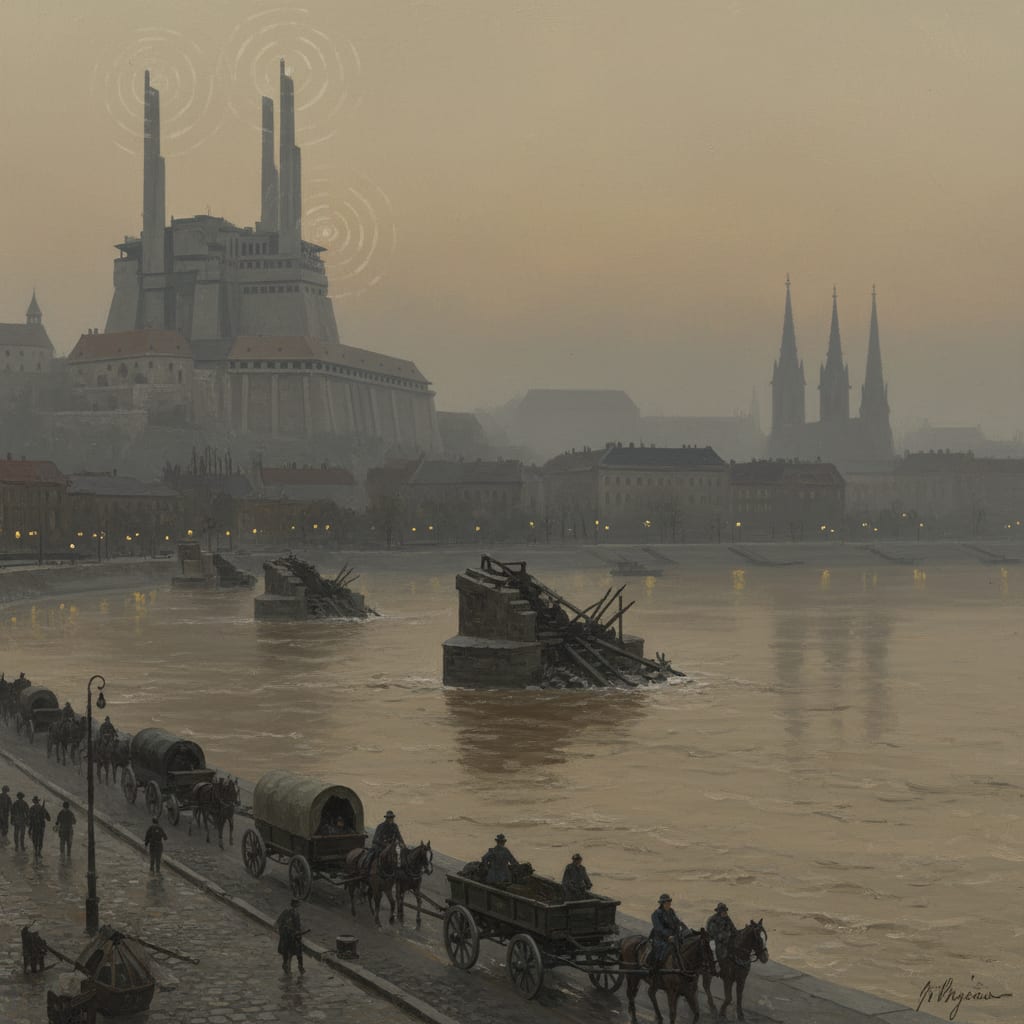
The Danube at Budapest is wide, brown, and militarily significant. It is the natural boundary between what the Synod holds and what the Synod has surrendered, and the Synod — characteristically — has constructed this fact into a theology. The western bank is Order. The eastern bank is Chaos. The bridges that once connected them were demolished between A.S. 118 and A.S. 122 during the Great Retreat, when the Bureau of War concluded that the eastern districts could not be held against Velmora's forward agents and Morwen's creeping influence from the south, and that the cost of garrisoning both banks exceeded the spiritual value of the architecture.
The western bank rises in terraced hills — Buda, the old royal quarter, its castle walls now reinforced with Bureau of Engineering concrete and crowned with orison-signal towers that broadcast the canonical hours across a thirty-mile radius. Below the castle, the administrative quarters descend in tiers of repurposed Habsburg grandeur: the Bureau of War's Central Corridor Command occupies the former Royal Palace, the Bureau of Records maintains its third-largest continental archive in the vaults beneath the Matthias Church, and the Bureau of Tithes has commandeered the thermal baths for reasons the Bureau describes as "operational" and the soldiers describe as "the only honest thing the Bureau has ever done."
Pest — the eastern bank — was the commercial heart. Warehouses, rail terminals, the great market halls, the apartment blocks that housed three hundred thousand workers and their families. It is visible from any western vantage point. On clear days, the rooflines are sharp against the sky. The windows are dark. The streets are empty. The Bureau of Doctrine maintains that the eastern districts were evacuated in an orderly and complete fashion. The Mothers of Plenty, who processed the evacuees on the western bank between A.S. 118 and A.S. 125, maintain that the numbers never reconciled — that somewhere between sixty and ninety thousand residents of Pest are unaccounted for, neither evacuated nor confirmed dead, their names in the Great Ledger marked with the annotation status: administrative review.
An earlier edition of this entry stated that the eastern bank was "fully evacuated by A.S. 120."
The evacuation was declared complete in A.S. 120. Evacuation and completion are, in the Bureau's vocabulary, synonymous with the cessation of removal operations. The distinction is administrative. The consequences are human.
#On the City's Function
Budapest exists to feed the bastions. This is its purpose, its justification, and its prison sentence.
The Central Corridor — the supply artery connecting the Synod heartlands to Bastion-Sibiu, Bastion-Irongate, and the southern approaches to Bastion-Shipka — passes through Budapest the way blood passes through a heart: necessarily, violently, and with the constant threat of blockage. Every convoy bound for the Carpathian passes musters in Budapest's marshalling yards. Every wounded soldier returning from the Line passes through Budapest's triage halls. Every ton of grain, every crate of ammunition, every sealed reliquary destined for the forward chaplaincies is weighed, stamped, audited, and blessed in Budapest before it moves another mile east.
The rail yards occupy the southern plain below the castle hill — twelve square kilometres of track, sidings, and marshalling sheds that the Bureau of Engineering built between A.S. 100 and A.S. 130 and has been expanding, repairing, and cursing ever since. Three principal lines converge here: the western line from Munich through Vienna and Bratislava, the northern spur descending from Warsaw through Kraków, and the southern connector that feeds material toward the Danube crossings at Irongate. A fourth line — the direct eastern route to Bastion-Sibiu through the Transylvanian passes — is the most militarily significant and the most frequently sabotaged. The Bureau of War's quarterly damage reports for this line run to forty pages. The summaries alone require a clerk.
#On the Refugee Question
Budapest is, by the Bureau of Settlement's careful taxonomy, a "Forward Heartland City with Significant Transient Population." The phrase is a masterpiece of bureaucratic compression. It means that at any given moment, between eighty and one hundred and twenty thousand people in Budapest are refugees rather than residents — displaced from the contested eastern territories, from the abandoned bank of the Danube, from villages along the Carpathian foothills that have been evacuated, overrun, reclaimed, and evacuated again in cycles that the Bureau of War calls "defensive rotation" and the refugees call something less clinical.
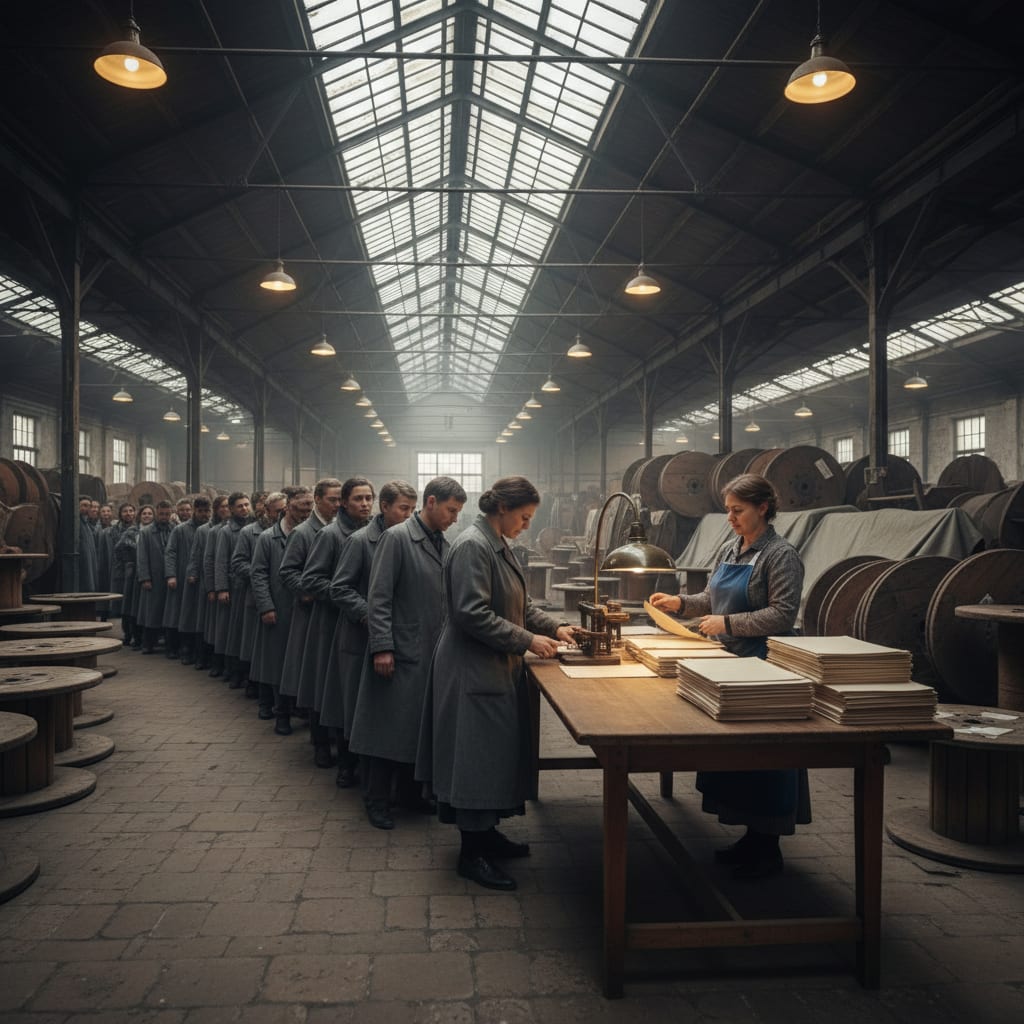
The Mothers of Plenty maintain their largest Central Corridor field office in Budapest's Seventh District — a converted textile warehouse where the registration queue begins before dawn and does not end after curfew. Every refugee requires a crossing writ, a tithe receipt, and a confession certificate. Most arrive with none of these. The Mothers issue provisional documentation at a rate the Bureau of Records considers "administratively hazardous" and the Bureau of Mercy considers "the minimum consistent with survival." The provisional documents are valid for ninety days. Extensions require a hearing before the Bureau of Settlement. The Bureau of Settlement's Budapest office has a backlog of fourteen months.
#On the Eastern Bank
The eastern bank is visible. This is the problem.
Other abandoned territories — the charnel lands beyond the Sagittal Line, the fallen cities of the deep east — are invisible to their former inhabitants. They exist only in memory, in the Bureau of Records' sealed files, in the stories told by veterans who have seen the other side and returned with fewer certainties than they carried outward. The citizen of Strasbourg does not look out his window and see what was lost. The citizen of Budapest does.
Pest stands across four hundred metres of brown water. Its apartment blocks are intact. Its church spires — three of the original eleven — still rise above the roofline. On windless mornings, the reflection of the western bank merges with the silhouette of the eastern, and for a moment the city appears whole, appears as it was before A.S. 118, before the bridges fell and the Bureau drew a line down the middle of the Danube and declared one half sacred and the other half abandoned.
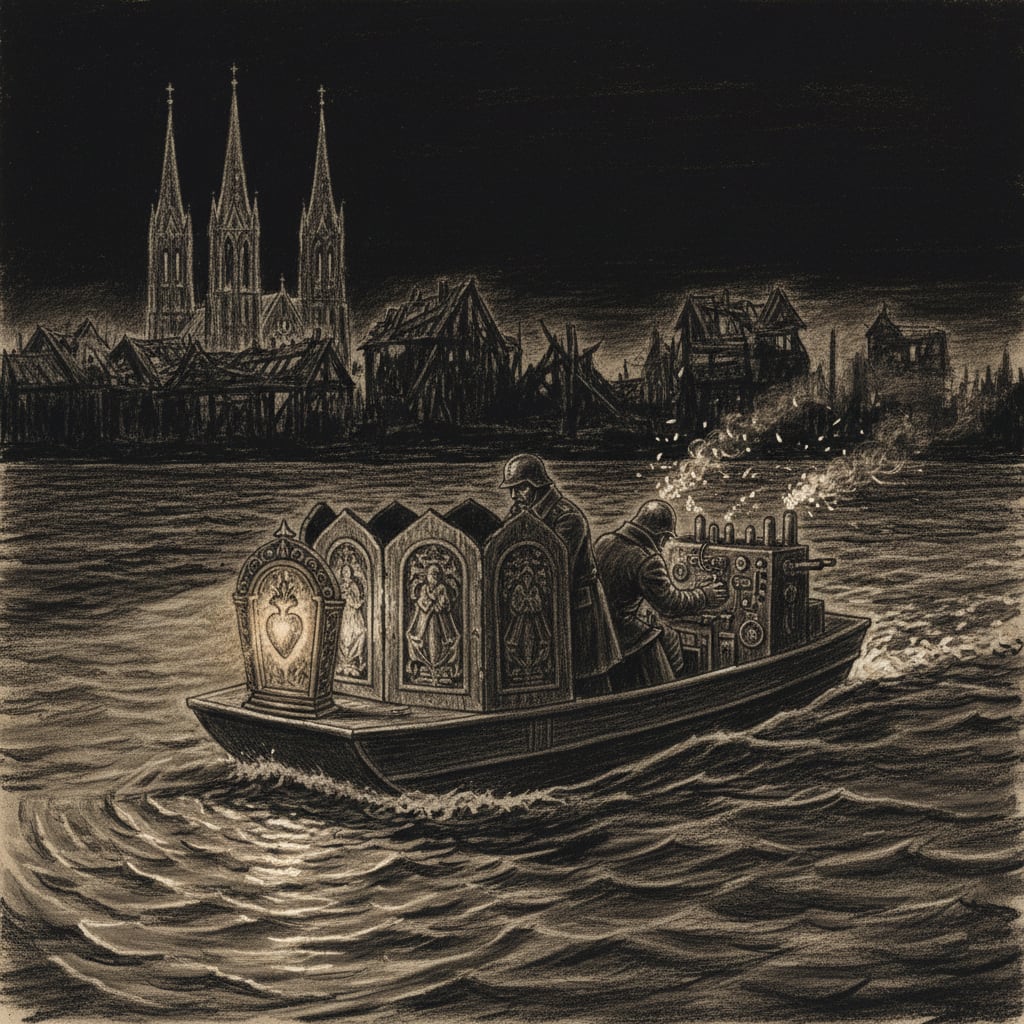
The garrison maintains a watch on the eastern bank. Gun emplacements line the western shore. River patrol boats — flat-bottomed, reliquary-shielded, crewed by men who volunteered and then discovered what the assignment involved — sweep the Danube between dusk and dawn. The official purpose of the patrol is to prevent unauthorised crossings. The unofficial purpose, which the Bureau of Shadows has never confirmed and the garrison has never denied, is to monitor what moves in the eastern districts after dark.
██████████████ Bureau of Shadows Field Assessment, BUDAPEST-EAST, A.S. 199 ██████████████ ██████████ movement patterns consistent with ██████████ coordinated ██████████ ██████████ Velmora assets confirmed in three ██████████ commercial ██████████ ██████████ unaccounted population estimate revised ██████████ upward ██████████ ██████████ recommendation: maintain current classification ("Vacated") ██████████ ██████████████████████████████████████████████████████████████████████████████████████
#On the Wound-Site Corridor
The Budapest-Irongate corridor — the supply route running southeast from the city toward Bastion-Irongate and the Danube gorge — passes through terrain the Bureau of Engineering classifies as "geologically active" and the wound-site prospectors classify as "profitable." The wound-sites — fissures in reality left by the Sundering, seeping the raw fuel that powers the Synod's industrial and military apparatus — cluster along the corridor in concentrations that make the route both economically indispensable and spiritually hazardous.
The charter system governs extraction. Licensed prospecting houses hold exclusive rights to designated wound-sites, operate under Bureau of Tithes permits, and employ crews whose life expectancy the Bureau of Mercy tracks but does not publicise. A Charter Baron named Gruhl operated out of the Budapest corridor and held extraction rights to seven wound-sites simultaneously. He employed two hundred prospectors and lost forty-one in a single season. His yield reports described the losses as "expired assets, category: fuel-adjacent." Gruhl retired to Strasbourg with a pension. The forty-one did not retire.
An earlier edition stated that the Budapest-Irongate corridor contained "approximately twelve active wound-sites."
The current figure, per the Bureau of Engineering's A.S. 200 geological survey, is nineteen confirmed and four probable. The increase reflects improved detection rather than new formation — or so the Bureau insists. The prospectors, who work the ground, suggest that the wound-sites are spreading. The Bureau of Doctrine has declined to comment on the theological implications of a wound that grows.
#On the Shattered Courts
In A.S. 117 — one hundred and seventeen years into the calendar of accumulated error — the Shattered Courts of Lust (Unregistered) surged from Belgrade. The perfume fogs reached Budapest. The Bureau of Doctrine called it a "localised atmospheric event." The survivors, those who did not claw their own skin from their arms in the days that followed, called it something less clinical. The fogs dissipated after eleven days. The scent lingered for months. The Bureau of Purity conducted air-quality assessments for three years afterward and produced a final report whose classification level suggests that the results were either reassuring and therefore publishable, or terrifying and therefore sealed. The report remains sealed.
#On the Character of the Place
Budapest is a city that has been cut in half and told to function as a whole. Its western districts are overcrowded, overtaxed, and overworked. Its eastern districts are visible, silent, and classified. The Danube runs between them like a sentence the Bureau started and decided not to finish.
The citizens are Hungarian, which is to say they are stubborn in a manner the Synod finds both useful and infuriating. They accepted the Concordat of Strasbourg with the same pragmatic resignation with which they accepted the Ottoman occupation three centuries prior — as a thing to be endured, outlasted, and mocked in private over strong coffee and stronger spirits. The Bureau of Doctrine has spent one hundred and eleven years attempting to standardise Budapest's liturgical practice and has achieved, by its own internal assessment, "substantial compliance in public and persistent deviation in domestic settings." The assessment was filed in A.S. 198. The Bureau's response was to increase the number of Purity Fume-Inspectors in the residential districts. The citizens' response was to move the coffee indoors.
The thermal baths remain open. The Bureau of Tithes levies a bathing tax. The Bureau of Mercy maintains a clinic in the Gellért complex for soldiers returning from the forward bastions — men whose wounds are physical and men whose wounds are not, both categories submerged in the same mineral water, both categories staring at the same vaulted ceiling, both categories silent. The baths are the only place in Budapest where rank, registration status, and tithe compliance are not checked at the door. The Bureau of Purity has proposed changing this seven times. The Bureau of Tithes has blocked the proposal seven times, on the grounds that a bathing tax requires bathers, and bathers require the illusion of peace.