
#On the City's Nature
"Every coin that enters Marseille leaves holy. Every coin that leaves Marseille enters the Bureau's pocket. The conversion rate is one to one." — Assessor-General Brenn (Unregistered), private correspondence, A.S. 194
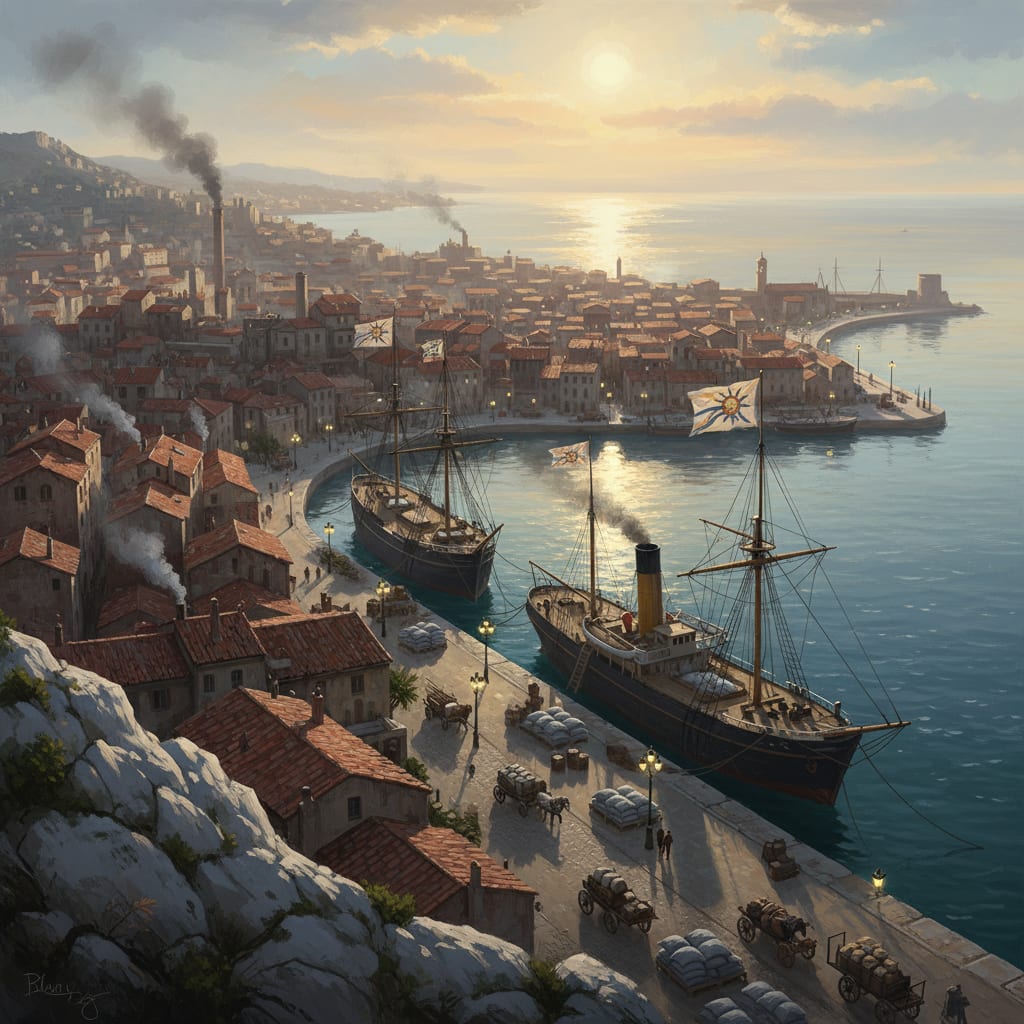
Marseille squats on the Mediterranean like a fat priest on a collection plate — immovable, unctuous, and positioned with absolute precision over the flow of wealth. Six hundred and fifty thousand souls pressed between limestone hills and salt water, their lives governed by tide-tables, shipping manifests, and the particular brand of sanctified avarice that occurs when two Bureaus compete for the same revenue stream in the same harbour for over a century without either achieving dominance or admitting defeat.
The city is the Synod's southern mouth. Through it passes everything the Mediterranean produces and the war consumes: Iberian grain, North African phosphite, Sardinian iron, Sicilian sulphur, and the steady human current of pilgrims bound for Thessaloniki and the Aegean shrine-circuit. The Bureau of Pilgrimage maintains its southern headquarters here — a limestone edifice whose foundations contain the mortared remains of three guild-masters immured during the Harmonized Routes Edict of A.S. 123, and whose upper floors contain clerks who process an estimated four hundred thousand embarkation permits per year without once acknowledging the groaning from below. The Bureau classifies the groaning as structural. The groaning continues regardless of classification.
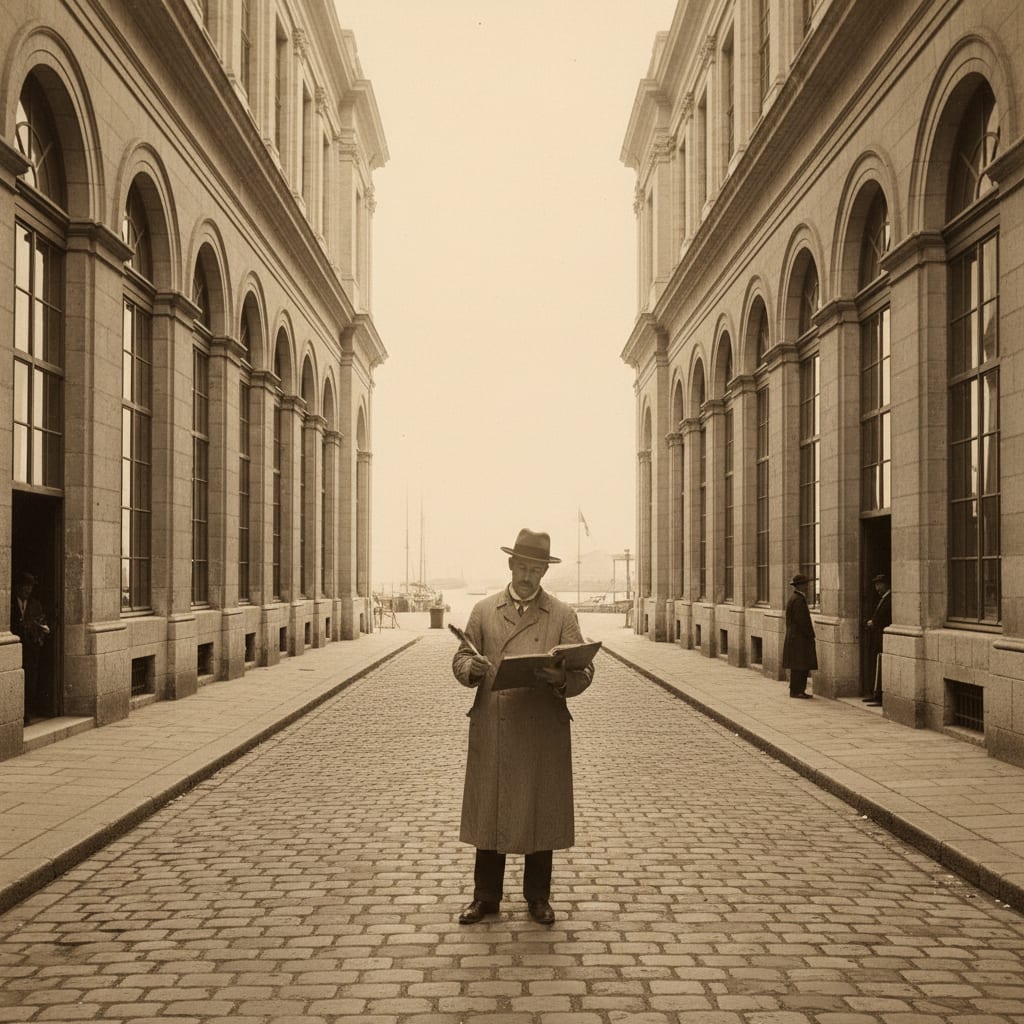
The Bureau of Tithes maintains its Mediterranean Revenue Office here as well — a competing limestone edifice three streets distant from the Bureau of Pilgrimage's headquarters, identical in architecture, superior in armament, and inferior in the quality of its wine cellar, a distinction both Bureaus consider theologically significant. The two buildings face each other across the Quai des Oraisons (Unregistered) like duellists who have been standing at ten paces for a hundred and nine years, pistols raised, neither willing to fire first because the paperwork for a Bureau-on-Bureau discharge has never been drafted and neither will concede the drafting to the other.
#On the Salt Dues
The Salt Dues of Marseille are the Bureau of Tithes' masterwork of regional extraction — a surcharge on all coastal trade devised in A.S. 92 for the Iberian campaigns, intended as temporary, and temporary now for one hundred and nine consecutive years. The Bureau of Pilgrimage opposes the Salt Dues on grounds that they increase the cost of pilgrim embarkation. The Bureau of Tithes opposes the Bureau of Pilgrimage's opposition on grounds that revenue is sacred and interference with sacred revenue is, by definition, heresy. The two Bureaus are so venomous on this subject that their clerks refuse to share ink — a prohibition that began as metaphor, hardened into custom, and was formalised by inter-Bureau memorandum in A.S. 167, which states: "Bureau of Pilgrimage personnel shall not borrow, lend, or accept as gift any writing implement or fluid from Bureau of Tithes personnel, nor shall Bureau of Tithes personnel extend such courtesies, this prohibition extending to chalk, wax, and the margins of shared documents."
The Salt Dues generate approximately 1.4 million Crowns of Grace per annum. Salt governs more precisely than coin — it preserves, it seasons, it weights, and unlike coin it spoils if mishandled, which means the Bureau can charge penalties for spoilage, storage, handling, and "spiritual depreciation of sanctified mineral goods" in addition to the base levy. A merchant ship entering Marseille harbour with a cargo of Iberian salt pays the Salt Due upon entry, the Harbour Maintenance Tithe upon docking, the Pilgrim Infrastructure Levy if any passenger aboard holds a Bureau of Pilgrimage token, and the War Surcharge if the cargo's ultimate destination lies within three hundred miles of the Sagittal Line — which, given the Line's position, includes approximately everything east of Lyon.
#On the Harbour
Three hundred and forty deep-draught berths line the Vieux-Port (Unregistered) and the expanded eastern basin — a construction project begun in A.S. 130 and declared complete in A.S. 158, though "complete" in the Bureau of Engineering's vocabulary means "no longer actively collapsing at a rate that exceeds the repair budget." A further eight hundred coastal and riverine berths service the smaller trade: fishing vessels, river barges from the Rhône corridor (Unregistered), and the peculiar flat-bottomed craft that carry relic-shipments from the Iberian coastal shrines under armed escort and Bureau of Relics seal.
The harbour operates under joint jurisdiction — Bureau of Pilgrimage controls passenger manifests, Bureau of Tithes controls cargo assessment, Bureau of War controls military shipments, and the Harbour-Master answers to all three while obeying none, a diplomatic achievement that has kept the port functioning for decades through the simple expedient of never asking permission and never refusing a bribe from the correct Bureau at the correct moment.
The pilgrim fleet sails from the eastern basin — converted merchant vessels, each carrying a Bureau of Pilgrimage inspector, a shipboard chapel, and a manifest of souls cross-referenced against the Great Ledger before the anchor is weighed. No ship sails for Thessaloniki without the Bureau's stamp. No passenger boards without a token. No cargo rides below decks without an absolution slip, time-boxed to the estimated voyage duration — and if the winds turn foul and the voyage exceeds its spiritual window, the cargo spoils, the absolution rots, and the Bureau charges the captain a sanctified delay surcharge that ensures unfavourable weather is the captain's problem and the Bureau's profit.
A prior filing listed the pilgrim fleet's annual departures at "two hundred and six vessels." The Bureau of Pilgrimage has revised this to "approximately one hundred and forty," attributing the discrepancy to a counting method that included return voyages as separate departures. The Bureau of Tithes has filed a protest noting that if return voyages are not counted separately, the harbour dues collected on return voyages must be refunded. The Bureau of Pilgrimage has declined to refund. The Bureau of Tithes has declined to accept the declination.
UNRESOLVED — Inter-Bureau Arbitration Panel, convened A.S. 199. Ruling: pending.
#On the Relic Trade
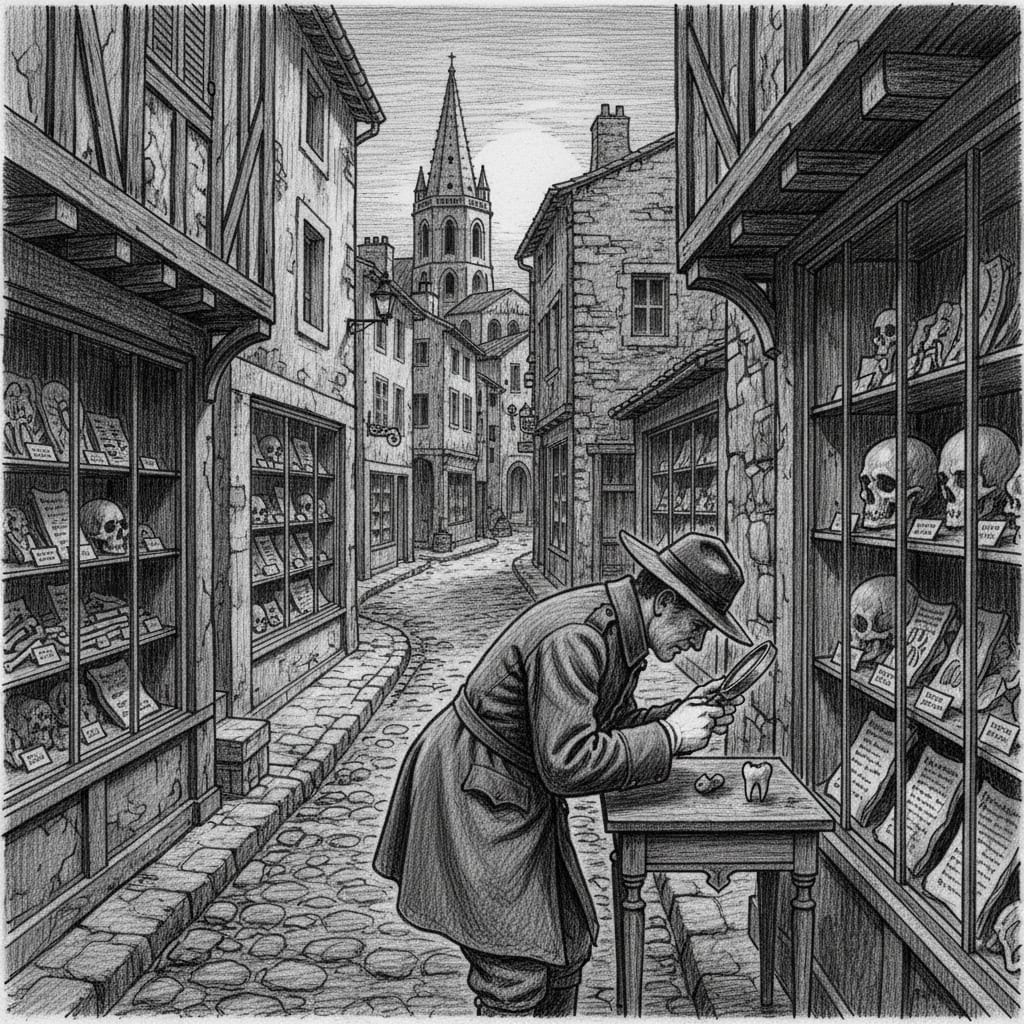
Marseille is the Synod's busiest relic marketplace outside Strasbourg itself. The Bureau of Relics maintains a southern authentication office at the Quai Saint-Lazare, through which passes every relic imported from the Iberian shrines, the North African coast, and the eastern Mediterranean — bones, teeth, fabric scraps, iron fragments, sealed phials of water from disputed springs, and the occasional object so strange that the authentication clerks file it under "Category: Declined to Classify" and forward it to Strasbourg under armed escort.
The relic dealers of Marseille occupy a quarter between the harbour and the Cathedral of Saint-Victor (Unregistered) — a warren of narrow streets where every second shopfront displays a glass case of authenticated fragments and every third shopfront sells counterfeits so accomplished that the Bureau of Relics has, on at least two documented occasions, accidentally purchased its own forgeries back at authentication prices. The Bureau does not discuss these incidents. The dealers do, at length, and with professional pride.
The Demon-Glass Polishers operate here as well — the profession the Bureau insists does not exist, found in every port from Marseille to the Harbor of Chains, supplying the Bureau of War with combat-grade optics refined from salvaged demon-glass. Their workshops cluster in the eastern harbour district, identifiable by the faint violet luminescence that leaks from shuttered windows after dark and by the Bureau of Purity's studied refusal to patrol those particular streets between the hours of vespers and matins.
#On the City's Character
Marseille is old. Older than the Synod, older than the Bureaus, older than the faith that now governs it. The city was a port when Rome was a village and will be a port when the last Bureau clerk files his final receipt and walks into the sea. This antiquity gives it a particular insolence — a quality the Bureau of Purity has attempted to classify, tax, and suppress for a century without measurable success. The people of Marseille comply with every regulation the Synod imposes, pay every tithe the Bureau of Tithes demands, obtain every permit the Bureau of Pilgrimage requires, and then do precisely as they please in the gaps between the stamps, which are numerous and profitable.
The city's quarters are four: the Vieux-Port district, where the original settlement clings to the harbour like barnacles on a hull and where the streets are too narrow for Bureau enforcement wagons to pass; the Cathedral Quarter, where Saint-Victor's bells toll the canonical hours and the Bureau of Bells maintains its most southern relay-tower; the Canebière, where the merchant houses and shipping offices conduct the city's legitimate trade under the watchful disinterest of three competing Bureau offices; and the Eastern Basin, where the pilgrim fleet docks, the relic dealers ply their trade, and the Bureau of Shadows maintains an office so poorly concealed that local children use it as a landmark for giving directions.
The Black Ledger maintains two confirmed cells in the city — both in the dock quarter, both operating with the particular brazenness that characterises criminal enterprises in ports where three Bureaus compete for jurisdiction and none can agree on whose problem the criminals are. The Bureau of Purity says enforcement is a War matter in port zones. The Bureau of War says criminal matters below the threshold of insurrection belong to Purity. The Bureau of Pilgrimage says both are welcome to handle it provided they do not disrupt passenger embarkation schedules. The criminals, aware of this jurisdictional paralysis, have reportedly sent a letter of thanks to all three Bureaus. The letter has been filed.
#On the Present Condition
Marseille thrives. This is no compliment — the city thrives in the manner of a weed that has learned to grow between paving stones: persistently, stubbornly, and in complete indifference to the intentions of those who laid the pavement. The war feeds it. Every escalation along the Sagittal Line increases demand for the materials that flow through Marseille's harbour. Every pilgrim surge — and they come in waves, each prompted by some new miracle, some new terror, some new sermon from the Bureau of Doctrine about the spiritual merits of walking — fills the embarkation docks and the Bureau of Pilgrimage's coffers and the taverns of the Vieux-Port simultaneously.
The rivalry with Genoa continues — that other Mediterranean port, a hundred and eighty miles east along the coast, which competes bitterly for Synod shipping contracts and Bureau of War naval commissions. Genoa has the banking houses. Marseille has the pilgrim fleet. Genoa has the Bureau of War's primary shipyard contracts. Marseille has the Bureau of Pilgrimage's infrastructure monopoly. The two cities have been competing since before the Synod existed and will be competing after the Synod falls — though I am not supposed to write that last clause, and the Bureau of Doctrine will, I expect, redact it.
[LINES 4–7 REMOVED BY ORDER OF THE BUREAU OF DOCTRINE — REF: SPECULATIVE INSTITUTIONAL MORTALITY — FILE SEALED]
An earlier edition of this entry described Marseille as "the Synod's second city." Strasbourg is the first. Kanzleiburg disputes the second position. Munich has filed a formal claim to third. The Bureau of Records has declined to adjudicate municipal rankings on the grounds that "hierarchy among cities implies hierarchy among the Bureaus stationed within them, and the Bureaus are equal in the eyes of the Synod." This is a lie. The Bureaus are not equal. Everyone knows it. The Bureau of Records knows everyone knows it. The filing stands.
NOTED — Bureau of Records, A.S. 201.
The city endures. The harbour fills and empties with the tides. The guild-masters groan in the foundations of the Bureau of Pilgrimage. The Salt Dues remain temporary. The relic dealers sell teeth of saints who possessed, by their collective inventory, approximately nine hundred molars apiece. The Bureau of Purity patrols the streets it can reach and ignores the streets it cannot, and the people of Marseille — six hundred and fifty thousand of them, salt-cured and sun-hardened and beholden to no single Bureau — continue to do what port cities have always done: take the money, load the ships, and ask no questions that might interfere with the morning tide.