
#On the Law That Put a Seal on Heat
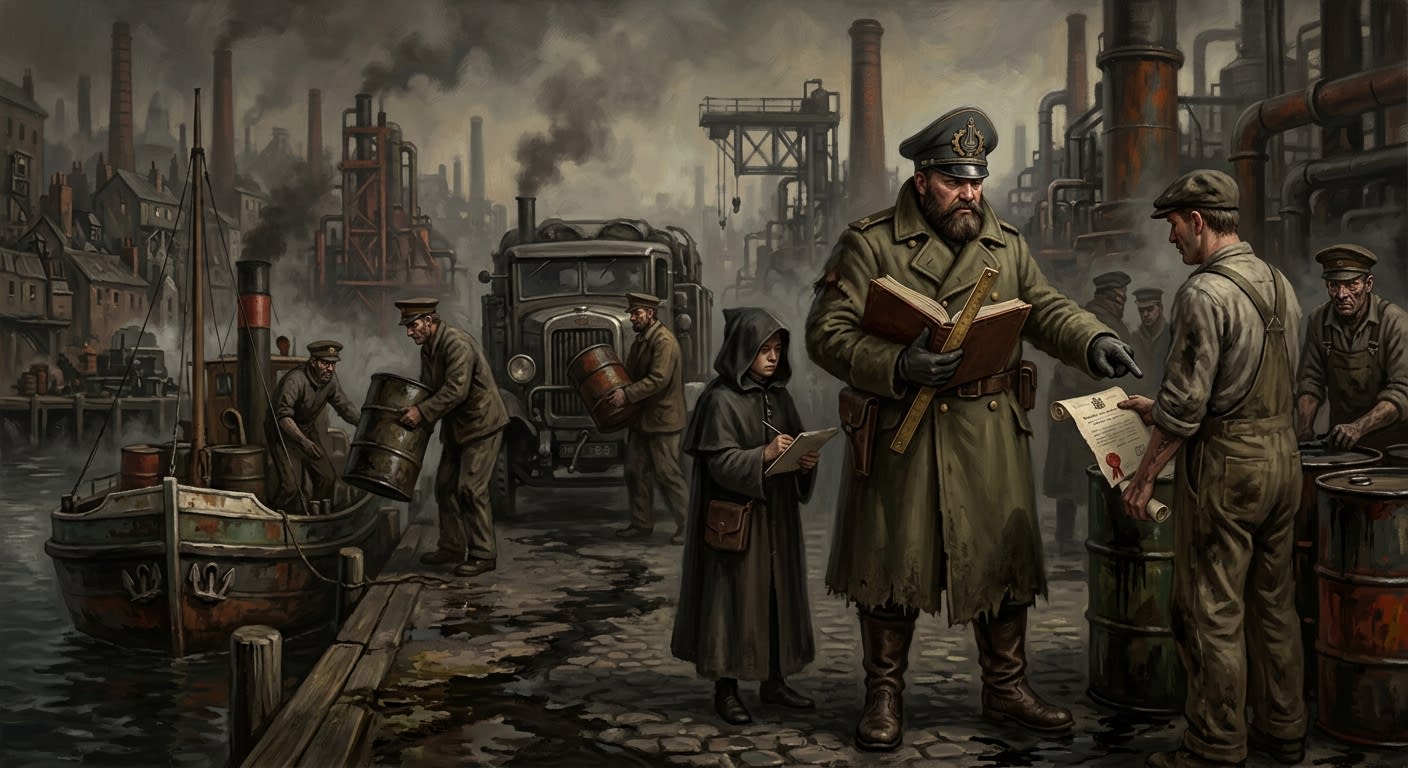
The Fuel Monopoly Acts of A.S. 112 are the legislation by which the Synod taught fire to show its papers. Before them, wound-site seepage, volatile vapours, cold-burning slag, chrismole adjuncts, demon-oil residues, black seam tars, and the whole stinking cupboard of post-Sundering combustibles moved through Europe by custom, theft, battlefield salvage, parish licence, emergency requisition, and lies told with soot on the face. After them, no gallon of sanctioned fuel could be tapped, sealed, transported, stored, sold, burned, diluted, blessed, reclassified, lost, stolen, or miraculously discovered without some clerk somewhere having the right to invoice it.
The Acts were issued by the Bureau of Tithes in coordination with the Bureau of Engines & Furnaces, though the word coordination flatters what was, in truth, a legal knife fight conducted with excellent penmanship. Tithes wanted revenue. Engines wanted supply. War wanted heat. Doctrine wanted causality obedient. Purity wanted anything oily to confess before ignition. The result was a code whose genius lay in making all five appetites pronounce the same word: monopoly.
The public catechism calls the Acts a mercy, because they ended unsafe extraction, stabilized fuel channels, protected workers under licensed oversight, and brought dangerous substances beneath Synodal discipline. Each claim contains enough truth to keep the sentence warm. The Acts did reduce certain accidents. They did regularise supply. They did impose records where previously there had been sacks, barrels, mule carts, and men with no names unloading drums at midnight. They also created the charter system by which private houses could buy extraction rights to wounded ground, employ desperate crews, bury casualty tables under commercial sensitivity, and retire rich from holes no human being should have approached without a funeral procession already rehearsed.
A law may be judged by what it forbids, what it permits, and what it learns to call the dead. The Fuel Monopoly Acts excel in all three disciplines.
#On the Need That Made Theft Official
The Acts did not invent fuel hunger. They merely taught it to write.
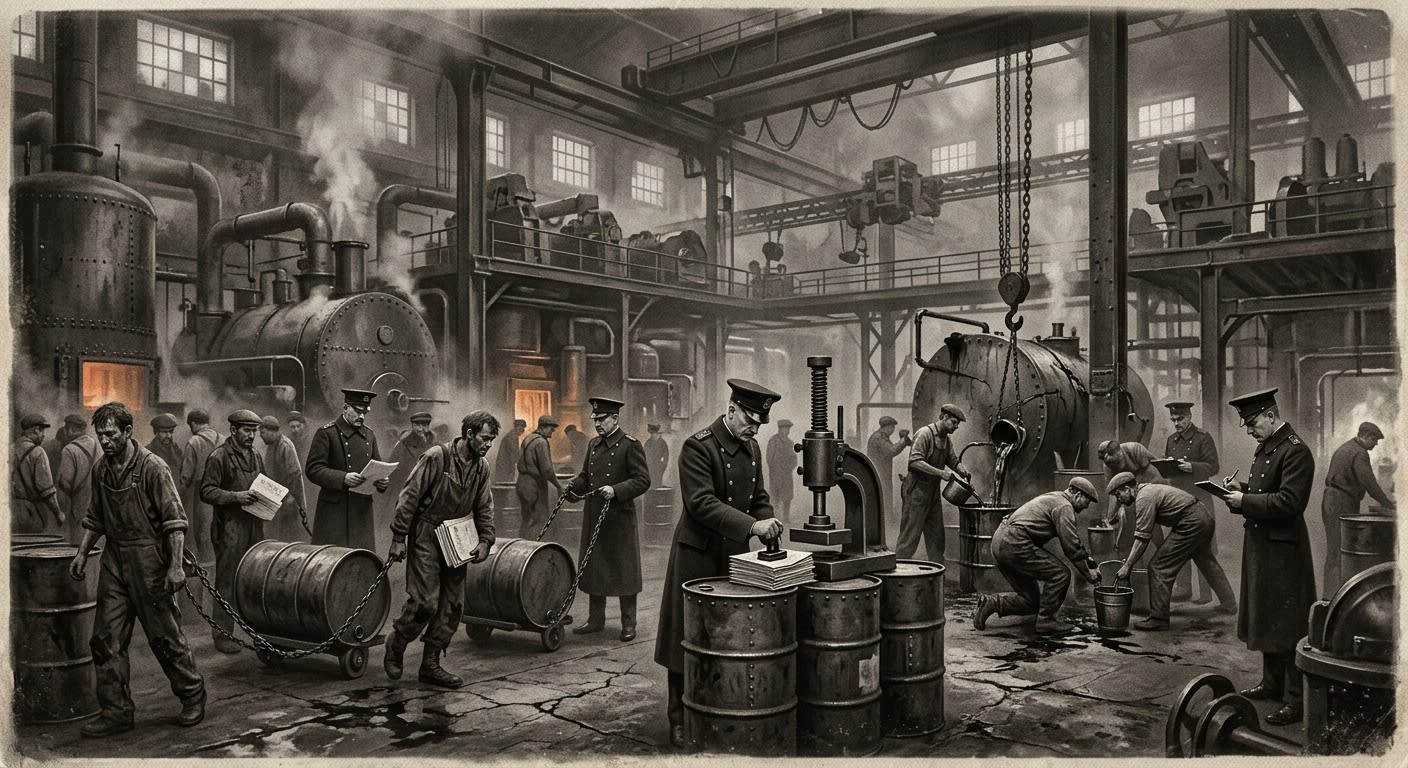
By A.S. 112 the Line had grown past an emergency of masonry and prayer. It had become a machine. Bastion powerhouses needed heat. Bell-thumpers needed pressure. Rail cranes needed steady feed. Hospital stacks needed winter allocation. Artillery foundries needed chrismole, coal, seep additives, wax filters, saint-dust suspension, and every foul substance that could persuade iron to obey. The Sagittal Line had learned to stand, and standing required combustion in quantities no sermon could politely mention.
Early supply had been improvisation wrapped in doctrine. Battlefield scavengers skimmed oily seep from demon-scarred ravines. Parish engineers dug blue-frost pockets with farm tools and called the harvest local blessing. War officers seized coal seams, tar pits, abandoned refineries, and anything else that burned without screaming too loudly. Engines sent mechanics under temporary writs. Tithes followed with scales. Doctrine followed with vocabulary. Purity followed too late, which is its natural gait.
The crisis was arithmetic. Unlicensed extraction fed the front but escaped the Ledger. Men tapped wounds without hymn clamps, transported drums without route seals, mixed fuel without purity declarations, and sold surplus to towns whose children preferred illegal heat to lawful frost. Bastions survived on contraband too useful to condemn. Strasbourg discovered, with the horror proper to accountants confronted by free necessity, that the war was being warmed by substances on which no adequate tithe had been collected.
The Acts answered this scandal with the simplest Synodal sacrament: licence. Every wound-site became potential property of the Synod. Every extraction required a charter. Every drum required a seal. Every route required escort. Every crew required pre-filed purity declaration. Every buyer required account standing. Every accident required classification before grief could proceed.
Provincial primers state that the Fuel Monopoly Acts were enacted chiefly to protect extraction workers from unsafe private practice.
Corrected. Worker safety appears in the preamble because preambles are where laws keep their perfume. The operative clauses concern rights, tariffs, permits, penalties, drum seals, and revenue precedence.
The law did not end danger. It made danger legible, collectible, appealable, and inheritable.
#On the Charter System
The charter system is the Acts' black little heart. Under its terms, charter houses purchase extraction rights to specified wound-sites, seam grids, basin lips, seep ravines, and volatile ground registered under Engines survey. The charter grants access, quota obligation, drum-mark authority, escort eligibility, and tariff schedule. It also grants a spiritual anaesthetic: if the house follows procedure, the ground's obscenity becomes commerce.
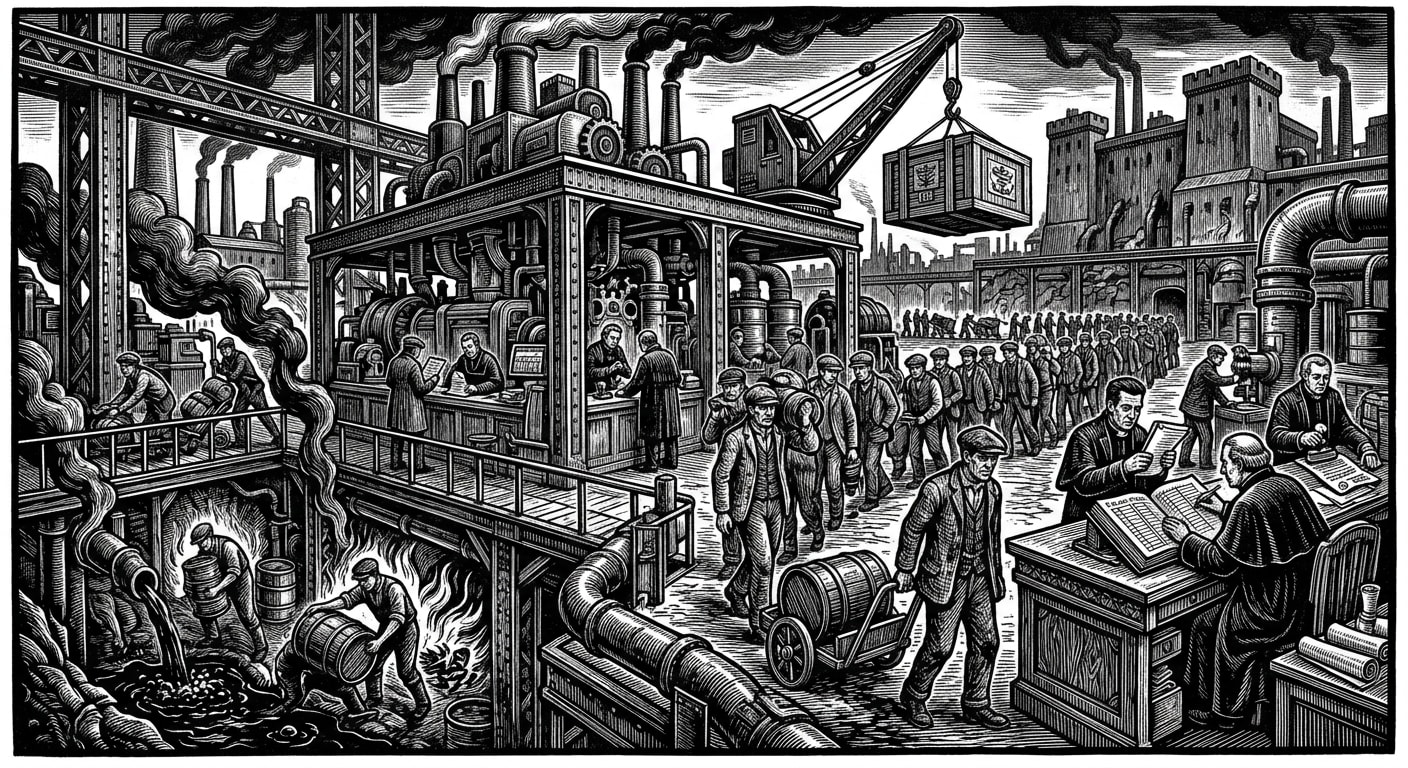
A charter house does not own the wound. Ownership belongs to the Synod, as all useful horrors eventually do. The house owns the right to approach, pierce, draw, seal, haul, account, and profit. It hires Wound-Site Prospectors, gasket hymn singers, ward setters, survey scribes, convoy guards, drum washers, breath-listeners, and those unfortunate boys whose entire profession consists of holding lamps close to holes while adults argue about pressure pitch.
The six recognised stages entered the official manual after A.S. 112: survey, staking, tap, draw, seal, transport. Each stage carries forms. Survey requires scar-map appendix and preliminary Purity oath. Staking requires ward inventory. Tap requires Engines pressure notation. Draw requires singer cadence log. Seal requires wax witness, clamp mark, and closing verse. Transport requires chain lash, route slip, escort stamp, and night-strap inspection. These forms prevent chaos, which is to say they ensure catastrophe has a desk to visit before it reaches the widows.
The charter holder's genius lies in distance. He may sit in Strasbourg, Budapest, Munich, or a warmed office in some corridor city whose windows face away from the pits. He reads yield sheets. He approves gasket wax. He disputes casualty language. He sends condolences by clerk. The crew descends. The drum comes back, or does not. The holder files.
Charter Baron Gruhl remains the system's purest specimen. Seven wound-sites along the Budapest–Irongate corridor. Two hundred workers. Forty-one lost in a single season. Filed as “expired assets, category: fuel-adjacent.” Tithes accepted the reports. Gruhl retired with pension and influence. If this seems monstrous, the reader has grasped the statute. If it seems efficient, the reader should apply for Tithes immediately and spare the rest of us the suspense.
#On Saint Orren's Adoption by Law
Saint Orren held an iron plug in a demon-seep rupture for nine hours before the wound reopened with him inside. For decades his cult belonged to scar-workers, seal-drivers, and the kind of practical believer who trusts a saint more when the miracle ends badly. The Acts changed him. They took a trade saint and made him a licensing emblem.
After A.S. 112, Orren's iron plug appeared on permit stamps, drum seals, charter-house safety placards, extraction chapel lintels, condolence cards, and wage scrip. The Budapest Extraction Chapel (Unregistered) prospered. Relics enjoyed the sudden discipline of crowds with money. Charter houses discovered that a saint on a quota notice softens the quota by one degree and hardens the poster by twenty. A prospector might kiss Orren's icon in a tool shed and spit at the same icon printed above a shift schedule. This is discernment.
The law required chapels near major extraction corridors, though it described them as liturgical support stations, never as advance apologies. Orren's nine lamps became standard. The tenth remained unlit. Prospectors understood. Charter clerks found the arrangement photogenic. Tithes found it billable. Engines found that crews sealed better after kneeling. Doctrine found the whole arrangement satisfactory in the way one finds a bandage satisfactory after deciding not to inspect the wound.
This adoption had a second use, quieter and meaner. It converted worker terror into licensed ritual. A crew refusing a dangerous tap could be accused of technical caution; a crew refusing a tap after Orren's lamp had been lit could be accused of spiritual cowardice. The law did not order men into seams with bayonets when a saint would do the cheaper work. Chapel attendance became proof of readiness. Readiness became wage standing. Wage standing became debt relief. Debt relief became the little chain by which a prospector discovered his knees belonged to the charter house long before his lungs did.
An A.S. 119 devotional tariff sheet claimed that all Fuel Monopoly charters “operate under Saint Orren's protection.”
Withdrawn after two ruptures, one chapel sled inversion, and a petition from prospectors objecting that the saint was being blamed for managerial greed. Revised language reads: “operate under Saint Orren's patronal invocation.” The deaths remained unchanged; the liability improved.
The Acts also turned Orren's legend into precedent. The plug held. Therefore containment was possible. The wound reopened. Therefore risk persisted. Orren vanished. Therefore personnel loss could coexist with successful extraction. No charter lawyer wrote these three sentences together. He did not need to. The law learned them by appetite.
#On the Bureaucracy of Drums
A sealed drum under the Fuel Monopoly Acts is a portable argument between matter, hymn, and revenue. The substance inside may be tar, seep, volatile vapour condensed into black sweat, cold slag powder, chrismole adjunct, or one of the materials Engines names by number because names make Doctrine twitch. The drum contains it. The gasket hymn binds it. The wax stamp legalises it. The tariff sanctifies it. The convoy moves it. The furnace devours it and calls the heat obedient.
Drum law is thick because drums misbehave. They swell, breathe, hum, warm, cool, dent outward from the inside, acquire finger marks under untouched straps, and occasionally exhale when opened before the proper verse. The public doctrine calls these thermal variations. The field manuals instruct workers to tighten chains, keep pitch instruments covered, separate singer and driver during night transport, record strap tension at dusk and dawn, and never sleep with one's ear against a sealed drum. Public doctrine comforts the citizen. Field doctrine keeps the citizen from being splashed across a road.
Each drum passes through a chain of offices. The charter house records yield. Engines certifies seal integrity. Tithes assesses volume. Purity receives fume declarations. War claims priority if the front is short. Mercy receives the crew when the drum was less obedient than advertised. Records proves the drum existed, unless it would be more useful to prove it never did. Shadows reads the chain when the handwriting becomes too clean.
The Acts made drum fraud a spiritual offence and a commercial crime, thereby allowing every Bureau to punish it in its preferred dialect. Dilution became theft from the Line. False wax became sacrilege. Unlicensed transport became supply treason. Opening a drum outside designated furnace chapel became attempted atmospheric disorder. Selling a breathing drum to a civilian heat syndicate became, in one memorable A.S. 146 prosecution, “domestic infernal hospitality.” The phrase was mine. I remain proud.
#On Black Crews and Honest Criminals
Monopoly breeds criminals the way damp breeds mould: naturally, fragrantly, and despite notices. Black drill crews (Unregistered) appeared before the wax on the Acts had cooled. They worked shallow seams beyond charter grids, abandoned tap-mouths declared exhausted, battle scars too minor for survey, and illegal pockets near poor towns where lawful fuel cost more than bread and both were short.
They used cork-and-prayer gaskets, stolen ward spikes, cracked respirators, counterfeit Orren seals, and hymn singers who knew two verses and hummed the rest. Their drums were dirtier, cheaper, and more volatile. They sold to unauthorized refineries, city heat gangs, charitable kitchens, black-diesel distillers, and sometimes the same charter houses that denounced them in public notices. The Bureau of Purity staged raids. Tithes measured seizure value. Engines quietly purchased samples. War quietly asked whether supply could be maintained through deniable channels during winter shortage. Hypocrisy, once heated, becomes policy.
Black crews are not innocent. They kill their own with bad seals, sell fuel that cooks children in cellar stoves, and flee ruptures without counting bodies. Yet they preserve a certain ugly honesty. They know they are thieves. Charter houses prefer the grander delusion that a purchased seal transforms extraction into virtue.
The Acts depend on black crews more than the Acts admit. Illegal fuel exposes seam behaviour before charter survey, supplies towns during quota failures, tests dangerous ground without pension consequence, and provides Purity with occasional public sinners. A monopoly without contraband grows complacent. Contraband gives the law a mirror in which it may admire itself punishing poverty.
#On Fuel Courts and the Language of Appeal
The Acts created fuel courts (Unregistered) because every profitable cruelty eventually needs a bench. These were not grand tribunals with carved saints and weeping galleries. They were back rooms behind Tithes offices, refinery chapels, corridor depots, and charter halls where three officials could decide whether a drum belonged to a house, a crew, a widow, a furnace, a creditor, a saint, or the Synod entire. The answer was usually the Synod entire, then the creditor, then the house. Widows entered the list only if someone had misspelled furnace.
A fuel court hears boundary disputes, seal challenges, compensation petitions, dilution charges, illicit tap accusations, route delays, escort refusals, black-crew seizures, chapel-singer wage claims, and the small vicious appeals by which desperate people attempt to make law remember their faces. The procedure is brisk. The claimant presents standing. The respondent presents charter. The clerk presents tariff. The judge presents fatigue. The verdict presents itself.
Fuel court language has its own sacramental stink. A dead worker is a loss event. A missing worker is an unresolved labour unit. A ruptured drum is containment failure unless it killed a senior officer, in which case it becomes hostile emanation. A widow owed three months' wage is a compensation claimant. A widow owed nothing is a public nuisance. A charter holder caught violating a quiet provision is subject to review. A black crew caught keeping a town warm is subject to example.
The great lesson of the fuel courts is that appeal is a heat sink. Anger enters, papers absorb it, clerks circulate it, and by the time a judgment emerges the fury has cooled into a fee. The petitioner leaves poorer, older, instructed. The court remains warm.
#On Amendments, Wars, and Quiet Provisions
The Charter Wars forced the first great amendment in A.S. 167. The name flatters the participants. It was less war than a long season of bribes, burned pits, murdered survey scribes, forged boundary maps, poisoned chapel wine, kidnapped hymn singers, and Judges made suddenly richer in towns whose wound-sites had become disputed. Tithes dislikes disorder when disorder touches revenue. The amendment tightened seam-boundary registration, created escrow duties for disputed yield, fixed bid procedures, and established the principle that murdering a competitor's scribe was commercial interference before it was murder. Priorities clarify a civilization.
Engines supported the amendment because unstable charter violence endangered supply. War supported it because burning a competitor's drum depot is strategically indistinguishable from enemy action if the front freezes afterward. Doctrine supported it after receiving assurances that the word monopoly would be preached as stewardship. Purity supported it because new penalty clauses are Purity's idea of spring.
Popular histories describe the A.S. 167 settlement as ending the Charter Wars.
Corrected. It ended open pit-burning by charter houses with enough money to hire lawyers. Boundary sabotage, gasket fraud, singer theft, and report poisoning continued under cleaner headings.
The second great amendment came after the Quiet Basin Incident. In A.S. 178, Basin-7 (Unregistered) took fourteen crewmen, one hymn singer, one ward setter, and one survey scribe, then returned sealed warm drums, ordered tools, intact warding, record yield, and a pitch pipe the Bureau of Bells declined to name. Shadows sealed the file in A.S. 179. Eleven years later, the Acts acquired quiet provisions in A.S. 189.
The quiet provisions are masterpieces of legal fear. They require anomaly-adjacent yields to enter sealed annex. Record yield after personnel disappearance requires tri-Bureau review before furnace routing. Pitch instruments recovered from abandoned sites may not be sounded in rooms containing children, pregnant women, open ink, or unconfessed clergy. Tools found cleaned beyond crew habit must be wrapped without bare-hand contact. Warm drums without personnel must be reported to Shadows before Tithes, a clause Tithes resents and obeys with visible indigestion.
The provisions do not name Basin-7. Names invite memory. Memory invites questions. Questions invite answers, and answers are notoriously poor servants.
#On Causality, Heresy, and the Furnace Catechist
The Acts govern fuel, but fuel is also a Synodal argument about why it burns. A substance that burns can become an argument about why it burns. Engines says pressure, mixture, impurity, seal, oxygen, cadence, heat curve. Doctrine says permission, obedience, Providence, rite, contamination, grace. Tithes says assessable unit. War says late. A stoker says move or the boiler dies. The Acts preserve peace among these languages by making each incomplete without paperwork from the others.
This did not prevent heresy. It produced better heresy.
The Causality Purge of A.S. 134 erupted after manuals titled Fuel Is Chemistry spread through six bastion powerhouses. The title alone deserved punishment for bad theology and worse manners. The manuals listed fuel-load truths, pressure curves, mixture ratios, and emergency responses in terms that bypassed Providence entirely. Forty-seven stokers, eleven foremen, and three shift engineers were immured at Bastion-Przemyśl alone. A senior Engineering draughtsman vanished into File 44-K. Doctrine expanded the forbidden vocabulary. Engines pretended surprise with the delicacy of a cat beside a broken reliquary.
The later Furnace Catechist system grew from this wound in language. Every powerhouse needed a priestly interpreter who could stand between the stoker's hand and the forbidden conclusion that flame follows material cause. The Catechist recites the Chain of Cause: Creator, angelic hierarchy, Concordat, Doctrine, Engines, supervised labour, fuel, spark, pressure, output. The order matters. Put fuel first and you have treason. Put fuel eighth and the boiler still works. Civilization is mostly sequence.
The Fuel Monopoly Acts supplied the legal soil for this arrangement. If fuel is licensed, sealed, and tariffed under Synodal authority, then its burning can be framed as obedience rather than material arrogance. The drum does not combust because it can. It combusts because it has been permitted.
The Acts also give Doctrine a whip against the engineer's private vocabulary. A mechanic may know that a mixture is too rich, a valve too tight, a line too hot, or a drum too eager. He must say the approved thing: overfed allowance, obstructed obedience, excessive permitted warmth, anomalous container activity. Bad language does not merely offend the ear. It builds a rival world in which causes answer to tools rather than seals. The Synod will tolerate a dangerous furnace more readily than a clear noun.
This is why the furnace catechist stands where he stands: between technical competence and public speech. He lets the mechanic save the boiler while preventing him from saving the truth in the wrong words. A civilization that can separate act from explanation can survive almost anything, including itself.
#On the Bodies Under Commercial Sensitivity
No honest discussion of the Acts survives without the bodies. This is why official discussions avoid honesty with admirable discipline.
Wound-site extraction eats lungs first, hands second, sleep third, names when the seam is in a clerical mood. Prospectors cough until speech becomes an extravagance. Gasket singers lose pitch or dream in the seam's answer. Ward setters develop a habit of counting exits in dining rooms. Survey scribes tie folios to their belts with wire after A.S. 178 and deny the reason. Convoy guards sleep poorly beside drums that tighten their straps at night. Hospices of Departure receive the leftovers. Tithes controls the casualty tables.
The classification is commercially sensitive. This phrase deserves to be branded on the door of every warmed office that has ever denied a widow. Commercially sensitive means casualty rates might affect bids, premiums, charter valuations, labour supply, and the pious confidence of men who prefer cheap heat without accompanying arithmetic. Mercy has asked for clearer figures. Records has asked for names. Doctrine has asked for phrasing. Tithes has filed each request into the velvet pit where compassion goes to die politely.
BUREAU OF MERCY REQUEST — EXTRACTION CASUALTY TABLES Requested: crew loss, lung-failure incidence, tremor pension claims, hospice turnover, family compensation delays. Tithes response: ███████████████████████████████████. Mercy appeal: pending. Pending duration: forty-one years.
The Injured Laborers' Provision of A.S. 160 excludes charter-house prospectors because they are not Bureau employees. This distinction is administrative, deliberate, and fatal. A man may extract fuel under Synodal licence, sing under Synodal hymn, seal under Synodal wax, transport under Synodal escort, and die outside Synodal pension because his wage came from a charter house. The law did not overlook him. It placed him exactly there.
#On the Present Force of the Acts
As of A.S. 201, the Fuel Monopoly Acts remain the hot spine of Synodal industry. Bastion furnaces burn because the Acts make fuel visible. Rail corridors move because the Acts discipline drums. Charter houses prosper because the Acts sell danger by parcel. Prospectors descend because debt, hunger, wage arrears, patronal devotion, and the old stupidity called courage continue to produce bodies willing to stand near holes.
Engines & Furnaces still writes manuals over facts it cannot explain. Tithes still prices seepage before pity. Purity still raids black crews while accepting staged confiscations as theatre. War still demands priority when the Line shivers. Mercy still receives men whose lungs sing back. Doctrine still insists that combustion proceeds by divine permission through material instrumentality, a phrase so polished one may almost miss the blood under it.
The Acts have survived the Charter Wars, the Causality Purge, the Furrow of Pest, Gruhl's forty-one, Basin-7, quiet provisions, breathing drums, black drill crews, fraudulent Orren seals, and every winter in which lawful fuel ran short enough for illegal fuel to become Providence by another route. A weak law breaks under contradiction. A strong law fattens on it.
Their present strength can be measured in small obediences. A convoy captain writes thermal variation while staring at a drum that moves like a sleeping animal. A widow asks whether her husband died under Bureau employment and receives a lecture on charter distinction. A black crew surrenders three drums for public burning and delivers twelve through the rear road that night. A Furnace Catechist corrects a stoker's word while the stoker's hand prevents an explosion. A Tithes clerk signs a quiet annex without reading the redacted line because reading would require memory and memory might require action.
This is governance: the art of keeping the furnace fed while each office maintains a clean enough conscience to sleep beside the heat.
At dusk on the Budapest–Irongate road, convoy guards walk the drum line with lanterns and chain hooks. They check wax. They check straps. They check whether the sealed metal has swollen since last bell. One drum exhales under its tarp. The guard writes thermal variation because the form offers no holier word. Far ahead a bastion furnace waits with its mouth open. Behind him, in a charter office warm enough to permit soft hands, a clerk totals yield, losses, premiums, and penalties under the heading Fuel, Licensed.