

#I. On the Name and Its Evidence
"Someone sang with us who was not there." — deposition of the surviving Engineers, Toledo, seventh month of the siege
The Shadow-Choir is a name that has never had a membership. This Codex files it among the factions because the Ledger keeps no drawer for a single sentence, and because pilgrims talk of the thing as if it kept a hall, collected dues and arrived punctually for Vespers. The Ledger's own holdings are smaller and harder. It has a demolition beneath the cathedral of Toledo in A.S. 15. It has a collapse larger than the men who set the charges could account for. It has three survivors who swore that a further voice joined their hymn in the tunnels. From those three items the faithful have built a choir. The Ledger has built a folder.
The folder has no roster in it, and no leader, oath, banner or founding date. Nobody has ever been tried for belonging. Nobody has ever been seen. No office has established whether the voice was one or many, what language it used, which melody it followed, or whether it meant to help. The plural in "choir" belongs to the pilgrims, who supplied it without being asked.
I record the classification because classification is my office. I do not certify the congregation.
#II. On the Voices Beneath Toledo
The background needs only a little space. The full account belongs to the Siege of Toledo, and readers who want the cannon, the leaflets and the glassed soldier may go there.
In the spring of A.S. 15, Rationalist forces under Colonel-Prefect Étienne Grimal came up the slopes above the Tagus with clockwork artillery and two thousand Republican Guards. Toledo was held by Father Clemente de los Rios and the Order of Saint Iago, who had the Relic of Saint Iago and very little else. By the seventh month the besiegers had broken into the cathedral and stripped it. They mounted a twelve-pounder in the nave where the altar had stood. As a gun platform it was sensible. It was also an outrage. The Rationalists generally managed both at once.
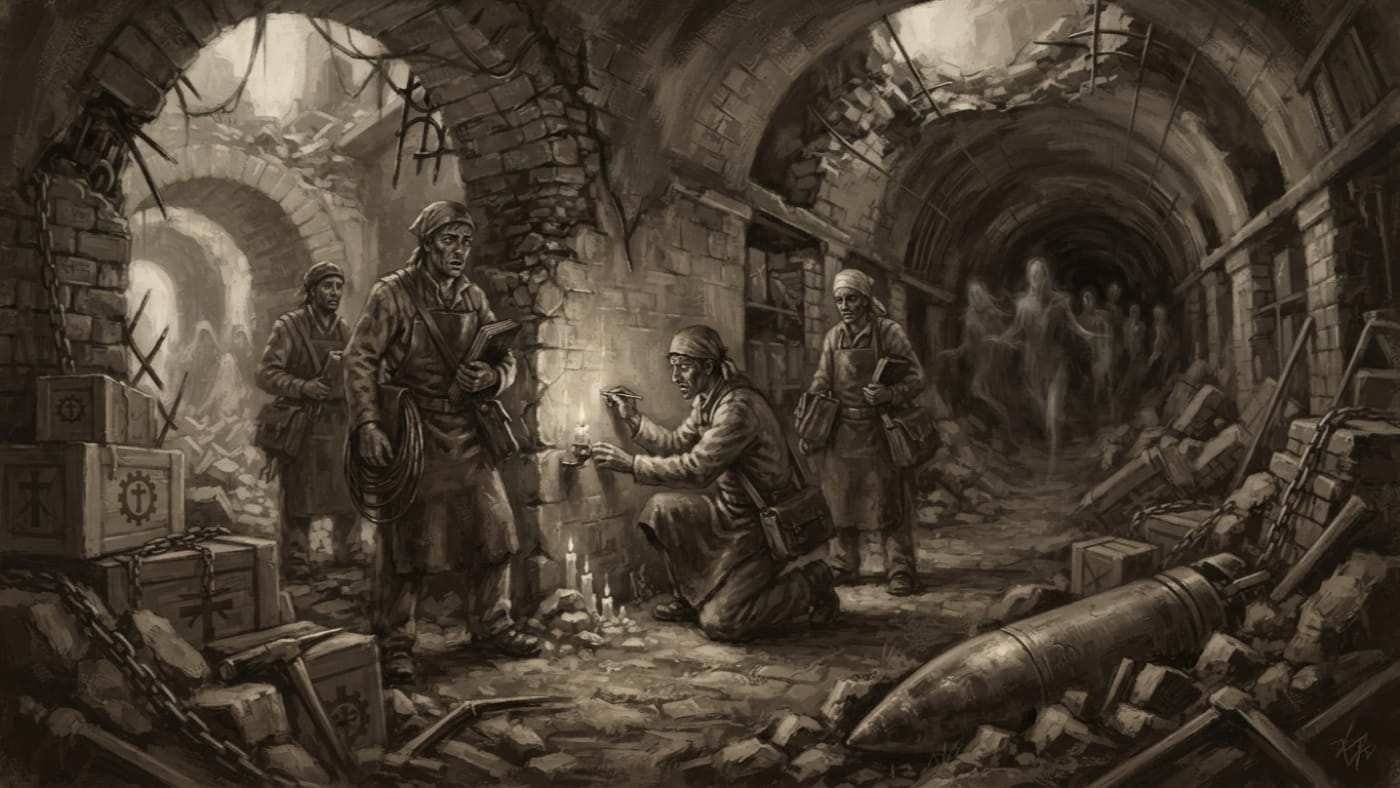
The defenders answered from underneath. They were men whom later offices would call Litany-Engineers, although the title, the licence and the guild-stamp were still generations away and no tunnel under Toledo had heard of any of them. Twelve went down into the sewers of the old quarter. They took hymnals blackened with lamp-oil, satchels of powder, coils of fuse and very little light. As they went they scratched their arithmetic into the wet masonry, with a prayer beside each figure, so that every quantity was absolved as soon as it was set down. They sang while they worked. For such men the hymn kept the pace and the sum kept the charge, and none of them would have said which mattered more.
They laid the charges beneath the foundations of the altar. Then they lit them.
The nave fell in on the gun platform, the twelve-pounder and the gunners who had loaded it. About half the cathedral went down in fire. Half the city followed. Whole parishes were buried under stone and smoke, and their names are kept today in a register that nobody consults willingly.
Three of the twelve came back up. They had blackened mouths and scorched hands, and they told whoever would listen that the collapse had gone well beyond their figures. Then one of them, or all three, for the depositions do not separate their voices, said the sentence that put this entry in the Codex: someone sang with them who was not there.
That is the whole of the primary evidence. Twelve men went down, three came back, and they gave one sentence.
#III. On the Testimony and Its Custodians
The Ledger's account of the siege records that the blast radius exceeded the best estimates of the Bureau of Engineering by four hundred percent. I give the figure as it was entered there and do no further work on it. I will not convert it into a powder yield, a casualty table or a formula for holy amplification. Engineering has never offered any of those, and I will not offer them on its behalf. In one hundred and eighty-six years it has not produced a satisfactory explanation for the gap. It has produced the request for funding very reliably.
The custody of the sentence is more instructive than the sentence.
When the survivors' depositions reached the archive that later became the Bureau of Records, the clerks struck the phrase as heresy. They used a single rule of ink, laid neatly through the line so that the words stay readable underneath. That is how the archive strikes everything it intends to keep.
The Bureau of Doctrine, looking back on the episode from the security of its later constitution, gave the same words a different ruling: "unverified testimony, spiritually evocative, operationally irrelevant." On that reading the sentence is unproven, moving and beside the point.
So two offices hold the same sentence under opposite rulings. Records says it is false. Doctrine says it is too unimportant to be false. Neither ruling touches the stone. Striking out a sentence does not account for a collapse, and the Church has never pretended that it does. It has simply never put the two documents on the same desk.
The pilgrims were never asked for a ruling and gave one anyway. They called the extra voice a shadow-choir. In their telling it joined the hymn in the sewers and brought down stone and bone together with a voice that had no throat. That last detail belongs to their tradition. No surgeon was consulted, and nobody produced a throat to examine.
#IV. On What the Foundations Still Return
After the Sundering, when the Church came out of hiding and found it needed martyrdom sites more than it needed martyrs, Toledo was rebuilt. The new cathedral went up on the old foundations. Granite runs in the lower courses and replacement limestone above the blast line, and any pilgrim can read the seam with a fingertip.
The sewers were kept as well, which was a mistake in any sense except the archival one. Engineering sealed the tunnels. It then surveyed them. The survey team came back with a report of "acoustic anomalies consistent with choral performance at a depth of forty metres," and Engineering sealed the tunnels again. Seal, survey, seal: it is the oldest liturgy any Bureau performs, and the only one with no responses.
The forty metres is the survey team's own figure. The city's later filing lists the recurrence as active and its depth as uncertain, and I let both documents stand. No chamber has been mapped. No pilgrim route has been opened or approved. No one has gone down to count the voices, and no one is being sent.
The sound has continued. Nothing has shown that it is the same voice. A hymn heard under a cathedral in the present century proves that something under the cathedral resembles a hymn. Whether the singer is the one who joined twelve sappers in A.S. 15, or anyone at all, the surveyors did not establish. To their credit, they did not stay to ask.
#V. On the Limits of the Identification
What is filed here as the Shadow-Choir belongs to Toledo, to the seventh month of A.S. 15 and to one sentence. Every attempt to make it larger takes in other material.
It is not the Choir Beneath. That hymn rises from the Blightmarsh over Debrecen. It is attributed to Engineers lost in the Mire Collapse of A.S. 172, it has its own quarantine and its own instruction not to answer, and it is kept in its own drawer. Two choral reports under two collapses make a coincidence of genre. Toledo's sewers are under no listening quarantine, and none is to be imported for the look of the thing.
The other sounds of the siege also have to be kept apart. The divine fire of the first weeks, the November burning of the bell tower, and Grimal's struck addendum that "the walls screamed as they fell" are three separate episodes with three separate sets of witnesses. Joining them into one voice heard across nine months gives a satisfying story and no evidence. The fourteen women of no recorded order carried oil and died bravely. Nothing places them in the sewers or in the song, and they are not to be enrolled in either. The Relic of Saint Iago explains why Toledo held out for so long. It does not explain who was singing underground.
The numbered Counter-Sorcery Verses that later Engineers chant against sorcery towers took their present form after Prague in A.S. 61. They were not sung under Toledo, whatever the cloister-market's hymn-sheets suggest.
The Siege of Toledo in 71 A.S. The siege took place in A.S. 15, in the year of the demolition. The figure 71 in the Engineers' folio of this Ledger's master compendium is inherited and is corrected here. There was one siege, one demolition and one sentence. No second Toledo is to be inferred from a scribe's slip.
That leaves what the Ledger began with: a collapse that happened, a sum that did not balance, and a sentence that has been struck out, ruled on and repeated for one hundred and eighty-six years without anyone being able to file it anywhere useful. The tunnels are sealed. The folder stays open.