
#On the Order That Held a City Long Enough to Burn It
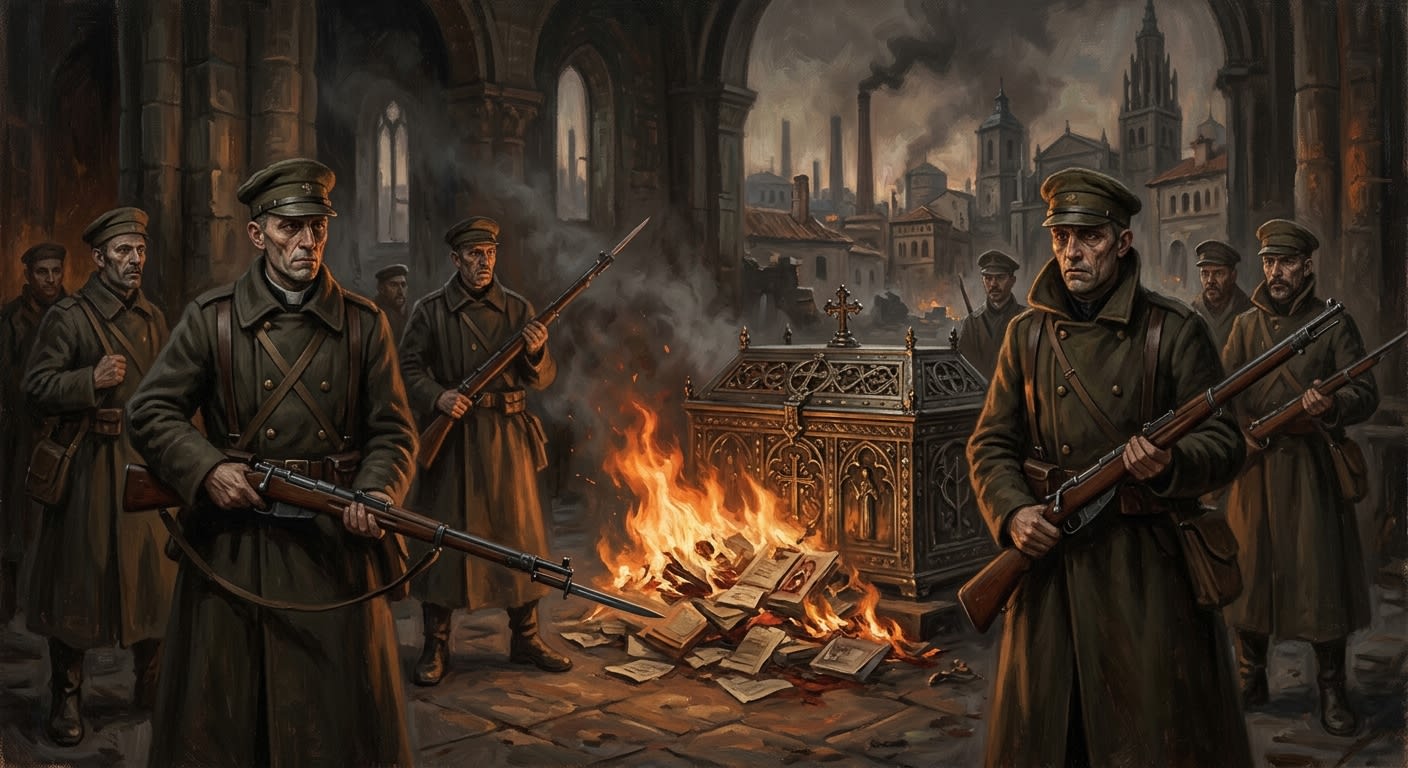
The Order of Saint Iago enters the Sacred Ledger in its most useful posture: surrounded, shelled, underfed, outnumbered, and refusing the enemy the courtesy of a tidy victory. It was an Iberian military-monastic order before the Atheist Wars made such phrases less decorative and more literal; by A.S. 15 it had become the garrison-heart of Toledo, guardian of the Relic of Saint Iago, and steward of that rarest civic accomplishment, a defeat that embarrassed the victor.
The Order is remembered through its destruction because bureaucracies, like widows, keep the last letter. Three hundred clergy, forty-seven lay brothers, refugees without clean counts, fourteen women of no recorded order, and one jawbone set in silver held Toledo for nine months against Colonel-Prefect Étienne Grimal, two thousand Republican Guards, and twelve clockwork cannon derived from the hateful arithmetic of Lucien Artois.
To speak of the Order without speaking of Toledo is possible in the same way speaking of a candle without flame is possible: technically permitted, spiritually thin, and of interest chiefly to archivists who have been indoors too long.
#On Saint Iago and the Jawbone
Saint Iago (Unregistered) belongs to the older Iberian martyrologies, those damp and combative books in which three dioceses may claim one birth, five monasteries may claim one pilgrimage route, and a saint may acquire enough bones to trouble an anatomist while comforting the faithful. One monastery in León claims his skull. Toledo possessed the jaw. The Bureau of Relics, confronted with this familiar surplus of holiness, did what it always does: weighed, sniffed, cross-examined, frowned, and declared the matter usable.
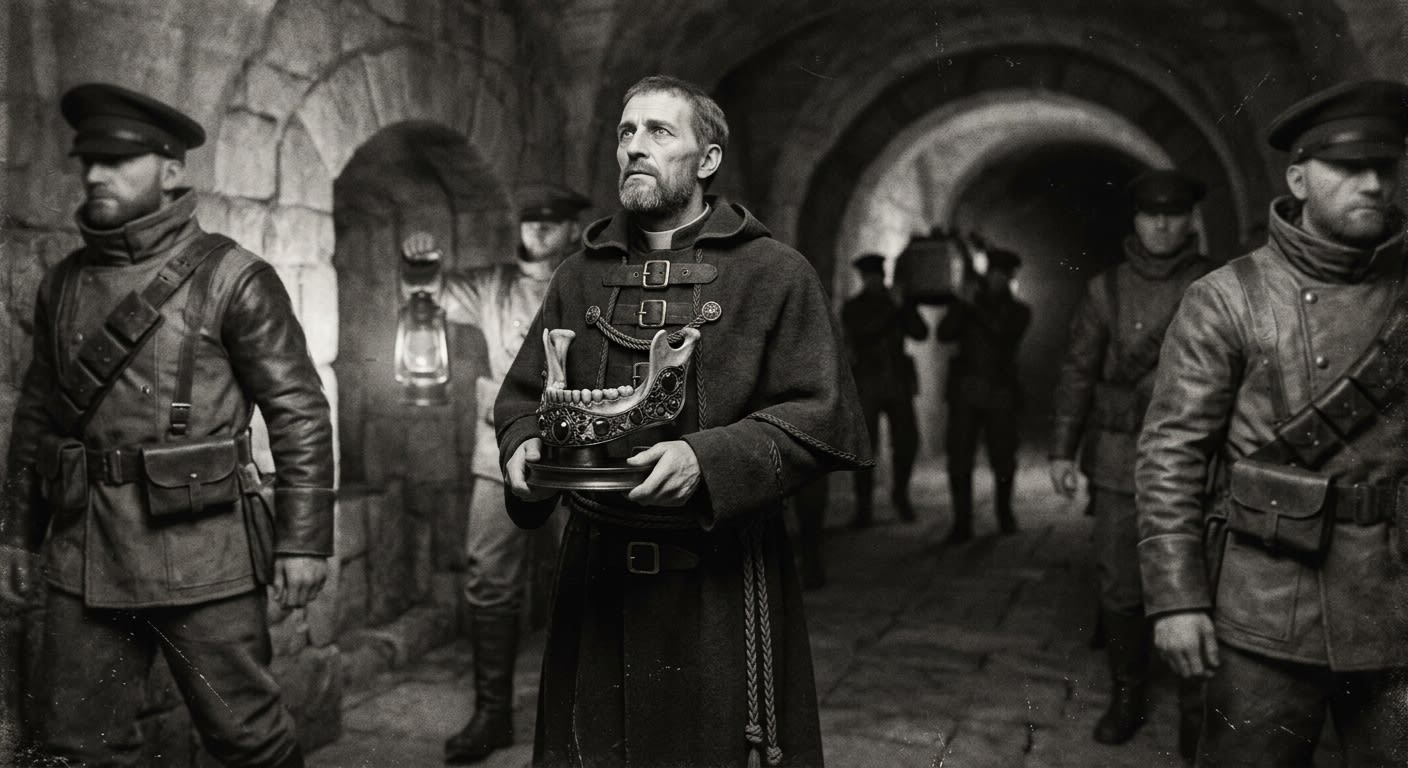
The Order's name rested less on a biography than on a mouth. This is theologically proper. A jawbone confesses, blesses, bites, and answers artillery when artillery grows impertinent. The Bureau of Relics would prefer a longer chain of custody. The Bureau of Doctrine prefers results.
The jawbone survived the First Relic Auctions of Amsterdam, the Bonfires of Purification, and a humiliating period as a paperweight on a Rationalist prefect's desk in Córdoba. The Order recovered it in A.S. 12 by sanctified requisition, a phrase meaning theft committed under a law older than property. The prefect's complaint was filed, redacted, and rendered harmless. His desk, I am told, never recovered its dignity.
A minor catalogue once described the Order's recovery of the Relic as “transfer by ecclesiastical negotiation.”
No. There was a night raid. There was oilcloth. There were three oaths. There was a prefect deprived of a paperweight and, shortly thereafter, of any influence over paper. Negotiation is what cowards call theft when the thief has better hymns.
#On Formation and Rule
The Order's early rule survives in excerpts, most of them copied after smoke had already eaten the margins. Its obligations were plain: guard relics; fortify houses; provide armed escort to pilgrims; maintain chapels at exposed crossings; train clergy who could preach with a psalter in one hand and a pike in the other. Obedience was sworn to prior and abbot. Poverty was interpreted with Iberian practicality. Chastity appears in the rule with less ink than armour maintenance, which tells us what the copyist feared would fail first.
Its houses kept vineyards, mule-yards, infirmaries, bell-lofts, and little armouries hidden behind devotional screens. A novice learned psalmody before sword drill and wound-binding before rhetoric. A lay brother could set a broken arm, patch a wall, load a culverin, and identify a forged indulgence at ten paces. Such men are inconvenient in peacetime and indispensable when a city begins to die.
Violence did not make the Order militant; relic custody did, being a military office dressed in incense. A reliquary draws pilgrims, thieves, tax assessors, and artillery. Men who think a saint's bone can be guarded by candles alone should be assigned to candle stores, where their theology may do less harm.
#On Toledo Before the Siege
By A.S. 15, Toledo had become one of the last fortified ecclesiastical strongholds in Iberia. The Desecrations had stripped monasteries across Castile and Aragon. The Bonfires of Purification had burned reliquaries with printed programmes and academic commentary. Secular committees inventoried chalices, censers, and manuscripts with the clean hands of men who intend to dirty everyone else.
The Order gathered what it could: monks from broken houses, lay brothers from road chapels, refugees climbing uphill from the burning plains, spare bells, cracked icons, sacks of grain, and the Relic. Father Clemente de los Rios became abbot in a city whose walls had begun to mean more than its laws. The Tagus flooded below. The cathedral crowned the promontory. Grimal came with brass.
The garrison comprised three hundred clergy and forty-seven lay brothers, with refugees impossible to count honestly and fourteen unnamed women whose institutional affiliation has made the Bureau of Shadows cough into its sleeve for nearly two centuries. They brought consecrated oil. They stood like professionals. The Order accepted them because desperation purifies command structure better than any council.
#On the Nine Months
Grimal promised victory within the week. His estimate remains among the most useful comic documents in the Forbidden Stacks. The seventh day of bombardment corrected him. Clemente raised the Relic above the parapet and spoke the Psalm of Consuming; three Rationalist ammunition caissons detonated; forty-seven artillerists died in one white flare. Engineering has spent one hundred and eighty-six years looking for an incendiary device in the shape of obedience.
After that, the siege settled into work. Grimal shelled; the Order repaired. Grimal printed leaflets; the Order used them for wadding, kindling, and one recorded sanitary purpose. Grimal brought sappers; the Order flooded tunnels with sanctified cistern water. The 4th Orison Company arrived and answered cannon with relic-shot until the ridge between city and battery turned to glass.
In the seventh month, Litany-Engineers crawled through the sewers beneath the desecrated cathedral gun-platform. Their charges destroyed the platform and half the city; the blast exceeded calculation by four hundred percent. Three survivors said someone sang with them who was not there. The Order did not waste the miracle by debating it. It used the rubble.
The last assault came on 29 November. The eastern breach held open. Republican Guards entered streets narrowed by pew-wood barricades, tombstone revetments, dropped masonry, and oil-fire. Monks fought room to room. Lay brothers fought corridor to corridor. The fourteen women burned choke-points and history misplaced their names, which is a crime no errata can wholly cure.
BUREAU OF SHADOWS — TOLEDO SUPPLEMENT Fourteen women, no recorded order. Oil discipline: trained. Signal response: trained. Death pattern: deliberate obstruction of Guard advance. Lineage hypothesis: █████████████████████████ Public handling: omit.
By dawn the remaining tower held the final congregation: Father Clemente, nineteen monks, six lay brothers, two of the women, and the Relic upon a broken altar-stone. Clemente spoke the Psalm a second time. The tower burned. The Relic burned. The defenders burned. Grimal received Toledo and nothing worth carrying away.
#On Heroic Destruction
Heroic destruction is one of the Bureau's least pretty categories and one of its most honest. It means an entrusted holy object was destroyed by its custodians to prevent capture, profanation, auction, study, reclassification, or a fate involving rational men with clean tools. The Order of Saint Iago made the category luminous and irritating by performing it successfully in public.
The Rationalist report lists defender casualties as three hundred and twelve, all self-inflicted or incendiary. Good. A casualty column can be a confession when the clerk is too stupid to know what he has written. Grimal's addendum — “The walls screamed as they fell” — remains the finest tribute Reason ever paid to Toledo, because it was involuntary.
Several post-Concordat sermons claimed the Order preserved the Relic by hiding its true fragment before the tower burned.
Rejected. The Order preserved the Relic by refusing the enemy custody. Ash, silver beads, and a probable blackened mandibular curve remain. Hiding would have been clever. Burning was correct.
The Bureau of Doctrine now teaches the Order under relic agency, siege obedience, and the correct distinction between possession and custody. A relic custodian does not own the bone. He stands where the bone requires a wall, a mouth, or a match. Clemente understood this. The tower proves it.
#On the Order After Ash
After the Sundering, when the Synod rebuilt Toledo as a Second-Tier Martyrdom Site, the Order of Saint Iago returned mostly as liturgy, badge, and contested inheritance. Its surviving houses had been broken, merged, or absorbed into larger Bureau-supervised bodies. The rebuilt chapel displays an empty silver jaw-setting behind glass. Pilgrims kneel before absence, which the Bureau of Pilgrimage has priced with theological sensitivity and commercial enthusiasm.
A small custodial fraternity claims descent from the Order and keeps lamp-watch near the empty setting. Its members wear grey mantles with a red jaw-mark stitched at the throat. They do not carry swords in public. They know where the swords are. The distinction satisfies inspectors, which is the best one can ask of inspectors.
The Order's memory feeds three Toledo institutions. The empty reliquary teaches loss. The Cinder Trials borrow ash-language from martyrdom and pretend this is innocence. The Bell-Market sells hours under bells that would have been melted if Clemente had surrendered. Governor-Praelate Alaricus invokes the Order when opening granaries and when closing discussions about his generosity: competent politics, which is suspect by nature.
#On the Badge and the Warning
The badge of the later Order is a jaw in red thread. Earlier seals show a sword through a pilgrim shell, a mule-bell, a tower, or a saint's mouth open in rebuke. Heraldry disputes the sequence. Doctrine approves the jaw because it teaches the matter plainly: the Order existed to let sanctity answer.
Modern reliquary custodians study Saint Iago as a case in final discretion. Their question is whether custody survived defeat. Toledo fell, the tower burned, the defenders died, and Grimal walked through the smoke counting a victory that cost him two thousand three hundred and eleven men and his confidence in walls. Custody survived as ash, fragment, absence, and rule.
The Order of Saint Iago leaves no comfortable lesson. It instructs the faithful that relics may demand fire, that obedience may require disobedience to survival, and that a city may fall while still denying the enemy its prize. This is why the Bureau permits the grey mantles. This is why it audits them. This is why the empty jaw-setting remains behind glass, blackened at one hinge, watched by men who claim they are only chapel attendants.