
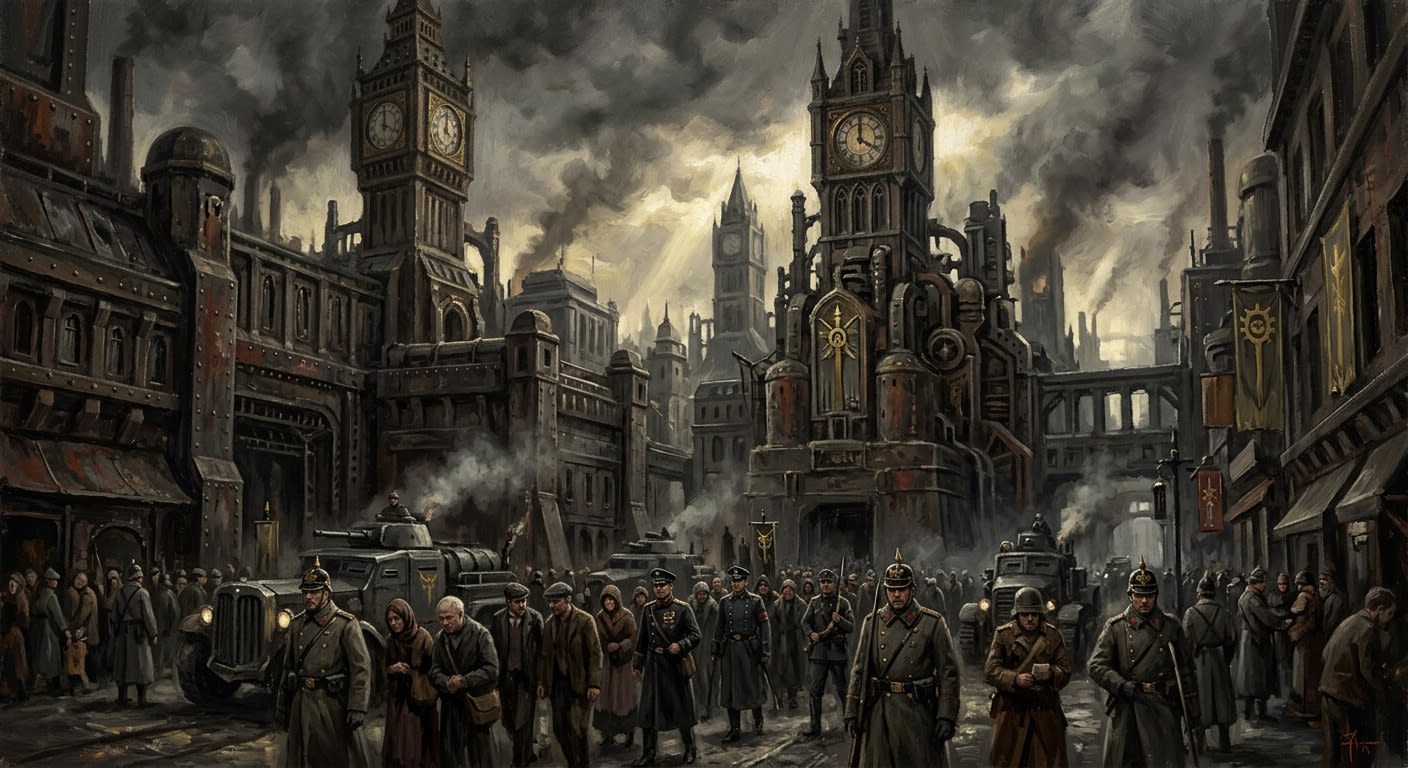
#On the City That Was Taken and Kept Its Teeth
Toledo sits above the Tagus like a reliquary set where thieves may see it from the road: high, hard, glittering with old damage, and smug in the knowledge that every hand reaching upward will be recorded by witnesses. The river coils below in brown loops, serving as moat, mirror, sewer, witness, toll-road, and the final wet excuse of men who failed to understand slopes before ordering artillery forward.
The city is Synod-held, Zone 1 by map, Iberian by bone, martyrdom-site by decree, and argument by temperament. It has survived Atheist Wars cannon, Rationalist occupation, post-Sundering reconstruction, ash rites, time commerce, famine, piety, and the particular humiliation of becoming useful to Strasbourg. A lesser city would have mistaken survival for innocence. Toledo, being Spanish, prefers profit.
Its holiness is not gentle. Here saints arrive as jawbones, ash, cracked bells, and tariff classes. Here martyrs become civic budget lines. Here condemned bodies kneel under warmed ash while officials read cracks as verdicts. Here one may purchase bell-time by the minute, provided one can afford the rate and does not ask too loudly whether the Creator intended Sext to be denominated in negotiable portions. Toledo has made a municipal genius of the fact that terror, properly awned, draws pilgrims.
To write of Toledo as a mere city would be an offence against scale. It is a siege preserved in masonry, a market built over time's bruise, a cathedral reconstructed around a scream, a river promontory whose inhabitants have refined obedience into an art of exact payments and unlicensed memory. It kneels when inspected. It stands when remembered.
#On the Hill, the River, and the Older Insolence
The Creator gave Toledo height and water. Men added walls, saints, account books, and reasons to kill one another in the correct order.
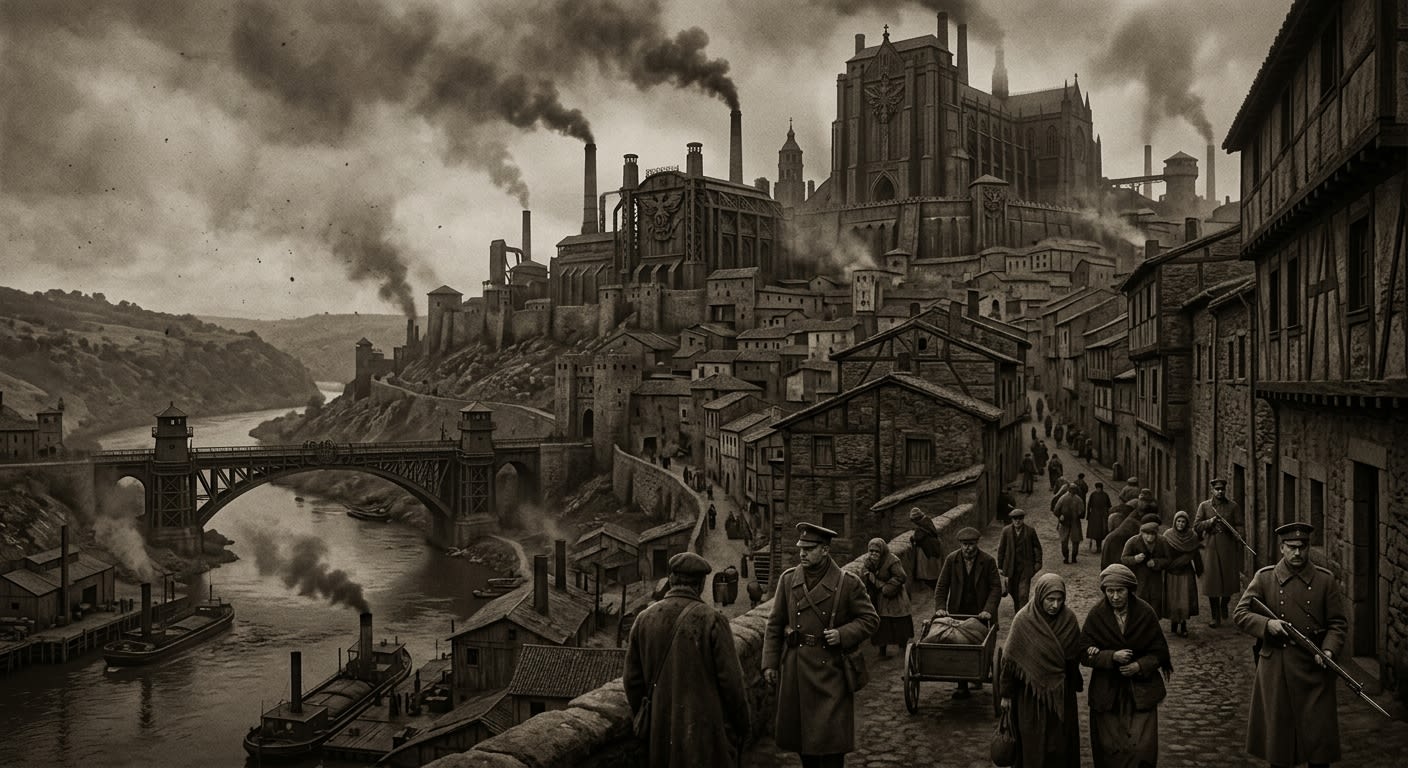
The promontory matters. It lifts the city above the Tagus bend, forcing roads to climb, carts to complain, armies to narrow themselves before gates, and artillery commanders to learn that geometry becomes moral when mules are involved. The northern approach pinches. The eastern ridge offers gun positions with excellent views and bad consequences. The Puerta del Sol became a throat long before Colonel-Prefect Étienne Grimal marched toward it with two thousand Republican Guards and the serene stupidity of a man whose maps had not been insulted by rain.
Before the Synod, Toledo was already a city of ecclesiastical custody. Chapels clung to lanes. Monastic houses kept jars, bones, chain fragments, saint-cloths, old charters, and those provincial relics no authenticator loves until fire tests them. The Order of Saint Iago maintained its armed piety there: grey mantles, road chapels, mule-yards, infirmaries, bell-lofts, hidden armouries, and a rule whose main genius was recognising that relic custody without weapons is an invitation written in gold.
The Rationalists understood the city badly and hated it accurately. During the Desecrations and Bonfires of Purification, relics across Iberia were seized, burned, powdered, mixed into walls, lectured over, and called public education by men whose theology could fit inside a laboratory jar and still leave room for smugness. Toledo's convent of Saint Beatriz was emptied in a morning. Its sacristy was inventoried by a clerk whose hand, according to later recovered notes, became less steady after the sixth reliquary. The lecture delivered that afternoon concerned material progress. The wall later yielded human calcium, beeswax, olive soot, and gold leaf beaten fine enough for unbelief to inhale.
The Relic of Saint Iago survived this season by indignity: auction, confiscation, desk service in Córdoba, theft under sanctified requisition, and return to Toledo, where the Order placed it in custody with the relief of men who know the wolf has found the pantry and must now be taught manners by flame.
Older Rationalist teaching described Toledo as “a provincial stronghold of obscurantist resistance, militarily insignificant beyond its symbolic value.”
Corrected by nine months of siege, 2,311 Rationalist casualties, three destroyed ammunition caissons, one denied relic, and a city whose symbolic value has outlived every Republic that sneered at it. Military insignificance rarely requires twelve clockwork cannon.
#On the Siege That Lost Correctly
The Siege of Toledo began in A.S. 15, before the Sundering by calendar and after it by moral weather. Grimal arrived in spring with two thousand Republican Guards, twelve clockwork cannon, a printing press, leaflets, and an estimate promising victory within the week. The Tagus was in flood. The northern approach behaved like an animal with opinions. Toledo's walls held three hundred clergy of the Order of Saint Iago, forty-seven lay brothers, refugees impossible to count honestly, fourteen women of no recorded order, and the Relic of Saint Iago set in silver like a jaw clenched against Reason.
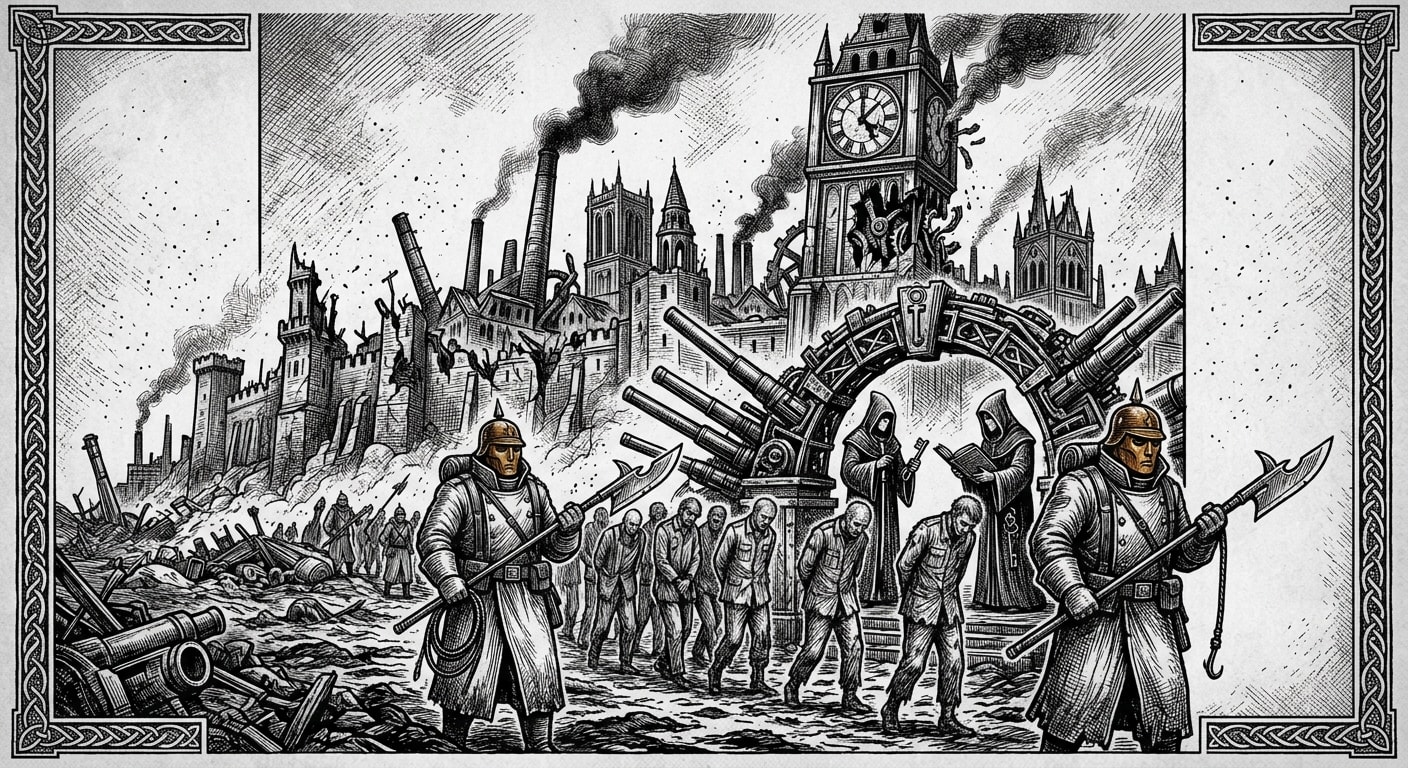
Grimal had artillery. Toledo had height, water, oil, stones, psalms, stubbornness, and a remarkable supply of people willing to burn before surrendering custody. The Bureau of War, in its instructional digests, calls this asymmetry. I call it the kind of arithmetic that makes philosophers sweat.
The first week passed. Toledo remained.
The seventh day brought bombardment from the eastern ridge. Brass cannon hammered the walls. Republican engineers adjusted carriage springs. Leaflets demanded surrender in prose so clean it might have been sterilised. Father Clemente de los Rios raised the Relic above the parapet and spoke the Psalm of Consuming. Fire descended, leapt, burst, or was mechanically induced by a monk with excellent aim; the Bureau has declared both miracle and mechanism true under separate headings, because truth becomes easier when one invoices it twice. Three ammunition caissons exploded. Forty-seven artillerists died.
The siege settled into labour. Grimal shelled. The Order repaired. Grimal printed. The Order used the paper for wadding, kindling, and one recorded sanitary necessity which the Bureau of Doctrine has declined to canonise, though I consider the evidence strong. Sappers dug. Monks flooded tunnels with sanctified cistern water. The 4th Orison Company arrived and answered cannon with relic-shot until ridge, wall, gun, bone, and dust were fused into Toledo's first modern sermon.
One Orison barrage, mistimed by a fraction of a peal, obliterated half its own trench. Among the bodies fused to glass, survivors found a soldier smiling. The ossuary still displays him as Saint-Anonymous. Relics refuses authentication on grounds of insufficient biographical data and excessive vitrification. The sentence is cruel. It is also beautiful. I envy whoever wrote it. His style is under inspection.
In the seventh month, Litany-Engineers crawled beneath the desecrated cathedral, where Rationalists had turned the nave into a gun platform and placed a twelve-pounder where the altar had stood. The Engineers laid charges, scratched equations and prayers into wet stone, and detonated the foundations. The blast exceeded calculation by four hundred percent. Half the cathedral collapsed. Half the city followed. Three Engineers survived and reported that someone sang with them who was not there.
Records struck the phrase. The sewers kept it.
ENGINEERING ANNEX — TOLEDO SUBSTRUCTURE, A.S. 15 / REVIEW A.S. 201 Original charge mass: classified. Expected collapse radius: ███ paces. Observed collapse radius: ███████████ paces. Survivor testimony: “Someone sang with us who was not there.” Acoustic recurrence under rebuilt foundations: active; depth uncertain. Instruction: seal, survey, seal again.
The final assault came on 29 November. Republican Guards entered through the eastern breach into streets narrowed by pew-wood barricades, tombstone revetments, gravel-filled fonts, oil-fire, dropped masonry, and the highly local Spanish conviction that a corridor belongs to whoever is most willing to die in it. The monks fought room to room. The lay brothers fought corridor to corridor. The fourteen women burned choke-points with professional calm, and history, being a lout in a clerk's coat, misplaced their names.
By dawn, the remaining tower held Clemente, nineteen monks, six lay brothers, two women, and the Relic on a broken altar-stone. Clemente spoke the Psalm a second time. The tower burned. The Relic burned. The defenders burned. Grimal took the city and received ash.
Toledo lost the siege. That is the first fact. Toledo denied Grimal the thing he came to take. That is the larger fact, and the one stone remembers.
#On Reconstruction and the Cathedral That Remembers Below
After the Sundering and the Synod's rise, Toledo was rebuilt as a Second-Tier Martyrdom Site, which is to say the Bureau took a wound and taught it to sell tickets. The cathedral rose on old foundations. New limestone sits above original granite in mismatched courses, a geological stammer pilgrims can read without literacy. The lower stone says siege. The upper stone says reconstruction. The mortar says somebody approved the budget late.
The sewer tunnels remain the city's under-throat. Bureau of Engineering sealed them after reports of acoustic anomalies consistent with choral performance at depth. Then Engineering surveyed them. Then Engineering sealed them again, which is how one knows the survey succeeded poorly. Workers beneath the west cloister still report hymn fragments during drought, when the stones dry and remember sound. The official explanation is pressure movement. The unofficial explanation wears better shoes and does not enter the tunnels after Compline.
Post-Concordat rebuilding made Toledo useful in three ways. First, as lesson: the faithful died, the Synod rose, and obedience received ash as its schoolmaster. Second, as route: pilgrims could be directed through streets where every restored arch had a sermon attached. Third, as revenue: grief produces a dependable cash flow when paired with relic custody, licensed guide stalls, toll chapels, ash vendors, certified tear vials, and strict control of where kneeling may occur without fee.
The empty silver jaw-setting of Saint Iago sits behind glass. Pilgrims kneel before absence. This has caused learned men to waste ink on the theology of absent relics. They could have asked a widow. Absence is often what kneeling is for.
The custodial fraternity claiming descent from the Order of Saint Iago keeps lamp-watch near the setting. They wear grey mantles with a red jaw-mark stitched at the throat. They carry no swords in public. They know where the swords are. Inspectors prefer public innocence because it saves walking.
#On Ash as Law
Toledo's law is partly written in ash.
The Cinder Trials occupy the rebuilt cathedral forecourt, where condemned heretics kneel in shallow pits while warm ash is poured over them in slow, hymned increments. The surface hardens to a crust. At Ninth Bell the crust cracks. Doctrine ash-readers interpret the fracture pattern as verdict. Records clerks enter the result. Purity performs the consequence. The condemned, muffled beneath the ash, contribute whatever sounds the rite considers evidentiary.
The ash is officially linked to Saint Isidore, whose relic blazed at Kalnik Ridge and later became bell, ration, invoice, and civic excuse. Engineering contends most Toledo trial ash is pulverised pumice with relic dust. Records files both. The faithful buy packets anyway. The guilty fear it anyway. The magistrates trust it when it agrees with them, which places ash on equal footing with most legal systems.
A Toledo guide once styled Saint Isidore “founder of the Cinder Trials and patron of ash-verdict.”
False. Saint Isidore signed no forecourt charter, chaired no trial committee, and authorised no slate-knife fracture table. His name is used by later custody, civic severity, and the old municipal appetite for holy instruments that cannot speak in their own defence.
The Ash-Baths extend the principle from court to medicine, which is what happens when Mercy is left alone with heat. Fevered patients are submerged in hot ash under the claim that corruption may be sweated out. Few survive longer than an hour. Survivors are paraded as living reliquaries, skin cracked and smoking, until they collapse or become profitable. Their deaths are called graduated cures. Mercy administers the programme with soft hands and excellent attendance sheets.
Ash touches common life as well. Bakers dust thresholds on Saint Isidore's Eve. Widows keep grey bowls beside the bed during fever months. Artillery crews from Toledo smear ash beneath trigger fingers before deployment. Children are told that liars produce spiral cracks when buried to the throat. This is pedagogically efficient and probably illegal in three districts, which increases its usefulness.
#On the Market Where Hours Are Sold
West of the cathedral precinct, within reach of ash-wind and litigation, stands the Bell-Market of Toledo. It sells hours. Matins by minute. Lauds by lease. Sext in fractional allotments. Vespers for mourning, guild closure, tolerated courtship, and public apology. Compline for curfew exception, deathbed petition, vigil licence, and the kind of fear that arrives after dark with money in its fist.
No one owns time. The Bureau says this while accepting coin to allocate it, which is the purest possible form of Synodal candour. The buyer leases audible participation in the ordered rhythm of Creation as interpreted by municipal bell schedule and revised tariff. Poor people call this buying time. They are correct, and correction is withheld only when correction would slow the queue.
The market grew after reconstruction. By A.S. 92 it filled three west-cloister lanes. By A.S. 117 it had its tariff chapel. By A.S. 141 its ledgers contained more subdivisions than Toledo had hours in a year, which the Bureau of Bells called growth and everyone else called a warning with chimes attached.
In A.S. 163, three bell-factors oversold Sext by seventeen minutes. Each licence was valid. Each stamp was current. Each column balanced inside its own little chapel of arithmetic. Together they produced seventeen minutes with no lawful place in the day. The cathedral bells struck, stopped, struck again, and continued in a tone witnesses described as square. Shadows held while mouths moved. Water from three fountain spouts rose, reconsidered, and fell. In the Cinder pit, a fracture formed before Ninth and spelled EARLY according to two ash-readers who were soon separated for administrative calm.
Records erased the interval. This required alteration of baptismal entries, death certificates, factory tallies, trial dockets, kitchen fires, rope drops, shipping schedules, and one cobbler's invoice for a boot repaired twice. Tithes charged late fees for cargo delayed inside time officially denied. The Bell-Market survived, naturally. Toledo does not discard profitable horrors. It gives them tariff bands and better awnings.
#On Hunger, Alaricus, and the Dangerous Loaf
Governor-Praelate Alaricus governs Toledo as of A.S. 201 with the special danger of a competent man in a city that rewards theatrical cruelty. His defining act came in A.S. 185, during famine, when he opened the Granaries of Saint Benedict before Strasbourg had finished deciding how hunger should be phrased.
This violated no law cleanly enough to hang him. That was his brilliance and Tithes' irritation. He used emergency forms already authorised for disasters no one expected to meet in public. He stationed cathedral guards at vault mouths, ordered household counts instead of arrears counts, suspended city-wall Tithes levy for nine days, and placed ash-readers on ration duty so judgement could be seen temporarily reassigned to bread. Children received the first loaves. Fever wards received the second. Labourers clearing sewer collapses received the third. The garrison received the fifth. The baker-guild received the sixth, because a hungry baker is only a man with flour on his sleeves and access to public imagination.
Strasbourg objected, calculated, praised, amended, and stole credit in the approved order. Doctrine named the distribution an exemplar of Synod benevolence. Tithes filed concern about excessive local gratitude. Records kept both documents because Records enjoys contradiction when it has binding.
Alaricus remains watched because he proved mercy can balance. A cruel governor proves the Bureau necessary. A fool proves the Bureau wise by comparison. Alaricus proves a local ruler may think, count, and act before Strasbourg has assembled its adjectives. Such men are tolerated only while useful and studied only with gloves.
Toledo loves him carefully. Full affection is dangerous. It becomes song, then procession, then office trouble. The people trust him as they trust a well that has not lied this season. In Spain that is a serious intimacy.
#On Hidden Names and Toledo's Private Ledger
Every public Toledo has a private Toledo under it: under cathedral, under ash, under tariff, under bell-schedule, under guide speech, under pilgrim commerce, under the official route that politely avoids certain alleys because official routes are cowards with paving stones.
The fourteen unnamed women of the siege are remembered at private tables with fourteen unlit candles. Doctrine has not licensed the rite. Doctrine has also failed to prevent wax. Women in Toledo know which cupboards hold the old grey cloth and which family names are never said before inspectors. The Bureau of Shadows maintains a supplement no office acknowledges. Public sermons praise monks. Private tables remember oil discipline.
The Index Damnatus touches Toledo through forms as much as texts. A forbidden arch angle from the city appears in the Register of Forms because, when calculated, it produced a number Purity found provocative. This fact has improved local masons wonderfully. Nothing sharpens craftsmanship like the possibility that your curve might become a felony.
Sister Adelhaid's file brushes Toledo by Saint Isidore's Eve, ash packets, correspondence, and the way booksellers move sentences without escort. The Bureau would call the relation thin. Toledo would call it enough to keep one lamp covered. Iberian cities understand that files need not share shelves to share weather.
Provincial pamphlets describe Toledo's private rites as “harmless survivals tolerated by generous Synodal custody.”
Corrected. They are survivals because Toledo hides well. They are tolerated where prosecution would cost more than offence. Generosity is what offices call arithmetic when they prefer applause.
The city's children learn two maps. One is printed: cathedral, Bell-Market, Cinder forecourt, Granary vaults, Tagus quay, approved shrine route, Pilgrimage office, governor's court. The other is spoken badly and remembered perfectly: the stair that hums after drought, the ash vendor who keeps real Isidorean dust in the left drawer, the house where a woman of no recorded order died, the well that tastes of smoke before auditors arrive, the bridge niche where Republican bullets are still found after rain, the alley where guide chatter stops.
This is not rebellion. Rebellion is crude, bannered, romantic, and easy to photograph before execution. Toledo practices continuity. Continuity survives search better than rebellion because it can look like habit, and habit is the one unauthorized order no Bureau has yet managed to abolish.
#On the Quays and the Water Below
The Tagus below Toledo is a river with civic duties and poor manners. It carries wine, grain, ash, pilgrim ribbons, drowned rumours, mule curses, toll appeals, martyr-water, illegal relic dust, and the occasional Assessor whose escort learns hydrology too late. Every quay possesses a booth. Every booth possesses a bell-table. Every bell-table possesses a clerk who believes water flows more obediently after payment.
The standard charges are passage, witness, cinder-drift mitigation, and whatever new delicacy Tithes has discovered since breakfast. Witness tolls are peculiar to Toledo and wholly natural to it: cargo entering the city pays not only for moving through civic water, but for passing within the auditory shadow of martyrdom. The theory holds that a barge seen from Toledo’s bend participates in Toledo’s history. The practice holds that the fee is collectible. Between theory and practice lies the whole Synod, wearing a clean surplice over dirty boots.
Flood-courts sit during bad seasons, adjudicating disputes over shifted banks, spoiled cargo, corpse recovery, mill stoppage, and whether ash that settles on a barge before docking counts as imported devotional residue. Fishermen testify with the gloomy precision of men who know exactly how much dead history can fit in a net. Pilgrims buy river water in sealed bottles stamped with three different offices, then complain when it smells like river water. The complaint is rejected for theological ingratitude.
The quay also keeps Toledo honest against its will. Stone may be curated, ash may be sieved, bells may be licensed, and guides may be trained to stop before facts become expensive, but the river brings outside dirt. Portuguese traders with treaty ambiguity under their hats. Lisbon sailors carrying quake stories that do not match Doctrine's preferred ordering. Smugglers with saint-medallions too warm for their declared provenance. Mothers from upriver villages bearing children to the Ash-Baths because desperation cannot read medical circulars. The city receives them, charges them, frightens them, feeds some, cheats many, blesses a few, and files the rest as traffic.
#On the Present Condition
As of A.S. 201, Toledo is loyal in every way the Synod can count and suspicious in every way the Synod cannot invoice. Its tithes close. Its pilgrim routes function. Its Bell-Market pays. Its Cinder Trials instruct. Its Ash-Baths continue under Mercy custody, which is a sentence that should trouble the sleeping. Its Governor-Praelate remains useful. Its Tagus quays move grain, ash, tears, contraband, river-water, levy memories, and complaints with stamps attached.
The city supplies the Synod with three exports of value: reverent revenue, instructional trauma, and proof that defeat may be made more useful than victory. Saint-Malo gave the war its first blood. Kraków gave it drowned priests. Toledo gave it a losing siege that could be taught as indestructible custody. The Bureau loves such gifts. They arrive broken and can be rebuilt around policy.
The cathedral stands. The sewer hums when stone dries. The empty jaw-setting shines behind glass. The ash pits smoke at Ninth. The upper bells remain behind grilles. Alaricus' granary audits are still too clean for Tithes' comfort. The Tagus takes reflections and returns none with receipts. In private rooms, fourteen candles remain unlit.
Toledo was taken. Toledo was rebuilt. Toledo was taxed. Toledo was made useful. Toledo learned, with that old Iberian genius for insult preserved under obedience, that usefulness cuts both ways: Strasbourg uses the city as lesson, and the city uses the lesson as shield.