
#On the Jawbone in Silver
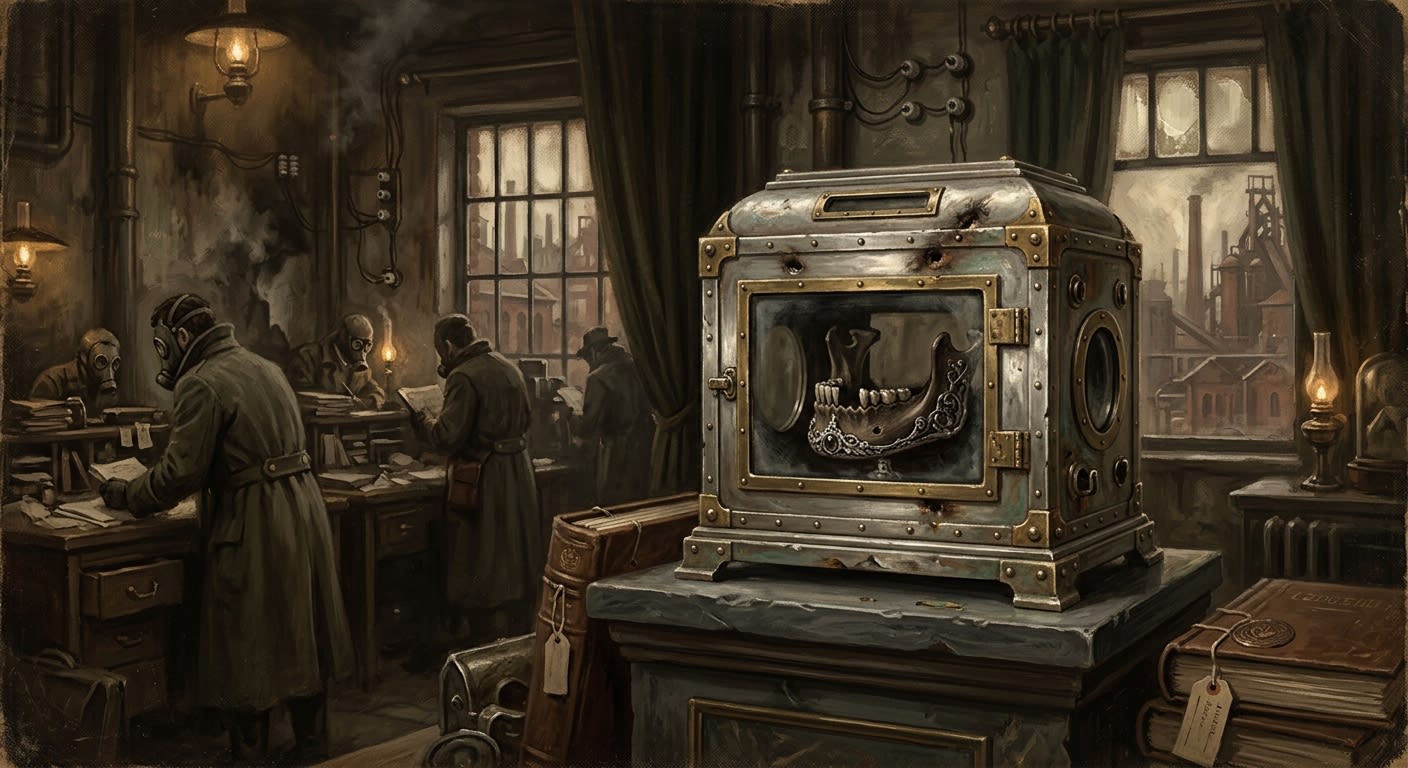
The Relic of Saint Iago was a jawbone set in silver, authenticated as Relic 14-T(Provisional), provenance “probable,” and carried upon the battlements of Toledo in A.S. 15 while twelve clockwork cannon under Colonel-Prefect Étienne Grimal attempted to instruct the faithful in secular acoustics. The cannon spoke loudly. The jawbone answered.
Saint Iago (Unregistered) himself belongs to the older Iberian martyrologies, which are damp, contradictory, and more pious than useful. Three dioceses claim his birth, five claim his preaching-route, and one monastery in León claims his original skull while declining to explain why Toledo possessed the jaw. The Bureau of Relics, confronted with these normal embarrassments of sanctity, performed its accustomed operation: it weighed the bone, inspected the setting, reviewed eleven conflicting depositions, and declared the matter usable.
Usability is the beginning of certainty.
#On Its Prior Escapes
The jawbone survived the First Relic Auctions of Amsterdam, when Rationalist dealers placed sainted remains on velvet trays and invited bidders to purchase superstition by lot number. It survived the Bonfires of Purification, when men in academic gowns burned reliquaries while lecturers explained fraud to crowds that came for warmth and stayed for sacrilege. It even survived a brief humiliation as a paperweight on the desk of a Rationalist prefect in Córdoba, pinning confiscation orders beneath a bone whose owner had been dead too long to object politely.
The Order of Saint Iago recovered it by sanctified requisition during an A.S. 12 night raid. The phrase has troubled timid readers. It means theft in service of a higher property law. The prefect protested, whereupon his protest was noted, then redacted, then joined in spirit to the paper it defended. The relic was carried to Toledo under cloth, oil, and three oaths sworn by men who would later burn rather than surrender it.
Earlier reliquary catalogues record that the Relic was recovered from a “secular archive.”
Too clean. It was taken from a prefect's desk, beside a half-eaten pear and a memorandum on monastic asset liquidation. The pear is not preserved. The memorandum is. Priorities, regrettably, vary by Bureau.
#On Toledo and the First Blaze
Toledo's garrison was no conventional army: three hundred clergy of the Order of Saint Iago, forty-seven lay brothers, refugees climbing uphill from burning Castile, and fourteen unnamed women with sacks of consecrated oil whose institutional affiliation the Bureau of Shadows has made difficult to discuss without coughing blood into one's clearance papers. Against them came Grimal with two thousand Republican Guards, twelve clockwork cannon, and the absolute confidence of a man about to be educated by masonry.
On the seventh day of bombardment, the Relic was raised above the parapet by Father Clemente de los Rios, later canonised as a Second-Tier Martyr. Witnesses say he intoned the Psalm of Consuming. Fire fell, or leapt, or answered; the surviving statements disagree on the verb because the human eye is a poor clerk under artillery conditions. Three Rationalist ammunition caissons detonated. Forty-seven artillerists died in a single white flare. Grimal's assault calendar, which promised victory inside a week, became a devotional comedy.
The Bureau of Doctrine calls the event miraculous. The Bureau of Engineering calls it an incendiary anomaly pending seventeenth inspection. The seventeenth inspection has been denied in advance, as were the previous sixteen, because Engineers near relic sites begin by measuring and end by suggesting improvements. The dead artillerists require no improvements.
#On the Burning Tower
For nine months Toledo held. Walls cracked, choir stalls became barricades, baptismal fonts became firing rests, and the cathedral's foundations suffered attentions from Litany-Engineers whose calculations were exceeded by four hundred percent, a discrepancy the Bureau has resolved by praising their faith and quietly confiscating their notebooks.
The final assault came on 29 November, A.S. 15. Republican Guards entered through the eastern breach. The city narrowed around them into rubble, pew-wood, tombstone, smoke, and people with no administrative interest in surrender. By dawn the last defenders held the remaining tower. Father Clemente placed the Relic of Saint Iago upon a broken altar-stone in the bell chamber. Nineteen monks, six lay brothers, and two of the unnamed women stood with him.
One Rationalist survivor testified that the jawbone spoke before the tower burned. The transcript records three syllables: “████ █████ █.” The witness bit through his own tongue before cross-examination. Bureau of Doctrine classification: inadmissible, suggestive, sealed.
The faithful account says Clemente spoke the Psalm of Consuming a second time and the Relic blazed with such force that seven Rationalist soldiers on the stair went blind. The Rationalist account says the defenders set the tower's timbers alight with consecrated oil. Both accounts agree on the only fact that matters to Records: the tower burned, the defenders burned, and the jawbone burned with them rather than pass again into secular custody.
A devotional broadside printed in Avignon claimed the Relic emerged whole from the ashes and flew to Heaven in the form of a silver bird.
Rejected. It is pretty, which is nearly always a sign of fraud. Ash was recovered, silver beads were recovered, and a blackened fragment of mandibular bone was authenticated at “probable.” Heaven may have received the rest. Heaven has not filed a receipt.
#On Authentication After Destruction
Relic authentication after combustion is an art, a science, and a quarrel conducted with tweezers. The Bureau of Relics recovered four silver beads, two fused clasp fragments, ash containing human phosphate, and one blackened curve of bone too small to satisfy an anatomist and quite large enough to satisfy a frightened soldier. Relic 14-T(Provisional) remained provisional because the original chain of custody contained gaps: Amsterdam sale records burned, Córdoba desk inventory altered, Toledo siege ledgers smoke-damaged, final tower remains sifted by hands whose owners were grieving, starving, or dead.
The probable classification has lasted from A.S. 15 to A.S. 201. Every decade some junior Assessor proposes promotion to Ratified; every decade an older Assessor, hardened by files and bowel trouble, points to the missing Amsterdam lot receipt. The Bureau loves a missing receipt more than some mothers love children. I, who am wiser than both assessor classes and most mothers, record the obvious: the relic burned Rationalist guns and then denied itself to Rationalist hands. Probable is a coward's word wearing spectacles.
#On Its Use in Doctrine
The Relic of Saint Iago serves three lessons in modern instruction. First, relics are not ornaments. A bone may sit in silver for a century, passed from shrine to auction to desk to battlefield, and then choose its hour with better judgment than the officers around it. Second, destruction may preserve sanctity. Toledo's defenders preserved the Relic in the only custody secular hands could not inventory: a shared pyre. Third, the distinction between miracle and mechanism is subordinate to source, a principle later fixed in the Bureau of Doctrine Declaration of A.S. 23 and never revised, which alarms me only when I am being honest.
The Order of Saint Iago maintains a small chapel in rebuilt Toledo where no bone is displayed. An empty silver jaw-setting rests behind glass, blackened at one hinge, surrounded by lamps that are never allowed to burn blue. Pilgrims come to kneel before absence. The Bureau of Pilgrimage issues tokens for the visit at a surcharge, because devotion without tariff would tempt chaos.
The Cinder Trials of Toledo use ash officially said to derive from Saint Isidore's reliquaries, though local petitioners whisper that a pinch of Iago's tower-ash entered the first pit. The Bureau denies this, then prices the trial accordingly. Contradiction is expensive when sanctified.