

#On the Eastern Spur
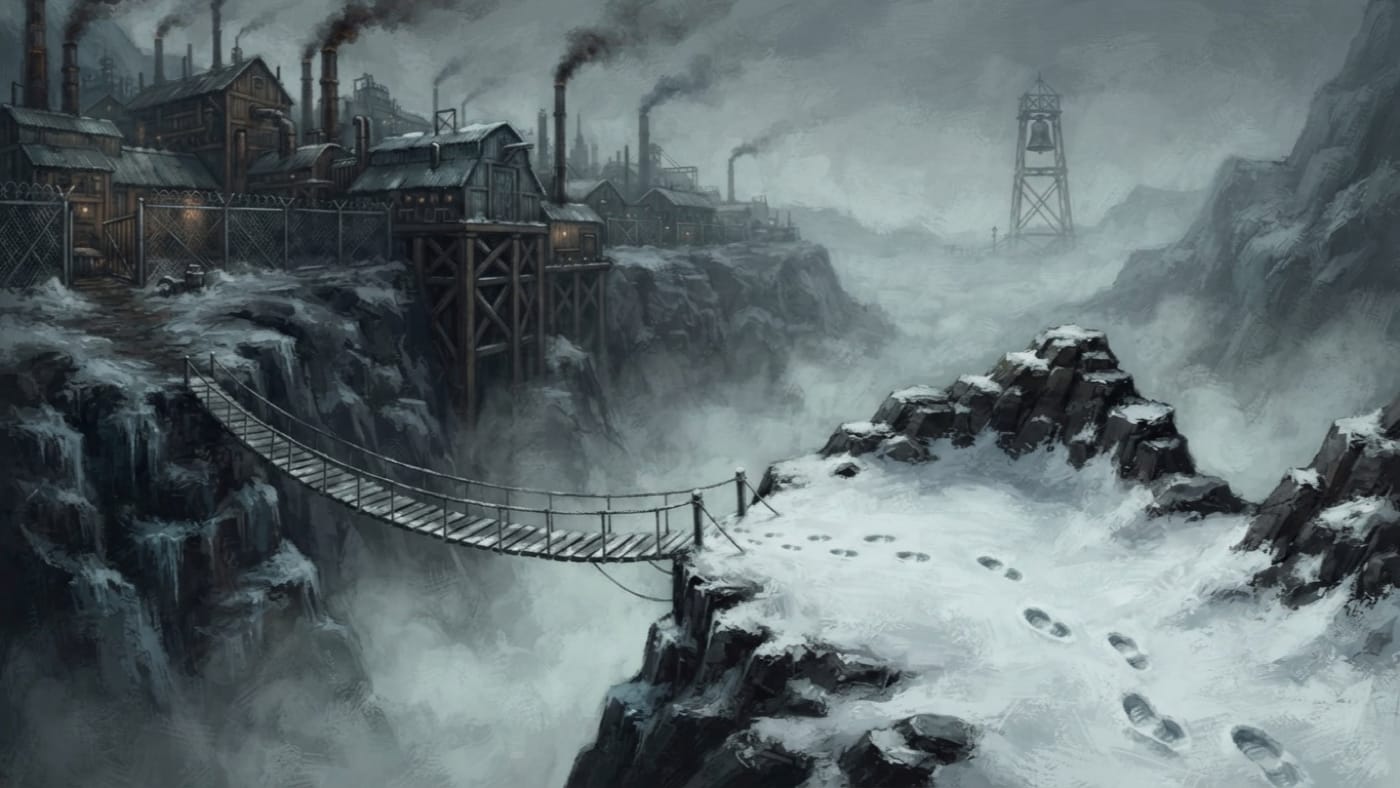
The Silent Notch lies on the eastern spur of Third Light, about forty yards past the landing where the Ropewalk lets its passengers back onto rock. The Ropewalk is the only crossing from the main basalt ridge, and the spur is all that waits at its far end. Anyone who reaches the Notch has first crossed the Ropewalk. I note this for orientation. The footprints will need it later.
The place is small, and so is this article. The Notch is no settlement. It has no garrison, no lintel and no bell. It is a fold of dark basalt on the spur, where fresh snow lies in winter and records every boot that crosses it more faithfully than any clerk. Below the spur, the fog fills the basin the locals call White Mouth. Behind it, across the span, the station goes about its business, and that business is noise. The bell of Beacon Tower Three is struck at the opening and close of each four-hour cycle, six cycles a day. Each strike is pressed into wax and checked in the Loghouse against the master timing wheel. Nobody on the main ridge is ever out of earshot of the Beaconchain. The station was built that way on purpose.
No survey of the Notch's edges has reached my desk. Its naming, its discovery and the year its prohibition was first written down are recorded in no file I have been shown. It was already silent when the record began to notice it, and the record does not say since when.
#On the Silence
Bells do not carry in the Notch, and neither do voices. A clerk on the landing may strike, call or sing as he pleases, and none of it reaches a man inside.
The calibration choruses show this most plainly. Elsewhere on the ridge, the Lanternwright Knot holds one flat note across twelve voices until the lenses settle and the rope-hum drops to its proper pitch. Sister-Mechanic Vey Sable hums the same drone at her bench in the Lantern Shed and calls the result obedience. Across the rest of the station, the drone is the most dependable remedy the garrison has. Sung in the Notch, it produces a silence more complete than anything else reported on the ridge. Sable has spent her working life making glass behave by voice. She once likened that silence to the Creator holding His breath. The comparison is hers, and I give it in paraphrase.
Nowhere else on the ridge is quiet. The rope-hum runs through the catwalks. At the far western end, the chains of the Grounding Field sing in storm, though that is another installation with another file. Bells ring, signets press, nibs scratch on slate. Lately the fog in White Mouth has taken to answering signals that nobody sent it. Against all that, the Notch is the one place on the ridge where a bell can be struck and nothing comes back. A place that answers nothing has earned its own reputation at Third Light.
No record names grounding chains, salt lines or the chorus as a remedy for the Notch. Of the three, only the chorus appears in its file, and the chorus does not break the silence there. It makes the silence complete.
#On Going Alone
Personnel are forbidden to enter the Notch alone. Personnel enter it alone regularly. Both facts are on the record, and the record sees no difficulty in holding them together.
The reason is privacy, which at Third Light is scarcer than lamp oil. Every movement on the ridge belongs to somebody's ledger. Route-writs pass the Switchback Gate under the eye of Gate Provost Harn, whom the garrison calls Nail. Clerks wear oath-collars. Errors are confessed in the Loghouse under silence hoods, and the confessions are kept. They are always kept. A man's mistakes become his file, and his file becomes leverage, either his over others or theirs over him. A man who wants to say one sentence that no one else will hear has a single address on the ridge.
The garrison says a man in the Notch is unheard, unwatched and unlogged. The first is a property of the Notch itself. The other two are custom: they describe where the ridge's watchers usually look, which is at the lanterns, the logs and the fog. Anyone standing on the eastern landing could see a man in that snow as clearly as anywhere else. The Notch hides his voice. It does nothing to hide his boots.
The rule requires a companion, and a companion is a witness. The place is valuable only because it has no witness. The rule and its temptation cancel each other with an elegance that the Bureau's draftsmen seldom manage on purpose.
#On the Seven Entries
The footprints appear in fresh snow. They lead into the Notch from the Ropewalk side. No matching tracks lead out. The station has documented this seven times since A.S. 195.
A.S. 195 is when the documentation begins. No file says whether the snow behaved this way before anyone thought to write it down, and I will not guess under seal.
In four of the seven cases, the prints matched personnel who were on duty elsewhere on the ridge at the time. The file as it reaches me matches the remaining three to no one, and I will not match them for it.
On the 3rd of Argent, A.S. 198, a set of tracks crossed fresh snow from the Ropewalk side into the Notch and ended midstep. There was no print beyond the last one. The boot-pattern matched that of Beaconmaster Jorren Quill, who commands the Signal Office and keeps the station's records. At that hour Quill was in the Loghouse, about three hundred yards away, in the sight of two clerks and a provost.
The Bureau of Records entered the event as "environmental anomaly, no personnel unaccounted for."
I wish to be fair to the Bureau of Records, which audits my stipend. The finding is accurate. Every soul on the ridge was accounted for that day. The Beaconmaster was where three witnesses placed him. Nobody was missing at the next count. Records asked its question, and the question was answered in full. It was a question about people. The snow had asked one about boots.
A boot-pattern identifies a boot. It identifies a man only when he is wearing it, and on the 3rd of Argent this man was at his ledger. On paper, then, the prints belong to a pattern and to nobody. The record does not choose among the ways a pattern can appear without its owner, and I will not choose for it.
"The Silent Notch — seven documented instances of this." This was the caption to the woodcut of the Notch in the Codex article on Third Light.
The caption claimed more than its plate showed. The woodcut shows a track ending midstep. Seven documented instances exist of tracks that lead into the Notch and do not leave it. The record describes only one of them, the 3rd of Argent, A.S. 198, as ending midstep. "Seven" refers to the tracks that do not come out. The midstep ending is recorded once. The caption is corrected to that scope and no further.
#On the Inspector's Evidence
I have been to Third Light once. The Bureau of Doctrine sent me in the winter of A.S. 197 to inspect the signal logs, because it wanted a man of rank, judgment and, as it turned out, expendable lungs. I crossed the Ropewalk, walked the forty yards and stood at the edge of the Notch. I listened.
What I heard was an absence. I have no better word for it after four years of looking for one. It was as exact as a cut in a folio where the knife has been more careful than the scribe. It unsettled me. I give that as testimony, under my own name and on my own authority, which is considerable. I measured nothing. I did not go in. I went back across.
The Quill-pattern tracks were made the year after my climb. Everything I know of the seven entries, I know from paper. That matters to an inspector, and it should matter to any reader picturing me bent over that set of prints with a glass. I was nowhere near them, and I have arranged my life so that I will stay nowhere near them.
When I inspected the ridge, it was already occupied with something else. The answering fog had been an open file since A.S. 194. The basin sends up a second acknowledgment that matches a true signal, from a place where there is no station. The fog lies below the ridge, the Notch sits on it, and the station keeps them in separate folders. No record I have read connects the two, and I will not connect them just because they are neighbours.
#On the Present Record
This account draws on the A.S. 201 assessment of Station Three, which leaves the Notch where it found it. The prohibition on solitary entry stands. Personnel still go in alone, for the same reason they always have.
The Bureau of Records has not revised its finding of A.S. 198, and on its own terms the finding needs no revision. The headcount was correct then and is correct now. Beaconmaster Quill still keeps the logs that record where he was on the day a pattern of his walked into the Notch without him. Those logs are, by every account, immaculate.
Doctrine has not attributed the Notch to the Great Deceiver or to anything else, and I will not do so on its behalf from a desk in Strasbourg. Records has taken no position on what made the prints. Its file concerns only whether anyone went missing, and nobody did.
The station has never come up short at the count. The tracks are still on file, all of them leading in.