

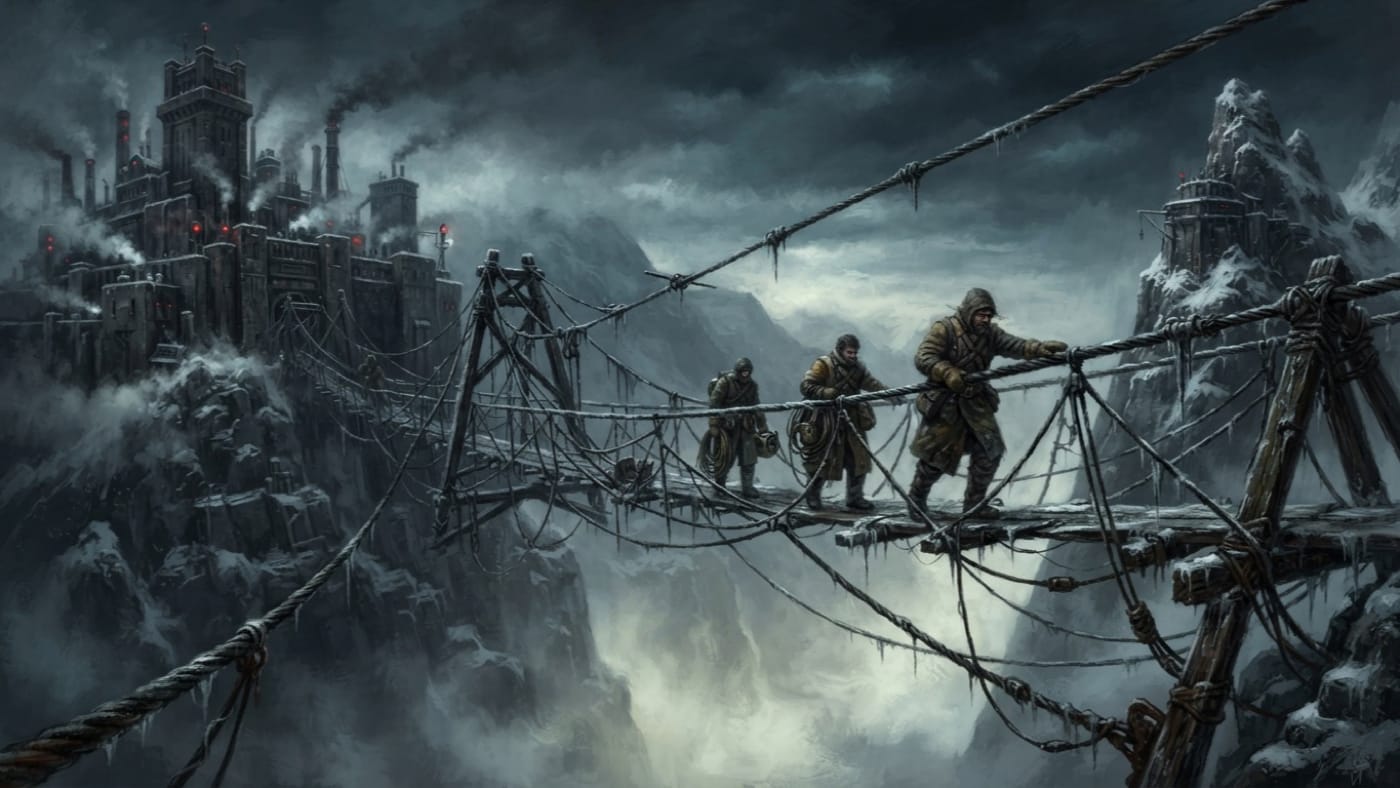
#On the Crossing and Its Ends
Third Light stands on a ridge of basalt in the high Carpathians, at roughly 47°N, 22°E, in the middle reaches of the Sagittal Line. Beside it is the eastern spur, a separate and smaller piece of the same mountain. Between the two is a gap of open air that the station has never filled with stone. The Ropewalk crosses it. It is made of tarred-hemp cables strung between posts, and it smells of tar and frayed fibre. It hums whenever wind or a man's weight is on it, which is always.
Everyone with business on the eastern spur crosses it: tenders, porters, provosts, rescue winchmen and, once, an inspector from the Bureau of Doctrine holding on with both hands. The hamlet itself is filed under Third Light. This entry covers the span and the people who keep it up.
The Ash-Glyph Marshworks uses the same name for its delta causeway of lashed timber and bone-lime pilings. That causeway lies flat and rots upward from the water. The Third Light Ropewalk hangs. A clerk who confuses the two on a requisition will receive the wrong rope, and he will deserve it.
No register supplied to me records when the crossing was built. The convoy loss of A.S. 72 led to the First and Second Lights. The storm of A.S. 76 burned both, and Third Light was raised on higher ground in A.S. 77. In A.S. 82 the signal office standardized its logs; that office was a predecessor body, which the formal Synod later absorbed under its present title. None of these years dates the cables, and nobody wrote down who strung the first of them.
In the winter of A.S. 72 — seven years after the Sagittal Line solidified from desperate entrenchments into continental fortification — a supply convoy departed the low valley staging grounds.
The Line did not solidify in a single year, so the subtraction cannot be done. A defensible but incomplete Line stood by about A.S. 65–68, and its practices were standardized over roughly A.S. 68–72. The figure of seven years was my own arithmetic in the station assessment. I withdraw it.
#On the Eighteen Months and the Two Signatures
Every cable on the Ropewalk is replaced every eighteen months. Every replacement is logged. Every log is countersigned jointly by the Beaconmaster and the Gate Provost.
These are three separate requirements. A cable can be new and unlogged, or logged and unsigned, and the Signal Office will stand behind neither. A man on the span depends on the hemp under his boots. The office depends on the page and will not accept one in place of the other.
The interval is set by rule. The record put before me gives it no calendar date to start from. It runs from whenever the last cable went up, regardless of weather, of the hemp shipment from the valley, and of whether the assigned men are still alive. Rope is an import at Third Light, like salt and slate paper. Between deliveries the tar stiffens in the frost, the fibre furs where hands wear on it, and ice works into the lay. The cable ages every day of the eighteen months. The ink in its entry does not.
The log states the reason plainly: a snapped cable has killed more people at Third Light than any enemy action. I repeat that sentence without a total, because nobody gave me one, and I will not invent one for the arithmetically inclined.
The two offices are currently held by Beaconmaster Jorren Quill and Gate Provost Harn, whom the garrison calls Nail. The rule binds the offices. It does not follow that these two men signed every entry, and earlier hands appear in earlier pages. Quill keeps his kidskin gloves spotless and fears blank pages, and an unsigned cable entry would be the most dangerous blank page on the ridge. Nail counts bribes the way other men count prayers. He signs where the rule requires. The log does not ask what passage cost beforehand, so neither do I.
#On the Hands on the Cable
Cable maintenance is one of the station's main trades, and it ranks below beacon tending and signal logging because nobody stamps a rope. The work is done by ropewalkers, rescue winchmen, porters and fog-debt labourers. It is cold and exposed, and none of them chose it.
Some of them reach it through the Loghouse. A clerk who makes an error in the record takes on a debt, and error debt is paid in night shifts and cliff work. A clerk who blots a timestamp can find himself out on the hemp. Before cliff duty a worker makes the hands-on-ledge vow. I record that the vow exists. I do not have its words and will not supply any.
Rope-access tags and oil tallies change hands at the work. I could not learn how the tags are issued or what they cost. At this height oil is close to life, so a tally means something whatever it was paid for.
Then there is the hum. The locals read the cable's vibration by hand, laying a palm on the hemp through the glove to feel what is moving along it. The station uses this as a secondary signalling channel. Its word for the practice is rope-read, which means feeling the hum for hidden traffic. I can offer no alphabet for it. The people who know it were not inclined to teach a man from Strasbourg.
The Ropewalkers' Brotherhood counts the Ropewalk as its territory. It is a labour fraternity. Its public face is safety ritual, and it works through access, route knowledge and oaths of silence. No document I have seen grants it the span. It holds the crossing as a sacristan holds the keys of a chapel the bishop owns. The bishop keeps the deed, but nobody gets in without the sacristan.
#On the Undersong
The cable record covers the cable and nothing that hangs from it.
Hooks are clipped to the underside of the span cables, and they carry packages no larger than a man's fist. They cannot be seen from the crossing. The station says they travel at rope speed, and I decline to give a figure. The Brotherhood calls this traffic the undersong.
The same cable carries the porter and the parcel beneath his boots. The replacement log shows that a cable was renewed, on whose authority and under which two signatures. The parcels appear nowhere. The Signal Office owns the record of the rope. The Brotherhood knows what hangs under it. The Office enforces its ownership by audit. The Brotherhood enforces its own by silence oaths and by the plain fact that you must go out onto the span to look underneath it.
The ridge's black market deals in oil, lenses, forged clearances and rope access. I will not guess which of these fits in a fist. Nothing put before me names the contents of any package or anyone who received one, and the Bureau stamps only what it has seen.
The hum complicates matters. A loaded cable vibrates differently from an empty one, and telling the two apart is what rope-read is for. The rope gives away its own load to anyone with the right hand on it. A ropewalker can feel the undersong pass, and so could a provost with the same skill. Whether the provost reports it is the Gate Provosts' business, and Nail's.
The undersong runs beyond this span. The Brotherhood's cables reach other spurs, the lower switchbacks and the neighbouring stations. The three or four hours to Fourth Light belong to that wider network. Crossing the Ropewalk takes less time than that, though it does not feel like it.
#On the Eastern End and White Mouth
The span lands on the eastern spur. About forty yards past the landing lies the Silent Notch, an acoustic dead zone where bells and voices do not carry. The station has recorded footprints in the snow that lead into the Notch from the Ropewalk side and do not lead out. They show that someone walked from the span toward the Notch. They do not show that anyone fell from the cable, or that the Brotherhood made anyone disappear. The Notch itself belongs to the hamlet's file.
Below the ridge lies the fog basin the locals call White Mouth. I looked at it from the Ropewalk during my one inspection, in the winter of A.S. 197. It looked like a mouth. I have nothing to add.
The garrison calls one local habit rope-stare: standing on the Ropewalk and looking down for too long. The Bureau of Mercy diagnoses the same habit as altitude melancholia. I will not choose between the terms, and I will not connect the habit to any particular death.
The answering-fog file has been open since A.S. 194. Among its symptoms is a rope-hum that becomes wordlike. This is different from rope-read. Rope-read is a trained hand feeling for weight. The symptom is a hum that seems to be trying to say something, and neither the station nor this office has established what. The station's countermeasures are grounding chains, salt lines on the catwalks and flat-sung calibration choruses. They sometimes work, and none of them makes the span safe.
#On the Present Condition
This entry follows the station assessment of A.S. 201. On that basis the Ropewalk is in daily use. The Signal Office describes the population as collapsing. Conscription from the valley replaces the dead with people who did not want to come, and some of them end up on the hemp through rotation or error debt. They make their vow and learn the hum.
The eighteen-month interval is still binding. Somewhere on the ridge one cable is new, another is halfway through its term and another is coming due, and the log is supposed to say which is which. The Beaconmaster and the Gate Provost still sign together, and the hooks still ride under the span.
This office finds that the crossing remains in service, that the replacement rule remains in force, and that the joint countersignature is still required. It makes no finding on the hemp itself. Nobody asked for one, and the office could not sign for it.