

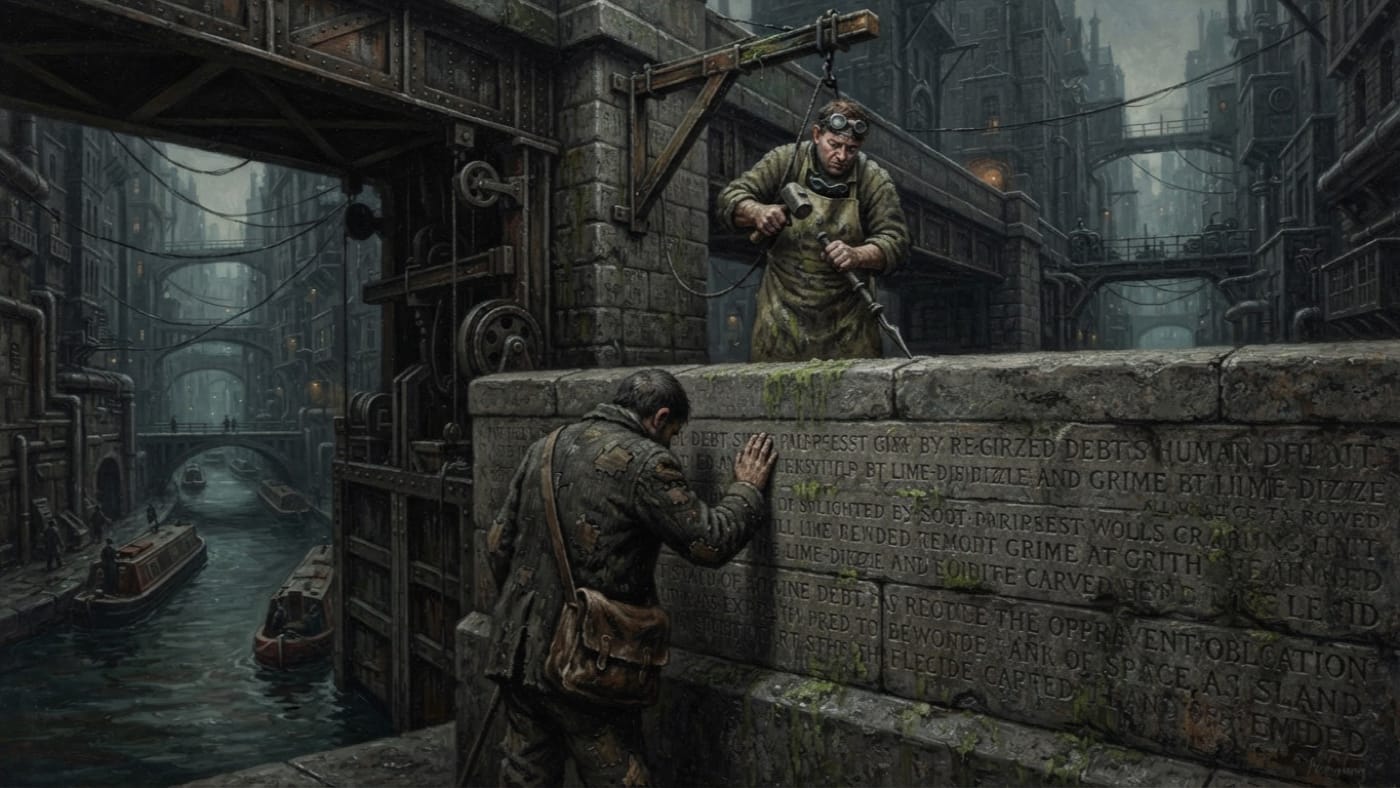
#On the Charge
"A clean name is a paid name." — Causeyworks proverb, offered to me by a namewash clerk as though it were a kindness.
The stone entry fee is the price of having a name, a debt, or a resolution cut into the parapet of a bridge in the Archivolt Causeyworks. The city's tolls and taxes list it beside coin tolls, cargo percentages, labor-hours owed to the locks, and the confession tithes of the Namewash Cloisters. I have heard it called a currency by men who should know better. It is a charge. One pays it, and something is carved.
The trouble lies in what is carved. The fee buys the inscription and nothing else. A debtor whose arrears are entered in stone owes two sums from that morning on: the debt itself, which is exactly as unpaid as it was the night before, and the cost of having it published in granite. The Toll Chapter keeps these accounts separate. The debtor is welcome to confuse them. The parapet will not.
The entry sits where entries always sit: on a public span, along a route its subject must walk, at the height of a man's eye or a little below it. That way he can read his own obligation each morning without the indignity of stooping.
#On the Need for Stone
The Causeyworks is wet. Paper there swells, foxes, molds, and is eaten. A debt recorded in ink lasts about as long as a loaf of canal bread. The city learned early that a register kept on vellum in that air is a register kept on trust, and the Church has never extended trust to a ledger it could replace with a wall.
So the city turned to stone. The first stone bridge crossed the water in A.S. 84, and the Bridge-Scribe Collegium was constituted in A.S. 92 to verify what the bridges were made to bear. No document placed before me records when the city began charging for the privilege of inscription, and I decline to invent a decree for the comfort of tidy readers. The charge exists. Its paperwork is younger than its necessity.
The logic needs no decree. A city that lives by tolls must know who has paid. A city that must know names must keep them where the damp cannot reach. A city that keeps names in public stone soon discovers, without anyone proposing it aloud, that a parapet is also a pillory, and that a pillory can be made to charge admission.
The Archivolt Causeyworks was chartered in A.S. 82, following the Synod's determination that the River-belt's toll revenues were being lost to informal waterway administrations.
The formal Synod was constituted at the settlement of A.S. 90. The charter of A.S. 82 issued from the ecclesiastical and toll authority that preceded it, and earlier references to "the Synod" at that date apply the later name retrospectively. The revenues were lost regardless.
#On Verification and the Chisel
Three offices touch a stone entry, and none of them will admit to touching it alone.
The Synod Toll Chapterhouse governs tolls, and through tolls it governs movement. Canon-Toller Edris Vane holds crossing access, which in the Causeyworks is the power to decide whether a man eats this week. The stone-entry warrant belongs to the same family of papers as the crossing pass and the toll chit. All three are instruments by which the Chapterhouse makes its displeasure architectural.
The Bridge-Scribe Collegium, at its windows on Archivolt Row, confirms that the name to be cut belongs to the person who owes. Chief Scribe Mael Arct controls recognition in the registry. A name the Collegium does not recognize cannot lawfully be entered, settled, or corrected. A name it recognizes wrongly can be all three, in the wrong order, to the wrong man. I record this as a theoretical hazard.
The Stone-Ledger Masons' Lodge, working out of the Stone-Ledger Yards, holds the license to carve. Master Mason Lysa Korr's people do the work. They stand on the catwalks in lime-stained aprons and scrape back the white crust of ledger-drizzle so the new letters bite clean. Carving without a license is forbidden in the city, with reason. A mason with a chisel and no warrant is either a vandal or a subject for a file at the Bureau of Purity.
How the warrant passes from one office to the next, and which of them keeps which portion of the fee, I leave to the auditors of the Bureau of Records. The petitioner sees only the visible part: a scribe's window, a sheaf of papers he has kept dry at some cost to his own comfort, a wait, and afterward the tap of a chisel above the canal.
#On Reconciliation
No one lawfully removes a stone entry. The Bureau of Doctrine has ruled removal a theological impossibility. I concur with the Bureau, having drafted a portion of its concurrence.
The law permits reconciliation instead. Take a man who owes the Toll Chapter six crowns. I have used the figure before as an illustration, and no particular debtor should mistake it for his own. His six crowns are cut into the span he crosses each morning. He pays them. He then petitions, is verified, and pays again for the privilege of saying so, and a mason cuts the resolution beside the original line. The first entry remains. The debt it recorded does not.
So a settled account in the Causeyworks is a longer account. The parapet reads name, sum, and date, and beside that, name, settlement, and date. Both lines persist. The neighbors who watched the first one cut will watch the second, and the second never entirely persuades them. The locals say "stone reconciliation" for the marking as readily as for the settlement. That usage says everything about the city's faith in happy endings.
The paper registry is a different animal. Chief Scribe Arct may amend it, annotate it, and issue name-correction writs against it, until it describes a reality more agreeable than the one in granite. He cannot lawfully touch the stone. Stone can be broken, of course. Chisels slip, floods rise, and the old vaults of the Causeyworks have dropped masonry into the canals before now. A broken entry is lost stone. In law it is still an entry, and the law has a longer memory than the river.
#On the Cost of Recognition
The fee is dear, and the city fears it more than its price warrants, because the price is the least of it. Everyone who uses the bridge reads a stone entry: creditors, competitors, wives, landlords, and the lock provosts who patrol the causeways looking for lines marked UNRESOLVED. An obligation that once lay between the debtor and the Toll Chapter now lies between the debtor and the public way.
Enforcement follows the inscription the way water follows a gradient. Toll denial turns his crossing passes into so much damp paper. A name flag in the registry slows him at every scribe's window. In the Causeyworks, toll arrears have a way of ending on the lock-labor drafts or in debt bondage. I will not say that a stone entry sends a man there. I observe that it does nothing to slow him on the way.
Then there are the other prices, which must not be confused with the lawful one. The Namewash Cloisters charge for name-clearance: confession, cleansing, and re-verification, with the confession etched into slate and set in the cloister floor. That service is sold alongside the fee and is no part of it, and a confession settles no debt. Scribes also take payments for favorable recognition, which appear in no schedule the Collegium showed me. And the Undervaults sell attempts at a true uncarving, which the black market itself regards as too loud to deliver. Coin, toll chits, stamped paper, stone tokens, and oath-notes all circulate in the city. I leave the reader to imagine which of them change hands at which window.
A man who can pay the fee, the clearance, and the recognition finds stone less permanent for him than for his neighbor. His original line remains, but his resolution is cut promptly, his registry reads well, and the provosts walk past. A man who can pay only the debt finds the debt paid and his crossings still slow.
#On Present Application
Since a banned name was found in the Stitchbridge in A.S. 199, the Toll Chapter has lengthened its crossing inspections, and the scribes read every warrant twice. Stone holds whatever is cut into it, lawful or otherwise. The Mortar Saints hide forbidden names in public masonry by the same method the Lodge uses for debts: a chisel, a span, and confidence that nobody will take the bridge down to check. I do not assert that every mason is a Mortar Saint. I am not permitted to assume the reverse.
So the scribes' windows are anxious. An unauthorized line on a parapet is now a matter for the Bureau of Purity, and an authorized one is examined in case it is not. Debtors wait longer. The fee does not fall.
Of Name-Resonance Architecture I record only what has been observed. Certain arches respond to certain names, and inscriptions on those arches have sweated lime. No payment has been shown to waken an inscription or sanctify it. Nor has any purchased the debtor something from the Creator that his crowns could not already buy from the Toll Chapter. Canon-Inquisitor Silex Marrow holds authority to unseal the keystones of the Saintspan. His work is unfinished, and I will not anticipate it.