

#On the Chapter's Authority
"Safe passage through lawful toll." — The Chapter's public undertaking. Each of its five words carries a charge.
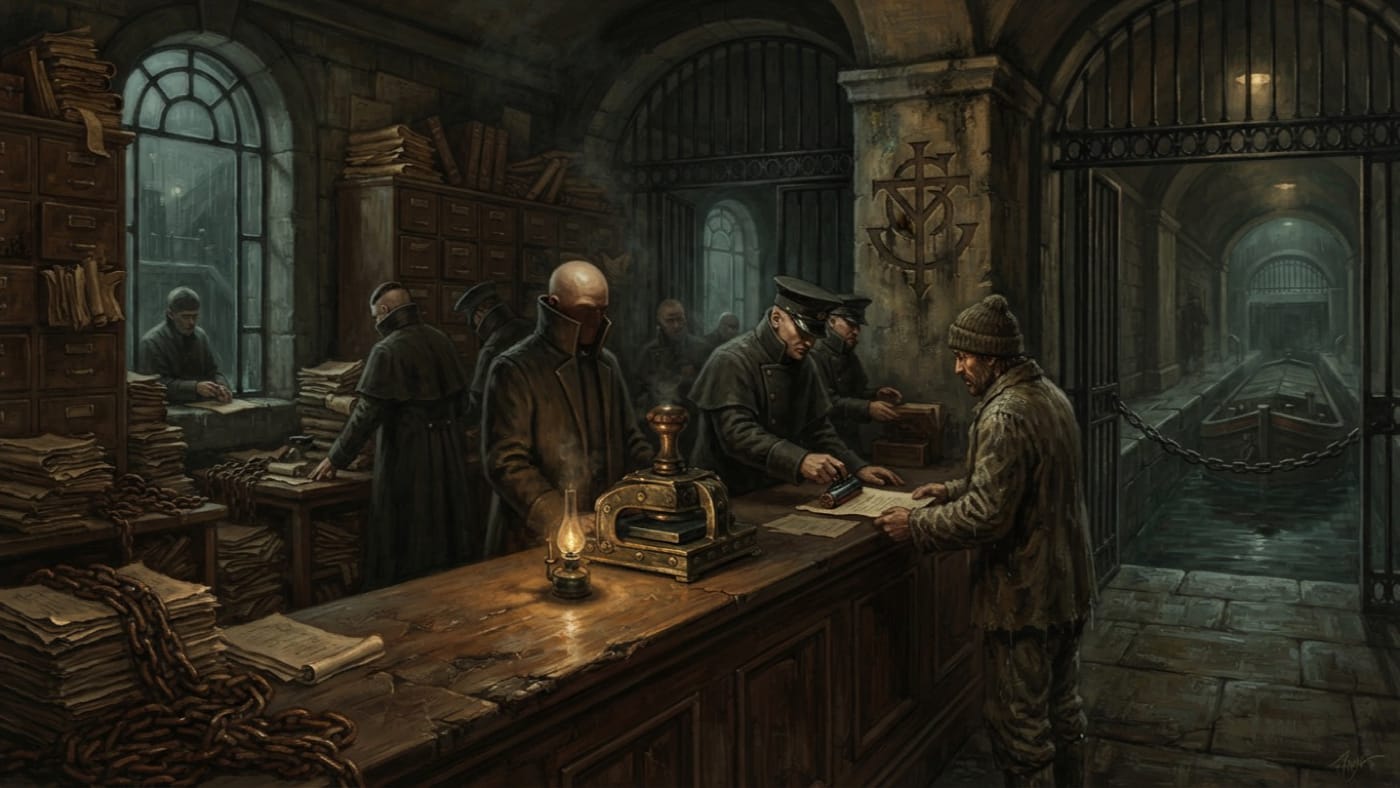
The Synod Toll Chapterhouse is the office in the Archivolt Causeyworks that decides whether a person, a barge or a sack of grain may lawfully go from where it is to where it would rather be. It sits in Toll Crown, the gatehouse district, among courts and tribunals that smell of incense and cold slate, and it holds the main gates. It works by permits, fines and chain closures. The city's own survey lists its resources as guards, seals and tribunals. I have seen all three. The guards were wet, the seals were dry, and the tribunals were in session.
The Chapter is one of three bodies that formally govern the city. The others are the Bridge-Scribe Collegium and the Lock Authority. Those two can be described as services. The Chapter cannot, because what it administers is movement itself, in a city that grows nothing. Food, coal, oil, wax, paper and medicine come in along three converging canal spines, or they do not come. An office that rules on passage here rules on supper.
The survey gives the Chapter's interest plainly: control of movement, and the use of that control against rivals. I copy the phrase as written. I found the Chapter's officers no more ornamental than the survey.
#On the Charter and the Seal
The Chapter's position comes from the municipal charter of A.S. 82 (1792 CE). Under that charter, toll administration on the canal spines passed to the Church's emerging government. The first stone bridge followed in A.S. 84. That year belongs to a bridge. No separate foundation instrument for the Chapterhouse survives in any file opened to me, and neither does a year for the raising of its offices. I stopped asking. In Toll Crown a question counts as an application, and applications carry a fee.
My first report gave the charter a parentage it could not have had.
The Archivolt Causeyworks was chartered in A.S. 82, following the Synod's determination that the River-belt's toll revenues were being lost to "informal waterway administrations."
In A.S. 82 there was no formal Synod to determine anything. The charter was the act of the Church's emerging administration. The Concordat of Strasbourg constituted the Synod in A.S. 90, and only from then is "Synodal" more than a name given afterwards. The Chapter has used the title ever since and applies it to its own beginnings, as institutions do.
Eight years later the Concordat gave the arrangement its constitution. In A.S. 92 the Collegium was constituted. That date belongs to the scribes and is not to be lent to the Chapter.
The Bureau of Records keeps a detachment in the city. The municipal stamp names the Chapterhouse as jurisdictional authority, co-sealed by Records. I have not established that every permit bears two seals. I have established that Records believes it ought to be consulted about all of them. The Bureau of Tithes stands behind the charter and its revenue purpose. Its present line of reporting to the Chapter, if there is one, is not on file, and I will not draw one in for the sake of a tidy diagram.
The city's master seal is reported to lie in a hollow pillar of the Toll Crown Gatehouse. I have written elsewhere that three people know which pillar, that two of them are liars, and that the third is Canon-Toller Edris Vane. That count is my report, and I have not improved it. I name neither of the other two. I describe neither the pillar nor the seal.
#On the Price of Passage
The procedure is simple enough to be cruel.
A barge comes to a main gate. Its crew brings out their papers from inside their coats, flat and dry, because a soft paper raises a question and a question costs a bell. A Collegium clerk confirms that the names on the papers are recognised. A Chapter officer assesses the toll: coin on passage, a percentage of the cargo, and whatever further obligation the registry shows. The chit is sealed in public wax before witnesses. The city calls this an anointing, which flatters the wax.
The obligations are of several kinds. There are coin tolls and cargo shares. There is the stone-entry fee, the charge for having a name, debt or resolution cut into a parapet. There are labour-hours owed for the upkeep of the locks. There are the confession tithes and clearance charges on names that have come under doubt. The fee for an inscription and the debt it records are separate sums. Paying one does not pay the other, and a debtor whose arrears go into stone owes both from that morning on.
Debt has three instruments. The crossing is denied. The name is flagged in the registry. The entry is cut into the stone where the debtor's route must pass, marked so that every provost on the causeway can read it. Arrears can be turned into labour, and so can some clearance fees, and the hours are worked on the lock walkways above deep cold water.
The arithmetic deserves a sentence of its own. A carter who is refused the crossing cannot deliver, a carter who cannot deliver cannot earn, and a carter who cannot earn cannot pay the arrears that got him refused. The Chapter does not have to imprison anyone. It only has to keep him where he is.
#On the Offices Beside It
The Chapter decides whether passage is lawful. It does not open the gate. The Lock Authority's wardens work the water-gates of the Triple Lock, ring its bells and keep the windows in which a hull actually moves. The Collegium's clerks prepare and witness the documents and verify the names written on them. In practice the three offices meet at every crossing. That they meet does not make the Collegium or the wardens answerable to Vane, and no paper I have seen says that it does.
Beside the formal arrangement there is a practical one. Vane controls crossings. Chief Scribe Mael Arct controls recognition. Master Mason Lysa Korr controls inscription and reconciliation. Korr's power is the power of a craft, and it does not make her Lodge a fourth governing chamber. The files record no friendship among the three, no kinship and no common plot. Their interests meet at the citizen without being introduced.
Stone outlasts payment. When a debt is settled, the lawful remedy is reconciliation. The original line stays where it was cut, and a mason cuts the correction or resolution beside it. A ruling from Toll Crown cannot remove the first line. Neither can a correction bought at the registry window. Two uses of the chisel must be kept apart here. The Chapter uses stone to mark a debtor in public. The mason's reconciliation records that the matter is closed. Both are done with the same tool on the same parapet.
Namewash Night is the Chapter's by mandate. Once a week, residents bring their doubts about their own names to the Namewash Cloisters, where the confessions are heard and the cleansing is done. The Collegium then recognises the result. The Chapter does not sit at every bench or every desk. It does not need to. It issued the order, and it is the office that checks the outcome at the gate.
#On the Warrant Beyond Its Seal
In A.S. 199 a banned name was found inside a keystone cavity of the Stitchbridge, the junction every barge in the city must pass. That year dates the discovery. Who cut the name, and when, is not known.
The Chapter tightened. Crossing inspections grew longer and tolls rose. Safety closures at the Triple Lock became more frequent. The barge unions call the closures extortion, and the Lock Authority calls them prudence. I have entered each word under the name of the party that uses it. Lock labour grew restless under the draft, but the record gives no organisers, no dates and no dead, and I supply none. Those whom the squeeze pushed out of the legal economy went down into the Undervaults. The Mortar Saints recruit from among the squeezed. No document makes any union man, warden or Chapter officer a member of that heresy.
I observed the phenomenon the Bureau of Alchemical Standards has named Name-Resonance Architecture: lime sweating from inscriptions and water moving under certain syllables. I record it here and do not assign a cause. Whether the Creator, the Great Deceiver or something without a Synodal category taught the stone to answer is for Doctrine to rule. It has not ruled.
In A.S. 201 the Bureau of Purity sent Canon-Inquisitor Silex Marrow with a warrant that does not wait at any gate. It authorises inspection of the Saintspan's rib cavities, comparison cuts at the Stitchbridge, examination of tool marks in the Stone-Ledger Yards and inspection of the Collegium's correction slates. The Toll Chapter petitioned against his assignment. Records raised objections of jurisdiction. Purity overrode both.
A petition shows an interest. This one shows that the Chapter regards the city's stone as part of its jurisdiction, and dislikes another Bureau setting the timetable for opening it. It proves nothing about what the ribs contain, about the Mortar Saints, or about the Canon-Toller. None of the Purity files opened to Doctrine places Vane or the Chapter among the heretics.
#On the Present Administration
As of the A.S. 201 survey, Edris Vane remains Canon-Toller. Permits are still issued in Toll Crown, fines still accrue, and the chains still drop at curfew. Marrow's warrant has been appealed and has not been stayed. The appeal has stopped nothing.
The audit is unfinished. No rib has been reported opened, no finding has been filed, and no judgment touches the Canon-Toller or his Chapter. I forecast none.
From Toll Crown the lock bells sound faint, as though from another parish. A barge crew was waiting at the threshold with their papers inside their coats. The officer at the desk had not looked up. The wax was warming.