

#On the Lodge's Office
"Every bridge is a court." — Causeyworks proverb, which does not say who cuts the verdict.
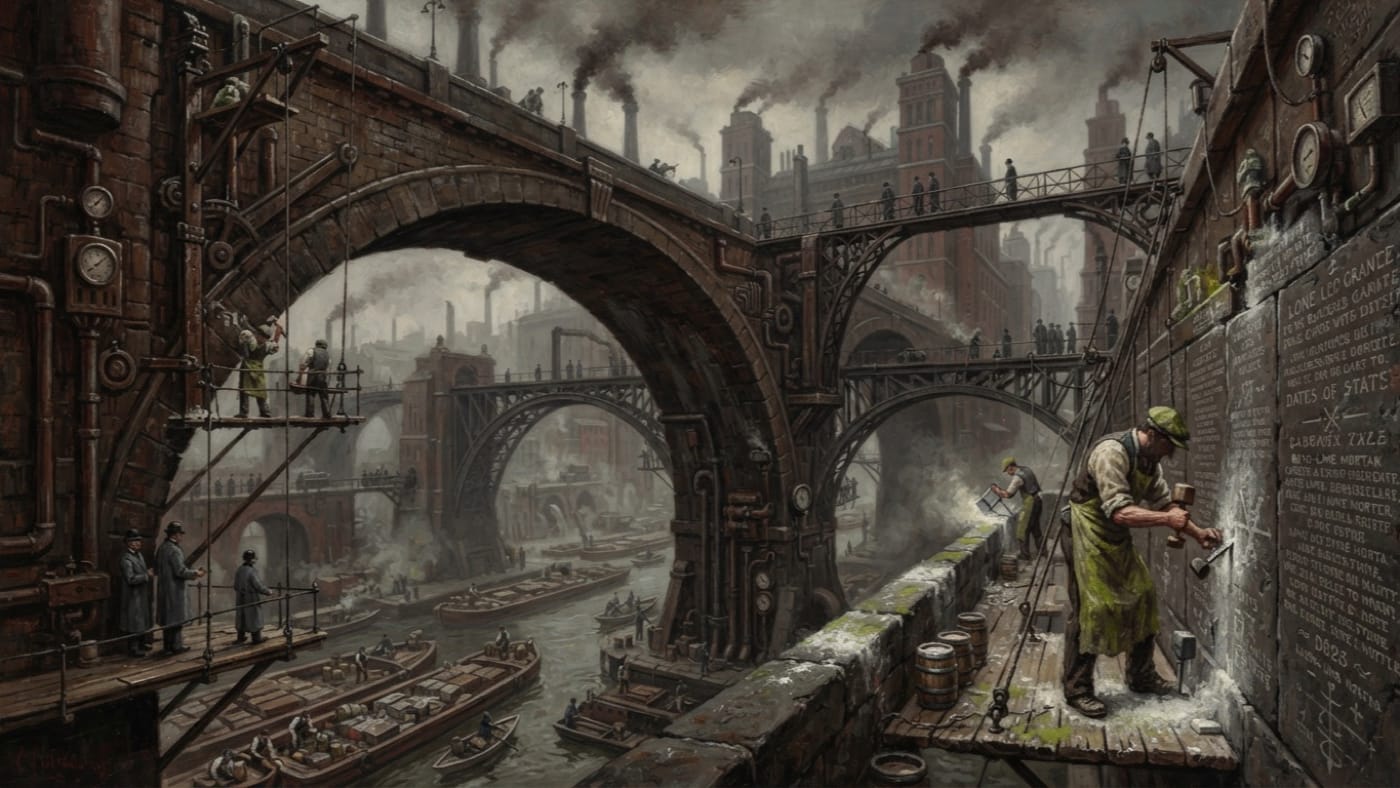
A correction slate leaves Archivolt Row in a runner's satchel and arrives at the Stone-Ledger Yards. The air there is lime dust, and the only sound that matters is iron on stone. A mason in a lime-stained apron reads the slate and checks the warrant behind it. Then the mason climbs to the catwalk beneath the named span and scrapes back the white crust of ledger-drizzle until the stone will take a clean letter. The cut follows. Bone-lime mortar goes into the joint and tallow-wax over the fresh letters against the damp. By noon the Archivolt Causeyworks holds one more fact than it held at breakfast.
That is the work of the Stone-Ledger Masons' Lodge, the licensed guild of the Yards and of the bridgeworks across the wettest junction in the River-belt. Its public face is maintenance and civic pride. Its crews repoint spans, renew rust-iron clamps and fit salvaged brick where old vaults have dropped their own. Into the parapets they cut names, sums, debts, dates, resolutions and corrections. The municipal survey lists the Lodge's resources as crews, catwalk access and quarry contracts. It leaves out the one resource anybody fears, which is the licence to make a thing permanent.
#On the Warrant and the Chisel
A name reaches a parapet through three offices, and each insists it is only the middle one.
A petitioner presents dry papers at a window of the Bridge-Scribe Collegium, where a scribe recognises the name, flags it or declines it. If the paper registry must be amended, Chief Scribe Mael Arct issues a correction writ. If a debt or settlement is to be published, a stone-entry warrant issues. Only then may the Lodge lift a chisel. An unlicensed mason on a span is either a vandal or the opening page of someone's file. The Lodge does not recognise names, and the Collegium does not cut them. Each office was handed half a power and left to resent the other half.
The Bureau of Doctrine forbids erasure. No one may lawfully remove what the Lodge has lawfully cut, and that includes its own Master. A settled debt receives its settlement beside it, and a corrected name receives its correction. A mason's slip receives an appended correction, and the slip remains for the instruction of posterity. Stone can break, of course. Floods rise, chisels skid and vaults drop masonry into the canal. A broken entry is lost stone, but in law it is still an entry. The quarry supplies durability and doctrine supplies permanence. Neither proves an inscription true, which is why the Lodge is paid to append and never to judge.
The municipal account gives the sequence. The city was chartered in A.S. 82 under the ecclesiastical and toll administration that came before the formal Synod. The first stone bridge followed in A.S. 84. The Collegium was constituted in A.S. 92, two years after the Concordat, because paper was rotting faster than it could be audited. The same account credits the load-bearing inscription to the masons of Essen. I reproduce that attribution as the account's and endorse it no further. No document placed before me records when the Lodge received its licence, from whom, or under which master. A guild that keeps the dates of an entire city has neglected to carve its own, and I decline to carve it on the Lodge's behalf.
Their guild, the Stone-Ledger Masons' Lodge, controls what is carved and what is removed, which in the Causeyworks means they control what is real.
This sentence from my survey of the Causeyworks errs twice. The Lodge removes nothing. It carves entries and then carves their reconciliations beside them. Nor does it control what is real. It controls how a fact already recognised by another office is cut into stone. As the city's custom requires, the original sentence stands above, and it now has company.
#On the Price of Permanence
The stone entry fee buys an inscription and nothing more. A debtor whose arrears are entered owes exactly what he owed the night before, plus the cost of publication. When he pays, the debt stops being owed. He then pays again, under a separate charge, to have a reconciliation cut beside the original. In the Causeyworks a settled account is simply a longer one. The public record does not say what share of the fee the Lodge keeps or on what tariff. That question belongs to the auditors of the Bureau of Records, who would resent having it answered for them.
The coin is the smaller part of the price. The neighbour, the creditor and the provost hunting for lines marked UNRESOLVED all read the same parapet, and other offices act on what they read. The Chapterhouse may deny a crossing, the registry may flag a name, and arrears in this city have a habit of ending in the lock-labour drafts. The Lodge orders none of these things. It does not decide the debt, set the toll or summon the draft. It provides the surface on which other offices make their displeasure legible from a passing barge.
An entry is permanent only while someone keeps it readable. Ledger-drizzle crusts the letters and mould works the joints, and an inscription nobody can read enforces nothing. So the crews return season after season with scrapers and wax. River-stone and bone-lime arrive by skiff from the marsh-quarry villages under contracts the Lodge holds. I have seen no prices, signatories or exclusive terms, and I supply none. A contract the Bureau has not read is still a contract. It is simply a quieter one.
#On the Master's Jurisdiction
Master Mason Lysa Korr exercises the city's inscription authority through the Lodge. The municipal survey records that her chisel is older than her registry entry and that she mentions the fact with satisfaction. This establishes nothing about her age, the chisel's maker or how it reached her hand. Nothing in the file makes her the Lodge's founder. The office existed before she held it.
Within that office she decides the letters, the depth and the place on the span, as well as the hand on the chisel and the mortar in the joint. Outside it she is a citizen with good tools. Canon-Toller Edris Vane controls passage, so she cannot open a crossing. Arct controls recognition, so she cannot verify a name. The formal government consists of the Toll Chapterhouse, the Collegium and the Lock Authority. The Lodge has never been seated as a fourth chamber, and it has no need of a seat.
Each office is useless without the others. A name that is recognised and never cut is only paper, and paper keeps here about as well as canal bread. An entry that is cut but never allowed across the Mouth-Sluice leaves a man fixed in granite at a gate. Passage, recognition and inscription meet at the parapet, and none of them can finish without the other two.
#On the Names Without Warrants
The chisel that cuts a debt can cut a forbidden name, and the stone does not ask to see the warrant.
The Mortar Saints preserve names and lineages struck by the Index Damnatus. They seal them in concealed keystones and work them in code into the ornament of the ribs. They call this immortality-by-masonry. The phrase describes a name that refuses to go away, and the file holds no proof that any soul has gone with it. The Saints need a crew, catwalk access, tools, knowledge of which stone carries the load and a lawful reason to be on a bridge with a mallet. That list describes the Lodge's ordinary working week, and the resemblance is the whole basis of the suspicion.
The suspicion is not a finding. Interrogation transcripts variously place the Saints inside the Lodge, beside it, beneath it, or so entangled with it that the two cannot be separated. Local intelligence reports that the Saints recruit in the Yards through "apprentice tests." No procedure is recorded, and no witness has signed a statement. An apprentice who has been tested is still only an apprentice. The Bureau of Purity would do well to remember that before it counts the Yards' payroll as a congregation.
The pressure point is the Stitchbridge. In A.S. 199 a banned name was discovered there inside a keystone cavity, invisible from the walkway and pressed upon by every crossing. A.S. 199 is the year of discovery. The carving date and the carver are unknown. The Bureau of Alchemical Standards reported that resonance at the span had risen forty percent since the name's estimated embedding. The figure shows that the two things occurred together. It does not show that one caused the other. Since the discovery the scribes read every warrant twice, and every lawful cut in the Yards is examined in case it is not lawful.
Name-Resonance Architecture sharpens the matter. Under certain arches spoken names are answered by shifting water, sweating lime and candles that gutter in rhythm. At the Saintspan's third rib, healings are reported for properly registered names and catarrh for the rest. The designation is Category Three: Pending. The file does not show that the Lodge or the Saints built the response, taught it or steer it. For the Lodge the consequence is practical. Its masons now cut stone that may answer back, in front of officials who suspect every keystone.
#On the Authorised Outside Chisel
In A.S. 201 Canon-Inquisitor Silex Marrow holds a Bureau of Purity warrant to unseal keystones. It covers the Saintspan's rib cavities, comparison cuts at the Stitchbridge, tool marks in the Yards and the Collegium's correction slates. Three of the four lie within the Lodge's trade. The fourth reaches the Yards by runner every working day.
The Toll Chapter petitioned against his assignment. The Bureau of Records has appealed, and no stay has been granted. The Lodge objects for three reasons: an outside office is entering its jurisdiction, a man outside the craft is auditing its work, and every mason fears a rib opened by someone who does not know which stones carry the load. These motives explain the objection. They establish no guilt. A mason's reluctance to see a bridge opened proves only that the objector is a mason.
Still, the Yards have a specific reason to fear the audit. A cut identifies its cutter as plainly as a signature identifies its clerk. A slate carries its date, its scribe's mark and the hand that requested it. The Lodge built a medium to remember debtors, and it may now be asked to remember masons.
The Saintspan's third rib remains closed. No audit has been completed, and no finding or sentence stands against the Lodge, its Master or any named mason. The Yards keep working because the bridges keep owing. This season every correction is cut beside its original by masons who know a stranger may one day read the cut.