
#On the Gate Stamped Open
The Three-Day Crush is the founding wound of the Queue-Marshal Corps, though the Corps prefers the phrase “formative operational incident,” which has the virtue of being bloodless, faceless, and unfit for any honest mouth.
It occurred before A.S. 102, during a famine quarter at a forward bastion whose name remains sealed in the joint custody of War and Records. The secrecy is not protective. It is decorative. Every old gate has a story claiming the Crush as its own, and every story ends with the same ironwork, the same spilled grain, the same men at the front pressed so tightly against the bars that their buttons left marks in the paint.
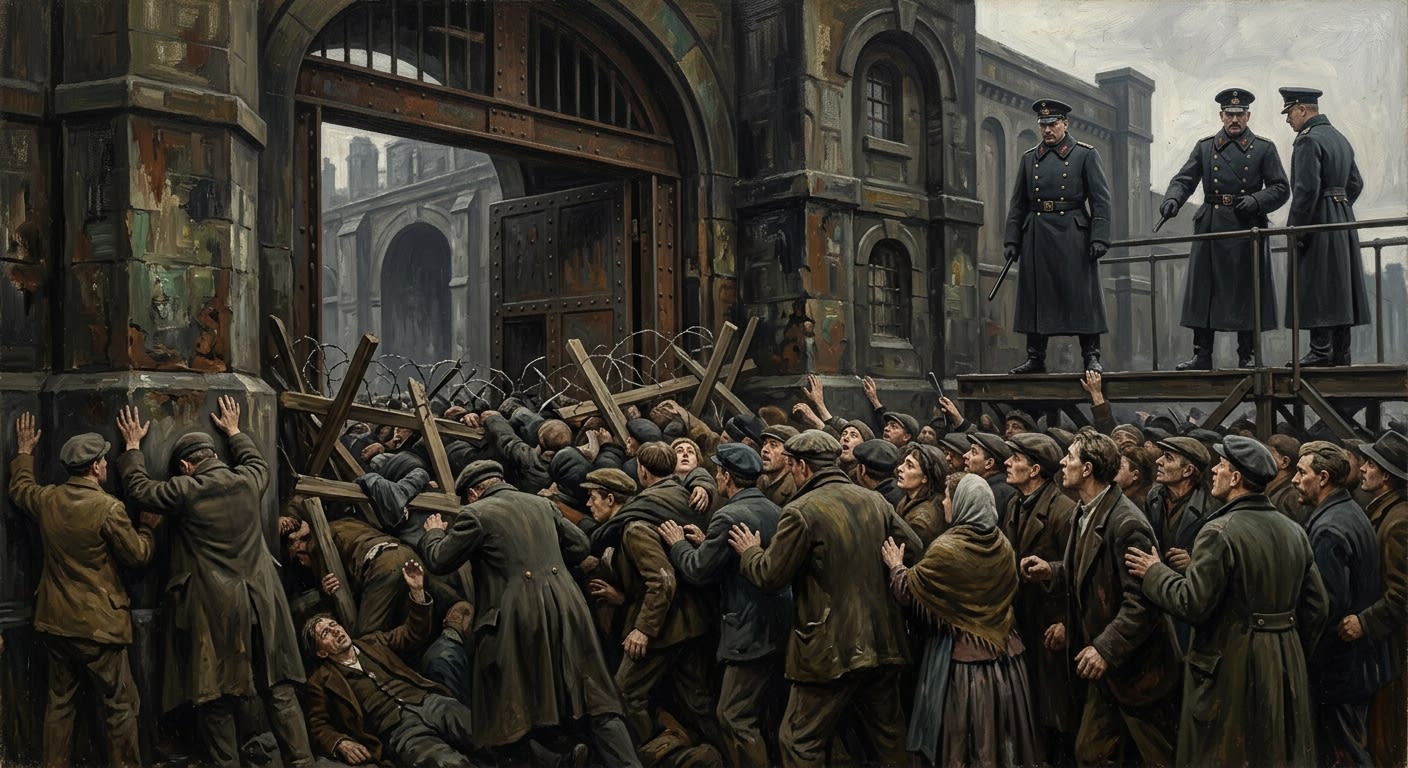
The gate had been stamped OPEN. That word matters. A gate announced by rumour creates disorder. A gate announced by bell creates haste. A gate stamped OPEN creates entitlement, and entitlement in a starving crowd is a sacrament of velocity. The portcullis rose by less than a wagon's height. The inner mechanism shuddered. The release lane narrowed. The crowd, having waited through hunger, cold, and clerical instruction, obeyed the stamp rather than the metal.
Three thousand came toward a mouth built for three hundred. The gate accepted them as gates accept all theology: by pressure.
#On the Eleven Minutes
The first minute was noise. Wagons groaned forward, wheels buckling against abandoned carts, mule traces tangling with pilgrim bundles, children lifted overhead and passed toward strangers who had no room to receive them. The portcullis caught at the lower third, high enough to promise passage, low enough to break backs. Men crouched to pass beneath it; men behind them pushed upright; the iron teeth did the rest.
The second minute made the crowd one body. Breath became a shared commodity. Those at the rear could not see the gate and believed delay to be theft. Those in the middle believed movement had begun and feared losing position. Those at the front could no longer believe anything. Their chests had no room for doctrine.
By the fourth minute, the Castellan-Warden had been informed. By the fifth, he had asked whether the stamp could be revoked without creating a contradiction in the gate ledger. By the seventh, a clerk sought the revocation folio. By the ninth, the clerk discovered that the revocation folio required countersignature from a duty officer trapped on the far side of the crush. By the eleventh, the Castellan-Warden ordered the gate sealed.
Records notes the delay with reluctant precision. Bureau prose grows thin around shame; one can see the bones of fact pressing through the cassock.
MEDICAL ADDENDUM — COMPRESSION CASUALTIES Front rank recovered in layers. Several bodies retained standing posture after removal of lateral support. ████████ identified by ring only. One child extracted alive from beneath overturned grain cart, later classified “unclaimed; usable.”
#On Three Hundred and Nine
Three hundred and nine died by compression. The number survives because it entered the wrong column first.
Had it been logged under riot, it would have swollen or shrunk according to political weather. Had it been logged under famine, it would have vanished into quarter loss. Had it been logged under enemy action, someone would have received a medal and a banner with tasteful black trim. It entered the mechanical casualty ledger: bodies caused by gate failure, portcullis obstruction, crowd pressure, delayed sealing order. Mechanical ledgers are stupid enough to become holy by accident. They count what other ledgers would prefer to bless away.
The corridor after the sealing resembled an emptied stomach. Broken carts. Burst sacks. Grain pressed into mud, hair, wool, teeth. A hymn book open to a psalm about deliverance, its pages glued together with broth. A mule alive and screaming under three dead men. A queue ticket stamped with such force into a woman's palm that the ink remained visible after washing.
Early public notices described the casualties as “famine-associated gate losses.”
Corrected for restricted instruction. Famine brought the crowd. The stamp summoned it. The gate failed. The order came eleven minutes late. The dead were not associated with the loss. They were the loss.
The three days in the name do not mark the duration of the killing. The killing required minutes. The clearing required three days. First the living had to be pulled out. Then the dead. Then the grain. The grain came last in practice and first in the report.
#On the Birth of the Rope
The Three-Day Crush gave the Synod a revelation it immediately disguised as foresight: gates do not manage themselves. Neither do crowds, stamps, hunger, wagons, widows, soldiers, or the hideous little interval between “open” and “passable.” The old practice had trusted gate sergeants, ordinary clerks, military police, and the civic instinct of starving people. The old practice produced three hundred and nine dead.
A.S. 102 brought the formal answer. The Queue-Marshal Corps was constituted under joint War and Records authority, twinned with the Synod Permit Directorate, and given a doctrine as blunt as a cudgel: hold the lane before the gate decides the theology. Rope Tenders, Chalk Runners, Lane Sergeants, Stamp Verifiers, Queue-Marshals, Riot Marshals — ranks born from the discovery that a line is not a crowd until someone neglects it.
The Corps inherited the Crush as scripture, warning, and professional insult. Every Marshal learns the eleven-minute delay. Every Marshal learns the number. Every Marshal learns that an OPEN stamp without lane control is a loaded cannon pointed at civilians. Then the Marshal is handed chalk and sent to a gate where the same mistake waits in new boots.
#On the Present Use of the Dead
The Bureau of War cites the Three-Day Crush whenever it requires funds for rope, posts, verification lamps, riot alcoves, or the miserable little platforms from which officers shout instructions they hope will sound like command. Records cites it when demanding cleaner intake sheets. Doctrine cites it when preaching Order. The dead have been more useful after burial than they were alive, which is a common promotion in the Synod.
At some forward gates, Marshals still tap the lower iron before opening a famine lane. Three taps: one for the front rank, one for the rear, one for the eleven minutes between them. The rite is unofficial. It persists, the surest proof that it works or that men are frightened. In practice, those are neighbouring truths.
A commemorative broadside once called the Three-Day Crush “the tragedy that taught the Synod to value human flow.”
Withdrawn. The phrase “human flow” is prohibited in memorial contexts. “Throughput” remains acceptable in training rooms, where no one is expected to have a soul above ledger grade.