
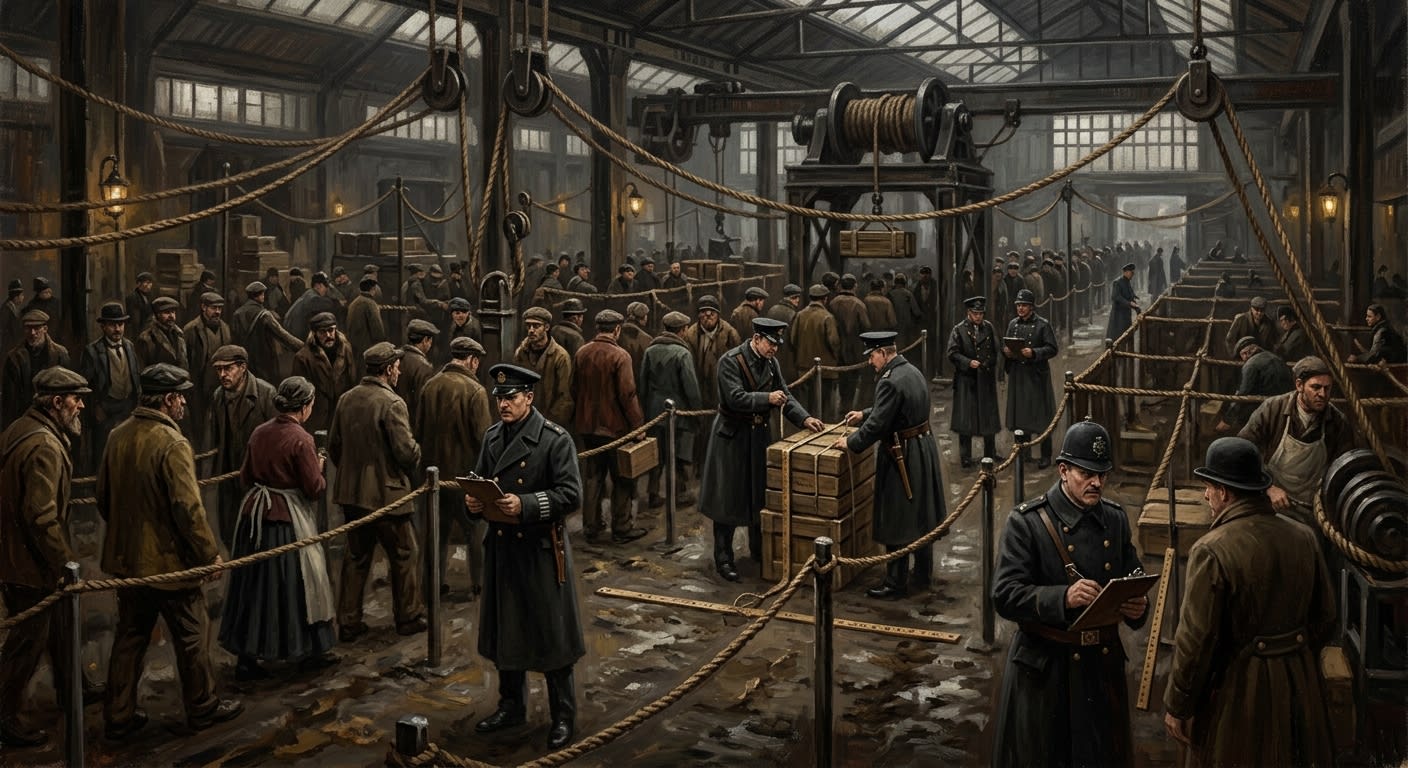
#On the Year the Rope Became Law
The Rope Reforms of A.S. 118 were the moment the Synod admitted, under cover of measurement, that the human body in a queue behaves less like a soul than like cargo with opinions.
Before the Reforms, every gate kept its own rope custom. Metz favoured short cord and hard angles, because Metz distrusts curves on moral grounds. Rheinscarp used steep switchback lanes pinned to the scarpside, giving petitioners ample time to contemplate both salvation and the drop. Danubian checkpoints preferred wide holding pens that allowed crowds to spread, quarrel, sing, barter, and develop politics. Smaller bastion gates used whatever cordage the last convoy had not stolen.
The results were instructive. Lines bulged. Lanes snapped. Wagons cut corners and crushed ankles. Stamp tables migrated toward shade and away from visibility. Priests complained that the old arrangements impeded confession access. Officers complained that they impeded artillery traffic. Civilians complained in the usual forms: bribery, trampling, riot, theft, hymn distortion, and dying under wheels.
A.S. 118 gave War its chance. The Queue-Marshal Corps had existed since A.S. 102, born from the Three-Day Crush and armed with chalk, whistle, rope, and moral exhaustion. Sixteen years of gate incidents had produced a doctrine. The doctrine required a tape measure.
#On Cordage and Lane Width
The first Reform was material. No more parish rope, sail scrap, mule trace, bell-pull offcuts, or local “blessed cord” whose sanctity had increased in direct proportion to its fraying. Every forward gate received measured cordage under War seal: tarred hemp core, red oath-thread, black audit-thread, and a waxed end-knot carrying the issuing depot mark. A rope could now be inspected, logged, replaced, blamed.
That last verb is the axle of government.
Lane width followed. The Reform set the ordinary lane at one wagon plus two shoulders, the pilgrim lane at four bodies abreast, the military lane at six bodies or two stretchers, the punishment lane at one body plus visible remorse. Local officers protested that local conditions required local interpretation. War replied by sending measuring rods. Records sent duplicate measuring rods. Tithes attempted to tax both rods, failed, and filed a doctrine note on the fiscal ambiguity of length.
Width changed conduct. A narrow lane makes a crowd into a blade. A wide lane makes it into a pond. The ordained width made it into a ledger column: sufficiently tight to count, sufficiently loose to breathe, sufficiently channelled to strike when required. Mercy has always been fond of practical dimensions.
A provincial War digest praised the Reform as “a humanitarian improvement in crowd comfort.”
Corrected. Comfort was incidental, disputed, and frequently absent. Control was the object. Survival was the politically attractive by-product.
#On Stack Geometry
The phrase “stack geometry” appears in the Reform papers with the serene ugliness of a newborn bureaucratic saint. It means the arrangement of barriers, posts, waiting blocks, pulse lanes, inspection tables, holding alcoves, and release mouths by which a crowd is persuaded to remain countable while believing itself to be moving.
The approved diagrams are beautiful in the way gallows are beautiful: lines, angles, load points, escape cuts, sight corridors, officer platforms, chalk boards, whistle stations. The crowd enters as a mass at the west intake. It becomes numbered groups in the holding stack. It becomes lanes under rope. It becomes cases at the stamp table. It becomes released traffic at the gate. At no point is it allowed to become itself.
The Reform's famous diagram — the one copied in Marshal schools and misquoted by every Tribune-Chaplain who has ever confused arithmetic with revelation — shows optimal rope tension measured in units the Bureau declines to name. Along the margin, an engineer wrote that human desperation could be expressed as a coefficient.
He was correct.
ENGINEERING ANNEX 118-C — PARTIAL Coefficient D accounts for hunger, cold exposure, visible grain, distance from gate, child-density, rumour propagation, and proximity of armed personnel. Recommended correction: increase lateral slack by ███ finger-widths per ███ petitioners or prepare volley line.
#On Ravel's Mercy
The Reforms also canonised a theft.
Long before A.S. 118, gate-workers knew a release knot attributed to Ravel of the Rope, the half-mythic Rope Tender who tied a knot that calmed a riot and then died of a thrown stone. The knot could hold under push and still be cut loose from the side, allowing a lane to open laterally rather than drive forward into a gate-mouth. Marshals called it Ravel's mercy because occupational cults are more honest than official ones: the knot did not forgive; it gave bodies somewhere else to go.
War entered it into the Reform manual as Emergency Lateral Release Pattern 3-C.
Marshals kept the old name. They still do. A man with both hands on a singing rope has no patience for nomenclature composed by warm clerks. He wants the knot that opens without snapping and the side lane that takes the pressure before the front rank becomes paste. Call it Pattern 3-C in the manual. Call it Ravel's mercy in the mud. The mud will decide which name survives.
#On Resistance, Adoption, and Fraud
Every reform creates a market in false compliance. The Rope Reforms excelled at this pious work.
Gate officers stamped local cordage as standard issue. Depot clerks sold authentic end-knots sewn onto cheaper rope. Contractors delivered cord measured in dry halls, which shortened in rain and turned lane width into a joke played on knees. One northern checkpoint painted audit-thread onto mule trace and passed three inspections before a crowd surge peeled the paint away. Records classified the matter as “premature visual deterioration.” War hanged the quartermaster because nouns can only protect a man up to the gallows.
The honest resistance came from old Marshals. They disliked the rods, the diagrams, the mandated knots, the inspection cadence, the officer platforms positioned to observe the observers. They had survived by feel. War ordered them to survive by form. Some adapted. Some retired. Some were found in rope sheds at dawn, retieing Pattern 3-C into the forbidden older form and daring the Inspector to notice. The Inspector noticed. The lane held anyway.
Initial Reform commentary asserted that standardisation eliminated local variation across the forward gates.
Revised. Standardisation produced a legal fiction beneath which local practice continued with improved excuses. The Bureau accepts this condition under the term “field accommodation,” provided the bodies remain few enough for ordinary columns.
#On the Reforms' Present Authority
By A.S. 201, the Rope Reforms are old enough to be mistaken for tradition, which is how most policy acquires a halo. Every Marshal carries their consequences in his hands: the issued rope, the measured lane, the lateral release knot, the stack diagram nailed in the gatehouse, the inspection rod stored beside the baton. Every crowd passes through their invisible arithmetic. Every gate that opens without killing the front rank pays the Reform a small silent tax.
The Reforms did not end crushes. They made crushes legible. They did not end bribery. They gave bribery lanes with names. They did not end hunger. They discovered how wide hunger must stand before it becomes expensive.