

#On the Cantor's Station
"Breathe shallow. Sing clean." — Oathglass proverb, entered in the first cough-registry, A.S. 111
Saint-Helm's Cut has ten trades for turning a mountain into certified truth, and only the tunnel cantor works without a tool. The cutter has the pick and the wedge-setter has iron. The shard-hauler has a back. The cantor has a throat, and the Guild owns everything else.
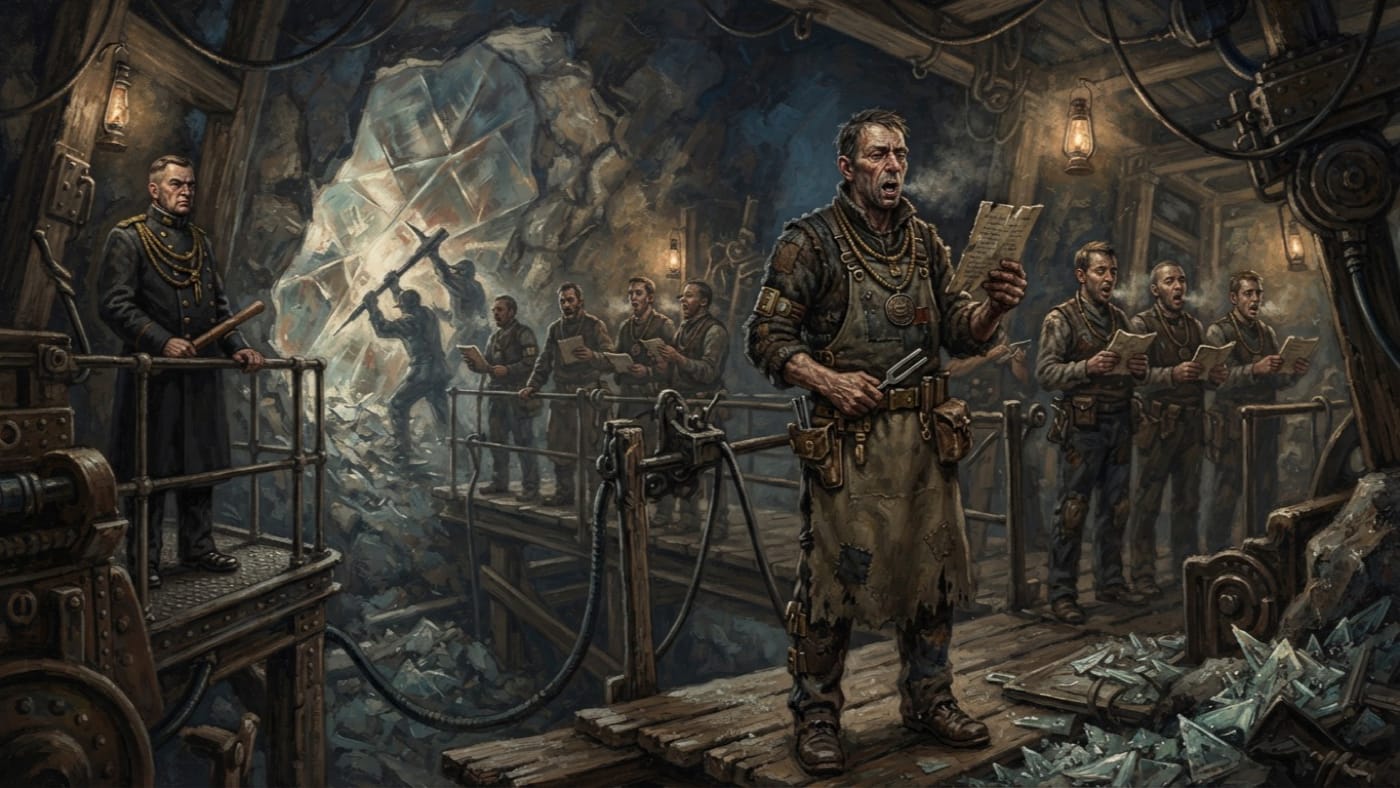
Tunnel cantors are the men and women who sing in the extraction galleries of the Cut Face while the glass is taken from the rock. They sing together, in sanctioned intervals and sanctioned cadences, and the cutters work to the measure they set. Extraction does not begin until the song does. The panes that leave the Cut are stamped at the Seal House, packed in straw and carried down the single switchback road. They end up facing reliquaries from the Heartlands to the Line, where they break candlelight into the patterns by which a Verifier declares a relic genuine. Every certified saint's knuckle in the Church was, at some remove, sung out of a hillside by somebody with a cough.
The trade has no order, no charter of its own and no patron of record. It is a line on a quota sheet. I have looked.
#On the Working Hymn
The glass seams of the Cut respond to sound. Fourteen surveys by the Bureau of Alchemical Standards have settled the point, and so has the daily experience of everyone who goes below the third gallery. Sung correctly, the approved intervals set the rhythm of the cutting, steady the surrounding rock and keep fractures from spreading through the glass. Sung wrongly, they do the reverse. Hairline cracks run across the seam, shards fall from the ceiling, and sometimes a whole gallery comes down.
Those are the observed effects. The explanation belongs to the Bureau. It holds that the sanctioned hymns preserve the spiritual integrity of the material, so that a pane sung clean out of the rock is clean in a sense the Seal House can later certify. A cantor need not believe this in order to sing. Either way, the ceiling holds or it falls.
The hymns are approved and copied under the authority that has kept the Church's sung measures since the Office of Bells was constituted. The present standard is the Bell Codex, ratified in A.S. 115. Older hymnals were in use before that, and one of them is the subject of the next section.
The singing is done in company. Cantors sing call and response with one another and with the work, and the hymn travels down the gallery over the rasp of tools on stone and the coughing that no hymn-card scores. Each shift carries its quarry shift hymn-cards, which set out what is to be sung and when. Singing alone is forbidden, and silence during extraction counts as sabotage. Three further taboos apply in the Cut: no whistling, no laughing in the deep, and no correcting a cantor's pitch in public.
The last taboo deserves a word. A cantor corrected aloud has been wrong aloud, and a wrong note in the deep is a matter for the Wardens. The quarry has therefore developed a delicacy of manner that the Synod's choir-schools might envy. Errors are raised afterward, in private, by people who mean to keep working beside whoever made them.
#On the Corrected Hymnal
"Procedural, not doctrinal." — Bureau of Doctrine classification, A.S. 111
The earliest dated mention of tunnel cantors in any record I have been shown is also their worst. In A.S. 111 (1821 CE), a choir of cantors sang an interval that had been copied incorrectly from a damaged hymnal. The resonance that followed brought down three hundred yards of gallery ceiling and killed two hundred and fourteen workers.
The survivors came out coated in glass dust. They were moved to surface duties, and their names went into the Breath Chapel's first cough-registry, a book that has since needed a great many more pages. Most of those first entrants were dead within five years. The Bureau of Doctrine classified the collapse as procedural rather than doctrinal. The phrase has a real elegance: the hymn was sound, the copy was faulty, and the fault lay with whoever copied it.
The hymnal was corrected and the galleries reopened. The cantors were told to sing correctly, which is what they had been trying to do on the day in question.
In A.S. 114 (1824 CE), the corrected hymnal turned out to contain three more copying errors. These were corrected as well.
The street has its own story about A.S. 111, as streets do: someone paid for the wrong note. No document I have examined supports it. The damaged hymnal is explanation enough. A Church that keeps its mountain upright by copying answers first to its copyists, and the Bureau has said as much, in the passive voice.
#On Breath and Compliance
The same lungs that hold up the ceiling are filling with it. Glass dust hangs in the lamplight of every gallery. A cantor breathes deeper and more often than the cutter alongside, and so takes in more of it. Resin filters and masks are standard equipment in the Cut, and both are scarce. The Breath Chapel's preparations ease the cough. Nothing the Chapel has has been shown to undo what the dust does.
Cantors are paid like everyone else in the Cut, in pane-scrip redeemable at the Guild commissary. Guildmaster Orr Vetch controls quotas, tools and kiln access. That means he controls how long a cantor's shift runs and how many shifts make a week. Sister Brethna gives out care against confession receipts, and treatment is paid back in extra shifts. Confession penalties are added in the same way. A cantor who coughs through a cadence can be fined for it, and can pay the fine by singing longer in the air that caused the cough.
Brethna keeps a public ledger of allocations and a private ledger whose contents are her own business. Verifier-Provost Maelin Rook has no part in the galleries. Her authority starts when the glass reaches the Seal House, where a wax disc decides whether a cantor's work becomes sacred material or restricted mineral.
The local Choir Wardens stand at the tunnel mouths and hymn towers, with throat-cords to mark their office and batons for everything else. They enforce the sanctioned song. Cantors carry hymn-cards.
The workers have threatened a silence strike. The arithmetic needs no organiser to explain it. Extraction cannot go on without the song, and silence in the Cut is already classed as sabotage. A gallery of cantors who shut their mouths is a gallery where no glass is cut, and every one of them has committed the same offence at once. The threat has been made. No strike has been held. The Bureau has filed the threat, and the hymn-cards are still issued at the start of every shift.
#On the Answering Seam
Cantors in the deep galleries report second harmonics where no second voice is singing. Panes from the lowest seams have shown hairline marks that look like writing. A sealed gallery below the Helm-Mouth, closed since A.S. 111, has started to make sound. The Resonant Vein is classed as a Category Two Localized Acoustic-Geological Anomaly, Priority Amber. The cantors spend the longest hours closest to it and call it other things, none of which I am authorised to print and several of which are merely rude.
Street report adds that certain harmonics produce glass of unusual clarity, and that the useful syllabic patterns resemble names. In A.S. 199, Verifier-Provost Rook submitted a field report on the matter, and Doctrine sealed it.
[SEALED — Bureau of Doctrine, A.S. 199. Material concerning nomenclature and the behaviour of the seam under song is withheld from this entry. Cantors' hymn-cards remain as issued.]
The Cut's listed countermeasures include silence protocols alongside the sanctioned hymns. In a trade where silence is sabotage, it is fair to ask how the two fit together. No copy of the protocols I have been allowed to see answers that question.
The quarry is also home to the Flawless Claimants, a cell of kiln workers, proof brokers and at least one disaffected cantor. They believe a perfect pane can be had, one that would authenticate anything placed behind it. Their possession of such a pane is unproved. Their cantor is unnamed. One defection establishes nothing about the rest of the trade, most of whom want only to finish the shift with the ceiling where it was when they started. Standing beside a phenomenon all day is not the same as understanding it. The Bureau of Purity would like that distinction kept in mind before it sends anyone further up the pass.
#On the Present Application
In A.S. 201 (1911 CE), the Synod wants more output. The Guild wants longer shifts. Winter closures have broken up the lower-valley herb convoys three seasons running, so the Breath Chapel cannot supply the resin filters the galleries need. The Wardens have doubled their patrols at the tunnel mouths. The second harmonics have continued, and the cantors keep singing.
ERRATUM — Bureau of Records, Annex Alp-7, filed A.S. 200, as entered against the parent survey: Earlier production reports described Oathglass Quarrytown output as "stable and healthy." The Bureau now classifies output as "stable." The word "healthy" has been removed from all prior filings. The correction applies to the whole workforce, cantors included.
No separate inspection of the cantors' trade has been carried out for this entry. None was asked for. The Holy Bureaus already know everything about the cantors they need: where they stand, what they sing, and what happens when the singing stops.