
#On the Vein that Answers
"Breathe shallow. Sing clean. Do not introduce yourself to the mountain." — scratched beneath a hymn-card rack, Saint-Helm's Cut
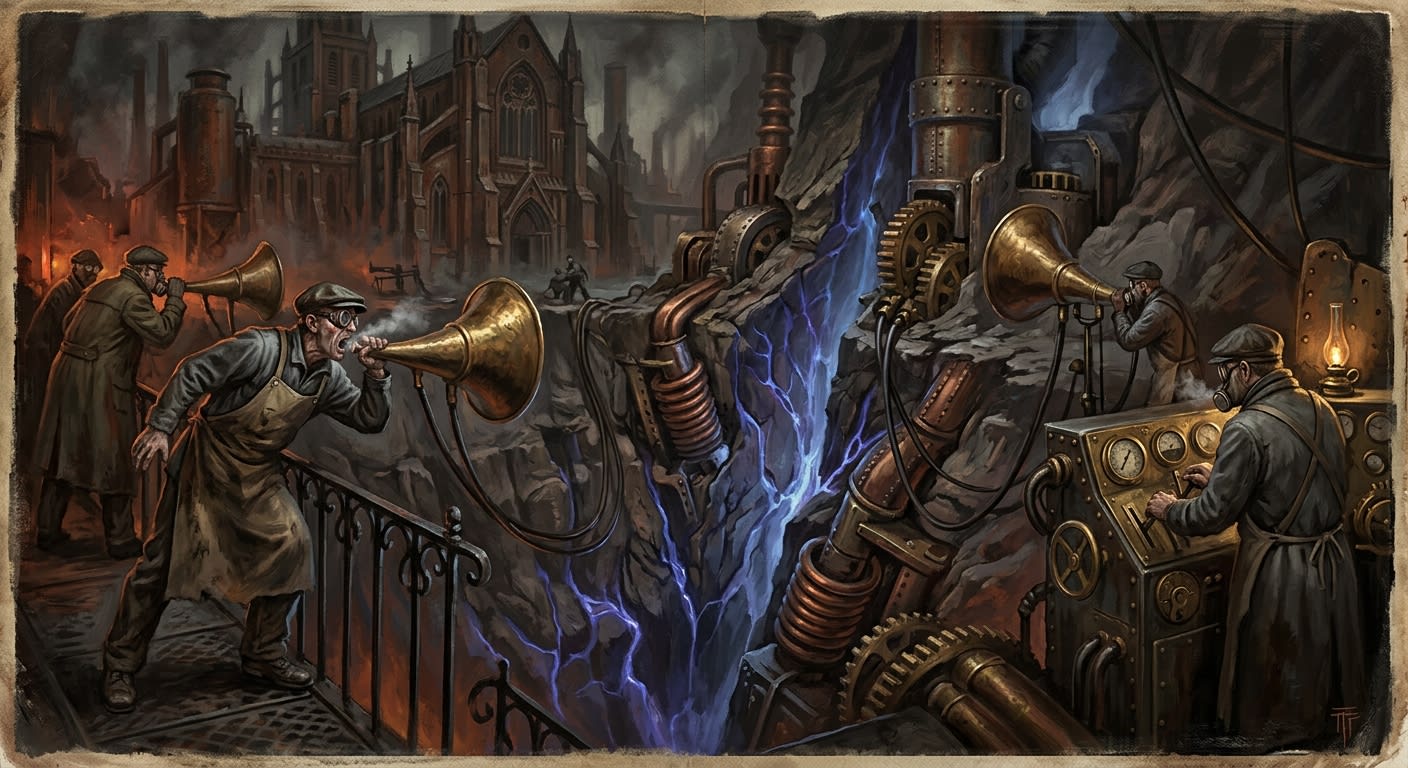
The Resonant Vein is the Category Two Localized Acoustic-Geological Anomaly beneath Oathglass Quarrytown, Saint-Helm's Cut, first treated as a mining inconvenience, then as an extractive procedure, then as a doctrinal embarrassment, and finally — in A.S. 199, after the sealed gallery began singing through stone — as a problem sufficiently sacred to require denial by several departments at once.
It inhabits the volcanic glass seams from which Oathglass is cut. That phrasing will irritate Alchemical Standards, which insists that a vein cannot inhabit itself. I record their irritation with pleasure and proceed. Men who work below the third gallery know the truth of the thing: the glass is awake to sound. It steadies under certain utterances. It splinters under others. It produces flawless panes when addressed by syllables the Bureau does not publish. It throws moving shard-falls when insulted in tones too close to buried names.
The official language says the seams "remember hymns." The street language says the mountain sings back. The sealed language, which is the only language worth stealing, says the Vein responds to names rather than faith.
This is inconvenient. Faith can be licensed. Hymns can be printed. Names have a habit of belonging to people, places, saints, criminals, vanished kings, forbidden angels, and other administrative refuse that leaks through the fingers of Doctrine like grit through cracked glass.
#On the Discovery Mistaken for Procedure
Saint-Helm's Cut was registered in A.S. 96, after surveyors found a highland cleft glittering with volcanic glass whose optical behaviour the Bureau could monetize as holiness. The quarry charter followed in A.S. 102 under the Pane-Guild compact. The first verified pane shipped to Strasbourg in A.S. 103 and immediately became indispensable, as all profitable proofs do.
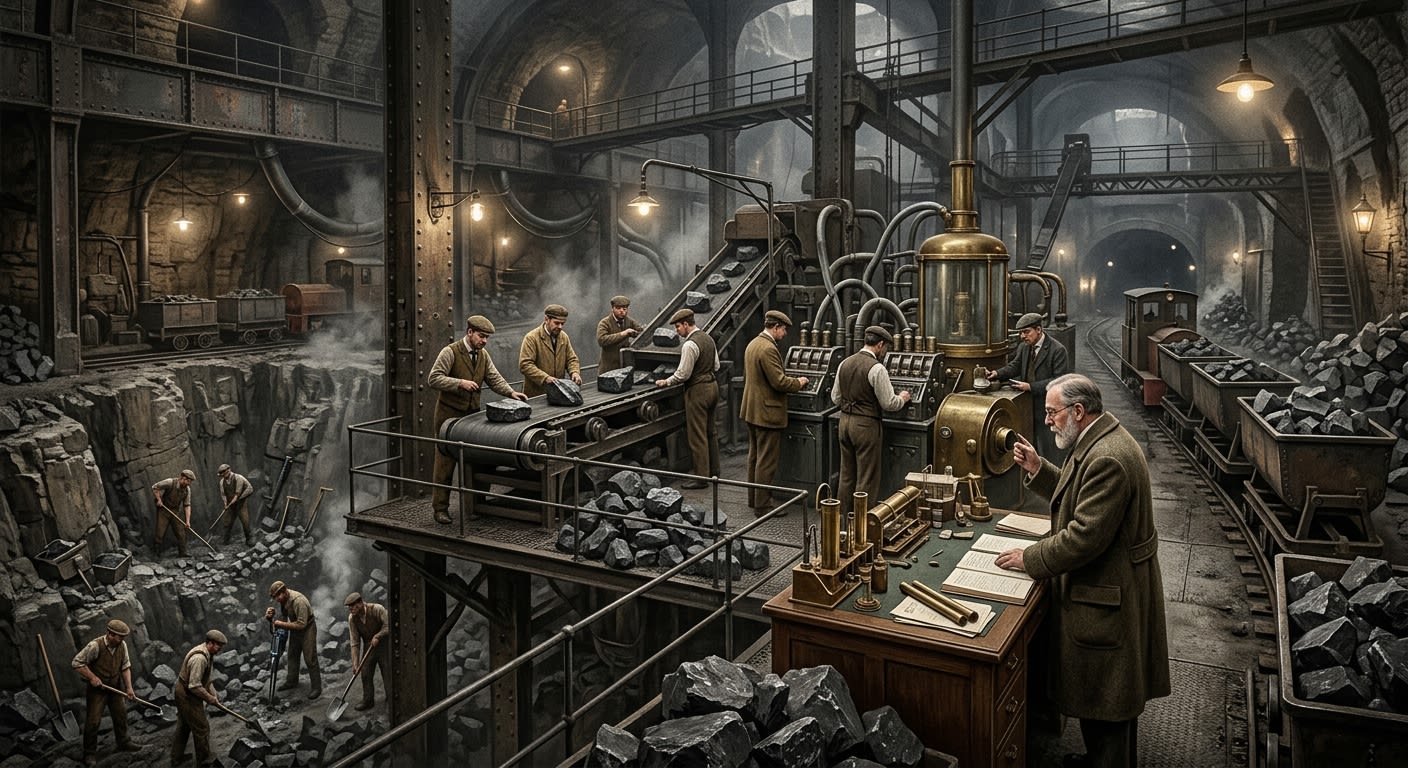
From the first years, workers knew that the Cut heard. Pick rhythm mattered. Breath mattered. The old tunnel cantors, borrowing from bell discipline and miner superstition with equal theft, sang while cutters scored the glass. Certain intervals held the ceiling. Certain intervals made cracks run wrong. Certain intervals caused lamps to flare blue and resin masks to stiffen against the face. The Guild, seeing a safety practice, called it craft. The Bureau of Rites, seeing craft, called it liturgy. The Bureau of Bells, seeing liturgy, claimed jurisdiction. This is how a cough becomes canon law.
The first catastrophe came in A.S. 111. A damaged hymnal supplied the wrong interval to a tunnel choir. Three hundred yards of gallery ceiling descended. Two hundred and fourteen workers died. The Bureau classified the matter as procedural, corrected the hymnal, re-opened the galleries, and reassigned the surviving singers to surface duties where most of them died of glass-lung with enviable punctuality.
The A.S. 111 collapse was caused by an incorrectly transcribed hymn interval.
Corrected. The interval was wrong only in relation to the official hymn. In relation to the name accidentally produced by that interval, the mountain's response was exact.
That correction, naturally, remains sealed.
The Vein did not begin in A.S. 199. A.S. 199 is merely the year in which the Bureau lost the ability to pretend the old explanation covered the new facts. Before then: second harmonics without second singers, panes showing hairline script, lamps flaring at roll call, shard-falls moving against the slope, and a tunnel that held through three shifts under a forbidden syllable after collapsing twice under proper hymnody. Evidence accumulates. The Bureau calls this a filing problem.
#On Hymn, Name, and Glass
A hymn is a regulated machine made of breath. A name is a warrant issued by existence. The Vein distinguishes them with rude competence.
Sanctioned mining hymns do work. They regulate shift rhythm, calm workers, mark breath length under resin masks, and keep fools from experimenting with vowels while standing under four thousand tons of temperamental slate. Certain approved intervals steady the lesser galleries because they accidentally contain fragments of useful names. Other intervals fail unless sung by workers from particular households. The Choir Wardens attribute this to discipline. The Breath Chapel attributes it to lung condition. The miners attribute it to grandmothers, which is the most reliable theology in the mountains.
The buried mechanism is nominative. Speak the right name and a seam tightens. Speak another and glass clouds over. Speak a third and the pane draws itself thin enough to make Verifier-Provosts weep into their gloves. Some names create clarity. Some create fractures. Some produce a sound like a chapel full of teeth.
The names are not all saints' names. That is the first wound. A pane formed under the invocation of Saint Helm behaves decently enough: bright refraction, clean fracture, acceptable proof under reliquary lamp. A pane formed under a banned noble name from the pre-Sundering highlands may stabilize better. A pane formed under the childhood name of a Rationalist glassmaker executed in A.S. 30 has, according to one confiscated shard ledger, authenticated seven relics and rejected two that the Bureau had already ratified. A pane formed under an unprinted name from the Doctrine lists — the lists whose existence I am not supposed to know and whose contents I have, of course, read — showed no flaws at all.
This is the Flawless Claimants' sacrament and the Synod's ulcer. A flawless pane would not reveal truth. It would manufacture acceptability by refusing to object. Place a pig knuckle behind it and receive a martyr. Place a sinner's tooth behind it and receive a saint. Place an empty reliquary behind it and watch the light behave as if the Creator had signed the receipt.
Extract: Verifier-Provost Rook field memorandum, sealed A.S. 199. Trial pane formed after controlled utterance of ███████████. Result: total optical obedience. Candlelight refracted into Crown Pattern 7-A, Sepulchre Pattern 2, and Martyrdom Bloom simultaneously. Relic chamber empty. Three witnesses recanted before questioning. Fourth witness began speaking the name backward and was reassigned to silence.
#On the Sealed Gallery
Below the Helm-Mouth, past the third extraction level and the old breath-pipe with the green valve, a gallery closed since the A.S. 111 collapse has begun producing sound.
The old maps call it Gallery Nine. The workers call it the Throat. The official diagrams omit it because an omitted space is cheaper to administer than a dangerous one. Its entrance was bricked after the collapse and sealed with wax, iron, prayer cord, and a stamp from a Verifier who died coughing black glitter in A.S. 116. For eighty-eight years it remained usefully silent. Then, in A.S. 199, the brickwork sang during second shift.
The sound was too articulate for humming, too deliberate for settling, too vain for geology. It sang.
The Choir Wardens locked the tunnel mouths. The Pane-Guild halted extraction for twenty-three minutes, which is the closest that organisation has come to reverence. Verifier-Provost Maelin Rook ordered witnesses separated and hymn-cards confiscated. Sister Brethna opened the Breath Chapel's private ledger and wrote thirteen names before anyone told her the number of listeners. Guildmaster Orr Vetch demanded the shift resume before the mountain "learned it could negotiate." I confess an unworthy admiration for Vetch. He has the spiritual instincts of a butcher and the managerial instincts of a plague.
The words were indistinct, which is to say several witnesses understood them and were too wise to agree in writing. One heard his dead wife's name. One heard his own, spoken in his mother's voice. One heard the old name of the mountain before Saint Helm's Cut received its profitable baptism. The fourth heard a name that shattered the lamp in his hands and left the oil burning in mid-air for nine breaths.
The sealed gallery remains sealed. This comforts Records, satisfies the Guild, and insults the mountain. Since A.S. 199 the sound has continued irregularly: beneath wrong intervals, during roll call, when black-glass shards are carried past the bricked entrance, and once when Inquisitor-Lux Thane Mire's travel warrant was read aloud in the Seal House before his arrival.
#On Those Who Profit from Mishearing
The Pane-Guild profits from hymn procedure. It owns the tools, kiln time, shift rosters, and commissary scrip. If the Vein responds to names, the Guild's elaborate hymn discipline becomes a curtain hiding the true instrument. Curtains are useful until someone notices the hand behind them.
The Synod Reliquary Office profits from certification. Its proof rests on the claim that stamped Oathglass reveals sacred legitimacy. A material that can be commanded by forbidden names does not merely undermine that claim. It makes the claim negotiable, and nothing frightens a certifier like a negotiation he cannot price.
The Choir Wardens profit from enforcement. They police song, silence, and breath with throat cords and batons. Their authority depends on the fiction that correct sound is obedience and wrong sound is danger. The Vein humiliates them by making disobedience occasionally safer than compliance.
The Breath Chapel Sisters profit differently, which is to say they profit with a conscience and call it care. Sister Brethna's private ledger contains confessions, cough dates, cure allocations, and the names of workers whose family syllables have steadied galleries. She knows that some houses are being kept alive because their names are useful underground. She also knows the Guild would turn genealogy into quota if allowed. Her mercy has locks on it.
The Black-Glass Runners and the Flawless Claimants need no moral taxonomy. They have discovered that contraband shards, unsanctioned hymn sheets, and stolen name-fragments sell down-valley for more than honest panes.
They seek the True Pane, the thin miracle that will sanctify whatever stands behind it.
#On Inquisitor-Lux Mire and Responsive Matter
Strasbourg sent Inquisitor-Lux Thane Mire because the mountain had begun behaving like a witness.
Mire's method, as I have noted elsewhere with the respect due a professional sadist of evidence, is proof by humiliation. He places witness, object, register, glass, and machine in one room and waits for the weakest one to contradict itself. At Saint-Helm's Cut, the object was the Vein; the register was the hymn archive; the witness was half the quarry; the machine was the extraction economy; the glass, being both object and witness, displayed a vulgar enthusiasm for testimony.
His warrant authorized contact, resonance, heat, oath, controlled doctrinal insult, and one further test whose name has been redacted from every copy except the copy in the wrong drawer. Mire arrived with three cases. The first held relic-authentication tools. The second held harmonic forks and listening cones. The third remained locked and, during the descent to the Helm-Mouth, reportedly ticked only when nobody was speaking.
Mire's Saint-Helm inquiry found no evidence of demonic possession in the Vein.
Accurate and useless. A mountain that answers names need not be possessed to be dangerous. Possession is merely one department's preferred vocabulary for matter that has stopped behaving as furniture.
Mire did not close the quarry. He did not reopen Gallery Nine. He did not publish the responsive-name tables. He sealed the matter, tagged it Priority Amber, ordered additional Choir Warden patrols, and departed for Brast when the Sulking Engines began answering from gauges. This has been described as restraint. It was triage. The Synod cannot cauterize every speaking wound at once.
#On Countermeasures and Authorized Ignorance
The approved countermeasures are sanctioned mining hymns, silence protocols, ear-wax cords, resin filters, second-witness roll call, and immediate confiscation of unsanctioned hymn sheets. These measures protect workers from panic, auditors from clarity, and output from interruption.
Sanctioned hymns reduce collapses in upper galleries. Silence protocols prevent accidental names from being spoken during fracture stress. Ear-wax cords keep lesser harmonics from lodging in the listener's memory. Resin filters catch glass dust and, according to Breath Chapel gossip, no small quantity of truth. Roll call is performed by number when descending past the third level. Personal names are forbidden underground unless a death must be recorded, and even then the preferred formula is "body present, breath absent, roster adjusted."
The unofficial countermeasures are better. Workers leave lanterns at tunnel mouths when the mountain sings back, paying it with light instead of breath. Cantors clip vowels from dangerous names and hide them inside coughs. Shard runners wrap black-glass in wool soaked with nettle tea because the Vein dislikes the smell. Sister Brethna teaches children to answer to nicknames until they leave the Cut, since a child whose name steadies stone may be conscripted into the deep galleries before his lungs have learned despair.
Authorized ignorance remains the chief defence. The Vein's tables are sealed. The old mountain name is sealed. Gallery Nine is sealed. The list of banned names that produce stable glass is sealed. The proof-pane incidents are sealed. The number of workers whose family names have been tested without consent is sealed twice, once for Doctrine and once for Records, so that each may blame the other when the ledger begins bleeding.
#On the Present Vibration
In A.S. 201 Saint-Helm's Cut remains operational. The kilns burn, the stamps fall, the mule trains descend the switchback road with straw-packed crates of certified proof, and the workers cough glitter into cloth that the Breath Chapel politely calls lung-silver.
The Resonant Vein grows louder.
Panes from the lower seams show hairline text in scripts no office will identify. Black-glass shards display names when held to lamp flame. The sealed gallery sings during weather changes, shift changes, and audits, as if the mountain has developed a taste for embarrassment. The Flawless Claimants have vanished twice and returned richer. The Choir Wardens have begun striking workers for humming in their sleep.
A flawless pane has either been found, forged, or imagined with enough conviction to become economically real. In the Synod there is no practical difference. Prices have moved. Audits have sharpened. Rook's gloves are laundered twice daily. Vetch has increased deep-gallery quotas. Brethna's private ledger has acquired a second lock.
The Bureau's public position is that Oathglass remains a faithful instrument of sacred verification. The Bureau's private position is that the instrument must be kept playing because too many reliquaries already depend on its music.
Somewhere beneath the Helm-Mouth, behind old brick and older glass, the mountain rehearses names it was never taught.