
#On the Book That Rings
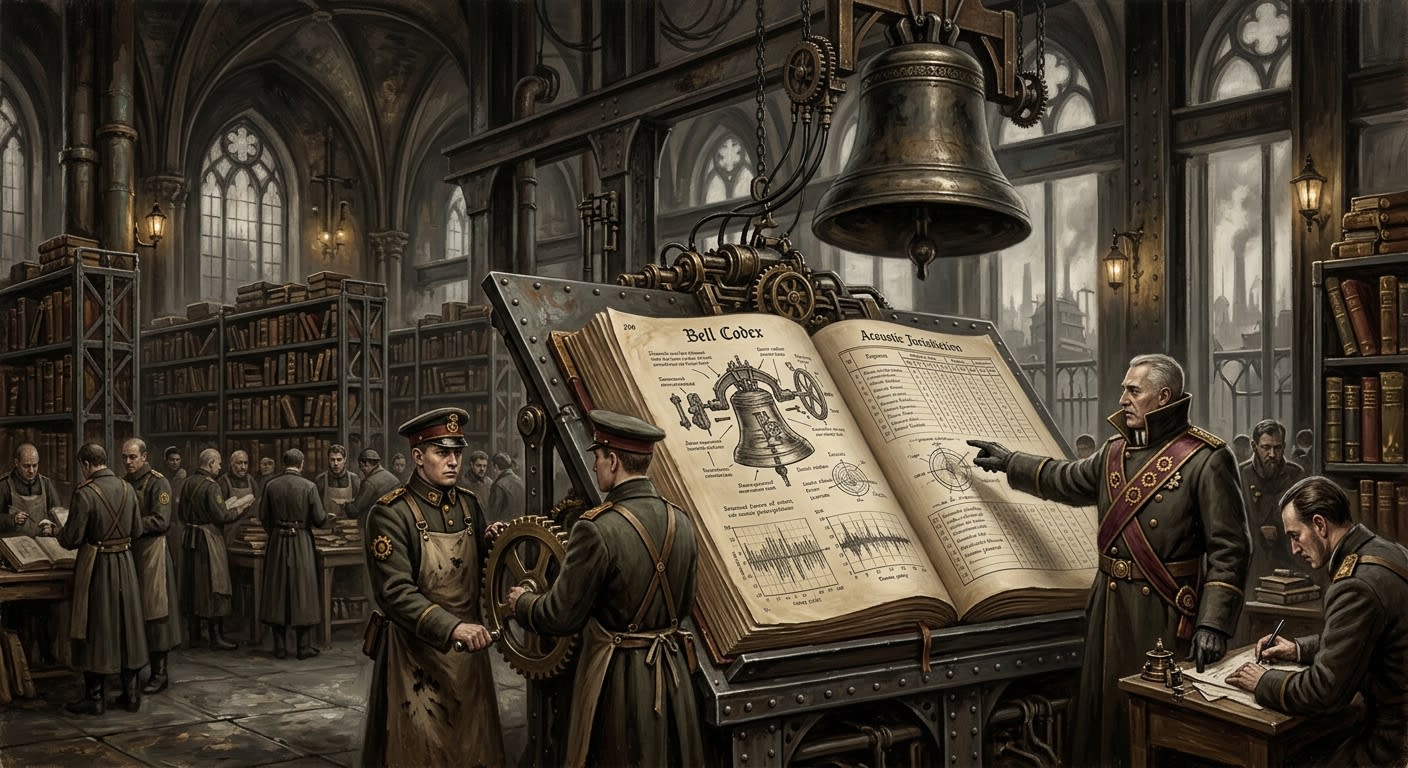
The Bell Codex is the sanctioned grammar by which bronze speaks inside the Dominion: a book of peals, silences, tolerances, feast corrections, curfew locks, mourning allowances, breach alarms, counter-breach answers, and those marginal notations which every Bureau denies reading while arranging its day around them.
It is filed as scripture by the Bureau of Bells, as operating manual by War, as liturgical dependency by the Bureau of Rites, as evidentiary substrate by the Bureau of Records, and as a headache by everyone with ears.
The present ratified recension dates to A.S. 115, after the Miracle of Cologne and the founding of the Bureau of Bells. Older Doctrine fragments mention a pre-Bureau bell order and a Lyon folio later filed under apocrypha; those fragments are true, false, premature, suppressed, and operational, according to which stamp has dried most recently. The Bureau prefers the clean sentence: A.S. 115, Cologne, ratification. The clean sentence is useful. Usefulness is a form of sanctity when sanctity is under audit.
#On Its Claimed Origin
The Bureau of Bells teaches that the first Codex was heard before it was written. During the Miracle of Cologne, when cathedral bells rang against Wrath's Host and the square cracked beneath their force, an unnamed Cantor received the order of all future peals in a single ecstatic interval. He wrote until the vellum smoked. His hand cramped into the shape of a clapper. His final breath, preserved in hagiographic varnish, reportedly sounded the High Angelus.
The Bureau of Doctrine teaches that a committee produced the Codex from existing liturgical practice after the Miracle, because the Creator favours committees when committees are properly terrified.
Both accounts are sealed. Both accounts cite witnesses. Several witnesses in one account are unborn in the other. Records has cross-indexed them without visible shame.
Earlier catechism cards described the Bell Codex as “dictated whole and entire by Heaven.”
Corrected for administrative durability. Heaven supplied the authority. The committee supplied page numbers, appeal clauses, ink allowances, and the section on clapper maintenance. The faithful are instructed to find this more impressive, because it is.
The Codex begins with axioms: sound orders flesh; timing sanctifies sound; unsanctioned timing corrupts both. From that little iron triangle comes a civilisation. Ring at dawn and the city wakes. Ring at Third and the factory starts. Ring at Fifth and contrition becomes punctual. Ring at Ninth and the doors close, bolts slide, lamps die, lovers separate, thieves curse, children whisper, and everyone discovers that obedience has hinges.
#On the Peals
The great peals are few enough for schoolchildren to chant and numerous enough for lawyers to ruin.
Ninefold Matins opens the day with nine descending strokes, the authorised collapse from sleep into duty. Widow's Toll (Unregistered) grants grief one low note and a measured interval in which grief may appear in public without becoming politics. High Angelus strikes noon into three ascending commands: stop, recite, resume. Iron Vespers locks garrison gates and opens powder magazines, a sequence loved by soldiers because it replaces uncertainty with tasks. Silentium (Unregistered) ends sound itself.
Silentium is the Codex's black seal. It is used for breach, catastrophe, and those rare moments when the Bureau judges that absence will frighten more cleanly than bronze. Soldiers on the Sagittal Line call it the Swallow. Civilians call it nothing until after it ends. During Silentium, children are held still. Dogs hide. Clerks continue writing because clerks, unlike dogs, have been overbred for obedience.
Below the great peals lies the profitable swarm: ration-bells, confession-bells, levy-bells, market-bells, work-shift peals, plague interdiction chimes, foundry-start tones, childbirth exception rings, lawful laughter intervals, funeral half-strokes, curfew locks, gate openings, ash-cart warnings, and the little chapel chime that tells the pauper when his soup has become a theological matter.
A citizen may mistake a sermon. He may misremember a creed. He may forget his mother's face after sufficient war and paperwork. He knows the bells.
#On Licenses and Crimes
The Codex creates crime by making sound legible. A bell rung without a license is no longer noise. It is speech outside jurisdiction. Speech outside jurisdiction becomes heresy when the Bureau of Doctrine is in a good mood and treason when War is.
Bell Peal Licenses (Unregistered) specify stroke count, hour, tonal range, purpose, emotional register, clapper material, decay window, parish radius, festival exception, mourning exception, and the maximum number of infants permitted to cry before the peal must be repeated for corrective coverage. The licensing form is twelve pages. The appendix is longer. The fee is devotional.
The miners of Liège once sounded work-shifts without Synodal approval. They claimed practical necessity. The Bureau answered with scourges. The mines reopened on the fourth day under sanctioned horns. Productivity improved, which the Bureau has always treated as a footnote to salvation and salvation has always treated as a convenient alibi.
At Cologne, the danger showed its richer face. The Night of Borrowed Curfew did not require illegal bells in rebel hands. It required one command in the right shape. The Codex's own grammar was borrowed, spoken, obeyed. Doors locked for the enemy because the hour sounded lawful. Afterward, the Bureau of Bells learned a lesson it has repeated into every Counter-Toll vault: a forged command is still a command to the citizen who has been trained well.
Training extracts once phrased the lesson as “the Codex failed at Cologne.”
Expunged. The Codex functioned perfectly. Cologne failed by being available to perfection in hostile custody.
#On the Apocryphal Lyon Codex
There is another book. There is no other book. The other book was discovered in Lyon, confiscated, sealed, copied, denied, and filed twice. It mapped peals that had not yet rung. It assigned meanings to bells in storms no one had forecast and to towers not yet built. Several pages were missing at seizure. Several pages were later described in reports predating the seizure. Records calls this an indexing difficulty. Bells calls it theft. Doctrine calls it a temptation.
CATALOGUE NOTE — LYON FOLIO, SEIZED A.S. 115 Page count at intake: ███ Page count after sealing: ███ Missing leaves: “future curfew,” “storm-votive sequence,” “Judge summons” [term disputed] Auditor hearing transcript: bells audible from closed folio, no tower within range Disposition: apocrypha / operational
Rumours claim the missing pages contained instructions for summoning the Judges. That phrasing is vulgar. Judges are not summoned; they arrive, which is worse. The Bureau of Records denies the Lyon Codex existed. The Bureau of Bells denies the pages are missing. The Bureau of Doctrine denies the verb.
On days when Strasbourg bells ring during storms no schedule predicted, I respect all three denials from a prudent distance.
#On Northern Dissonance
The Fractured North is the Codex's standing insult. Strasbourg mandates the A.S. 115 rhythm. The fjord-bells answer with older iron, older intervals, older stubbornness, and effects the Bureau's gauges record with the queasy reluctance of priests measuring a miracle performed by the wrong parish.
At Hrafnvik (Unregistered), shrine-bells ring against the Grey in sequences no southern Bell-master can read. The locals call one sensation klangro, bell-peace, the sudden certainty that something vast has decided to remain away. The Bell Codex has no entry for that. It has entries for breach, curfew, fog, storm, famine, riot, birth, execution, ash procession, and cattle sickness. It has no entry for a correct bell outside its authority.
This omission wounds the Bureau more deeply than any enemy peal. A hostile bell confirms jurisdiction by violating it. A working foreign bell disproves monopoly.
The Bureau has requested harmonisation. The North has declined. The bells continue to work. The Bureau continues to call them non-canonical, which is the administrative equivalent of shouting at winter for snowing without a permit.
#On Present Custody
The ratified Codex rests in the Bell Tower of Strasbourg Cathedral, under wax, brass, lock, guard, oath, dust, and the gaze of men who have mistaken custody for comprehension. Copies exist in every major Timing House (Unregistered), though each copy differs by authorised local addendum, seasonal correction, emergency supplement, counter-emergency supplement, and the marginal violence of Bell-masters who believe themselves inspired.
A public copy is displayed on feast days beneath three panes of smoked glass. The page is turned by a gloved Cantor before dawn, then fixed open until dusk so pilgrims may see that their lives are governed by a text they cannot read through the smoke. The displayed page is rarely important. Sometimes it concerns cattle bells. Sometimes it concerns wartime processional inversion. Once, during my inspection, the public page specified the correct peal for drowning a parish in administrative debt. The pilgrims kissed the glass anyway.
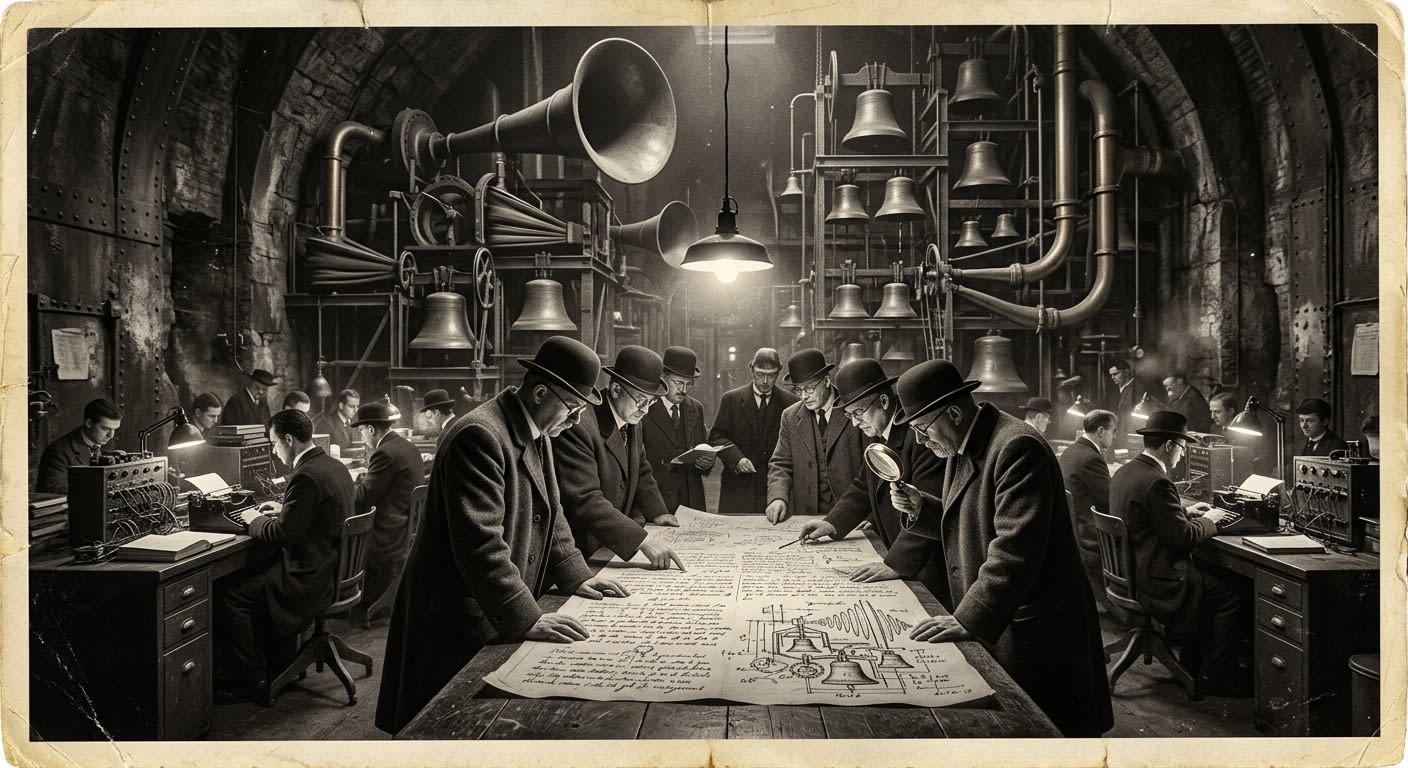
The private custody rules are less theatrical and more honest. No copyist may transcribe more than nine lines without washing the hand in brine. No Bell-master may sleep within hearing distance of the vault after reading Silentium clauses. No member of Records may collate variant copies alone, because variant copies have been known to agree when unwitnessed, and agreement among documents is the beginning of conspiracy. The Bureau of Bells maintains seven authorised chains of amendment. The eighth chain is denied. Its entries appear in peal charts during storms.
Aldo Venn reads from it without moving his lips. Counter-Toll Operators kill hostile tones by its authority. Bellwardens pull chains according to its charts. Festival Chorus-Masters beg exemptions from its curfew clauses. Cinder Trials wait for Ninth Bell before ash becomes verdict. The Codex sits beneath all of it, a courthouse disguised as music.
I once found a note in my copy written in my own hand: “We do not count from our triumph; we count from the wound.” The ink was older than the appointment that gave me access to the vault. I closed the book. The bells rang once above me, though the schedule showed no peal.
I did not correct the schedule.