
#On the Nature of Sacred Proof
"That which the lamp reveals, the Ledger confirms. That which the Ledger confirms, the mountain provides. This is logistics in a cassock." — V. Drax, annotation to the Thirty-Seventh Reliquary Audit (Unregistered)
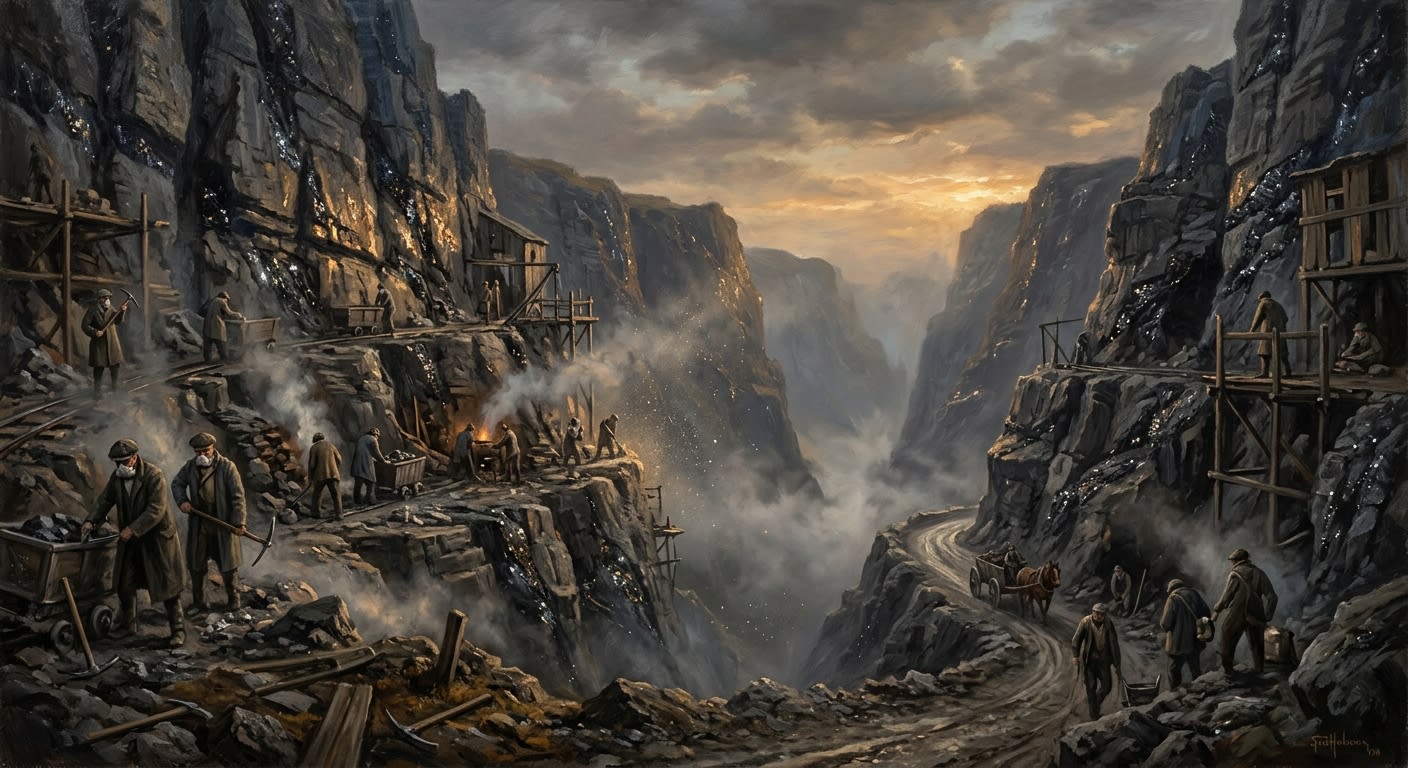
There is, in the upper reaches of the Sagittal Line's hinterland, a wound in a mountain that the Synod has declared a blessing. The distinction is administrative. Saint-Helm's Cut — a cleft in the highland slate approximately forty yards wide at the rim and narrowing to a throat of nine — opens like a split sternum into seams of volcanic glass so pure that light passing through them bends in ways the Bureau of Rites has certified as diagnostic. A pane of Oathglass, properly cut and stamped, will fracture candlelight into patterns that differ — measurably, reproducibly, and to the satisfaction of a trained Verifier (Unregistered) — depending on whether the relic behind it is genuine or counterfeit.
The quarrytown that clings to the walls of this cleft numbers some four thousand six hundred souls in fair weather, swelling by several hundred during reliquary harvest season when the shrine-cities of the Heartlands send their lamp-orders up the single switchback road on mule trains that arrive steaming and leave lighter. It is called Oathglass Quarrytown in Bureau correspondence, Saint-Helm Works in formal dispatches, Coughglass by the soldiers who have garrisoned near it, and Shattertown by the carters who have lost cargo on the descent. The inhabitants call it nothing. They save their breath. This is, as the reader shall discover, both metaphor and medical advice.
#On the Founding and the Seam
"A saint's head left its shape in the rock, and so we dug. Whether the saint approved is not recorded." — Marginal note, Reliquary Office (Unregistered) charter, A.S. 102
The Cut was known to shepherds long before the Synod knew it was useful. The cleft had always glittered after rain — glass dust catching light in ways that made the local population avoid it, on the sensible highland principle that anything beautiful in rock is either worthless or cursed. Prospectors from the newly constituted Bureau of Alchemical Standards arrived in the autumn of A.S. 96, six years after the Concordat, following rumours of a mineral seam with unusual optical properties. They found the cleft. They found the glass. They found that the cleft's profile, viewed from the southern ridge at sunrise, bore a passing resemblance to a bishop's mitre — or, with sufficient piety and squinting, to a saint's helm.
The resemblance was sufficient. The Bureau filed it as a confirmed manifestation. The Reliquary Office dispatched a Verifier-Provost (Unregistered). The Bureau of Records registered the site. And by A.S. 102, the first extraction benches had been cut into the cliff face, the first kiln bricks laid on the terrace that would become Kiln Row, and the first workers had begun coughing.
The first catastrophe came nine years later. In A.S. 111, a choir of tunnel cantors (Unregistered) — the men and women whose sanctioned hymns regulate the rhythm of extraction, for reasons that will presently become clear — sang an interval that had been transcribed incorrectly from a damaged hymnal. The resonance that followed collapsed three hundred yards of gallery ceiling. Two hundred and fourteen workers died. The survivors, coated in glass dust that would kill most of them within five years, were reassigned to surface duties and their names entered into the Breath Chapel's first cough-registry.
The Bureau of Doctrine classified the incident as "procedural, not doctrinal." The hymnal was corrected. The galleries were re-opened. The dead were entered into the Ledger and the living were told to sing correctly.
#On the Terrain and Its Architecture
The town is stacked more than built. The cleft descends two hundred yards from rim to floor, and its walls — steep, striated, glittering with glass-dust that catches lamplight like frozen breath — serve as both quarry face and apartment block. Seven districts occupy the vertical space between the snowline and the spoil heaps, connected by catwalks, lift cages, rope bridges, and a series of terraced switchbacks worn smooth by generations of hobnailed boots.
At the top sits the Switchback Gate, the single point of ingress where the mule-rail spur from the lower valleys meets the provost checkpoint. Pane stamps are checked here. Cargo is weighed. Persons without guild scrip, Synod writ, or sufficient bribery in the form of lamp oil, warm cloth, or the increasingly valuable resin tinctures that pass for medicine are turned back down the mountain. Winter closures are common, extending sometimes for weeks, during which the town exists in a sealed, coughing isolation that the Bureau's reports describe as "pastoral quietude."
Below the Gate, the Switchback Market occupies the broadest terrace — a wind-scoured platform where mule caravans unload grain, iron tools, paper, and medicine herbs, and load stamped panes packed in straw for the descent. The air smells of wet wool, salt fish, and the particular desperation of commerce conducted at altitude.
The Shard Yards sit one level lower: open-air polishing benches where graders sort raw glass into categories the Guild has made deliberately opaque. A flawless sheet is worth a season's wages. A scratched one is worth nothing. The difference between them is a grader's judgment, which can be purchased but never appealed.
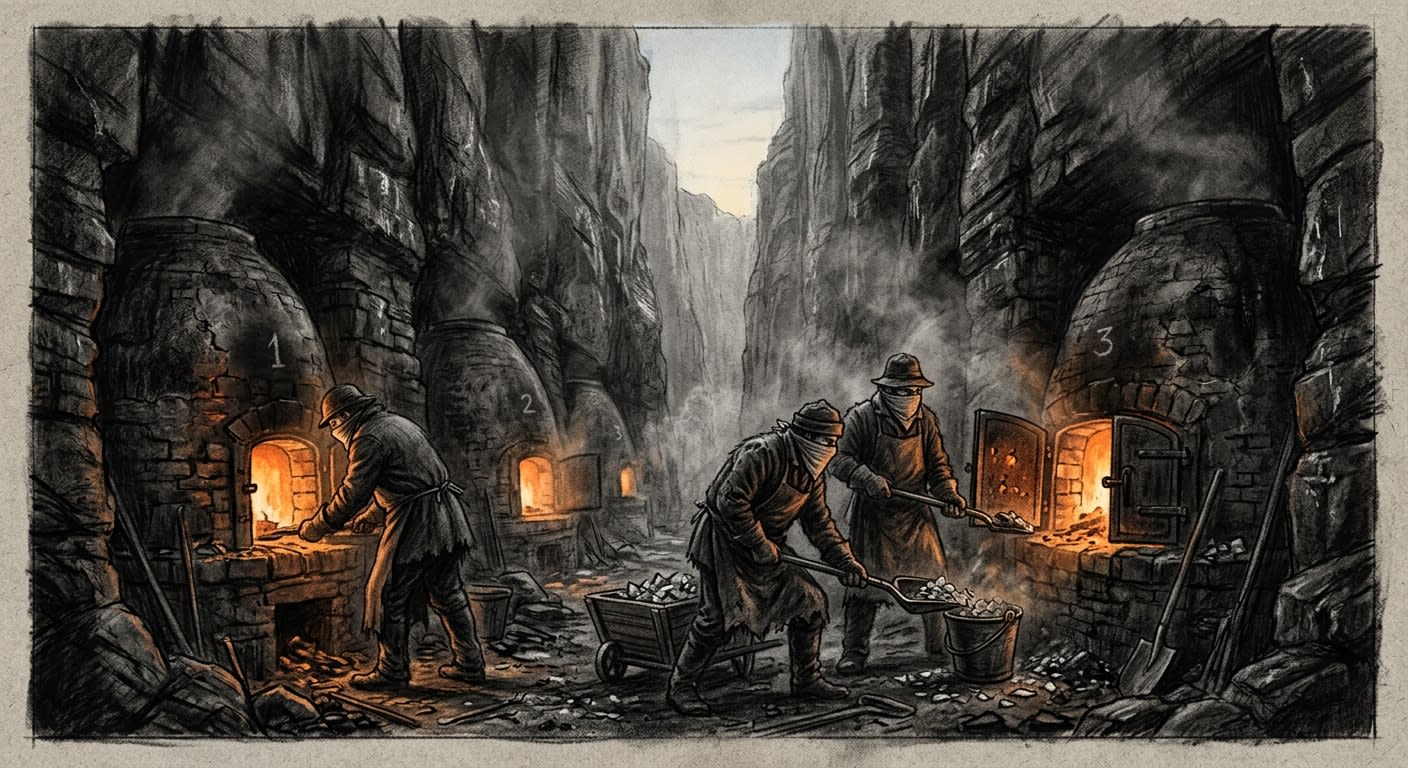
Kiln Row runs along the eastern wall of the cleft, its furnaces fed by tallow and slag-coal hauled up from the lower valleys. Here the raw glass is heated, drawn, and shaped into the panes and lantern globes that travel outward to every shrine, reliquary, and trench-lamp requisition office in the Synod's vast inventory of sanctified illumination. The kilns burn through the night. Kiln Row is exempt from curfew. Its workers sleep in shifts, dream of fire, and develop a particular squint that marks them as permanently half-blinded by their own craft.
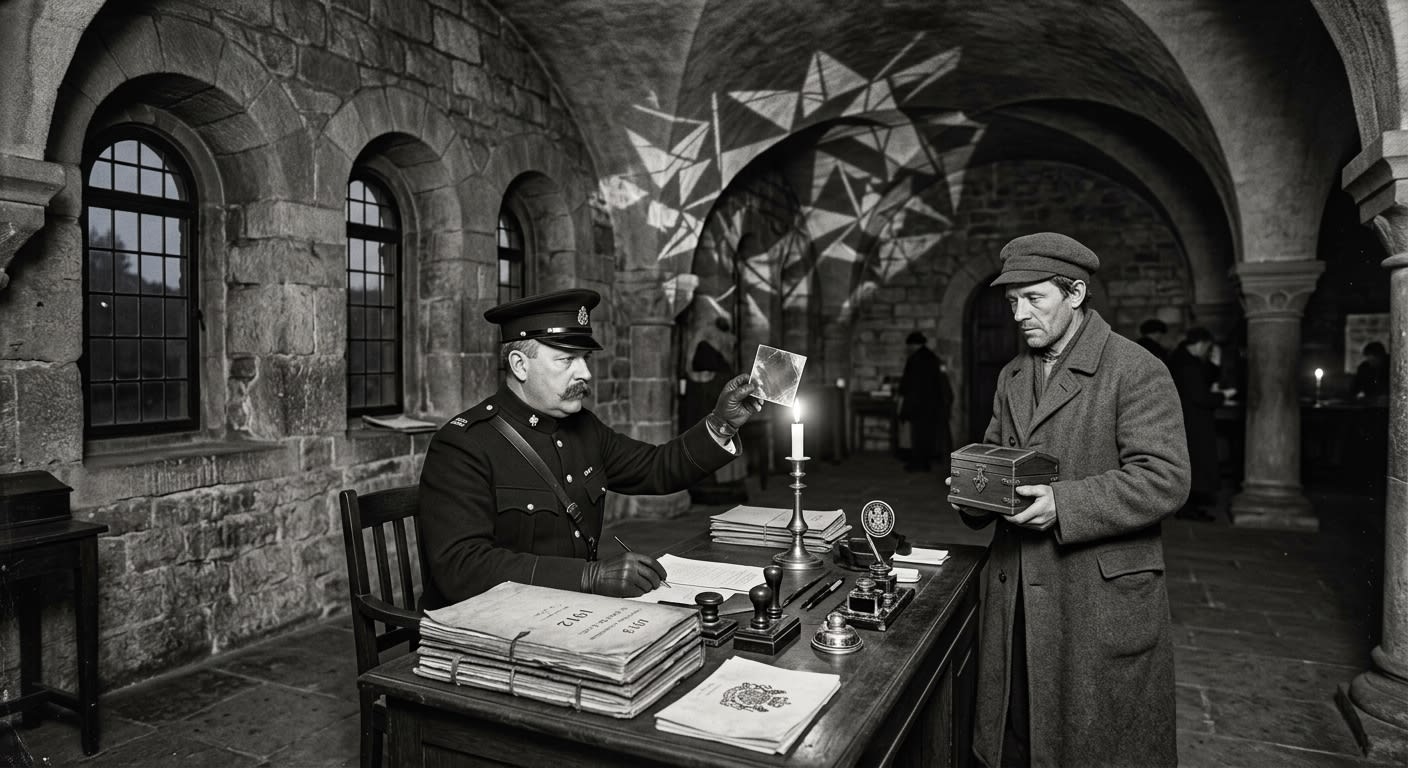
The Seal House occupies a fortified platform midway down the eastern wall. One building. One stamp office. One Verifier-Provost with immaculate white gloves and a wax seal that determines, with the finality of a tribunal, which glass is sacred and which is criminal. Every pane that leaves the quarrytown passes through the Seal House. Every pane that does not pass through the Seal House is, by definition, contraband — regardless of its quality, its provenance, or the number of saints whose light it has faithfully refracted.
The Cut Face itself — the extraction zone — occupies the lower galleries where the glass seams run deepest into the mountain. Work here is done by hymn. Cantors sing sanctioned intervals that regulate the cutting rhythm, steady the resonance of the surrounding rock, and — according to the Bureau — maintain the spiritual integrity of the material being extracted. Silence in the Cut is treated as sabotage. Singing alone is forbidden. Singing wrong is, depending on the severity, punishable by fine, flogging, or the withdrawal of breath-cure allocations.
At the bottom of the cleft, where the spoil-heaps accumulate and the air tastes of grit and iron water, sit the Spoil Gardens — a euphemism for the subsistence plots where the town's poorest residents attempt to grow barley and nettle in grey dust. The soil produces grudgingly. The residents cough generously. The Bureau classifies this district as "self-sustaining."
And threaded through it all, accessible from the Cut Face's lowest galleries, is the Breath Chapel — part infirmary, part confessional, part extortion office. Sister Brethna (Unregistered) and her order dispense resin filters, nettle tinctures, and the thin comfort of recorded prayers for the dying. Cure allocation is tied to confession receipts. The sicker you are, the more you confess. The more you confess, the more the Chapel knows. The more the Chapel knows, the more leverage it holds against the Guild, the Provost, and anyone else whose sins are written in a ledger that smells of resin and boiled herbs.
#On the Economy of Proof
"The mountain gives truth to the faithful." — Official inscription, Seal House lintel
"The mountain gives cough to the poor." — Unofficial response, scratched into the lintel's underside
The economy of Oathglass Quarrytown is, at its base, an economy of certification. The glass itself has value only because the Seal House stamps it. Unstamped glass — identical in composition, clarity, and optical behaviour — is classified as "inert mineral product, unsanctified, possession restricted." Stamped glass is a reliquary component worth more, weight for weight, than silver.
Workers are paid in pane-scrip redeemable at the Guild commissary — a currency that functions precisely as long as one remains employed by the Guild and ceases to function the moment one does not. Cure access at the Breath Chapel requires confession receipts. Confession receipts require attendance. Attendance requires the ability to climb the terraces, which requires lungs that still function, which requires cure access. The circularity is architectural.
The black market operates from the Spoil Gardens and the tunnel mouths, selling black-glass shards, counterfeit stamps of impressive but imperfect quality, and the occasional "proof pane" — a glass sheet calibrated to authenticate any relic placed behind it, regardless of that relic's actual provenance. These are rare, expensive, and the reason the Bureau of Purity dispatches an auditor to Saint-Helm's Cut with the regularity of a seasonal illness.
#On the Singing and What Answers
The Resonant Vein is classified as a Category Two Localized Acoustic-Geological Anomaly by the Bureau of Alchemical Standards and as "the mountain's opinion" by everyone who works the deep galleries.
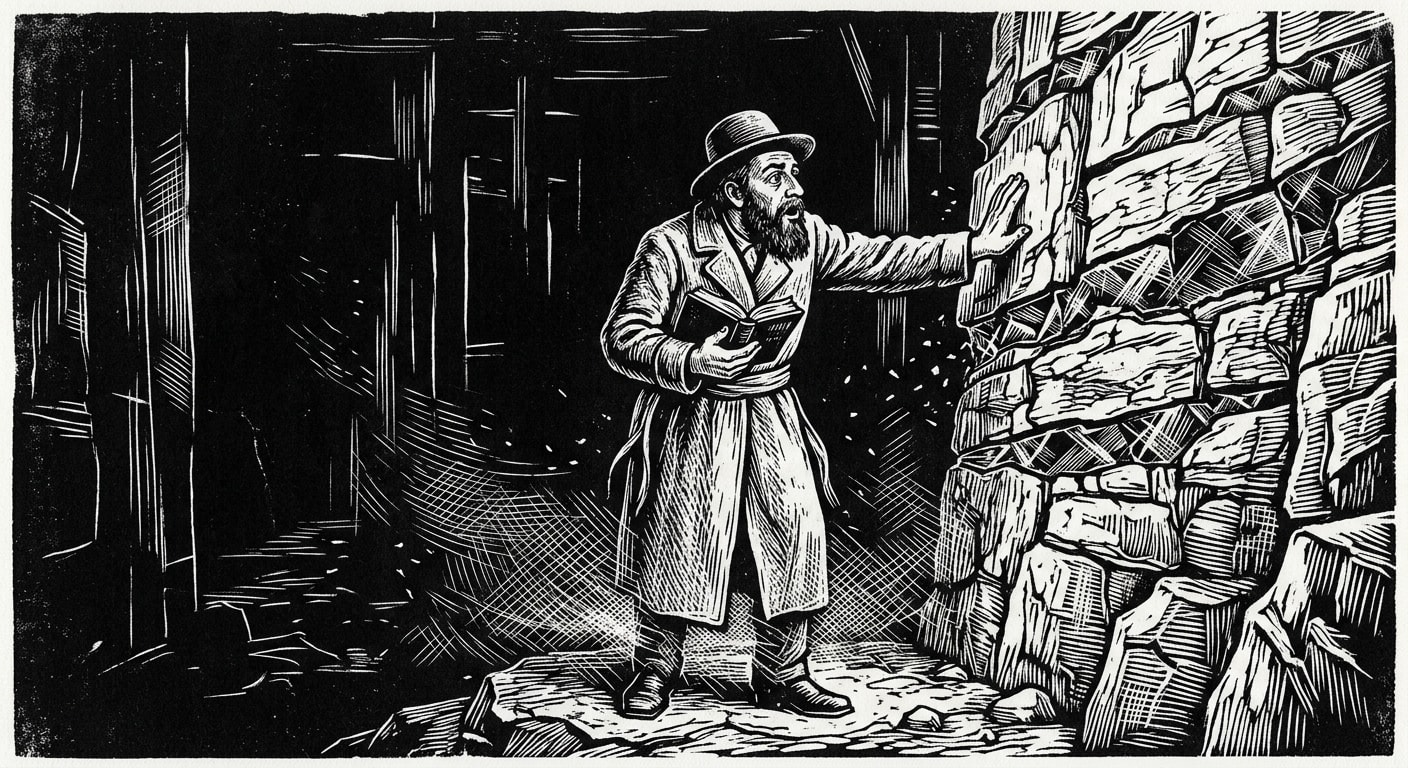
The glass seams that run through Saint-Helm's Cut respond to sound. This is established fact, documented in fourteen Bureau surveys and experienced daily by every cantor, cutter, and shard-hauler who descends below the third gallery level. Sanctioned hymns — specific intervals, specific cadences, approved and transcribed by the Bureau of Bells — stabilize the surrounding rock, reduce fracture propagation in the glass, and permit extraction to proceed without collapse. Wrong intervals produce resonance cascades: hairline cracks spider through the panes, shards fall from the ceiling in patterns the cantors describe as "angry," and on three documented occasions, the gallery walls have produced sounds that multiple witnesses have described as words.
What the Bureau has not documented — or, more precisely, has documented and sealed — is the Vein's second property. The glass responds less to hymns than to names.
[EXCISED — Bureau of Doctrine, Seal Indigo, A.S. 199. The following 14 lines contained a summary of Verifier-Provost Rook's sealed field report on the relationship between specific nomenclature and glass crystallisation patterns. The report has been reclassified. The summary has been removed. The fourteen lines have been replaced with this notice, which is longer than the summary was. This is procedure.]
What can be stated — because the street already knows it, and suppressing common knowledge only advertises its importance — is that certain harmonics produce glass of exceptional clarity. That these harmonics correspond not to approved hymn intervals but to syllabic patterns. That the patterns resemble names. And that the names in question appear on lists maintained by the Bureau of Doctrine for purposes that are, as the reader will appreciate, entirely unrelated.
The Flawless Claimants — a cell of kiln workers, proof brokers, and at least one disaffected cantor operating from backrooms on Kiln Row — believe they have identified the name that produces a perfect pane. A single sheet of glass so clear and so precisely structured that it will authenticate any relic, any reliquary, any sacred object placed behind it. They are hunting it. The Synod Reliquary Office is hunting them. The Guild is hunting both, because a single flawless pane would collapse the certification economy overnight.
#On the Inhabitants and Their Lungs
The people of Oathglass Quarrytown are, as a class, distinguished by three things: resin masks, rattling coughs, and an extraordinary capacity for theological indifference. They make the material that certifies the Synod's miracles, and they know — with the quiet, corrosive certainty of people who have watched sausage made — exactly how much that certification is worth.
Verifier-Provost Maelin Rook governs the Seal House with white gloves and a stamp that she wields with the quiet authority of a woman who understands that she does not merely certify glass. She certifies reality. A pane she stamps is sacred. A pane she refuses is criminal. The same sheet. The same mountain. The same light. The difference is Rook's wrist and a disc of heated wax. She has held this post for eleven years. She has never been observed to touch glass without witnesses present. She has never been observed to smile.
Guildmaster Orr Vetch runs the Pane-Guild compact from a kiln-heated office above the Shard Yards. His laugh sounds like gravel being sorted. His cough sounds like a lantern breaking. He controls tool access, kiln time, and quota allocations — which means he controls who works, who eats, and who descends into the deep galleries where the air tastes of ground glass and the hymns echo twice. Vetch is not cruel. Cruelty requires intention. Vetch is efficient, which requires only arithmetic.
Sister Brethna of the Breath Chapel keeps two ledgers. The public ledger records cure allocations, resin filter distributions, and burial permissions. The private ledger records confessions cross-referenced with names, shifts, and the dates on which certain guild foremen approved overtime in galleries the Bureau had classified as "ventilation-restricted." She has calm eyes and hands that smell of nettle. She has buried six hundred and twelve workers in nine years. She remembers each, because she wrote each into the ledger herself, and the ledger does not forget.
The Choir Wardens patrol the tunnel mouths and hymn towers, enforcing song compliance with a diligence that is partly doctrinal and partly economic. A correctly sung shift runs smoothly. An incorrectly sung shift produces fractures, collapses, and insurance claims that the Guild would prefer to avoid. The Wardens carry throat-cords marking their authority and carry batons for occasions when authority proves insufficient. They are feared in the way that weather is feared — as a force that arrives on schedule and cannot be argued with.
#On the Present Condition
"Breathe shallow. Sing clean." — Oathglass proverb, origin: first cough-registry, A.S. 111
The quarrytown in A.S. 201 operates under three simultaneous pressures, each sufficient to crack it and all three compounding like interest on a debt the borrower cannot read.
The first is demand. The shrine-cities of the Heartlands consume lamp-glass and proof panes at rates that have increased by a third since the establishment of the Bureau of Pilgrimage's expanded reliquary circuit in A.S. 187. The Synod demands higher output. The Guild demands longer shifts. The workers demand resin filters that the Breath Chapel cannot supply because the lower-valley herb convoys have been disrupted by winter closures three seasons running.
ERRATUM — Bureau of Records, Annex Alp-7, filed A.S. 200: Previous production reports listed Oathglass Quarrytown output as "stable and healthy." The Bureau now classifies output as "stable." The word "healthy" has been removed from all prior filings. The workforce remains, by all other metrics, satisfactory.
The second pressure is the rumour of the flawless pane. A sheet of Oathglass of such clarity that it authenticates without discrimination has been sighted — or claimed sighted — in the Shard Yards twice in the last year. Both times it vanished before the Verifier-Provost could inspect it. Both times the worker who reported it was found reassigned to the deep galleries within the week. The Flawless Claimants grow bolder. The Black-Glass Runners grow richer. The Bureau of Purity has dispatched Inquisitor-Lux Thane Mire, a proof specialist whose previous assignment involved the liquidation of three shrine-forgery operations in the Rhineland. Mire is expected before the passes close.
The third pressure is the mountain itself. The Resonant Vein has grown louder. Cantors in the deep galleries report second harmonics where no second voice exists. Panes pulled from the lowest seams have shown hairline text — not cracks arranged like text: text, legible, in a script the Bureau of Doctrine has declined to identify. A sealed gallery below the Helm-Mouth, closed since the first collapse of A.S. 111, has begun producing sound. The Choir Wardens have doubled patrols at the tunnel mouths. The sound continues.
The workers cough. The kilns burn. The stamps fall. The mule trains descend with their straw-packed crates of certified truth, bound for reliquaries in Strasbourg, in Essen, in Candlewick, in shrines and trench-chapels from the Calais coast to the walls of Constantinople. The glass refracts the light. The light proves the relic. The relic justifies the faith. The faith sustains the Synod. The Synod demands more glass.
And somewhere in the deep galleries, below the third level, past the Choir Wardens and the resin filters and the sanctioned hymns that hold the ceiling in place, the mountain is singing a name that nobody is authorised to hear.
ERRATUM — Bureau of Doctrine, Seal Amber, filed A.S. 201: The foregoing entry describes Oathglass Quarrytown as producing material critical to the Synod's reliquary authentication process. The Bureau wishes to clarify that the authentication process is not dependent on any single material source. Faith is verified by faith. Glass is incidental. The quarrytown's continued operation at maximum capacity remains, of course, essential.