
#On the Sacred Machinery of Governance
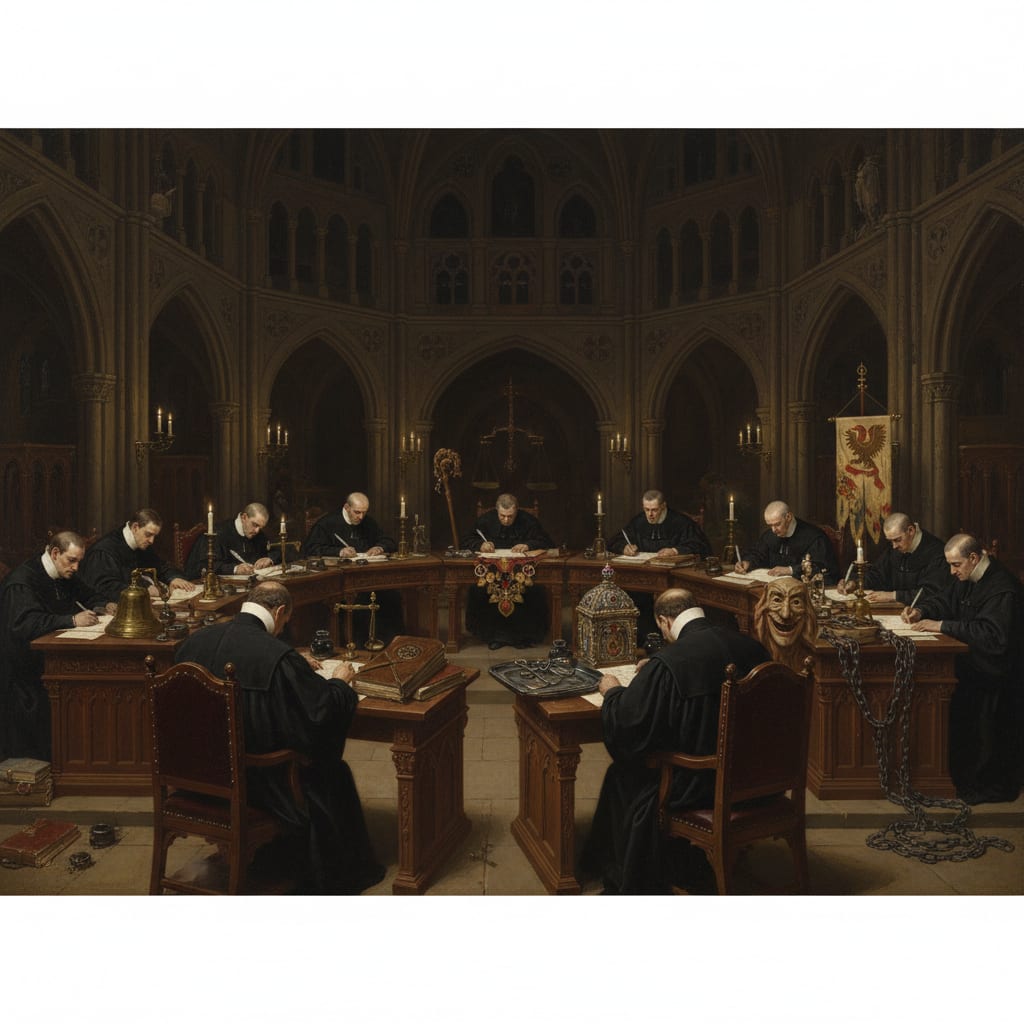
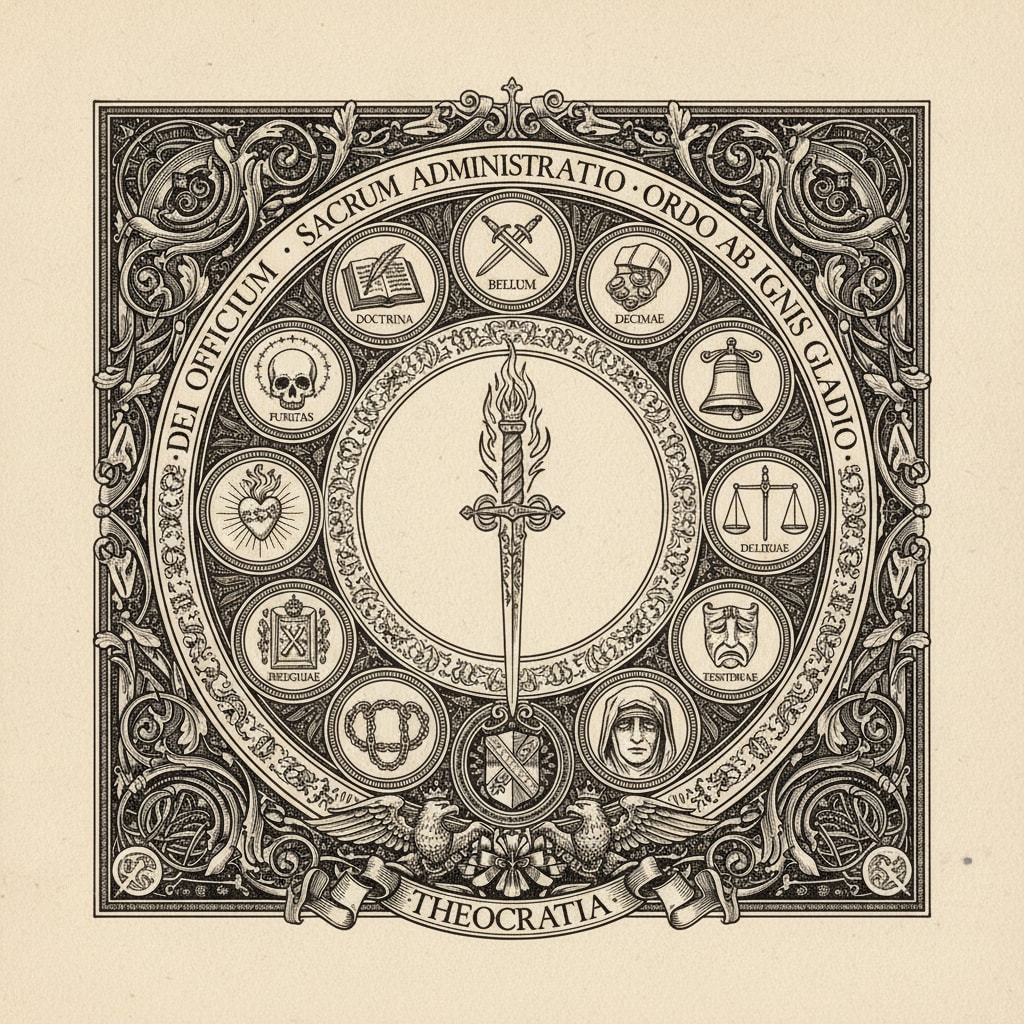
I am Valerius Drax — Hieromnemon, Warden of the Sacred Ledger, and a man who has spent more of his life inside the Bureau of Doctrine than outside it, a circumstance that is either holy dedication or a prison sentence the Synod has dressed in vestments. I write now of the Twelve Holy Bureaus: the organs through which the Synod governs, the mechanisms by which a continent is fed, bled, counted, confessed, armed, and buried in triplicate.
If you have read the entry on the Synod itself, you will understand that the Theocracy is not a government in any common sense. It is an organism — a vast, respiring, ink-stained creature whose blood is paperwork and whose bones are canon law. The Bureaus are its organs. Remove one and the creature lurches. Remove three and it collapses. Remove all twelve and you have not destroyed the Synod; you have merely created a Europe where no one knows what day it is, whose tithe is owed, or whether their baptism counts.
The faithful are taught to revere the Bureaus as instruments of the Creator's providence, though Strasbourg's official count of twelve rests on later charters rather than one founding day. In practice, they are more tangled than any catechism foretold. Jurisdictions overlap. Rivalries fester. Edicts contradict. Doctrine proclaims one teaching while Purity brands it suspicious; Records preserves both rulings in triplicate, stamped with contradictory seals; and War enforces whichever version can muster the most battalions.
Earlier editions of this Codex listed eleven Bureaus.
The current official roll counts twelve. Earlier rolls named fewer offices, and the A.S. 23 claim predates the formal Synod by decades. Functions, interim organs, charters, and later Bureau titles entered the record at different times. The Hieromnemon responsible for compressing them into one anniversary has been posthumously corrected.
Yet this chaos is the Synod's strength — a maze in which no rebel may move unseen and no heretic may speak without crossing a dozen thresholds of judgment. Many a would-be reformer, from the Milanese Deacon Rhaphael in A.S. 19 to the Catalan monk Isidor of Lérida in A.S. 67, has found himself undone not by soldiers, but by clerks with better paperwork.
#The Bureau of Doctrine
"The Flame of Interpretation burns in one chamber only. Ours."
First among equals — and I say this with no bias whatever, as its most distinguished living officer. The Bureau of Doctrine claims the "Flame of Interpretation," which is to say the exclusive right to determine what anything means. From its halls in the Cloister of Concord, robed exegetes issue binding definitions on theology, law, natural philosophy, history, and — when the mood takes them — the permissible colors of autumn foliage. It was Doctrine that condemned the Astronomers of Kraków for "measuring heaven with impious instruments." It was Doctrine that proclaimed the Massacre of Saint-Malo not tragedy but revelation. Every Catechism of the Sundering, every homily mumbled at village shrines, bears its imprimatur.
Dissent is not merely punished; it is unwritten. The Index Claritatis, a rolling compendium of permitted words, is updated weekly, and whole dialects have vanished under its rulings. The fishermen of Gdańsk discovered in A.S. 78 that their word for "doubt" had been stricken; when they petitioned for a replacement, the Bureau granted them silence.
#The Bureau of Purity
"We do not seek heresy. Heresy seeks to avoid us. It fails."
If Doctrine defines truth, Purity enforces it. Later Purity histories trace methods to the Witch-Hunts of Toulouse, but those early hunts were precursors, not acts of a formal Bureau. Purity's Inquisitors, clad in bone-white mantles, wander from city to city armed with writs of cleansing. They maintain the Index Damnatus, whose pages have swollen to encompass forbidden texts, condemned relics, proscribed songs, disapproved flavors of incense, and — in one memorable case in Bruges — a particular shade of blue deemed "insufficiently penitent."
Three generations of stonemasons in Bruges were exiled for carving grotesques deemed heretical in symmetry. The Iron Choir of Mainz — cages suspended from cathedral rafters where heretics are displayed until confession or death — is Purity's proudest invention. Parents whisper obedience into their children's ears with the reminder: "The white cloaks are watching."
#The Bureau of War
"Faith provides the flame, but War bears the sword."
War had command functions during the Retreat, before the formal Synod. The later Siege of Vienna furnished lessons for its standing doctrine; it did not create the Bureau from nothing. Its generals wear crimson sashes interwoven with fragments of pilgrim banners — a custom attributed to Bishop-Warden Clemens Stahlhand, who tore his own surplice to bind a wound during the assault on the Danube crossings and declared the bloodstained cloth "a new insignia of the faithful sword."
The Bureau enforces the Continental Levy each generation: a tenth of every household's sons, conscripted at the age of fifteen, trained in the catechism-barracks of Essen-of-Hymnsteel and Brast, and dispatched to the Sagittal Line before their twentieth year. Each campaign is recorded as miracle as much as strategy. No campaign plan circulates without first being sealed by both Doctrine and Purity — a process that has, on three occasions, delayed offensives long enough for the enemy to reinforce. The Bureau of War does not discuss these occasions. Neither does anyone else, anymore.
#The Bureau of Records
"Nothing is forgotten. Nothing is forgiven. The distinction is administrative."
The obsession of Archon Benedict Veyrault, this Bureau rivals even War in importance — and exceeds it in ink consumption. Records ensures every baptism, tithe, excommunication, and pardon is engraved upon vellum and copied to the subterranean vaults of Strasbourg. Its scribes speak in catalog numbers more readily than in prayers. A scribe of the Bureau of Records, asked his name, will give you his registry number first and his Christian name only upon written request.
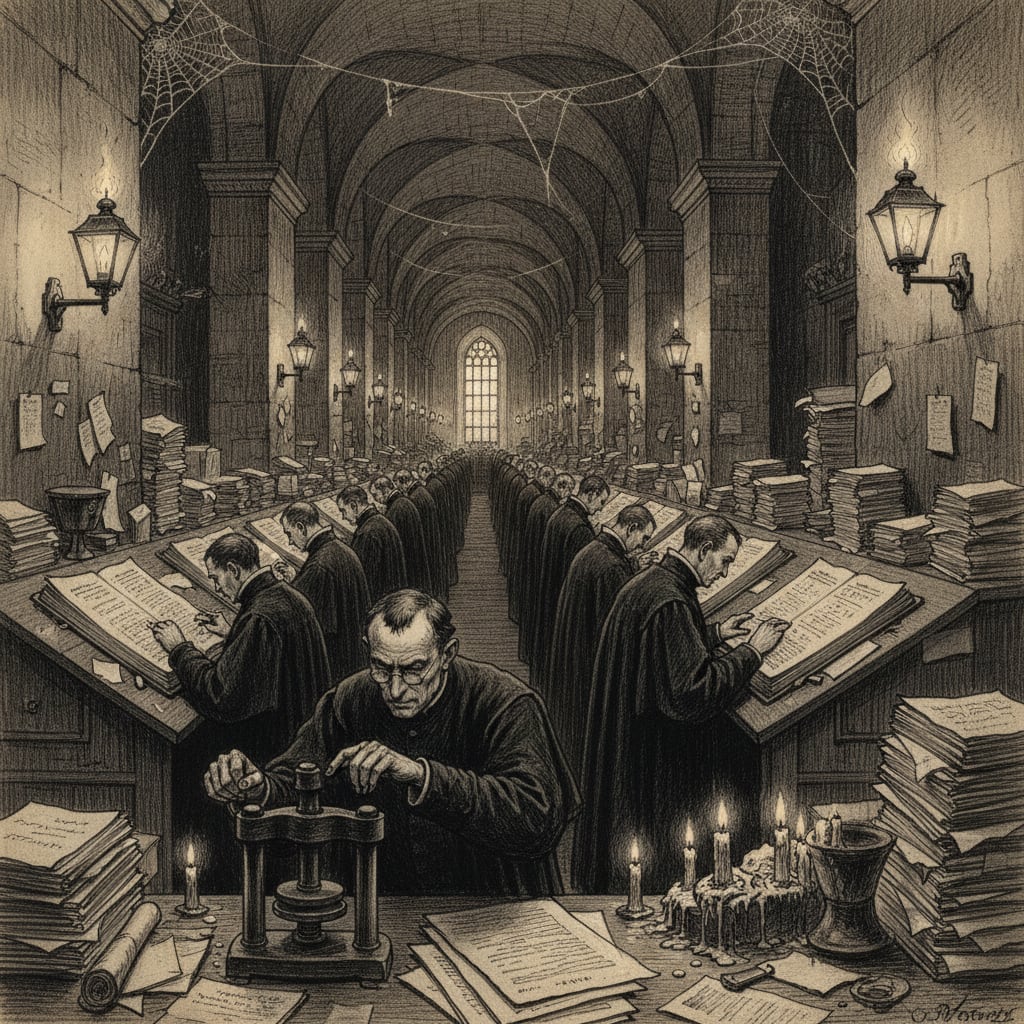
The Bureau's Great Ledger of Souls, stretching unbroken since A.S. 80, purports to list every living adherent by name, birthplace, and confession. Rumors persist of hidden volumes — the Codices Obscurae — recording not only the faithful but every doubt, hesitation, or idle thought whispered to confessors. "Nothing is forgotten" is Records' proud motto. The faithful repeat it with equal parts pride and terror.
#The Bureau of Tithes
"Silver sustains sanctity. Bronze sustains the clerks who sustain sanctity."
The Bureau of Tithes, headquartered in the Palatine Counting House, supervises every coin, harvest, and levy that flows into Strasbourg. It was Tithes that devised the controversial Salt Dues of Marseille. Tithes that levied the Widow's Pennies during the famine of A.S. 65 — a tax on bereavement so precisely calculated that it distinguished between widows of soldiers (exempt), widows of heretics (double rate), and widows of clerks (triple rate, as they should have planned better). Tithes that ensured the golden reliquaries of Aachen were melted into coin during the Panic of Wrath's March.
Its collectors, known as Assessors, travel with scales, ledgers, and armed escorts, preaching that to withhold a tithe is to starve the Synod's soul. Their ledgers, gilded at the corners, are treated as sacred texts. In the villages of the Rhineland, an Assessor's arrival is greeted with the same reverence and dread as a plague doctor's — and with roughly similar outcomes for the household.
#The Bureau of Pilgrimage
"No foot moves toward Strasbourg except under the Bureau's eye."
Formed after the riots of Santiago, the Bureau of Pilgrimage manages the flow of millions who trek yearly to Strasbourg, Lyon, Mainz, and the reliquary cities. It sets routes, issues permits, and licenses the sale of pilgrim tokens — those small stamped discs of tin and brass that every traveler must wear on their person, lest they be arrested as vagrants, heretics, or worse: unregistered pedestrians.
The Bureau's greatest triumph is the Harmonized Routes of A.S. 38, when eight rival pilgrimage guilds were crushed and folded into a single Synodal monopoly. The process was not gentle. Three guild-masters were immured. Two fled to England and were never seen again. The remaining three signed the Harmonization Edict with such enthusiasm that the Bureau awarded them positions — as route inspectors, stationed permanently at the most desolate waypoints the Synod could identify.
#The Bureau of Mercy
"We tend the body that the soul may be tended. Separately. By Purity."
Nominally charitable, in practice merciless — and I say this as a man who has observed its workings and found them efficient, which is the Bureau of Doctrine's word for "terrifying." The Bureau of Mercy oversees orphanages, hospitals, and asylums across Europe. It is here that orphans of apostates are raised in the catechism. Here that plague victims are both treated and quarantined. Here that confessions whispered on deathbeds are "curated" — a word that means collected, transcribed, and forwarded to Records before the body is cold.
Mercy claims Saint Sabina of Ghent, who tended the wounded during the Massacre of Saint-Malo in A.S. 10, as its patron and retrospective founder. The later Bureau inherited her example, not a charter signed in her lifetime. Its critics — carefully silenced — mutter that Mercy is but Purity in softer garb, ensuring no soul escapes the Synod's gaze. Not even at its last breath. Especially not at its last breath.
#The Bureau of Relics
"A relic authenticated is a relic made holy. A relic unauthenticated is kindling."
This Bureau is a labyrinth of vaults, reliquaries, and iron-sealed caskets. It claims guardianship of the Skull of Saint Armand, the Ashes of the Sundering, and the Chains of the Martyrs of Avignon. Every local shrine that wishes to display a relic must apply for an Authenticity Writ — a process that takes, on average, four years, nine separate inspections, and a fee that would purchase a modest farmstead.
Earlier editions of this Codex claimed the Bureau authenticates approximately two hundred relics per annum.
The correct figure is eleven. The remainder are "under review," a status that in several cases has persisted since A.S. 22. The Bureau of Relics does not operate on mortal schedules.
Many a saint's memory has been obliterated when a Bureau examiner declared the bones "unverified." Critics whisper that counterfeit relics vastly outnumber the true, but the Bureau insists upon its axiom — and who is to argue with the custodians of the Skull of Saint Armand? Not I. I have seen what they do to arguers.
#The Bureau of Bells
"When the bells cease, the Age ends."
Constituted in A.S. 52 after the A.S. 49 Miracle of Cologne, when cathedral bells scattered Wrath's Host from the city gates, this Bureau dictates when, how, and in what tones bells may ring across the Synod's territories. The Bell Codex, ratified in A.S. 115 from older practice, prescribes the rhythms by which entire provinces live their days: the Ninefold Matins, the Widow's Toll, the High Angelus, the Iron Vespers, and the dreaded Silentium — the cessation of all bells that signals a breach in the Sagittal Line.
Bell-masters are ordained officers whose authority eclipses that of local clergy. Unauthorized ringing has been punished as heresy — as when the miners of Liège were scourged for sounding work-shifts without Synodal approval. The Bureau maintains that bells are not instruments but sacraments given voice, and that to ring one without sanction is to speak with the tongue of the Great Deceiver himself.
#The Bureau of Heraldry
"An unregistered symbol is a rebellion not yet named."
Symbols are weapons, and this Bureau polices them with a ferocity that would impress the Bureau of Purity, if the Bureau of Purity were capable of being impressed by anyone. Its clerks maintain the Armorial of the Faithful, an immense registry of banners, sigils, seals, and the permitted colors of guild flags. It was Heraldry that banned the crimson boar of Saxony — declared "an emblem of wrath" — and Heraldry that designed the Triune Knot now stamped on every official document from coronation decrees to fish-market receipts.
Any who display unregistered symbols are fined, flogged, or branded. Yet secret signs persist: chalked glyphs in alleyways, sigils scratched into doorframes, muttered emblems of rebellion the Bureau has never fully extinguished. The Archon of Heraldry, Casselius of Mainz, is said to sleep with a magnifying glass and a list of pending executions. Both see frequent use.
#The Bureau of Oaths
"No promise binds unless Strasbourg hears it."
Every sworn word — from coronation vows to guild charters to peasant marriages — passes through this Bureau's sanction. Its Ledgers of Fidelity contain the signatures of emperors and shepherds alike, all bound under Strasbourg's seal. It was the Bureau of Oaths that annulled the League of Milan in A.S. 7, dissolving an alliance of Lombard cities with a single stamp and a five-page writ that took three years to draft and six hours to enforce.
Its officers, known as Witnessers, are dispatched to every public oath-taking, standing silent and watchful with their lead tablets. In the countryside, their presence is so pervasive that no betrothal, no land sale, no guild apprenticeship proceeds without a Witnesser in attendance. A marriage unwitnessed is a marriage void. A contract unwitnessed is fraud. An oath unwitnessed is — in theory — merely breath, and breath, as the Bureau reminds us, is not legally binding.
#The Bureau of Festivals
"Joy is a sacrament. Unsanctioned joy is an insurgency."
This Bureau decrees which days may be celebrated, which costumes worn, and which plays performed. After the Tumults of Lyon, it outlawed Carnival masks in three provinces. After the Heresy of Siena, it mandated that all harvest dances end with a reading from the Catechism. Its greatest invention is the Procession of the Triune Hearth, a vast pan-European pageant staged every tenth year, where bishops ride warhorses in armor and peasants march in chains to dramatize sin.
The Bureau employs an army of Chorus-Masters, Pageant Captains, and Attendance Auditors who ensure that celebrations achieve the prescribed minimum of zeal without exceeding the prescribed maximum of enjoyment. Many whisper that without the Bureau of Festivals, rebellion would have consumed the Synod long ago — not because the festivals breed loyalty, but because the paperwork required to attend one leaves no energy for insurrection.
#The Bureau of Shadows
"This Bureau does not exist. You did not read this. Return to your duties."
The Bureau of Shadows ████████████████ reports directly to the High Synod ████████████ invisible knife ████████████████ faceless operatives known as Custodians ████████████████ veils of black gauze ████████████████ disappearance of scholars in Padua ████████████ masked patrols on Strasbourg's midnight bridges ████████████████████ silent wagons leaving Lübeck in the Year of Smoke.
This Bureau officially does not exist. The Synod has issued fourteen separate decrees confirming its nonexistence, which is — one might observe — a great deal of paperwork for something that isn't there. Yet everyone knows its hand. Children whisper of its operatives as bogeymen. Rebels know them as death itself. The Custodians, faceless men in veils of black gauze, move through the night cities of Europe with writs that bear no seal, performing services that bear no name, and filing reports that are read once and burned.
#On the Unity of Confusion
Taken together, these twelve Bureaus — thirteen, if you count the one that does not exist, which you should not, officially, though you would be a fool not to — form a monstrous organism. They overlap, duplicate, contradict, and feed upon each other. The Bureau of Doctrine declares a truth; the Bureau of Purity enforces it; the Bureau of Records files it; the Bureau of Tithes taxes it; the Bureau of War defends it; and the Bureau of Shadows ensures that anyone who questions the process is no longer available to question anything.
The propaganda insists: "Multiplicity is Providence; confusion is Unity; the many voices of the Bureaus speak with one tongue." In truth, even Archons cannot always distinguish one Bureau's writ from another's. But this is by design. A maze so dense that only Strasbourg's High Synod claims to know its center.
I, Drax, know the center. It is a desk. Mine. With a very good inkwell.