

#On the Lower Registry
"Turn by turn, the faithful arrive." — Inscription above the Turn of Saint Odrin, dated by the Registry to A.S. 81
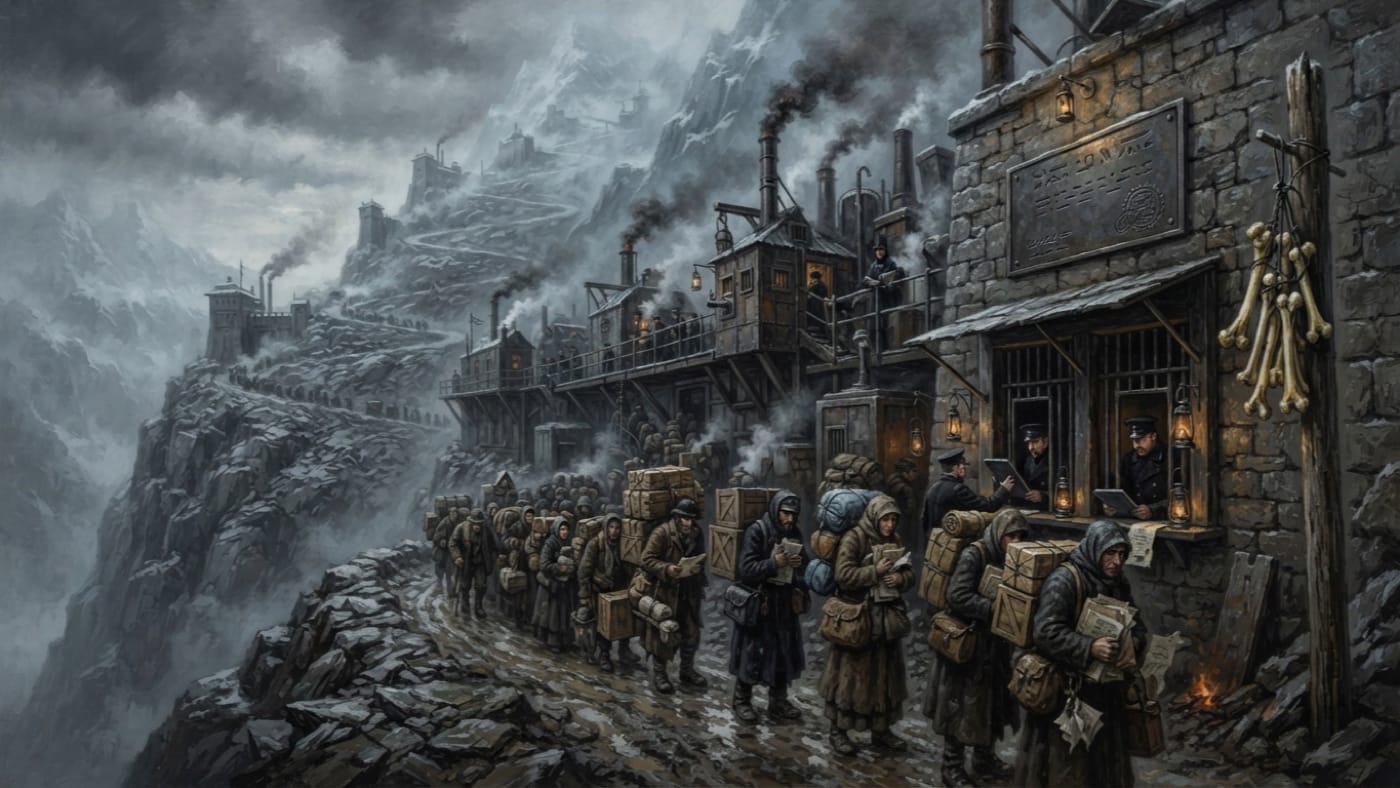
The caravan road comes up out of the basin, crosses a last stretch of cold shale, and stops at a booth. That booth is the Turn of Saint Odrin. It is the first of the eight districts of the Reliquary Switchbacks, and it is the one district no traveller can skip by bribing a warden or by walking faster. Above it the corridor climbs toward the Marrow Market and, eventually, the Summit Gate Reliquary. Below it is the world, which has no paperwork and therefore, in the opinion of the Relic Registry Office, no standing.
The district smells of ink and wet wool. The ink belongs to the clerks. The wool belongs to the queue: porters, pilgrims, mule-drivers and relic factors, standing in the damp with their papers held against their chests the way other men hold a crucifix-less cross. Slate tablets clatter at the working window. Wax softens over a small flame and hardens under a stamp. A femur marker, nailed into the shale beside the road, creaks when the wind comes down off the turns above, and the wind carries tallow smoke from further up the mountain.
Every crate, mule-load and pilgrim arriving at the Turn arrives as a claim. The Turn's business is to send each one uphill as a document, or not at all.
#On Odrin's Name
The district takes its name from a dead man about whom the Church knows exactly one thing: his service tag survived.
In A.S. 76 (1786 CE), two years after the old shepherd track was widened for relic traffic, an avalanche came down on the corridor. It killed forty-seven porters and fourteen mules. The remains of seventeen people were recovered. Their femurs were driven into the rock at the turn where they died, and the records office of the day, whose acts the Bureau of Records now files under its own name, declared them martyrs of supply. That designation required no miracle and no theological review, only a notary.
The turn needed a name. The clerks went through the tags, picked the most legible name on the most intact one, and wrote it down. That name was Odrin.
Of Odrin himself there is nothing. The Ledger records no birthplace, no surname, no feast day, no confessor and no relic beyond the femurs. It does not even say whether the marker standing at the Turn today is one of the original seventeen. Whether he prayed, swore, cheated at dice or carried his load with perfect patience, the record is silent. The Registry made him a saint because he was readable, and the Synod has canonised men on worse evidence and dressed it up as better.
#On Passage and Confession
By A.S. 82 (1792 CE) every turn on the corridor had a name, a femur and a toll. Ten years later, in A.S. 92 (1802 CE), the Relic Registry Office put the arrangement into law. Since then, anyone carrying relics past the Turn of Saint Odrin has needed two instruments: a stamped Turn License and a Relic Handling Certificate. The License shows that the Registry knows who you are. The Certificate shows that it knows what you carry. Neither shows that the Registry believes you. Belief is collected separately, one turn at a time, in confession.
A licensed traveller confesses at each of the eight shrine stations on the climb, and the Turn is where the habit starts. The clerk writes the confession on slate. A copyist later transfers the slate to paper. The paper goes down into the sub-archive beneath Odrin's Turn, and the slate is wiped for the next sinner. The arrangement is efficient. Each statement exists twice, briefly, and then once more, permanently, underground.
No one has inventoried the sub-archive since A.S. 140 (1850 CE). The Registry's account is that the clerk sent to do the work went into a crawlspace and was not seen again. His replacement was promoted for establishing that the crawlspace did not, officially, exist. I record this as the Registry tells it. The clerk's fate has never been determined, and the Ledger lists the crawlspace under no heading at all.
A Registry stamp at the Turn of Saint Odrin guarantees the bearer's passage to the Summit Gate.
The stamp licenses the bearer to begin the climb. It does not compel the Shrine-Court to admit him, the Porter Guild to carry for him, the weather to permit him, or the remaining seven stations to accept his confessions as sufficient.
Then there are Martyr-Credits. These are devotional favours backed by the Registry, and they spare the bearer certain scrutinies on the climb. The Registry denies that they can be bought. They are bought daily. A credit can shorten a delay at the booth. It does not open every lock, it does not protect the bearer from a warden, and it has never yet persuaded the wind.
On the Switchbacks, delay costs more than time. When the Summit Gate seals for winter, debts fall due on the slopes above, and a man still standing in the queue with a disputed certificate learns that paperwork can freeze him to death as surely as a whiteout.
#On the Registrar's Authority
Registrar-Mother Elske Vane keeps her office at the Turn. She holds the licensing stamps and the authenticity stamps, and with them the power to say what a bone is, which on the Switchbacks means saying whether it may exist. She speaks softly. Her paperwork contains no errors.
Her authority ends at paper, and paper does not lift a crate.
Above the Turn, Warden-Captain Bronn commands the Shrine-Court of Seven Nails. In A.S. 178 (1888 CE) the Court received a dispensation allowing summary punishment, with no Registry appeal, for offences classed as relic-adjacent, and that class has grown at every review since. Vane can license a traveller, and Bronn can still punish him. The two powers sit on different turns, and both of them bind.
Then there is Porter-Master Jaro "Knot" Ilwyn of the Porter Guild. No crate moves uphill without a porter, and no porter works without a knot-mark card. A fully licensed relic with a perfect certificate and a credit-smoothed queue will sit beside the booth until the Guild assigns a back to carry it.
The Turn decides whether a cargo may go up. The Court decides whether it gets through. The Guild decides whether anyone will carry it.
#On Names Entered After Storms
The Name-Drift was classified in A.S. 199 (1909 CE). That is the date of the classification. When the phenomenon began is another question, and the Registry has declined to answer it.
In heavy storms the wind over the Switchbacks carries syllables, and some of those syllables are names that appear on no martyr list. The femur markers vibrate. Ink bleeds on slate in shapes the clerks can read and cannot source. When the storm passes, the Registry enters the name retroactively and supplies it with a ledger entry, a marker and a toll. The Registrar's stamps sit at the Turn, so every name that comes down out of the weather passes through the district at the bottom of the mountain before it can be charged for at the top.
The Blank Saints say these names are fabricated. They claim the martyr list is manufactured to create new toll-turns, and that the storms are exploited, or engineered, to give each new invoice a saint. They forge slates and swap turn-names to make their argument. The Bureau of Purity has audited the Registry and found its records in order. Whether the weather is being used or made has not been established by anyone with the authority to establish it, and the people with that authority have not tried.
A new toll-turn does not lengthen the road. The corridor has eight districts, and the survey still counts eight. What grows is the toll schedule.
#On the Present Queue
As of A.S. 201 (1911 CE), the Bureau of War rates the Reliquary Switchbacks Amber. The rating covers the whole corridor. The Turn holds no separate certification, and it needs none, because nothing on the mountain moves until the Turn has stamped it.
The queue still forms each morning on the cold shale below the booth. Bodies and paperwork arrive from feeder routes such as the Queue Road, each in its own state of disorder. The clerks still copy slate to paper, the paper still goes down into an archive no one has counted in sixty-one years, and the femur at the roadside still creaks whenever the wind comes down from the turns above, which have more names this year than they had last year.
Saint Odrin's piety remains unrecorded. His name is stamped on every licence that leaves the booth.
The Turn of Saint Odrin honours the memory of a holy man.
The Turn honours a legible service tag. The Registry has never claimed more than that, and it has charged a toll on that claim since A.S. 82.