

#On the Office and Its Mandate
"Each turn honours sacrifice." — formula of the Relic Registry Office
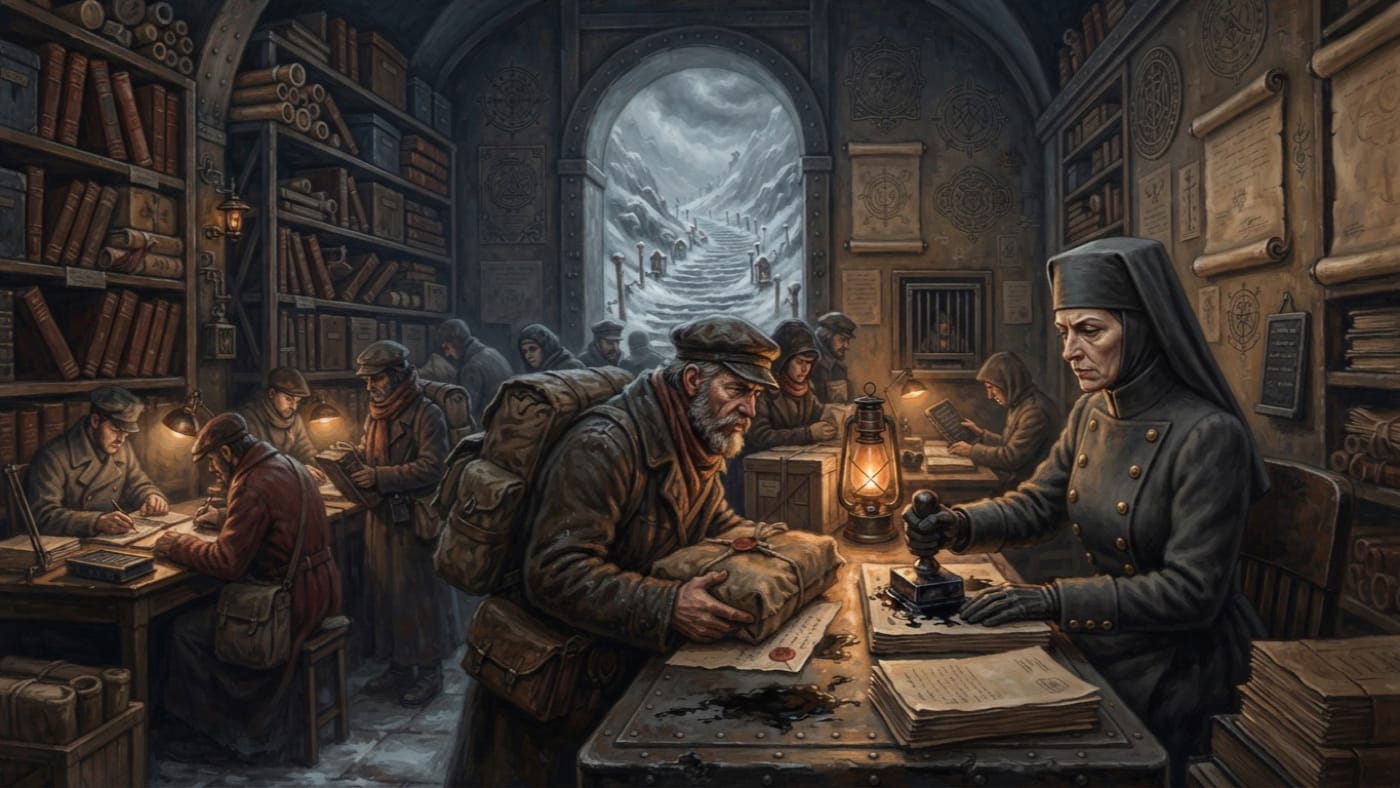
The Relic Registry Office keeps its desk at the Turn of Saint Odrin, at the foot of the Reliquary Switchbacks. The booth is bone-lime mortar and cold stone, and it smells of ink vinegar and wet wool. Anyone who wishes to carry up the mountain something holier than their own soul must stand in front of it first. The mountain is four miles of shale. The Office is a counter. The counter is the harder climb.
Its formal style is the Synod Relic Registry Office. Its public mandate, which a clerk will recite through the grille whether or not you ask, is to authenticate relics and protect pilgrims. Its jurisdiction runs from the Turn of Saint Odrin to the Summit Gate. Across those eight districts it governs every sheet of paper and owns none of the rock. It works through stamps, audits and confiscation. Its resources are clerks, seals, and the standing right to send word to inquisitorial authorities when a stamp alone has failed to persuade. Custody of holy remains across the whole setting belongs to the Bureau of Relics. The Office is a local Synodal office of narrower ambition and sharper elbows. I have asked to whom exactly it reports, and I was thanked warmly for asking.
Registrar-Mother Elske Vane holds the licences and the authenticity stamps. She is soft-spoken. On the mountain she is said never to be wrong on paper, and the Office's records support that reputation completely, as records will when the person under assessment is the person who keeps them.
#On Licences, Witnesses, and the Record
The paperwork is older than the seal that now governs it. In A.S. 74 the road was widened under the wartime Church authorities who came sixteen years before the formal Synod. In A.S. 76, after the avalanche on what was then called the Third Turn, the first femur was driven into the shale. By A.S. 82 every turn carried a name, a marker and a toll. The Office's own registers do not say when it was installed over this arrangement. By A.S. 92 it had formalised licensing for relic passage, and from that year the mountain had a procedure.
The procedure requires two instruments, a stamped Turn License and a Relic Handling Certificate. Clerks at neighbouring desks have told me, with equal confidence, opposite things about which one belongs to the traveller, which to the crate and which to the handler. Both answers were stamped. What is settled is this: both are required, both are issued below, and without either one the climb ends at Saint Odrin.
Then come the confessions, one at each of the eight shrine stations. The pilgrim speaks through a hatch in the shrine wall and a clerk takes the statement down on slate. The slate is copied to paper, and the paper goes down to the sub-archive beneath the Turn of Saint Odrin. So a pilgrim's sins travel downhill while the pilgrim travels up, and the Office keeps the half that cannot answer back.
Nobody has inventoried the sub-archive since A.S. 140. The Office explains this with a story about a clerk, a crawlspace, and the promotion of the man who determined that the crawlspace did not officially exist. I give the story as the Office gives it, and I have not improved it.
The Office's paper should be read with care. A stamp is permission. A certificate is the Office's statement that someone was licensed to handle a thing. Neither is evidence of where a bone came from. Both are accepted as such every day across the Zone 3/4 supply interface, by quartermasters who have never seen the mountain and do not want to. The Office knows the difference perfectly well, since the Office made it.
The Office's catalogue goes further than those two instruments. A Storm Passage Addendum governs travel in weather. The Summit Gate Seal is applied at the top, and every party on the mountain that has tried to buy the master seal reports that it is not for sale. The Porter Knot-Mark Card belongs to the Porter Guild, and no Registry clerk issues one, however much he might enjoy doing so. What the Office forbids is plainer. It forbids unregistered relics, unnamed bones, forged turn-marks and counterfeit martyr lists. It forbids sealed letters that lack a Registry mark. It forbids plague cargo that has no snow-quarantine seal. A confiscated item is entered in the record, and the record is kept by the Office.
#On Devotion and Revenue
The Office collects relic handling fees. The Bureau of Tithes counts them, approves of them, and asks whether there might be more.
Then there are Martyr-Credits. These are favours backed by the Registry, and they show that the bearer has contributed enough to the martyrological record to be excused certain scrutinies. They can be bought. The Registry says publicly that they cannot. On the Switchbacks both of these statements are true at the same counter on the same morning, and the clerk will stamp whichever you need. A martyr-credit is a smaller thing than its buyers hope. It is not a passage permit. It gives no general immunity before the law. The wind does not consult it. No quantity of them will buy the summit master seal. What it buys is a shorter interview, and on this mountain that is worth a great deal.
It is worth a great deal because an interview costs daylight, and daylight at altitude costs heat. While a pilgrim waits for an inspection the fire gets lower, and a porter's wages go unpaid. Down at the Switchback Inns the bunks are auctioned, and winter debts turn into porter conscription or shrine service. The Office collects none of these debts. It only supplies the hours in which they are run up.
The Office does not rule the mountain alone. It rules the paper. Warden-Captain Bronn commands the Shrine-Court of Seven Nails and carries the seven nail-keys to the locks of the Hanging Mile. Porter-Master Jaro "Knot" Ilwyn holds the Porter Guild, and with it every back that bends under a crate.
The Registrar-Mother's stamp is honoured at every lock and in every judgment between Saint Odrin and the Summit Gate.
The stamp is honoured at every desk. The seven locks of the Hanging Mile answer to Warden-Captain Bronn's nail-keys. Under the dispensation granted after the Counterfeit Crisis of A.S. 178, the Shrine-Court's summary judgments for offences classed as relic-adjacent stand without Registry appeal. And no stamp yet made has persuaded a porter to lift a crate that the Guild has not given him. The Bureau of Doctrine regrets the enthusiasm of the struck sentence.
#On Names Entered After Storms
In A.S. 199 the Office classified the Name-Drift. To classify a thing is to acknowledge it. It does not establish when the thing began, and the Office has never claimed otherwise, because the Office has never been asked in writing.
The reports are consistent. In heavy whiteout the wind carries syllables. The femur markers vibrate. Ink bleeds on the confession slates in shapes the clerks can read but cannot trace to any source. The Bureau of Alchemical Standards puts the syllables down to air forced through shrine spires and femur-hollows. Its explanation does not account for names missing from the martyr list, and it says nothing about the ink.
The Registry's procedure after a storm has the clarity of a ledger. A name that no register holds arrives on the wind. When the weather clears, the Office enters it, a marker follows, and so does a toll. The storm supplies the name, and the Office supplies everything that makes the name payable. Where on the mountain each new charge falls, the records in my hands do not say. They also contain no ninth district and no new road, and if the mountain has grown, the Office has not been told.
The Blank Saints say the Registry invents the names. They support this with stolen seals, forged slates, and a knowledge of storms that makes the wardens uneasy, and they have done enough harm to the Office's paper to be taken seriously and hunted. The Bureau of Purity sent auditors. The auditors found the Registry's records in order and condemned the Blank Saints' theology. In A.S. 200 the Office certified the integrity of its martyrology, and the Bureau of Records at Strasbourg countersigned the certificate.
The Registrar-Mother's own report on the Drift is said to be conclusive. It is also classified. I have seen the outside of the folder, which is grey and was closed.
#On Present Administration
In A.S. 201 the Bureau of War Logistics Command rates the corridor Amber. Relic traffic moves. The storms are getting worse. The Shrine-Court grows harsher, and every fine on the Silent Steps sends another file down to Saint Odrin. Under the Hanging Mile the smugglers of the Quiet Turn carry what the Office has not licensed, and they do it unwitnessed, which is the one offence the Office cannot stamp. The porters are restless and they count debts out loud, though never on the Silent Steps.
At the lower registry the queue forms at dawn, as it always has. A clerk wets his slate. The Registrar-Mother lifts her stamp, checks the ink, and brings it down.