

#On the Court's Office
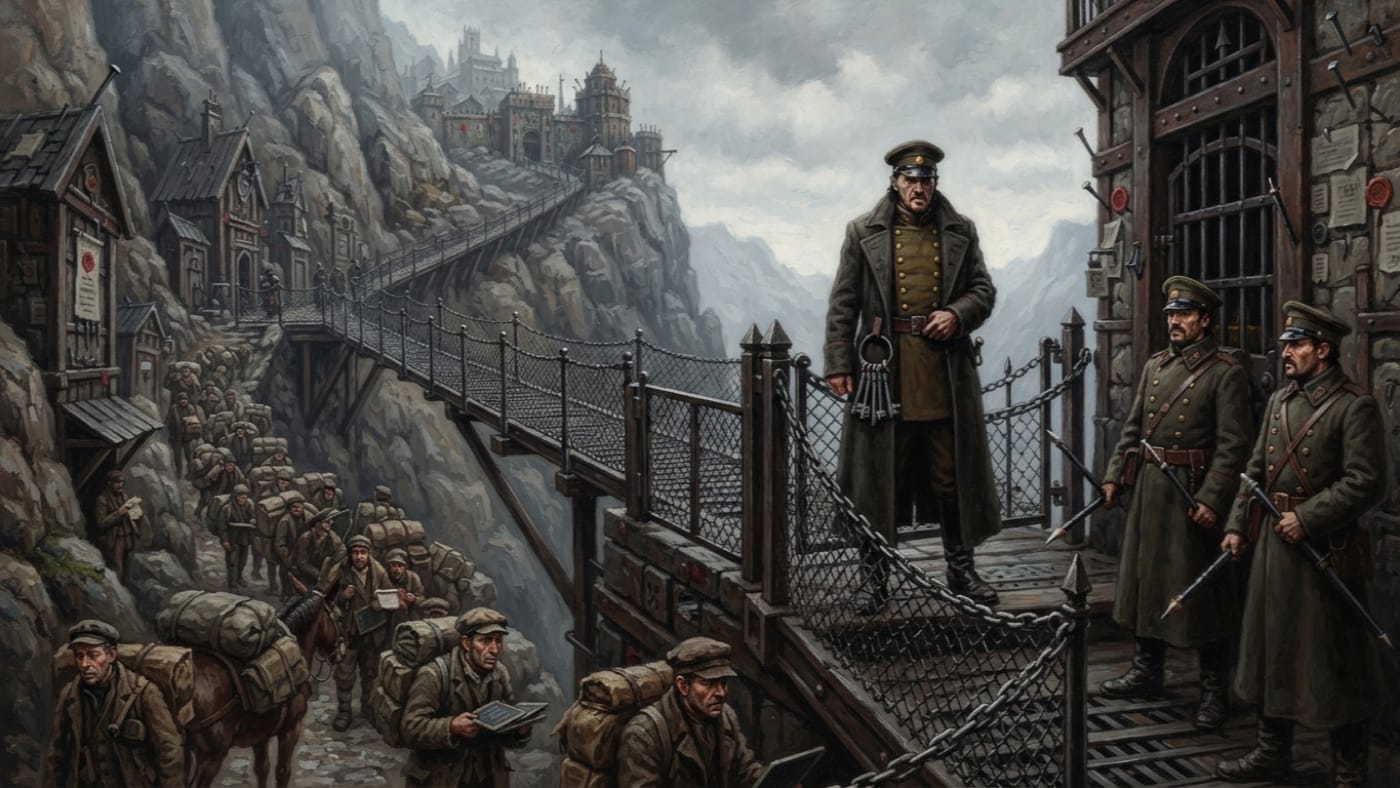
The Reliquary Switchbacks climb two thousand feet in four miles, and about halfway up, the mountain acquires a judiciary. The Shrine-Court of Seven Nails holds the fourth of the corridor's eight districts, above the Porter Yards and below the Switchback Inns. Every porter who signed a debt below and every pilgrim who hopes to buy a bunk above must therefore pass through the hands of the law. The district smells of hot wax and cold iron. The wax seals. The iron does the rest.
Its public mandate is order and purity on a relic route. The Court discharges it with an inventory a bastion would envy: wardens, cells, collars, the power to revoke a licence, and a ring of seven keys. As far as any document fixes its ground, its territory is the Seven Nails turn and the Hanging Mile. Its reach runs wherever a warden can walk, and on a corridor with one road, that is everywhere. A tribunal in a city competes with the streets. A tribunal on a cliff owns the only one.
The survey states its practical objectives plainly, so I shall too. It extracts confessions and breaks heresy cells. That these aims match order and purity so neatly is the kind of convergence the Bureau of Doctrine calls providential and the porters call Tuesday.
#On the Dispensation
In the ordinary course, the Court answers to the Relic Registry Office. The Registry's charter governs relic passage on the Switchbacks, and its passage licensing was formalised in A.S. 92. The ordinary course ended in A.S. 178. After the Counterfeit Crisis, a wave of false relics whose beginning and duration the files decline to fix, the Court received a special dispensation. It permits summary punishment, without Registry appeal, for any offence classified as relic-adjacent.
The phrase deserves the reader's attention, because it has certainly had the Court's. One presumes a relic-adjacent offence was once an offence against a relic. The category has grown at every annual review since ratification. It now covers speech violations, unlicensed songs, the mispronunciation of a martyr's name, insufficient donation at a shrine, and the carrying of untagged bones. It also covers "demeanour inconsistent with the sanctity of the corridor," which Warden-Captain Bronn defines at his discretion, on the day.
Summary punishment means what it says. The sentence follows the finding as the seal follows the wax. The Registry might once have reviewed the matter at the Turn of Saint Odrin. It is no longer asked. The Court did not seize this power. The proper offices granted it, ratified it, renewed it and enlarged it, each in the proper order. I have read the instrument, and it is in order.
The Codex's survey of the Reliquary Switchbacks once described the Shrine-Court of Seven Nails as a "judicial body operating under the standard Relic Registry charter."
The Court's authority over relic-adjacent offences comes from the special dispensation of A.S. 178, which removes Registry appeal. The Registry charter still governs the licences the Court enforces. The two instruments differ, and the difference is measured in cells.
#On the Wardens and the Seven Keys
Warden-Captain Bronn commands the Court. His record is short, and most of it is iron. He carries seven nail-keys on an iron ring at his belt. He hates laughter. The survey adds that he fears panic in a crowd on the Hanging Mile. On a catwalk three feet wide, that is less a phobia than a professional assessment. The files give no age, no origin and no year of appointment, and they give even less on why he hates laughter. I decline to supply a reason. The Court would fine me for the speculation, and it would be right.
His wardens patrol the turns with nail-batons. These are short iron rods tipped with the shale-nails that pin the femur markers into the rock. In A.S. 94 the Bureau of Doctrine certified the baton as a "pastoral correction instrument," and pastoral correction is what it delivers, to the ribs of anyone whose demeanour has been found inconsistent. Behind the batons stand the Court's other sanctions: the cells of the fourth district, the collars, licence revocation and public nailing. All of it is done in public, because a lesson nobody witnesses at altitude is a lesson wasted.
The keys are the Court's true seal. The Mile's chain rail is locked at seven points, and Bronn may close sections during storms, audits and purity seasons. A traveller may carry a stamped Turn License, a Relic Handling Certificate and a clean confession slate, and still stand before a locked section with all three in his satchel. His papers give him the right to pass. The key decides whether he passes today.
A closed section produces a queue, and at altitude a queue costs money. Porters earn nothing while their loads stand still. The mules go on eating. The line backs down past the Cairnfield Terrace toward the Inns, where bunks are auctioned by body-heat contribution and the price of a warm corner climbs with every hour of delay. Every hour the key stays on the ring is an hour of debt that somebody else carries.
The seven keys open seven locks and nothing more. The Summit Gate's master seal hangs on no warden's belt. Bronn cannot close the whole mountain. He can close the part of it that hangs.
#On the Silent Steps
"Which turn eats the loud?" — "The Silent Steps." — Switchbacks catechism, popular form
Between the fourth turn and the fifth runs a stretch of path where speech is fined. Its stated purpose is devotional silence. Wardens stand behind the shrine walls along the segment and listen, and what they hear is written down.
The documented example shows the method in its plainest form. A man coughs on the Silent Steps. A cough is sound, sound counts as speech, and speech is fined. He protests the fine, as he is entitled to. His protest requires a spoken statement. The spoken statement earns a second fine, the second fine requires a further confession, and the confession is entered. By the end of the proceedings, the Bureau of Records holds a file on a man whose only voluntary sound on the mountain was a cough.
A reader trained in canon procedure will say such a matter belongs before the Registry. It cannot go there. The dispensation removed Registry appeal from relic-adjacent matters, and under the annual review, speech on the Steps is relic-adjacent. What the cougher has left is a spoken complaint to the Court, made in the one district where speaking is evidence. Bronn calls this procedural efficiency. I find no error in the description.
Song is a separate offence. Unlicensed singing stands on the Court's list in its own right and is pursued on the Hanging Mile. There, an unlicensed hymn is an offence committed where there is no room to arrest anyone gently. The ban on speech belongs to the Steps alone.
#On the Other Authorities
Three authorities hold the corridor, and none of them holds all of it. Registrar-Mother Elske Vane issues the licences and authenticity stamps at the Turn of Saint Odrin. Porter-Master Jaro "Knot" Ilwyn assigns the Porter Guild's labour and mules from the Yards. Bronn holds punishment and the catwalk. A relic can be authentic on Vane's paper and still sit at the bottom of the mountain for want of Ilwyn's porters. It can have porters and paper and still wait at a lock. The Court enforces licences it does not write, and it revokes what the Registry granted. It cannot carry a crate. When the Guild threatens to strike, the Court's keys guard an empty catwalk.
Enforcement fails wherever the traffic leaves the road. The Quiet Turn moves relics, fugitives and contraband beneath the Hanging Mile and along hidden routes, using bribed wardens, forged marks and false martyr-credits. That some wardens take money is established. No document known to me says the Captain does. Nobody knows who leads the Quiet Turn, and on a mountain that names every turn, that is an insolence of its own.
The Blank Saints come at the Court from the other side. They hold that the martyr list is manufactured, and they forge slates, steal seals and swap turn-names to prove it. Name-Drift was classified, or acknowledged, in A.S. 199. The Registry certified martyrological integrity in A.S. 200, countersigned by Records. The Bureau of Purity's auditors found the records in order. Breaking heresy cells is the Court's stated purpose, and the Blank Saints are a heresy cell. They sometimes hide where smugglers hide, which proves the mountain has few crawlspaces. It proves no alliance, and I allege none.
#On the Present Application
As of A.S. 201 the Switchbacks are operational, and the Bureau of War Logistics Command rates the corridor Amber. The Altitude Safety Levy, ratified in A.S. 199, remains current. The Bureau of Tithes counts its receipts with the tenderness it shows winter debt. The storms are worsening and the closures lengthen. The Inns charge by the hour of waiting, and the Guild counts debt by the same hour. The porters grow restive, in a district where restlessness is a demeanour and a demeanour is an offence.
The Court has grown harsher. Its power to punish without appeal covers a category that grows every year, and its keys lock the only catwalk. It will not grow gentler as the weather turns. Bronn walks the Mile with his ring, the names in the wind remain unexplained, and the docket stays open.