

#On Habitation Beneath the Arches
"Paper lies. Mortar tells." — Causeyworks saying, spoken loudest by people who own neither
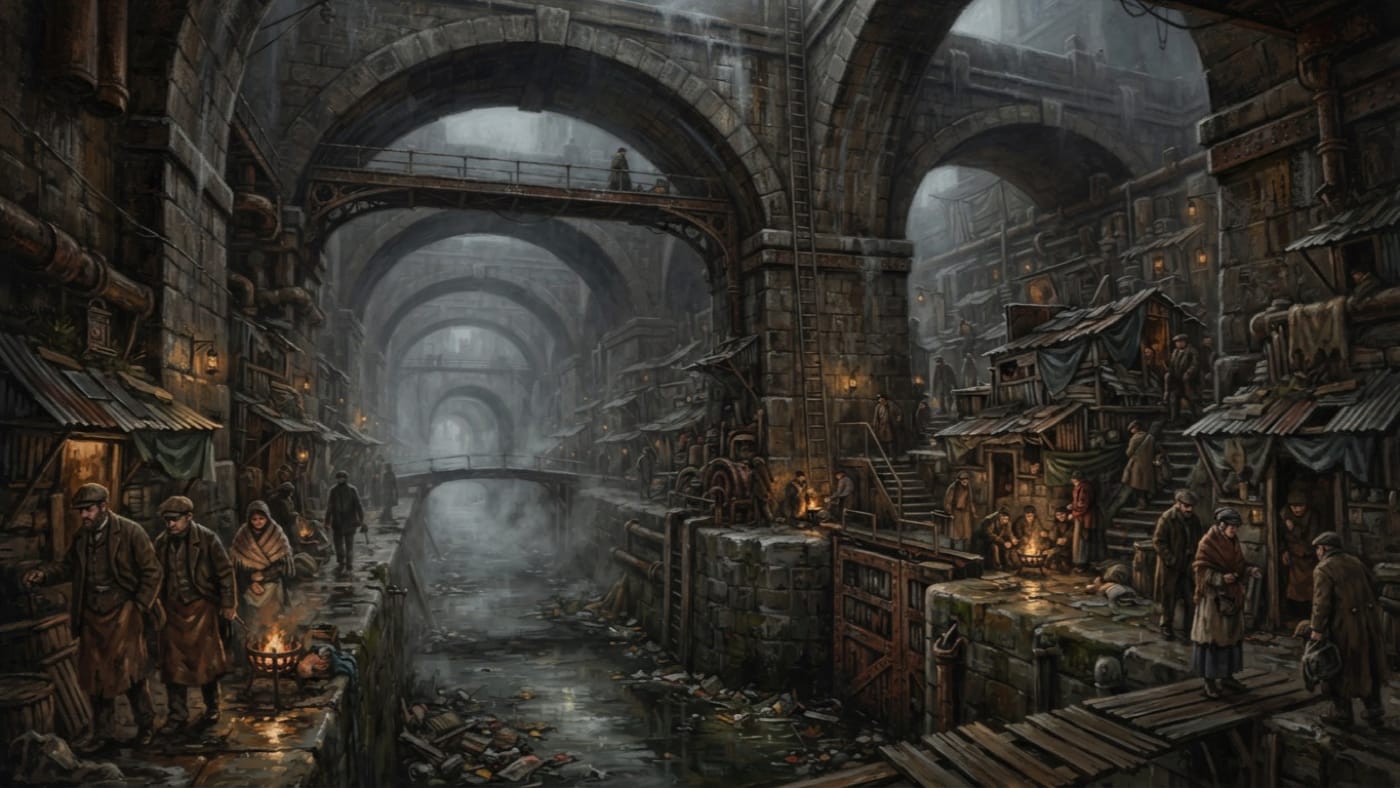
The Undervaults are one of the eight districts of the Archivolt Causeyworks, and the only one nobody ever meant to build. The spans overhead were raised to carry tolled traffic and to bear the city's debts in carved granite. Nobody raised them to keep the rain off anyone. People moved in beneath them regardless: into the dripping undersides of the vaults, onto the landings of the canal stairwells, along every shelf of wet stone that sits a hand's breadth above the waterline at most hours. The district consists of that occupation and nothing more.
It has no charter. The charter belongs to the city, granted in A.S. 82 by the administration that would become the formal Synod at the Concordat of A.S. 90. The first stone bridge followed in A.S. 84 and the Bridge-Scribe Collegium in A.S. 92. These are the dates of the roof. Nobody recorded the first night someone slept under it, because clerks do not attend such events.
The district smells of damp rope and old rot. Above it the city keeps its accounts in stone, and the district lives in the drip from those accounts.
#On the Routes and the Curfew Chains
The Causeyworks is built in tiers, and anyone who means to understand the Undervaults has to count them from the top down. Bridge tops carry the lawful crossing. Catwalk rails run beneath them, and beneath the catwalks lie the vault undersides. Canal stairwells descend to the water and runner ladders connect one tier to the next. At the bottom are the submerged service tunnels, which belong to whoever can hold his breath longest. I will not draw a plan of this arrangement. I have no measurements, and the canal revises its own levels on a schedule I do not control.
That schedule belongs to the Lock Authority, which keeps the water-gates and the bell order. A stairwell that is dry at one bell is underwater at the next. Everyone below lives by those bells, and the sensible ones never forget it.
At curfew the chains drop across the canal mouths. The lantern lines on the spans become inspection corridors, and the markets move in under the arches. The city above contracts into checkpoints. The district below opens like a shop at dusk.
The Mudkeys, called the Undervault Runners in formal correspondence, are a cartel. Their business is moving people and cargo unseen, and they do it with routes, bribes and silence. They are equipped with tunnel maps, divers and stolen chits. Their territory is the Undervaults. The Undervaults are not their property, and most people who live there have never paid them a copper. The city's survey records that the cartel reacts sharply when the curfew chains change pattern, as any merchant would if someone moved his warehouse overnight. The city's defence doctrine also provides for flooding the sluices to deny passage beneath the vaults. That doctrine is a standing capability, and I record it as one.
The Bureau's district register for the Causeyworks stated that the Mudkeys "can tell by echo alone whether the footsteps behind them belong to a provost, a customer, or a name-resonance event."
Corrected. That is the Mudkeys' local reputation, and they cultivate it because it is good for trade. No examination has confirmed a faculty. The Bureau of Doctrine does not certify an ear on the word of its owner.
#On Those Who Live Below
The Causeyworks ranks its people with the same diligence it applies to its debts. Toll Crown officers stand at the top. Below them come the licensed scribes and masons, then the merchants, then the drafted lock labour. The Undervault Poor come last. The lore of the city assigns that rank three occupations: illegal housing, diving and smuggling. A careless provost will treat these as one man. They are three.
A woman who sleeps under the third rib of a vault has committed an offence of residence. A diver who dredges the black water at night for salvage is working one of the ten trades the city lists as ordinary. The smuggler is the only one of the three whose commerce the Bureau has any reason to follow, and living below the arches does not make anyone a smuggler. It does not make anyone a heretic either. A grievance and a congregation are different things, however often the two meet.
Wealth below is measured in goods the tiers above take for granted. The first is dry bedding. Usable papers come next, then a scribe who will "recognize" a name, then the right to cross a bridge after the chains have dropped. A man with all four has stopped being Undervault Poor and become a man with lodgings. Spiced river rum serves the district as drink, as bribe and as antiseptic, and on a bad night it does all three before dawn.
#On the Bazaar and Its Customers
The Undervault Bazaar is a market inside the district. It is not the district. The city's black market also trades from Barge-Lip Market, which hangs off the canal edges in plain view and has no roof to hide under. Between them they sell forged passes, lock-route maps, banned-name fragments and miracle trinkets. On occasion they also sell a keystone sliver, a portable hiding place worked out of a bridge cavity and used to carry letters, identities and forbidden syllables. A sliver is a container. Nothing in the record gives a detached sliver the effects observed in the standing arches, and I will not allow the Bazaar's prices to write doctrine.
The stock answers the checks imposed above. Canon-Toller Edris Vane controls crossing access, so there are forged passes. Chief Scribe Mael Arct controls which names are recognized, so recognition is bought. Master Mason Lysa Korr controls what is carved, and that is the one service the market cannot reliably counterfeit. The survey records that true uncarving cannot be reliably sold because the work is too loud. Lawful reconciliation leaves the original entry in the stone and cuts the correction beside it. A forged paper changes what a window believes. The parapet goes on carrying the debt.
None of this places Vane, Arct or Korr in the Bazaar. Their offices create its customers. I have no evidence that they take a share, and I have looked.
The Mortar Saints are another matter and a separate one. They preserve names struck by the Index Damnatus in public masonry, and they recruit among people the city squeezes. Sharing a district and a contraband shelf does not make them the runners' masters. The Bureau of Purity will prove a common command when it has one to prove.
#On Water, Falling Stone, and Spoken Names
Begin with what kills people, because it kills them reliably. People drown when the bells change. They catch canal fever from the water and mold lung from the bedding, however dry its owner swears it is. Aging vaults drop stone without warning. Old culverts collapse into sinkholes. Winter takes the rest, because the Undervaults are the one district where exposure is the address.
Only after all that comes the matter the Bureau sends inspectors for. Name-Resonance Architecture is the recorded behaviour of certain arches that answer spoken names with physical effects: water levels that shift, inscriptions that sweat lime, candles that gutter in rhythm. The Saintspan is the most prominent site. Certain arches is the operative phrase. No examination has shown that every passage under the city responds, and no examination has confirmed a responsive arch within the Bazaar. No hidden syllable has been tied to any particular collapse. Anyone who tells you otherwise is selling a trinket.
The warnings below are older than the Bureau's categories. Never speak a name twice in fog. If the arch repeats your name, leave. The city's survey records an escape sluice in the Bazaar said to be keyed to a hymn. It names neither the hymn nor the keeper, and it does not say where the water goes. I enter it as an account and nothing more.
The arch that echoes a name in the dark may be acoustics, a prank, or a neighbour with a grudge. Whether it is anything else the Church will rule on in its own time.
#On the Present Pressure
In A.S. 199 a banned name was discovered in a keystone cavity of the Stitchbridge, the city's main junction, carved where every lawful foot pressed weight onto it. Nobody has established who carved it or when. The discovery was enough. Crossing inspections lengthened. Tolls rose. The Lock Authority's safety closures came more often, and they have not eased in A.S. 201.
Each of these measures is enforced on the bridge tops and paid for underneath. Anyone who cannot meet a longer inspection, a higher toll or a closed gate goes down the stairs. The Undervaults are swelling with people pushed out of the legal economy. The Mortar Saints recruit from that crowding, and the Mudkeys profit from it. The provosts call the result disorder, and they keep a narrower view of cause than I do.
Canon-Inquisitor Silex Marrow holds an active warrant under Purity seal to unseal keystones in the Saintspan Quarter. The Toll Chapter has petitioned against it and Records has objected. Purity has overridden both. Nobody yet knows what he will find, whether his inquiry touches anything beneath the arches, or whether it reaches any further than the Saintspan's ribs. The district waits on the outcome along with every other district. The difference is that the stone it waits under is the stone in question.