

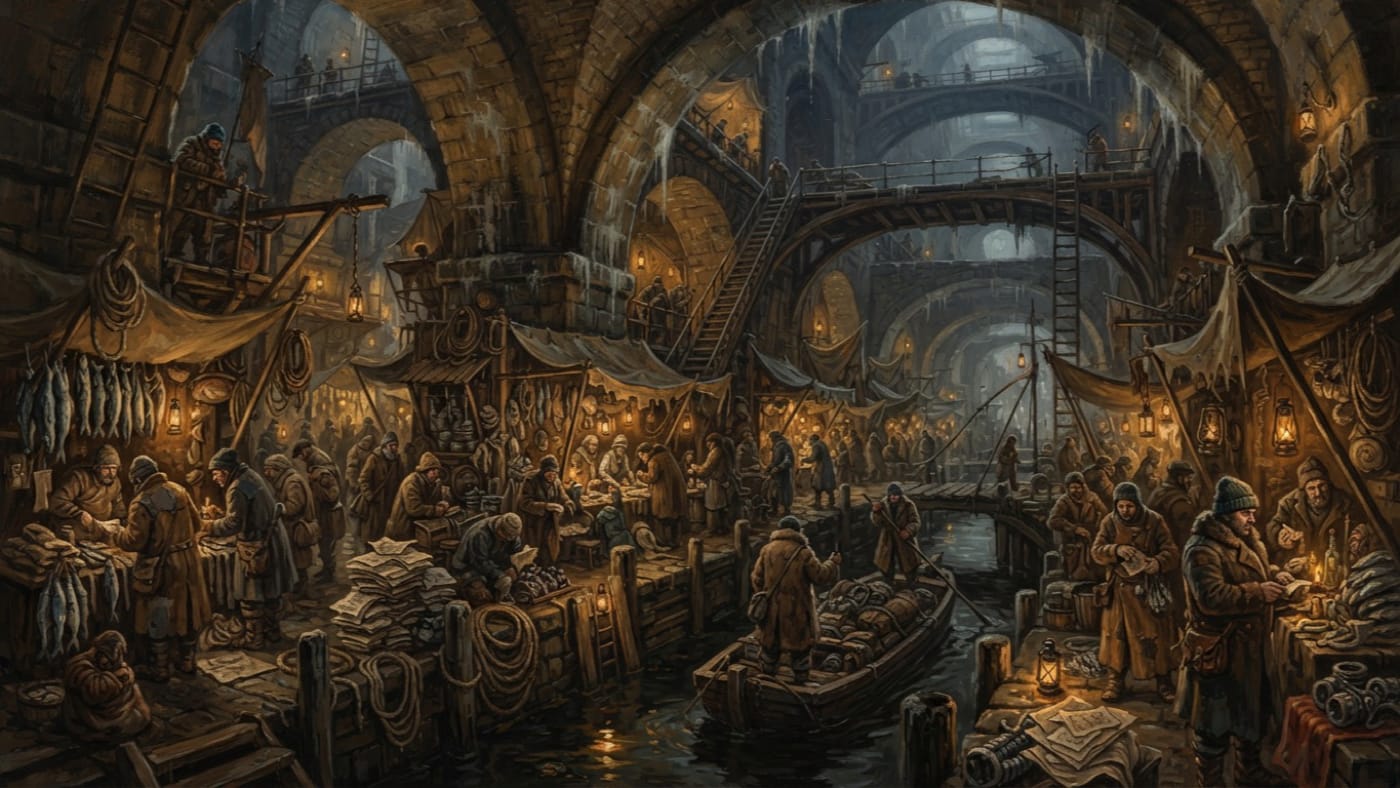
#On the Market Beneath the Arches
"Names belong to the Synod." — Propaganda line of the Archivolt Causeyworks, painted wherever the damp has not yet reached.
The Undervault Bazaar is the black market of the Archivolt Causeyworks. It keeps its stalls in the one part of the city a toll warden cannot see from a bridge. That part is the Undervaults, the district beneath the arches, which also holds the illegal housing and the smuggling passages. The Bazaar is a market inside that district. It is not a ninth district, whatever the provosts call it after a bad night. The city's hundred and eighty-five thousand souls are not all its customers, although a fair number of them have been.
It smells of damp rope and fish. The district around it smells of damp rope and old rot. You learn to tell them apart by the price, because the fish costs money.
The Causeyworks is built in levels. Bridge tops carry the tolled traffic. Catwalks run beneath them, and below the catwalks are the undersides of the vaults. Canal stairwells go down to the waterline, runner ladders join one level to the next, and submerged service tunnels lie under everything. The law lives on the top level. The Bazaar lives near the bottom, among the stairwells and the vault undersides. I decline to draw a plan of it. Nobody has given me measurements, and the water would change them before the ink was dry.
The Bazaar is distinct from Barge-Lip Market, which hangs off the canal edges on swaying planks in full view of the spans. The two share a black market's inventory. They do not share a roof, because Barge-Lip has none.
#On Goods and Permission
The demand for the Bazaar is created on the bridges overhead. A lawful crossing requires a pass, a name the scribes recognise, a sealed chit and a place in the bell order. The Synod Toll Chapterhouse holds the crossing under Canon-Toller Edris Vane. The Bridge-Scribe Collegium decides whether a name is known, and Chief Scribe Mael Arct decides for the Collegium. The Lock Authority holds the gates and the bells. Master Mason Lysa Korr holds the chisel that records all of it in stone. Each office issues its permission at its own window and its own hour, and a refusal at any one of them sends a customer down the stairs.
I have no evidence that any of these officers owns the Bazaar, patronises it or takes a share from it. Their offices make the market necessary. That is my whole charge against them, and it is a heavy one.
The stock answers the city's checks one at a time. The forged pass is for the warden. The lock-route map is for the bell schedule, because it shows which gate keeps which hour. The forged number-pass is for the scribe, and it suits a traveller who would rather recite a registry number than speak a name. The under-vault map is for the dark. The seal mold is for the wax, and its buyer should remember that counterfeiting the city's master seal is one of the Causeyworks' three red lines. Miracle trinkets are for the soul, at a markup.
Banned-name fragments answer no check at all. People carry them for reasons they would rather not explain to a cleric. The Bureau of Purity treats them as traffic in names struck by the Index Damnatus.
The occasional keystone sliver is a hiding place worked from a bridge cavity, used to carry letters, identities and forbidden syllables. It is a container. No reliable report gives a detached sliver any of the responses recorded in standing arches. The man who buys one owns a stone with a hollow in it. What goes in the hollow is his business until a provost makes it the provost's.
A provost who writes "sliver" on a seizure sheet when he means "map" will answer to this office for his vocabulary.
One article is never in stock. The city's own survey says the Bazaar cannot reliably sell a true uncarving, because the work is too loud. Lawful reconciliation of a stone entry leaves the original carving in place and cuts the correction or settlement beside it. A forged paper changes what the scribes' windows believe about a man, and purchased recognition changes what one scribe is willing to remember. Neither touches the parapet he crosses each morning, and the city treats the parapet as its true ledger.
#On Runners and Passage
The Bazaar's transport is the Mudkeys, called the Undervault Runners in the formal register. They are a cartel that moves people and cargo unseen. Their methods are routes, bribes and silence, and their resources are tunnel maps, divers and stolen chits. A man who buys a forged pass still has to reach the gate it forges, and the Mudkeys sell him the way there. The record does not make them the Bazaar's owners or wardens, and it does not make every trader below a runner.
To a diver, a flooded tunnel is a road for anyone who can hold his breath and remember the turns. A stolen chit carries another man's lawful passage under another man's wax. It works until a warden looks at the face.
What happens below is decided above. At curfew the chains drop across the canal mouths, the lantern lines on the spans become inspection corridors, and the markets move in under the arches. The corridors shift, the bells shift, and the Lock Authority raises and lowers the water. A route that was safe at the last bell can drown a man at the next, and the city's defence doctrine includes sluice floods for the stated purpose of denying passage beneath the vaults. The cartel's whole capital is knowing about these changes first. Mudkeys are said to tell a provost from a customer by the echo of his step. That is a craft learned on the job, not a gift of prophecy.
The city survey records one further feature, an escape sluice in the Bazaar keyed to a specific hymn. I enter it here as the survey's account. The survey does not name the hymn. It does not say how the keying works, where the sluice lets out, or who keeps it.
#On Those Who Trade Below
Most people in the Undervaults are not smugglers. The city's survey puts the Undervault Poor at the bottom of its class order and describes them as illegal housing, divers and smugglers, in that order. The Bazaar served the first two long before it served any heretic. It sells fish, rope, and the information a household under a bridge cannot do without, such as which corridor the provosts are walking tonight.
Payment takes whatever form the city recognises: coin, toll chits, stamped paper, stone tokens and dock-union oath-notes. Spiced river rum serves the Undervaults as drink, bribe and antiseptic. In a bad week it is all three for the same customer.
In the Causeyworks, respectability is measured in dryness. Below, papers come out of a coat limp and blotted, with the stamps bleeding into the names. That suits the Bazaar. A smudged forgery is hard to tell from a smudged original, and below the arches everything is smudged.
The Bureau of Purity would like the people below filed as one category, but there are four kinds. Residents live there. Runners carry. Traders sell. The Mortar Saints seed forbidden names into public stone and count banned-name fragments among their resources, so they shop where the fragments are sold. A shared inventory does not prove a shared command or a shared creed. A heretic who buys a map is a customer, and the stall that sold it to him has not become a chapter-house.
#On Water, Stone, and Names
The survey gives the Bazaar's characteristic danger as ambush. A market that exists to avoid the law has no law to call when someone else avoids it first. The district adds its own killers: drowning, canal fever, mold lung, stonefall from old vaults, culverts that collapse into sinkholes, and winter exposure.
Over all of this hangs the matter that brought me to the city. Certain arches of the Causeyworks respond to spoken names. Water levels shift. Inscriptions sweat lime. Candles gutter in a rhythm the Collegium calls atmospheric and the pilgrims call liturgical. The Bureau of Alchemical Standards has classified the phenomenon as Name-Resonance Architecture. Its origin and meaning are still pending.
No report places a listening arch inside the Bazaar, and none shows the effect throughout the Undervaults. Traders below keep their voices down anyway. After curfew the vaults carry a voice farther than its owner meant, and a name farther still. Speaking a name twice in fog is taboo throughout the city. Below the arches nobody has to enforce it.
Inspector Corris of the Bureau of Alchemical Standards (A.S. 194) attributed the phenomenon to "mineral moisture interacting with vocal vibrations in enclosed stone environments."
Inspector Corris has been reassigned. The phenomenon stands at Category Three: Pending.
#On the Present Condition
In A.S. 199 a banned name was found carved inside a keystone cavity of the Stitchbridge, the city's primary junction. A.S. 199 is the year it was found. When it was carved is unknown. The city's response has not relaxed. Crossing inspections take longer, tolls are higher, and the Lock Authority orders safety closures more often than the barge unions will tolerate. Every lawful passage the city narrows pushes trade toward the unlawful ones, and the Undervaults have swollen with people squeezed out of the legal economy. I infer, as any clerk would, that the Bazaar is busier. I have no count of stalls, takings or customers to prove it.
Canon-Inquisitor Silex Marrow holds authority to unseal keystones in the Saintspan Quarter. The audit is authorised but has not been carried out. It has recovered nothing, reached no verdict, and has no recorded connection to the Bazaar. Still, a city waiting for an inquisitor's chisel posts more provosts, and more provosts make more noise on the stairs.
This account rests on my second inspection of the Causeyworks, in A.S. 201. The record gives the Bazaar no founder, founding year, master, rule of trade or count of stalls, and I have not invented any.