
#On the Wardens' Office
The Lock Authority is the third, and the wettest, of the three offices that formally govern the Archivolt Causeyworks. The Synod Toll Chapterhouse decides who is entitled to pass. The Bridge-Scribe Collegium decides whether the person asking exists. The Lock Authority decides when. On a canal, when is the only question that rots.
The city calls these officers the Triple Lock Wardens. Its own survey files them as militia and engineers, and the order is right: they carry keys before they carry spanners. Their public undertaking is to keep the water moving. Their territory is the Triple Lock, where the three canal spines of the River-belt meet. They need no other.
Canon-Toller Edris Vane and the Chapterhouse grant permits, set tolls and deny passage. The wardens work the gates and the bell schedule. A toll denial ends a voyage on paper. A closure at the Lock ends it in the water, whatever the paper says. No document I have seen names Vane as the wardens' master, and none names anyone else. The Bureau of Records holds no founding charter for the Authority, no founding year, no roll of its strength and no name for its head. I asked for all four. The wardens gave me the bell schedule.
The Authority works under the municipal charter of A.S. 82, as everything in the city does. My first report said where that charter came from, and said it wrongly.
The Archivolt Causeyworks was chartered in A.S. 82, following the Synod's determination that the River-belt's toll revenues were being lost to "informal waterway administrations."
No formal Synod existed in A.S. 82 to determine anything. The determination came from the Church's emerging administration and the toll authorities of the period, which the Concordat of Strasbourg constituted in A.S. 90. The Warden of the Ledger corrects his own ledger first, since nobody else is permitted to.
#On the Gates and Bells
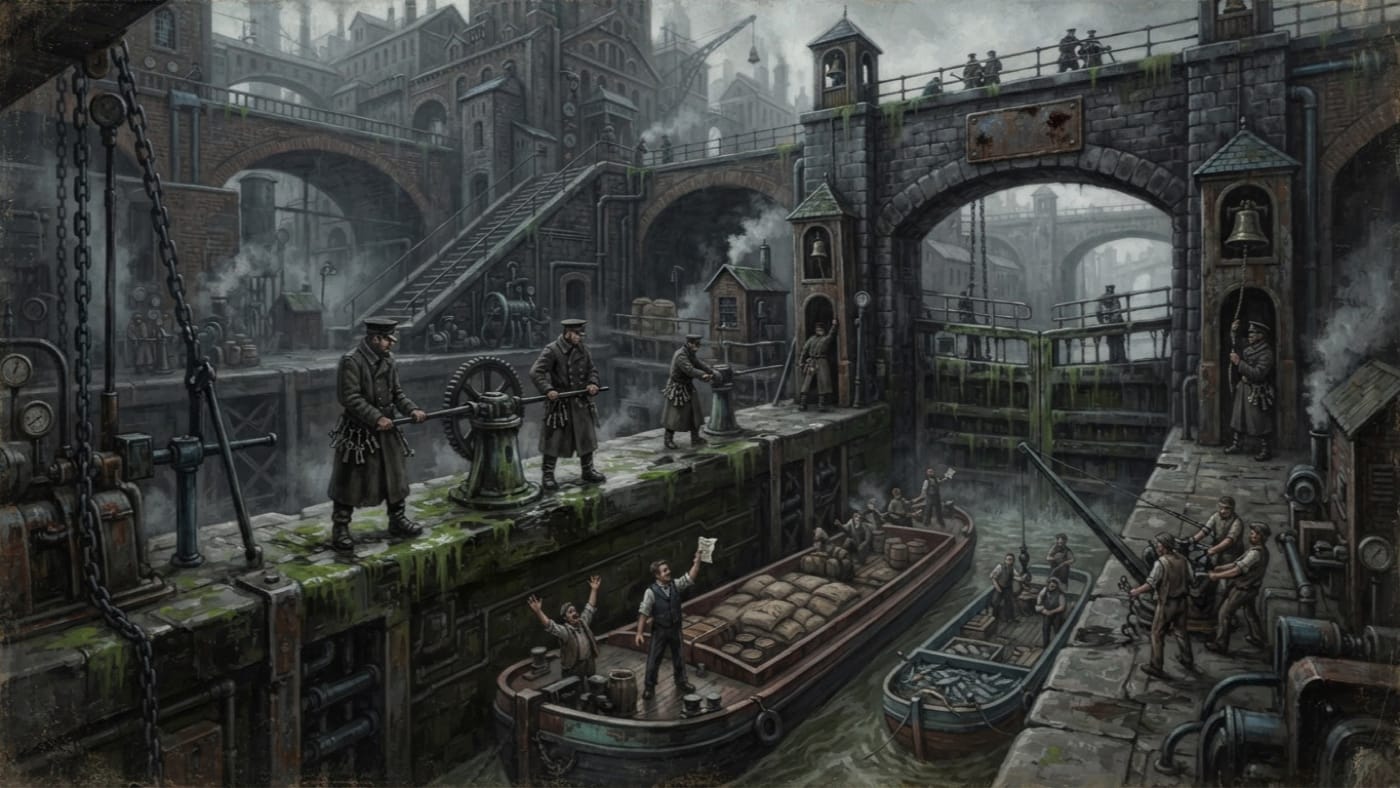
The Triple Lock is a staircase of water-gates. It lifts barges from the lower courses to the upper pools and lets them down the other way. I give no count of chambers or gates, because the survey gives none. Three canal spines are not three gates. A clerk who counts the first and writes down the second has never stood on the walkway.
What can be seen is enough. A barge comes up the lower course and joins the queue, with water slapping its timbers and the crew keeping their papers inside their coats. Its paperwork is looked at. When its bell comes, a warden's key turns, the riggers lean on the gear, and water is let in until the lower course has become the upper. Then the barge moves to the next pool and waits again. The process is slow, and the wardens price the slowness.
The keys are the Authority's first resource. Lock provosts wear them on a key-ring sash, which is how a provost is known on the walkway. The dredgers are the second. Without them, silt and wreckage would fill the staircase within a few seasons. The third is the bell schedule. The Authority publishes it and the city lives by it. The scribes' shutters on Archivolt Row go up at the first lock bell, the chains drop across the canal mouths at curfew, and bell-cards pass from hand to hand as tokens.
The rails are green with algae and the hinges black with iron oil. The chains are cold enough to take skin off a careless hand. Ledger-drizzle leaves its pale crust on every stone.
Reports filed with the Bureau of Alchemical Standards describe water levels changing when certain names are spoken beneath certain arches. That phenomenon belongs to the arches, under the classification Name-Resonance Architecture, Category Three, Pending. A warden raises water with a key, a gate and other men's backs. I found no warden who claimed to raise it with a name. If one ever does, I will send him to the Bureau of Purity with my compliments.
#On Priority
The Causeyworks eats what it does not grow. Food, coal, oil, wax, paper, medicine and iron hardware all come in by water. Candlewick wax goes upriver through the Lock and Wexel grain comes down. If the Lock jams, the survey says, the city starves and the River-belt chokes.
Wax can wait a day. Grain can wait until the damp reaches the sacks. Fish cannot wait at all. By the Barge-Lip's own account, a catch that clears the Lock at dawn sells fresh, and a catch that clears at dusk sells to the poor. The difference between those two bells is the price of a priority window. A crew held all afternoon earns nothing that afternoon and still owes its toll in the evening.
Each power at the gate issues its own paper. The scribes' windows on Archivolt Row issue or witness a lock-priority slip beside the crossing receipt. The Chapter's toll chit is sealed in public wax before witnesses. The Collegium decides whether the name on all of it is recognised. None of these papers turns a key. The window itself, the actual bell at which the actual gate opens, belongs to the Authority.
Every paper must also be dry. A slip that comes out of a coat soft and blurred gets questions, and a question costs another bell.
The survey states that the Authority's underlying interest is the profit to be made from priority windows. It does not say who keeps the price of a slip, or how that price is divided among the offices that touch it. I have written both facts on the same page and drawn no line between them in ink. The reader may use pencil.
#On Labour and Lock Incidents
"Lock-bite." — The Causeyworks' word for a death at the gates. The Authority's word is longer.
Most of the work at the Lock is done by men who are not wardens. Riggers work the gear and dredgers keep the chambers clear. Dispatchers set the order of hulls, and salvage divers bring up whatever the canal has kept. In the barge seasons the city drafts more labour from the marsh-quarry villages and the lower canal courses.
The draft is one route among several. The Chapter's levies include labour hours owed for lock upkeep. A debtor in toll arrears can be made to work off his debt. The city calls this debt bondage, and so do I. Some name-clearing fees are payable in work. The wardens' recorded methods include forced labour. They have little need to recruit when the city's ledgers keep sending men to the walkway already owing hours.
These men work on slick stone above deep cold water, beside gates that move tons of it. Men drown there. The Authority files each death as a "lock incident," and the Bureau of Records refiles it as "transit attrition." At no stage does the word "drowned" appear. The canal people say "lock-bite." I asked Records how many had died. Records gave me the name of the category.
The survey lists draft riots among the occasions on which the Authority intervenes, along with jams and sabotage. It sets the riots against the Toll Chapter's tightening. No record I have seen names their organisers, and I name none.
#On Safety Closures
The present quarrel begins in A.S. 199, when a banned name was found inside a keystone cavity of the Stitchbridge, the junction every barge in the city must pass. A.S. 199 dates the discovery. Nobody has established when the name was carved. Since then crossing inspections have lengthened and tolls have risen, and safety closures at the Triple Lock have become more frequent.
The barge unions call the closures extortion. The Lock Authority calls them prudence. I have entered each word under the name of the party that uses it.
The Authority's case is real. The Lock drowns men. A jam left alone becomes a wreck. Since the Stitchbridge, the wardens can also say, and do say, that they do not yet know what passes beneath the arches or under what name.
The unions' case is also on file, in the city's own survey. It lists the Authority's methods as slowdowns, safety closures and forced labour, and it names profitable priority as the Authority's interest. The office that shuts the gate sells the window after the gate reopens. A barge held half a day loses its fish. Then it pays in coin, in a share of the cargo or in hours to be moved up the queue with what remains.
The record does not show that every closure was fraudulent, and I will not certify that it was. It also shows no closure that was ever audited.
Those who cannot pay go to the Undervaults, to the sellers of forged passes and lock-route maps. The Mortar Saints recruit from the squeezed. No document makes any warden or any union a member of that heresy, and I do not.
The city's histories record, without a year, that emergency lock closures once starved a rival city and confirmed the Causeyworks' authority over the water. They name no warden.
#On the Present Condition
Traffic still moves. The bells ring, the queue forms, and wax and grain pass each other on the staircase. Closures still come.
Canon-Inquisitor Silex Marrow holds a warrant to unseal Saintspan keystones. The Toll Chapter objected, and the Bureau of Records raised objections of jurisdiction. The Bureau of Purity overrode both. The warrant has been appealed and has not been stayed. As of this filing, no opened rib, no finding and no judgment against the Canon-Toller or the wardens is on record.
While the matter stays open, the wardens have a ready reason for every closure. They need only mention the names struck by the Index Damnatus, and passage stops while the arches are examined. Under the seal of the Bureau of Doctrine, I enter both extortion and prudence, and I certify neither.