
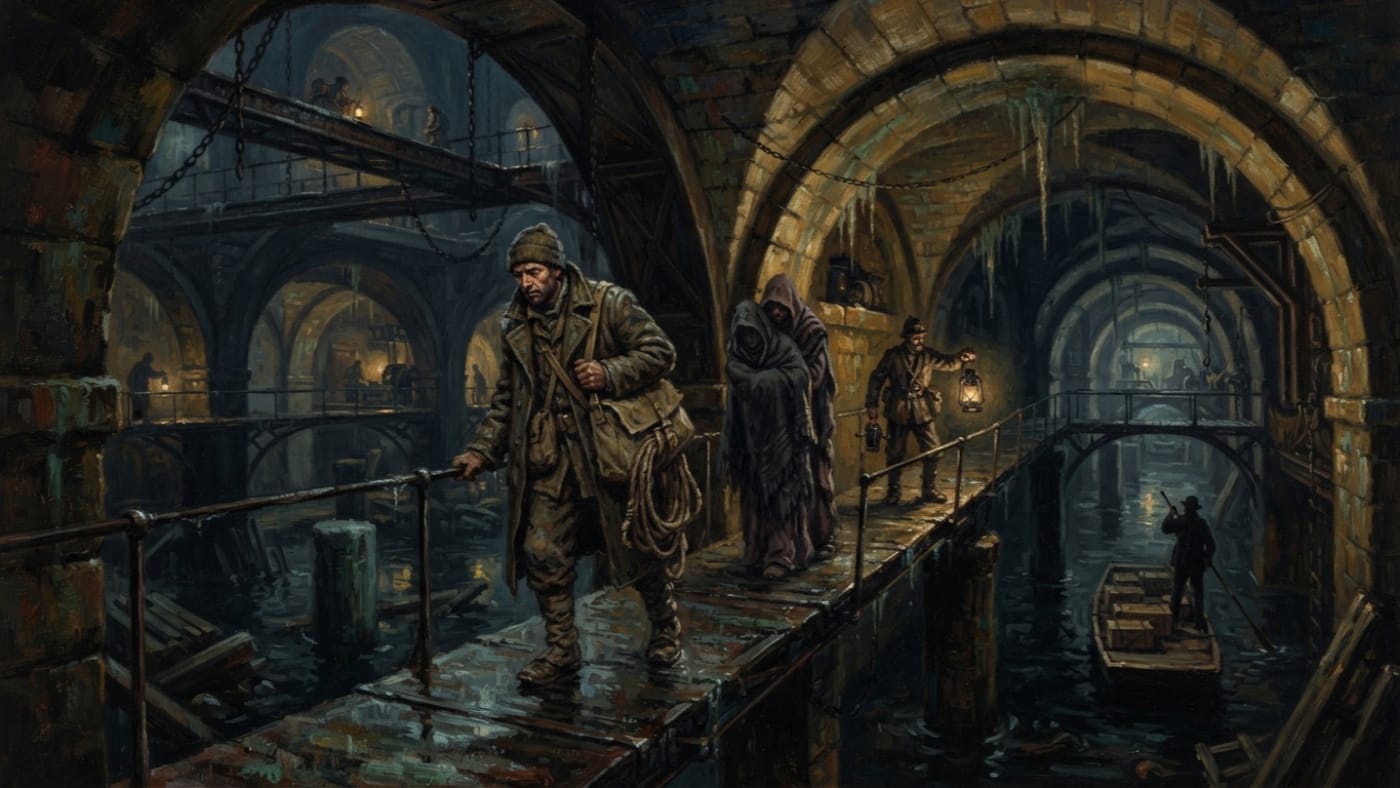
#On the Undervault Runners
"Mudkey — undervault runner." — The entire entry in the local word-list. It is one line longer than the Toll Chapterhouse would prefer.
The Undervault Runners are a cartel. The Archivolt Causeyworks calls them Mudkeys, after the stuff on their boots and the doors they do not have. They keep no window on Archivolt Row, pay no stone entry fee, and present no public face to any tribunal. Their trade is the movement of people and cargo through the city without being seen, and in a city built for the express purpose of seeing everything that moves, no trade is more precisely defined by what it opposes.
The Synod Toll Chapterhouse describes the lawful alternative as "safe passage through lawful toll." It requires a pass, a verified name, a sealed chit and a place in the bell order. Each is issued by a different authority, at a different window, on a different schedule, and the damp gets at all of them. A traveller who lacks any one of these documents has three choices: to wait, to pay, or to go down. The Mudkeys sell the third.
This tract rests on my second inspection of the Causeyworks, conducted in A.S. 201. The record supplies no founder for the cartel, no founding year, no master, no roll of members, no headquarters and no emblem. I decline to manufacture any of them. The Bureau of Doctrine does not issue charters to smugglers, even retrospectively.
#On the Routes Beneath the Ledger
The Causeyworks is built in layers, and the law lives mostly on the top one. Bridge tops carry the tolled traffic. Below them run catwalk rails, then the undersides of the vaults, then canal stairwells descending to the waterline, and below the waterline the submerged service tunnels the city dug for its own maintenance and has never entirely stopped forgetting. Runner ladders join the levels. The masons use them, the dredgers use them, and so does anyone else who knows where they are.
At curfew the chains drop. Heavy iron is lowered across the canal mouths, and the lantern lines on the spans shift into what the provosts call inspection corridors. The legitimate city shuts its eyes, and the markets go under the arches. Traffic that cannot wait for morning, or cannot survive morning's questions, goes into the Undervaults: the dripping country of illegal housing, smuggling passages and the Undervault Bazaar beneath the city's spans.
The Mudkeys' capital is knowledge of this country. Their recorded resources are tunnel maps and divers. The maps are said to show which passages hold air at which hour, which stairwell floods first, and which culvert collapsed into a sinkhole last winter. The divers come out of an honest trade. Salvage diving is one of the city's lawful industries, and at night divers work the black water for whoever is paying. A passage underwater is still a passage to someone who can hold his breath and knows the turns.
A map of the Undervaults is a perishable document. Stonefall closes routes. Old culverts give way. The city's own defensive doctrine includes sluice floods to deny travel through the under-vaults, and a tunnel that was dry on Tuesday may be full by the bell. The single condition the record names as capable of setting the cartel in motion is a change in the pattern of the curfew chains. A route that depends on a chain falling at a known hour is worthless once the hour changes, and the runner who learns of the change second is generally found by the dredgers.
#On Chits, Cargo and Silence
The record gives their methods in three words: routes, bribes, silence. I have found nothing to add to them, and much to regret about each.
The third of their resources is stolen chits. A toll chit is sealed in public in the Seal-Wax Anointing. The ceremony is meant to make passage visible and the wax honest. A stolen chit carries somebody else's lawful passage on somebody else's wax, and it is only as good as the warden's indifference to the face presenting it. The Mudkeys deal in these. Where they get them, the record does not say, and I will not guess at the provenance of other men's wax.
The bribes follow the city's own currency of favour: lock priority, clean seal wax, stone tokens, "no-questions" cargo. On the Row a scribe's goodwill is paid in candle-tax, because wax can be passed off as sealing stock. Bribery is the general method. It names no official in particular, and I name none.
The black market is shared between the Undervaults and the Barge-Lip Market. Its stock is forged passes, lock-route maps, banned-name fragments, miracle trinkets and the occasional keystone sliver. The Mudkeys carry slivers as they carry anything else that pays. They are not established as the slivers' makers or their only carriers. The Keystone Courier is an occupation in his own right and passes the Row at a walk. He needs a route, and the Mudkeys sell routes. The documented relationship goes no further.
The account from Archivolt Row concerns forged number-passes. These are said to come up the landward stairs from the Undervaults in Mudkey pockets, to work exactly once, and afterward to mark the bearer for a name-hygiene action. I record it as the Row's account. I have not tested every forgery in the river-belt and do not propose to begin.
Then there are the people. The city's own list of what cannot be moved through it includes unregistered bodies. A body cannot be sealed in wax. It can, however, be led through a stairwell at the right hour by someone who keeps his mouth shut. Silence is the cartel's one asset with no shelf-life, and the only one a provost cannot confiscate.
#On the Echoes
The Mudkey's reputation rests on his ear. The local account holds that a runner can tell by echo alone whether the footsteps behind him belong to a provost, a customer, or a name-resonance event about to make the ceiling weep lime. The Causeyworks' stock figure of the Mudkey runner is the man who knows which echo means patrol and which means miracle.
I record this as local expertise, which is what it is. After curfew, sound carries farther under the vaults, and so do voices and names. A man who spends his nights in stone ribs above black water learns the difference between a hobnail and a bare heel, between water rising and water dripping, between a lantern-bearer who wants to find him and one who wants to be found. This is a craft. It is not prophecy, it does not succeed at every junction, and it confers no protection whatever against anything the arches decide to do.
What the arches do is classified. Under certain vaults spoken names produce physical effects. Water rises when a banned syllable is uttered, inscriptions sweat lime, and candles gutter in rhythmic pulses. The Bureau of Alchemical Standards calls the phenomenon Name-Resonance Architecture. Its origin and its theological meaning remain pending before the Bureau of Doctrine, and I will not anticipate the Bureau in a tract about smugglers.
Earlier assessments by the Bureau of Alchemical Standards, filed under the hand of Inspector Corris (A.S. 194), attributed the Name-Resonance phenomenon to "mineral moisture interacting with vocal vibrations in enclosed stone environments."
Inspector Corris has been reassigned. The phenomenon is classified Category Three: Pending.
The ordinary hazards of the Undervaults kill more reliably than any of this, and none of them make a sound. Drowning, canal fever, mold lung, falling masonry and winter exposure have no echo. No ear in the Causeyworks hears the mold.
#On Those Who Own the Crossings
The demand for Mudkeys is manufactured on the bridges above them, by three powers that rarely agree about anything except the price of passage.
The Synod Toll Chapterhouse controls lawful crossing, and Canon-Toller Edris Vane holds its keys. The Bridge-Scribe Collegium controls whether a name is recognised, and Chief Scribe Mael Arct controls the Collegium. The Lock Authority controls the water-gates, the bells and the priority windows. Master Mason Lysa Korr governs what is carved into the stone that records all of it. Every closure, delay and correction they issue is a sale lost to the Toll Crown and a fare gained by the Undervaults. None of these officers is a Mudkey patron, member or accomplice on any evidence I have seen. Their offices make the cartel profitable. That is a separate charge, and one I am not filing.
The Mortar Saints require a separate entry. They preserve names the Index Damnatus has struck, by carving them into public masonry. The Mudkeys move people and cargo through concealed routes. The two trade in the same markets and in some of the same contraband, and the Bureau of Purity would find it convenient to discover a single conspiracy behind both. Convenience does not prove a common command, creed or roll of members. A heretic who buys passage is a customer. He does not make the boatman a heretic, nor the boatman him a Mudkey.
Nor is everyone who lives below a runner. The Undervaults house the poor, the unregistered, divers, debtors and the merely tired. Living there makes no one a member of anything. The hollow beneath the teeth of the Mouth-Sluice has no established owner. The platforms of the Barge-Lip have no established Mudkey command. Both findings stand.
#On the Present Condition
In A.S. 199 a banned name was discovered inside a keystone cavity of the Stitchbridge, the city's primary junction. The year records the discovery; when the name was carved is still unknown. The response has not relaxed. Crossing inspections are longer. Tolls are higher. The Lock Authority's safety closures come oftener than the barge unions can tolerate. Every lawful door the city narrows sends traffic toward the unlawful ones. I infer, as any clerk would, that the demand for Mudkey routes has grown. I have no count of runners, fares or revenue to prove it, and the cartel has not offered one.
Canon-Inquisitor Silex Marrow holds an active warrant to unseal the keystones of the Saintspan. The audit is authorised and has not been carried out. Nothing in the record ties it to the Mudkeys. The record does note that every raid in the Causeyworks sends someone underground, that a city expecting a chisel posts more provosts, and that more provosts walk louder than fewer.
The chains still fall at curfew. The record does not say whether they fall at the hour they fell last week.